Around the Patch

NEAT Epilogue
By Thayer Syme | thayer@flying-models.com
I WANT TO APOLOGIZE for running out of space two months ago with my notes on the Northeast Electric Aircraft Technology (NEAT) Fair. That said, I have one last tidbit to include before moving on to other topics.
The annual Vapor Games is one of the NEAT Fair highlights. It is sponsored by the Killer Rabbits and held under cover in their big-top tent. Flying both stock and modified ParkZone Vapors from Horizon Hobby, the contestants fly two tasks to determine the top dog.
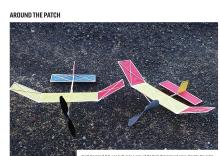
Competition was tight, and Devin McGrath finally emerged as the 2023 Vapor Games champion after a sudden-death limbo round. Known for his mastery of the sticks and high-energy aerobatic demonstrations, Devin has fun whenever he has a transmitter in his hand. Seen in one of the photos on his way to victory, Devin appeared to adapt to an eye patch just a few seconds into his obstacle course and spot landing run.
The patch was intended to be a handicap for all previous Vapor Games winners by removing their depth perception and thereby giving the rest of the field a chance. The loss of stereo vision didn’t seem to matter in the end.
Previous winners and patch victims themselves, Spencer Weigand and Adam Lilley finished in second and third, respectively. Perhaps the 2024 event should feature a double eye patch for previous winners?
But seriously, 2024 marks the 25th anniversary of the NEAT Fair and it promises to be the best yet. I hope to see a number of models from the early electric days flying with vintage power systems, as well as those upgraded with brushless motors and lithium batteries.
Gordon Johnson and Joe Malinchak are coordinating another round of micro-flying seminars, with speakers coming in from across the country and around the globe.
Scale Spar Stock
Moving on, I happened to casually glance at the wooden yardsticks next to the counter while waiting at the paint department in Lowe’s a week or so ago.
I was immediately struck by the quality of the stock and decided to buy a couple to have on hand. Yes, buy. It has been quite a while since they were handed out for free, but even at $2 each, these yard sticks are still a great deal if you choose with care and have the means to mill them to your desired size.
Yes, I am aware that creative modelers have been using wooden yardstick spars and stringers for decades, but I don’t recall much emphasis on what to consider while choosing your stock. My thought is that you can’t go too wrong by following the FAA guidelines for builders of full-scale wooden airplanes, so let’s start there.
The FAA mandates that full-scale wing spar stock must meet some minimum standards before it can be considered “aircraft quality.” Although I haven’t read its Advisory Circular 43.13B recently, to the best of my recollection, the FAA requires a minimum of 8 grain lines per inch, and no more than a 1:15 maximum grain runout. The growth rings also need to be within 45° of vertical. In plain English, the goal is a tight grain that shows vertical when the spar blank is laying on the workbench and runs as parallel as possible to the length of the board.
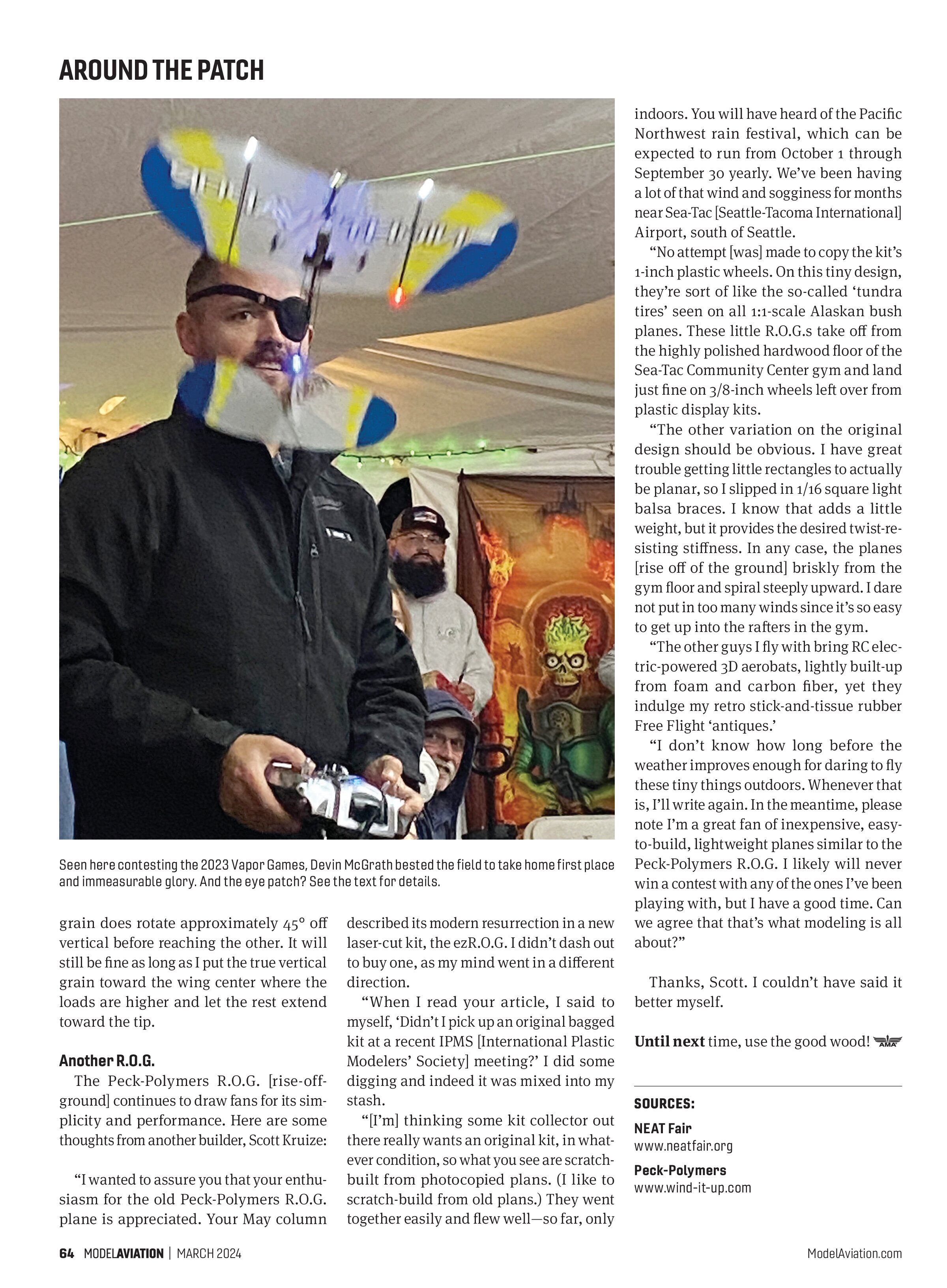
If this is too much gobbledygook, please direct your attention to the accompanying photo. Of the two pieces that I brought home, one of them counts right around 70 growth rings across its 1-3/8-inch width and nearly perpendicular to the stock faces. To be honest, I’m a bit vague on the actual number since I lost track of my count and didn’t feel like making a second late-night pass with my OptiVISOR.
Assuming it really is 70 rings, that works out to a staggering 50.6 rings per inch, allowing a 1:6-scale model to have spars with scale grain that actually exceeds the FAA recommendation! Oh, and did I mention that the grain runs all but perfectly true across the entire length? It couldn’t be drawn much better.

grain does rotate approximately 45° off vertical before reaching the other. It will still be fine as long as I put the true vertical grain toward the wing center where the loads are higher and let the rest extend toward the tip.
Another R.O.G.
The Peck-Polymers R.O.G. [rise-off-ground] continues to draw fans for its simplicity and performance. Here are some thoughts from another builder, Scott Kruize:
“I wanted to assure you that your enthusiasm for the old Peck-Polymers R.O.G. plane is appreciated. Your May column described its modern resurrection in a new laser-cut kit, the ezR.O.G. I didn’t dash out to buy one, as my mind went in a different direction.
“When I read your article, I said to myself, ‘Didn’t I pick up an original bagged kit at a recent IPMS [International Plastic Modelers’ Society] meeting? I did some digging and indeed it was mixed into my stash.
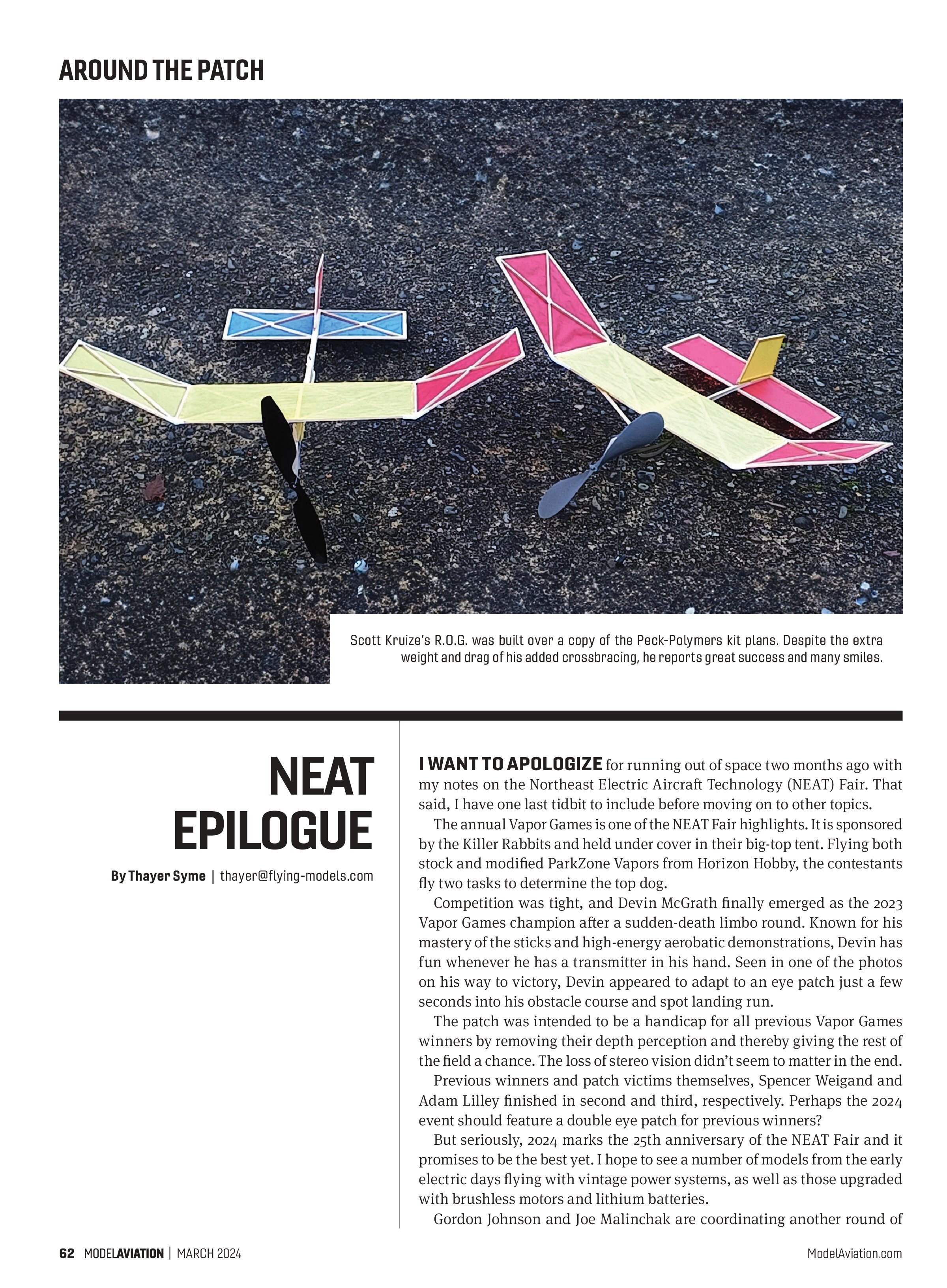
“[I’m] thinking some kit collector out there really wants an original kit, in whatever condition, so what you see are scratch-built from photocopied plans. (I like to scratch-build from old plans.) They went together easily and flew well—so far, only indoors. You will have heard of the Pacific Northwest rain festival, which can be expected to run from October 1 through September 30 yearly. We’ve been having a lot of that wind and sogginess for months near Sea-Tac [Seattle-Tacoma International] Airport, south of Seattle.
“No attempt [was] made to copy the kit’s 1-inch plastic wheels. On this tiny design, they’re sort of like the so-called ‘tundra tires’ seen on all 1:1-scale Alaskan bush planes. These little R.O.G.s take off from the highly polished hardwood floor of the Sea-Tac Community Center gym and land just fine on 3/8-inch wheels left over from plastic display kits.
“The other variation on the original design should be obvious. I have great trouble getting little rectangles to actually be planar, so I slipped in 1/16 square light balsa braces. I know that adds a little weight, but it provides the desired twist-resisting stiffness. In any case, the planes [rise off of the ground] briskly from the gym floor and spiral steeply upward. I dare not put in too many winds since it’s so easy to get up into the rafters in the gym.
“The other guys I fly with bring RC electric-powered 3D aerobats, lightly built-up from foam and carbon fiber, yet they indulge my retro stick-and-tissue rubber Free Flight ‘antiques.’
“I don’t know how long before the weather improves enough for daring to fly these tiny things outdoors. Whenever that is, I’ll write again. In the meantime, please note I’m a great fan of inexpensive, easy-to-build, lightweight planes similar to the Peck-Polymers R.O.G. I likely will never win a contest with any of the ones I’ve been playing with, but I have a good time. Can we agree that that’s what modeling is all about?”
Thanks, Scott. I couldn’t have said it better myself.
Until next time, use the good wood!
SOURCES:
NEAT Fair
www.neatfair.org
Peck-Polymers
www.wind-it-up.com