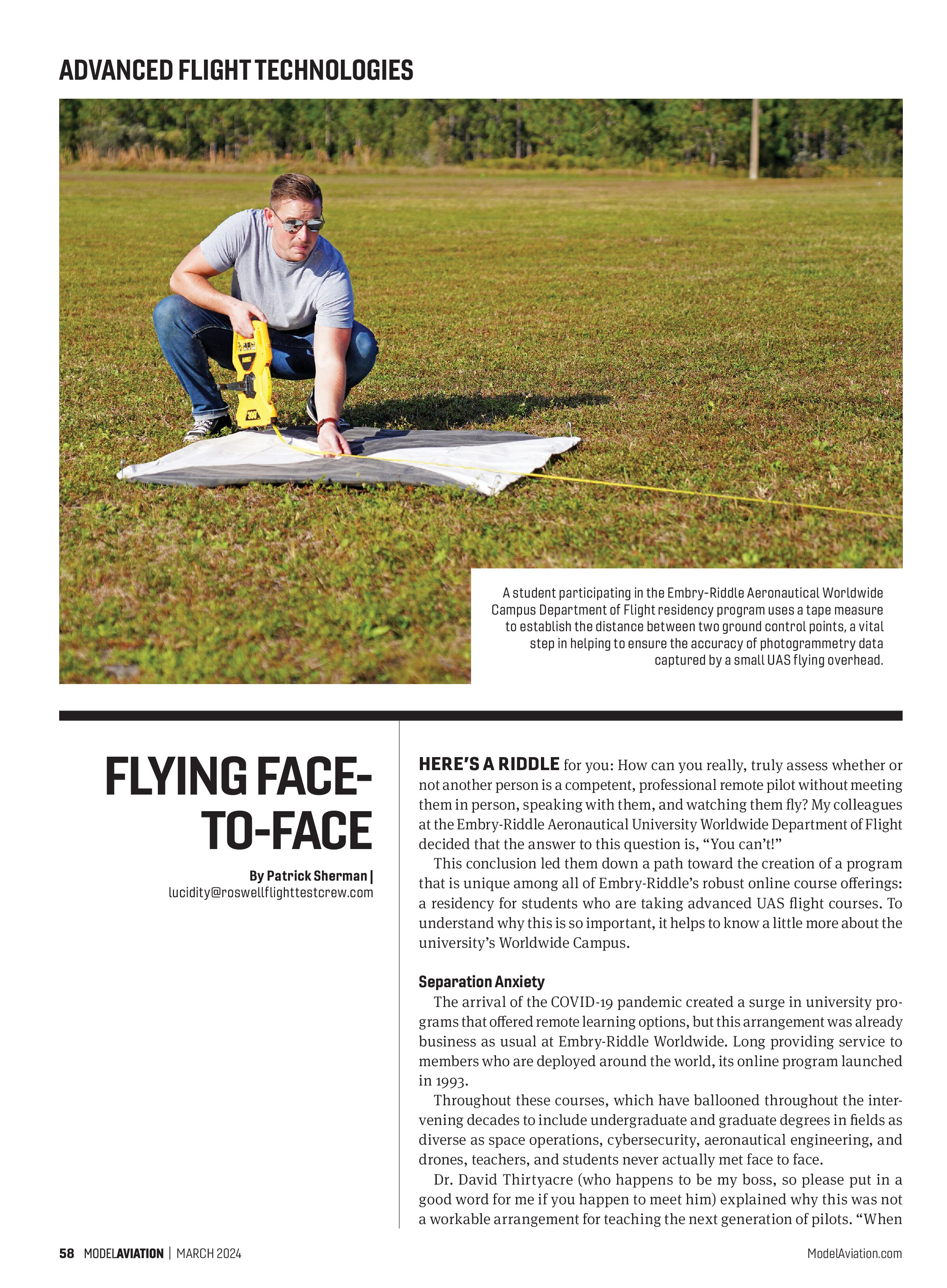
FLYING FACE-
TO-FACE
By Patrick Sherman
lucidity@roswellflighttestcrew.com

HERE’S A RIDDLE for you: How can you really, truly assess whether or not another person is a competent, professional remote pilot without meeting them in person, speaking with them, and watching them fly? My colleagues at the Embry-Riddle Aeronautical University Worldwide Department of Flight decided that the answer to this question is, “You can’t!”
This conclusion led them down a path toward the creation of a program that is unique among all of Embry-Riddle’s robust online course offerings: a residency for students who are taking advanced UAS flight courses. To understand why this is so important, it helps to know a little more about the university’s Worldwide Campus.
Separation Anxiety
The arrival of the COVID-19 pandemic created a surge in university programs that offered remote learning options, but this arrangement was already business as usual at Embry-Riddle Worldwide. Long providing service to members who are deployed around the world, its online program launched in 1993.
Throughout these courses, which have ballooned throughout the intervening decades to include undergraduate and graduate degrees in fields as diverse as space operations, cybersecurity, aeronautical engineering, and drones, teachers, and students never actually met face to face.
Dr. David Thirtyacre (who happens to be my boss, so please put in a good word for me if you happen to meet him) explained why this was not a workable arrangement for teaching the next generation of pilots. “When we started off the flight courses at the Worldwide Campus, we were very concerned about how we could make sure that the students have the kind of competency we want to see from someone who has a flight degree from Embry-Riddle. We had to make sure they have the kind of stick-and-rudder skills they need, and there just wasn’t a way to accomplish that without getting together with them in person.”
The residency is held twice a year, most frequently in Daytona Beach, Florida, where the university has its largest residential campus. This gives the students the opportunity to work on three separate projects while working side by side both with their instructors and their fellow students. At the top of the to-do list is a check ride to prove their basic proficiency as a remote pilot.
Lesson One: Simulators Work!
To demonstrate their skills, all students must complete several vignettes developed by the National Institute of Standards and Technology on its open test lane. This requires a series of precise, controlled maneuvers over a series of two-gallon buckets arranged on test stands. I wrote an entire column about it in the September 2022 issue of Model Aviation. Check that out for more information.
It’s a real test of your piloting skills, so—no surprise—you’re not going to pass it on the first attempt unless you know what you are doing and you’ve taken the time to practice. To ensure that students are able to make the most of their precious hours in Florida, the Department of Flight developed a simulator with the goal of helping them rehearse the required maneuvers. Known as the Embry-Riddle Uncrewed Pilot Trainer (ERUPT), it was developed in-house and made available to students for free.
By the way, if you’re interested in seeing how your own skills stack up, ERUPT isn’t just available to students for free. It’s available to everyone for free. You’ll find a link at the end of this article in “Sources,” where you can download it from the Embry-Riddle website. Bear in mind that it’s not a high-fidelity flight simulator—and it isn’t meant to be. Its only intention is to help students begin to develop the fundamental muscle memory that is required to operate UAS in a safe and controlled manner.
In that regard, it’s been a roaring success. Prior to the release of ERUPT, students would require an average of four hours to pass their basic proficiency assessment. Now, those who use the simulator prior to arriving in Florida can accomplish the same task in one hour. Don’t ever let anybody tell you that simulators don’t work!

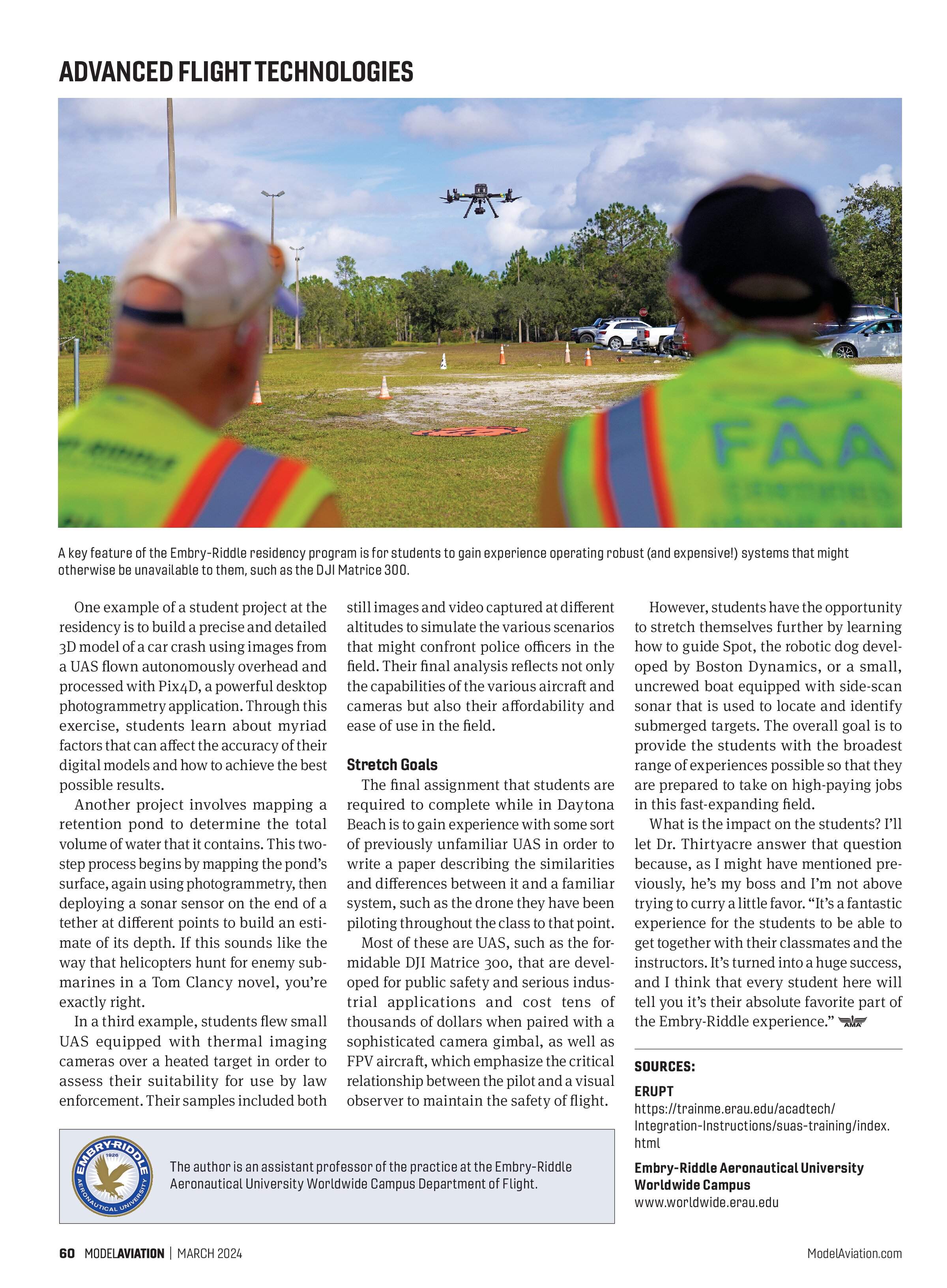
After a long day out flying in the Florida sunshine, students meet up in the evening to begin processing the data that they acquired during the day’s flight operations. Knowing how to work with data is as important as knowing how to work with UAS to deliver high-quality results.
Doing the Job
Of course, among all of the tasks that professional remote pilots might be expected to perform in their working careers, taking pictures of two-gallon buckets probably isn’t high on the list. Therefore, students are divided into teams and assigned a research project based on real-world UAS-use cases before they arrive in Daytona Beach. They must work together online to develop a plan to gather data then implement that plan during the residency. Their final report, based on that work, constitutes a key part of their grade in the course.
One example of a student project at the residency is to build a precise and detailed 3D model of a car crash using images from a UAS flown autonomously overhead and processed with Pix4D, a powerful desktop photogrammetry application. Through this exercise, students learn about the myriad factors that can affect the accuracy of their digital models and how to achieve the best possible results.
Another project involves mapping a retention pond to determine the total volume of water that it contains. This two-step process begins by mapping the pond’s surface, again using photogrammetry, then deploying a sonar sensor on the end of a tether at different points to build an estimate of its depth. If this sounds like the way that helicopters hunt for enemy submarines in a Tom Clancy novel, you’re exactly right.
In a third example, students flew small UAS equipped with thermal imaging cameras over a heated target in order to assess their suitability for use by law enforcement. Their samples included both

still images and video captured at different altitudes to simulate the various scenarios that might confront police officers in the field. Their final analysis reflects not only the capabilities of the various aircraft and cameras but also their affordability and ease of use in the field.
Stretch Goals
The final assignment that students are required to complete while in Daytona Beach is to gain experience with some sort of previously unfamiliar UAS in order to write a paper describing the similarities and differences between it and a familiar system, such as the drone they have been piloting throughout the class to that point.
Most of these are UAS, such as the formidable DJI Matrice 300, that are developed for public safety and serious industrial applications and cost tens of thousands of dollars when paired with a sophisticated camera gimbal, as well as FPV aircraft, which emphasize the critical relationship between the pilot and a visual observer to maintain the safety of flight.
However, students have the opportunity to stretch themselves further by learning how to guide Spot, the robotic dog developed by Boston Dynamics, or a small, uncrewed boat equipped with side-scan sonar that is used to locate and identify submerged targets. The overall goal is to provide the students with the broadest range of experiences possible so that they are prepared to take on high-paying jobs in this fast-expanding field.
What is the impact on the students? I’ll let Dr. Thirtyacre answer that question because, as I might have mentioned previously, he’s my boss and I’m not above trying to curry a little favor. “It’s a fantastic experience for the students to be able to get together with their classmates and the instructors. It’s turned into a huge success, and I think that every student here will tell you it’s their absolute favorite part of the Embry-Riddle experience.”
SOURCES:
ERUPT
https://trainme.erau.edu/acadtech/Integration-Instructions/suas-training/index.html
Embry-Riddle Aeronautical University Worldwide Campus
www.worldwide.erau.edu