RC SLOPE SOARING
BUILDING
TYPES
By Greg Schutte | gshoty@yahoo.com
WHEN I’M DECIDING to build a new model, I usually start with something that has caught my attention. The next decision is about the type of conditions in which I’m going to be flying it. The amount of wind is usually a big factor. The terrain is also to be considered.
After these are figured out, it is time for me to decide what materials I’m going to use. EPP is usually my go-to material. It seems to be the most versatile for Slope flying. Fiberglass and wood are also in the running and have had their place in the sport for longer than foam.
The sailplane that I first learned to fly and had hundreds—if not thousands—of Slope Soaring hours on was a two-meter glider called The Gentle Lady. The Gentle Lady is a built-up balsa aircraft with MonoKote covering. I covered it with transparent yellow and hot pink. It really glowed in the sky and allowed me to see what I was doing. It was great for the 8 to 15 mph wind in my area.
I learned how to Slope Soar with this glider, but landing it was kind of nerve-racking. Those pesky rocks, sagebrush, trees, tall weeds, and fences were all out to get me. It didn’t have spoilers, so coming down in a confined area was difficult. I would fly it for as long as I could so that there was only one landing. Depending on the amount of wind, this could be hours. I was forced to land a couple of times because my battery was getting low, but for light wind, a balsa airplane is tough to surpass. Sitting in a beach chair and flying my glider into the house lift band so I can “speck” it out on a nice, warm day is hard to beat.
The second Slope airplane that I built was one of blue foam by JK Aerotech called the Sniper. When I received the kit, I was shocked by its crudeness. It was basically just a couple of chunks of blue foam hotwired to have an airplane fuselage shape and wing, some Coroplast tail feathers, and a roll of colored packing tape.
I built this model according to the instructions and was very impressed with the way it flew. It required stronger wind to fly, but it was way more responsive and much easier to land in rough terrain. It would bounce to a certain degree, which made me feel better about my landings. I soon found myself using sagebrush as a catcher’s mitt to land my Sniper. Although blue foam is cheap to buy and easy to work with, it will turn into blue powder after a dozen or so bounces. My nose was always bent after the first hard landing.
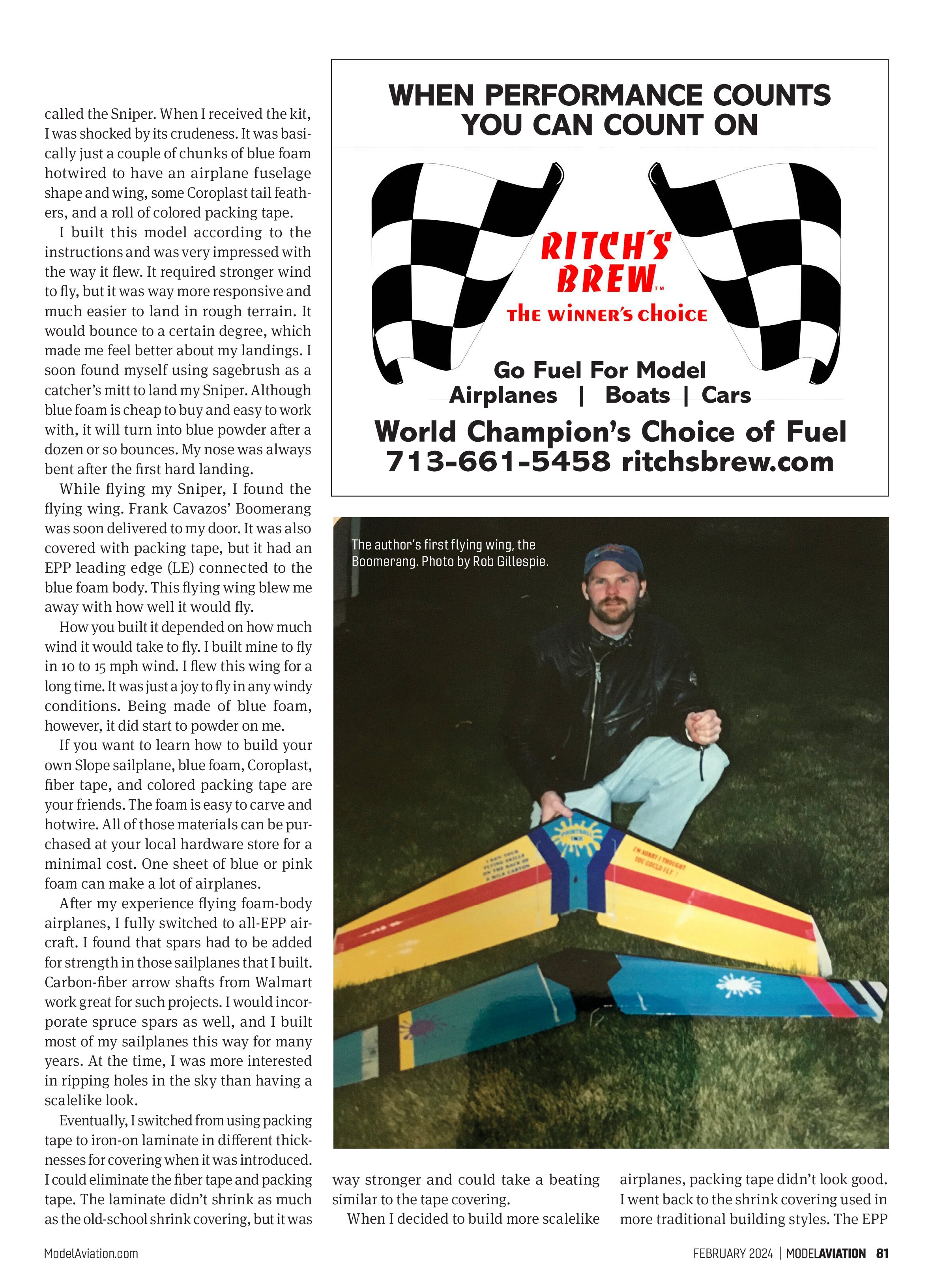
While flying my Sniper, I found the flying wing. Frank Cavazos’ Boomerang was soon delivered to my door. It was also covered with packing tape, but it had an EPP leading edge (LE) connected to the blue foam body. This flying wing blew me away with how well it would fly.
How you built it depended on how much wind it would take to fly. I built mine to fly in 10 to 15 mph wind. I flew this wing for a long time. It was just a joy to fly in any windy conditions. Being made of blue foam, however, it did start to powder on me.
If you want to learn how to build your own Slope sailplane, blue foam, Coroplast, fiber tape, and colored packing tape are your friends. The foam is easy to carve and hotwire. All of those materials can be purchased at your local hardware store for a minimal cost. One sheet of blue or pink foam can make a lot of airplanes.
After my experience flying foam-body airplanes, I fully switched to all-EPP aircraft. I found that spars had to be added for strength in those sailplanes that I built. Carbon-fiber arrow shafts from Walmart work great for such projects. I would incorporate spruce spars as well, and I built most of my sailplanes this way for many years. At the time, I was more interested in ripping holes in the sky than having a scalelike look.
Eventually, I switched from using packing tape to iron-on laminate in different thicknesses for covering when it was introduced. I could eliminate the fiber tape and packing tape. The laminate didn’t shrink as much as the old-school shrink covering, but it was way stronger and could take a beating similar to the tape covering.

When I decided to build more scalelike airplanes, packing tape didn’t look good. I went back to the shrink covering used in more traditional building styles. The EPP

core was still there and my A-10 is an example of this. I would put a layer of fiber tape down then cover it with the shrink covering. This method also uses lightweight spackle. The weight is usually heavier, so more wind is required for this type of model. You can build close to scale and keep the durability of the EPP.
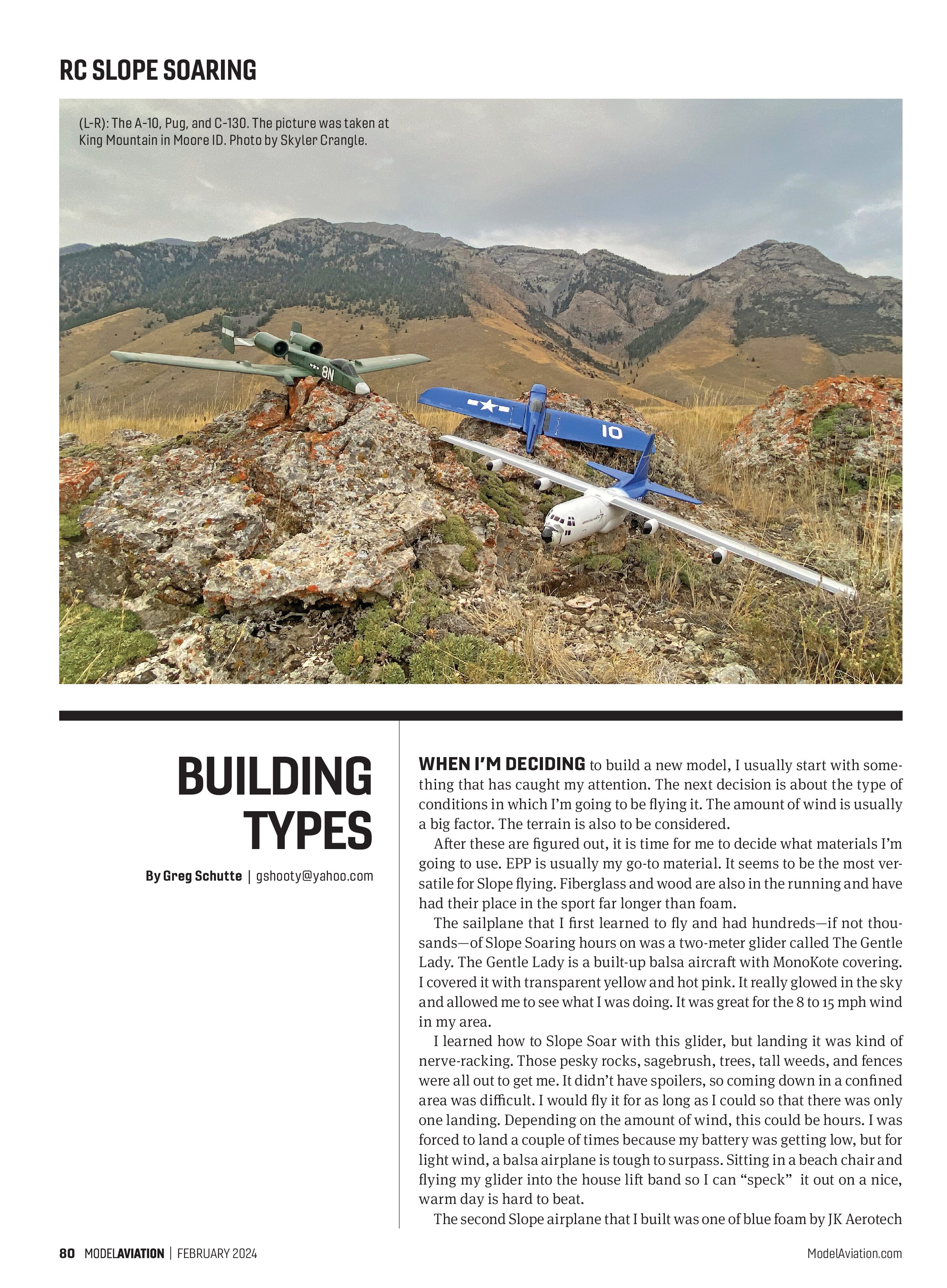
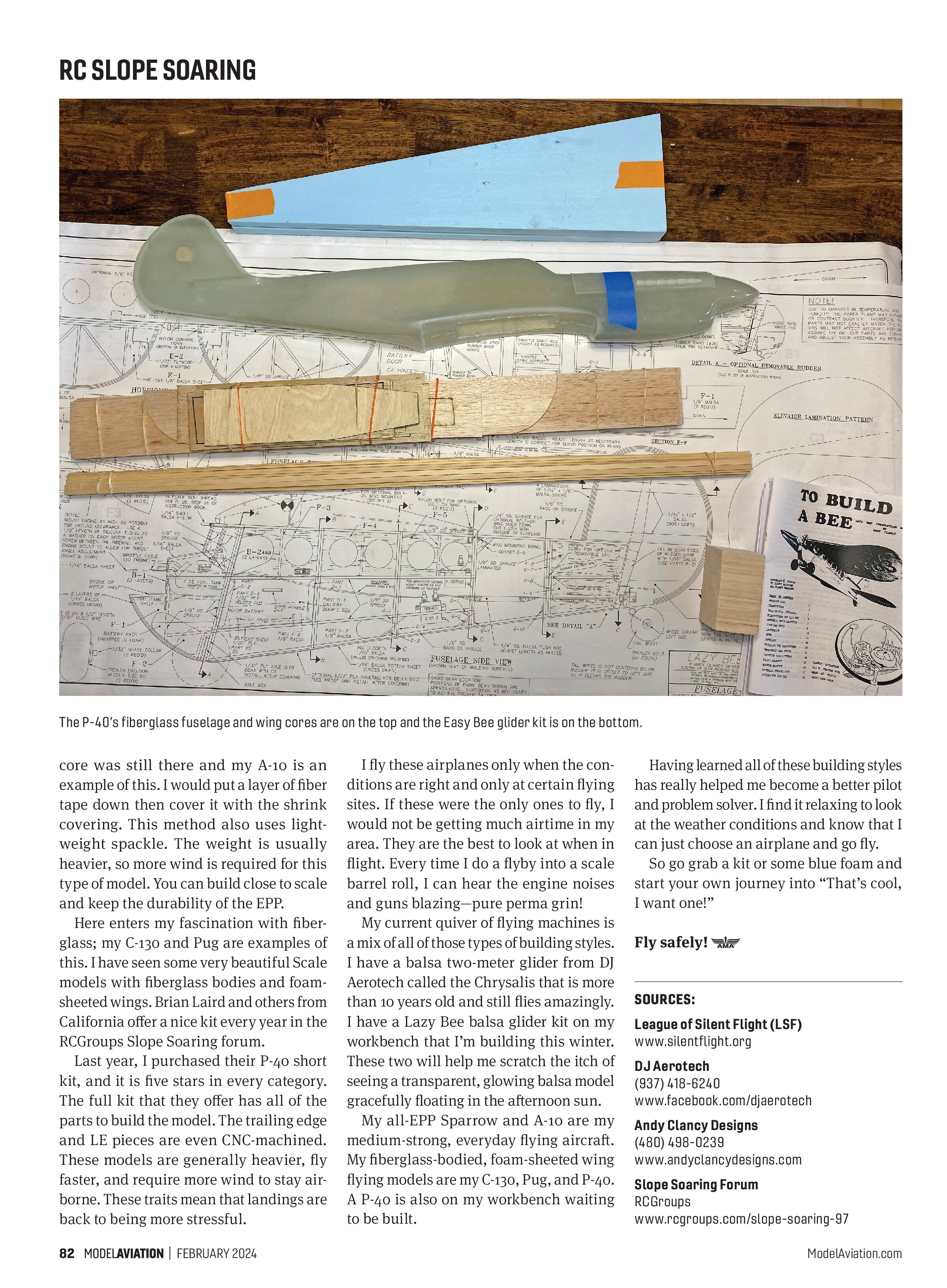
Here enters my fascination with fiberglass; my C-130 and Pug are examples of this. I have seen some very beautiful Scale models with fiberglass bodies and foam-sheeted wings. Brian Laird and others from California offer a nice kit every year in the RCGroups Slope Soaring forum.
Last year, I purchased their P-40 short kit, and it is five stars in every category. The full kit that they offer has all of the parts to build the model. The trailing edge and LE pieces are even CNC-machined. These models are generally heavier, fly faster, and require more wind to stay airborne. These traits mean that landings are back to being more stressful.
I fly these airplanes only when the conditions are right and only at certain flying sites. If these were the only ones to fly, I would not be getting much airtime in my area. They are the best to look at when in flight. Every time I do a flyby into a scale barrel roll, I can hear the engine noises and guns blazing—pure perma grin!
My current quiver of flying machines is a mix of all of those types of building styles. I have a balsa two-meter glider from DJ Aerotech called the Chrysalis that is more than 10 years old and still flies amazingly. I have a Lazy Bee balsa glider kit on my workbench that I’m building this winter. These two will help me scratch the itch of seeing a transparent, glowing balsa model gracefully floating in the afternoon sun.
My all-EPP Sparrow and A-10 are my medium-strong, everyday flying aircraft. My fiberglass-bodied, foam-sheeted wing flying models are my C-130, Pug, and P-40. A P-40 is also on my workbench waiting to be built.
Having learned all of these building styles has really helped me become a better pilot and problem solver. I find it relaxing to look at the weather conditions and know that I can just choose an airplane and go fly.
So go grab a kit or some blue foam and start your own journey into “That’s cool, I want one!”
Fly safely!
SOURCES:
League of Silent Flight (LSF)
www.silentflight.org
DJ Aerotech
(937) 418-6240
www.facebook.com/djaerotech
Andy Clancy Designs
(480) 498-0239
www.andyclancydesigns.com
Slope Soaring Forum
RCGroups
www.rcgroups.com/slope-soaring-97