RC SCALE AEROBATICS
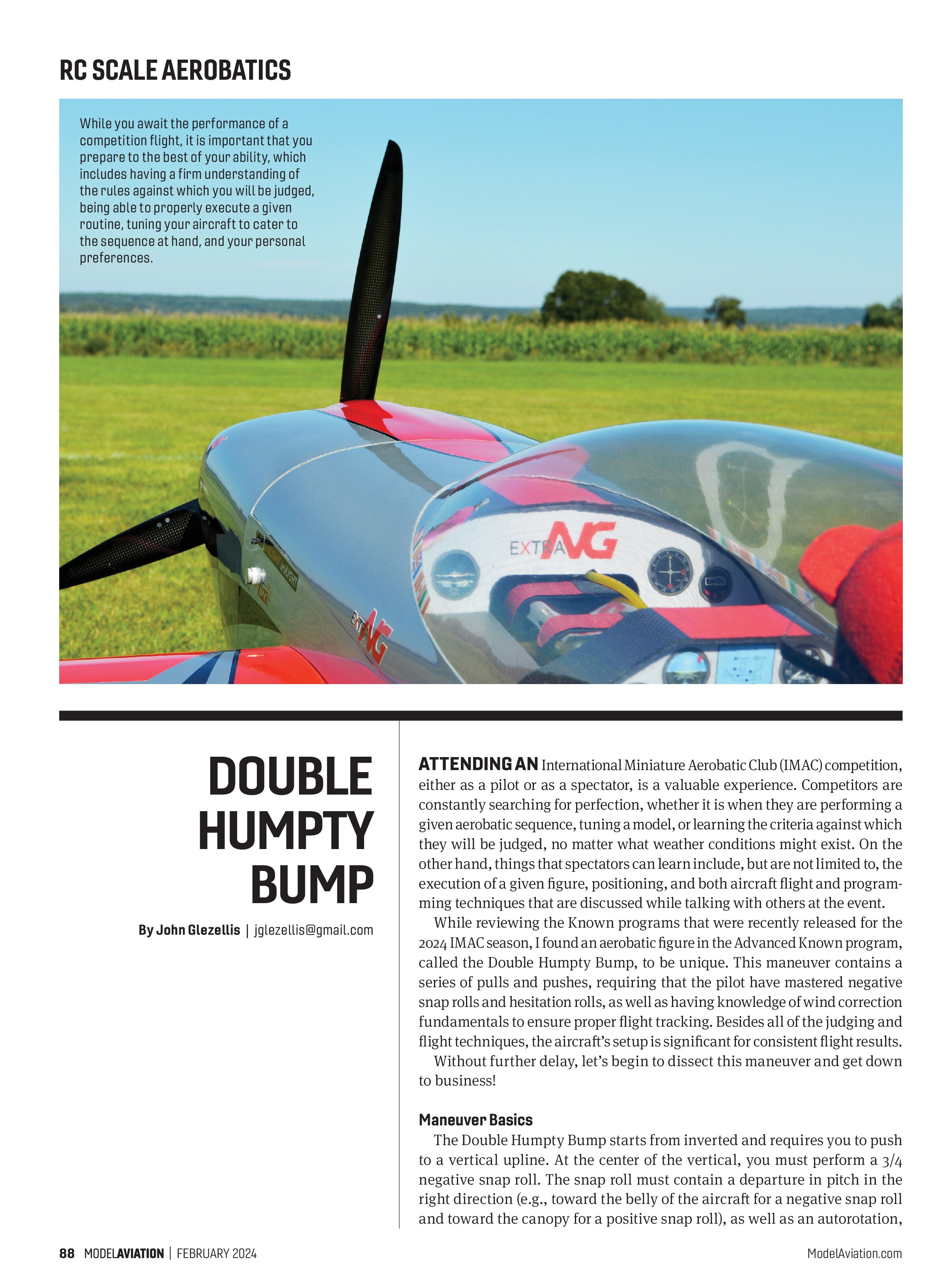
While you await the performance of a competition flight, it is important that you prepare to the best of your ability, which includes having a firm understanding of the rules against which you will be judged, being able to properly execute a given routine, tuning your aircraft to cater to the sequence at hand, and your personal preferences.

DOUBLE HUMPTY BUMP
By John Glezellis | jglezellis@gmail.com
ATTENDING AN International Miniature Aerobatic Club (IMAC) competition, either as a pilot or as a spectator, is a valuable experience. Competitors are constantly searching for perfection, whether it is when they are performing a given aerobatic sequence, tuning a model, or learning the criteria against which they will be judged, no matter what weather conditions might exist. On the other hand, things that spectators can learn include, but are not limited to, the execution of a given figure, positioning, and both aircraft flight and programming techniques that are discussed while talking with others at the event.
While reviewing the Known programs that were recently released for the 2024 IMAC season, I found an aerobatic figure in the Advanced Known program, called the Double Humpty Bump, to be unique. This maneuver contains a series of pulls and pushes, requiring that the pilot have mastered negative snap rolls and hesitation rolls, as well as having knowledge of wind correction fundamentals to ensure proper flight tracking. Besides all of the judging and flight techniques, the aircraft’s setup is significant for consistent flight results.
Without further delay, let’s begin to dissect this maneuver and get down to business!
Maneuver Basics
The Double Humpty Bump starts from inverted and requires you to push to a vertical upline. At the center of the vertical, you must perform a 3/4 negative snap roll. The snap roll must contain a departure in pitch in the right direction (e.g., toward the belly of the aircraft for a negative snap roll and toward the canopy for a positive snap roll), as well as an autorotation, which must occur either immediately following—or simultaneously with—the departure in pitch. In essence, the aircraft must be rolling in addition to having displacement in the pitch and yaw axes. You will then need to push half of a loop across the top of the box and perform a half roll that is to be centered on the downline.
Although the maneuver would be nearly complete if this was a traditional Humpty, a Double Humpty Bump is different. Across the bottom, the pilot will pull half of a loop and perform three points of a four-point roll centered on the upline before pulling to an inverted exit. Roll rates must be consistent and centered on the vertical segment, and rolling is direction-specific, depending on the snap that was performed earlier, to ensure an exit in the opposite direction from the original entry because this is an end-box maneuver.
Humpty Bumps are judged as a combination of lines and loops within the rulebook. The half loop in the middle of each Humpty can be of a different radius than the entry or exit radii, and in the case of the Double Humpty, the two half loops are not required to be identical and the entry and exit radii do not need to match.
Should a crosswind exist, the directions of the snap roll and point roll are critical to allow you to go against the wind across the bottom of the loop that joins both Humpty Bumps. The lines in these figures might be of different lengths, which will allow for different entry and exit altitudes.
Remember, the exit altitude must be significantly higher than the entry to allow for a proper spin entry and execution, which is the maneuver that follows.
Regarding flight in wind, the flight path should resemble a mix of perfect vertical lines and half loops, regardless of the amount of wind present. To do so, the pilot might have to apply more elevator input and/or corrective inputs at times to ensure

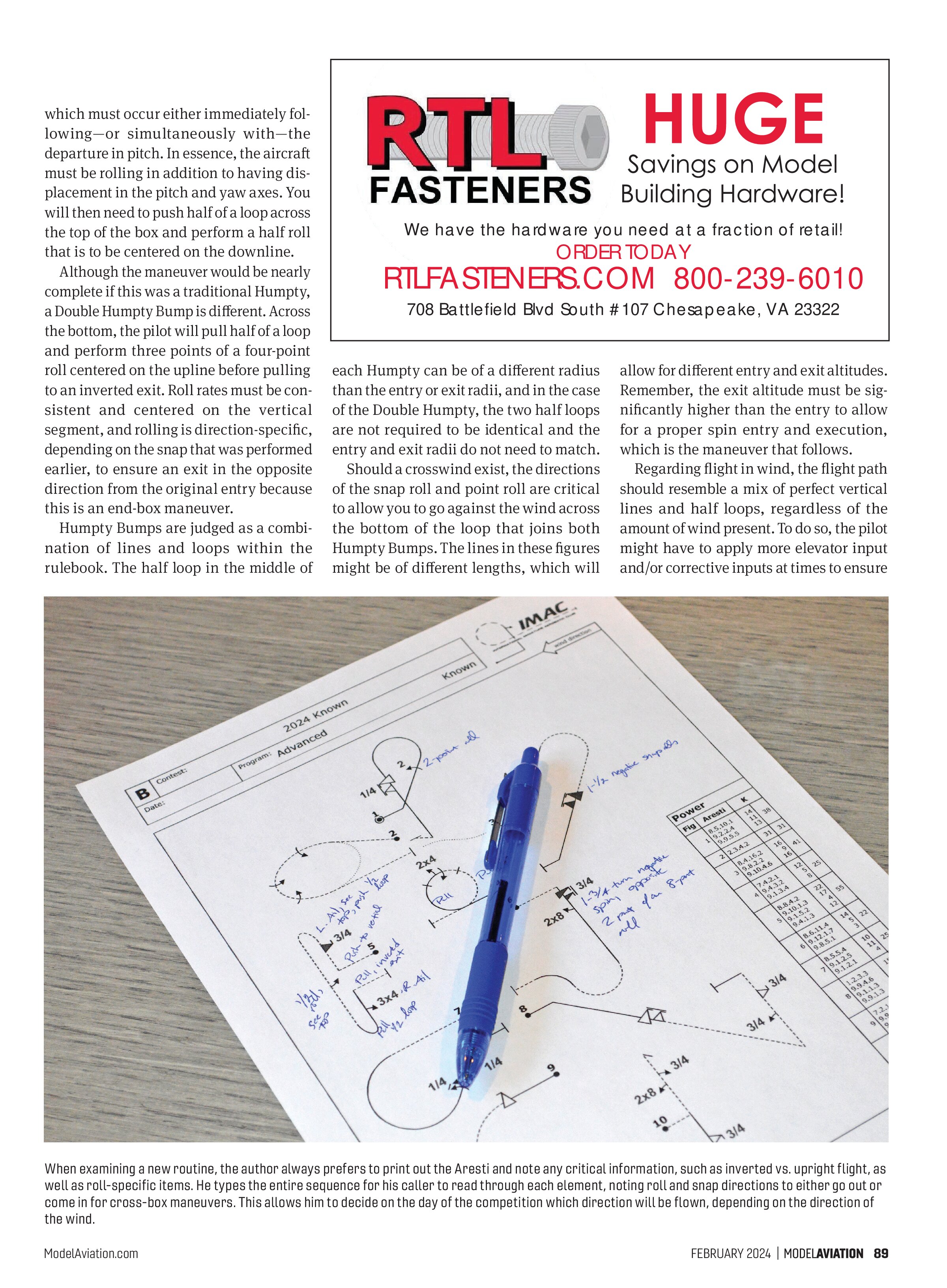
When examining a new routine, the author always prefers to print out the Aresti and note any critical information, such as inverted vs. upright flight, as well as roll-specific items. He types the entire sequence for his caller to read through each element, noting roll and snap directions to either go out or come in for cross-box maneuvers. This allows him to decide on the day of competition which direction will be flown, depending on the direction of the wind.
that a perfect loop or vertical line is shown. A vertical upline might require angling the aircraft into the wind by 10°, for example, but it is important that the flight path is correct and vertical, should that be required.
Programming Fundamentals
Because this figure contains a combination of elegant radii, point rolls, and an aggressive 3/4 negative snap roll, my preference would be to utilize two different flight modes that are located on a three-position switch. Precision cannot occur in a consistent manner if maximum rates upward of 40° of travel are used on all surfaces. I recommend that you use flight modes so that only one switch is used to control all dual or triple rates.
On my models, I use the low rate setting for all precision maneuvers, such as the looping and rolling elements of the Double Humpty, and medium rate only for the 3/4 negative snap roll. While I do utilize a third rate, that particular rate is for 3D flight and/or tailslides, so it is never touched for a maneuver such as the Double Humpty Bump.
Generally, I have found the deflection
Low RateMedium RateHigh RateAileron25°/30% exponential35°/40% exponential40°/65% exponentialElevator15°/30% exponential25°/45% exponential40°/65% exponentialRudder35°/50% exponential30°/55% exponential40°/65% exponential