OLD-TIMERS

REGINALD DENNY
By Bob Angel | samrcflier@verizon.net
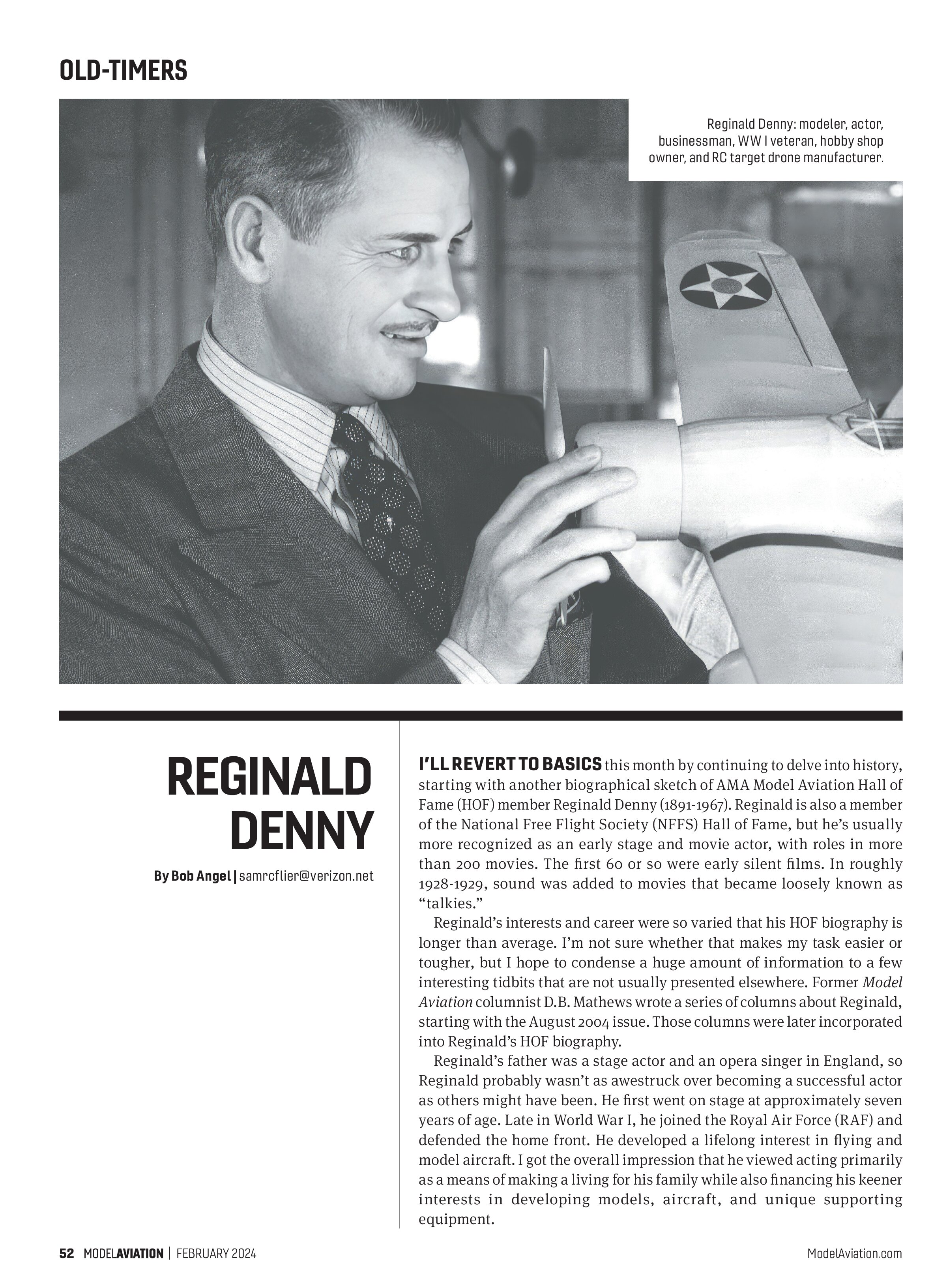
I’LL REVERT TO BASICS this month by continuing to delve into history, starting with another biographical sketch of AMA Model Aviation Hall of Fame (HOF) member Reginald Denny (1891-1967). Reginald is also a member of the National Free Flight Society (NFFS) Hall of Fame, but he’s usually more recognized as an early stage and movie actor, with roles in more than 200 movies. The first 60 or so were early silent films. In roughly 1928-1929, sound was added to movies that became loosely known as “talkies.”
Reginald’s interests and career were so varied that his HOF biography is longer than average. I’m not sure whether that makes my task easier or tougher, but I hope to condense a huge amount of information to a few interesting tidbits that are not usually presented elsewhere. Former Model Aviation columnist D.B. Mathews wrote a series of columns about Reginald, starting with the August 2004 issue. Those columns were later incorporated into Reginald’s HOF biography.
Reginald’s father was a stage actor and an opera singer in England, so Reginald probably wasn’t as awestruck over becoming a successful actor as others might have been. He first went on stage at approximately seven years of age. Late in World War I, he joined the Royal Air Force (RAF) and defended the home front. He developed a lifelong interest in flying and model aircraft. I got the overall impression that he viewed acting primarily as a means of making a living for his family while also financing his keener interests in developing models, aircraft, and unique supporting equipment.
Bits and pieces of Reginald’s biography have often been presented in modeling publications, even briefly in this column in June 2009, where I mentioned (probably erroneously) that he was an RAF pilot. Most articles cover similar highlights, including the fact that he opened a hobby shop in downtown Hollywood, right on Hollywood Boulevard. He had both an airplane kit and an engine designed under his own name called the Dennyplane and the Dennymite, respectively.
Living in Southern California, I visited that hobby shop just once before it closed.
I remember it being an average size shop, but it was almost like a small museum, with many models on display, mostly hanging from the ceiling. I later read that some of those models were built for sale and would be considered early ARFs or ready-to-fly models today.
In partnership with others, Reginald helped found the Radioplane company, which produced nearly 10,000 radio-controlled target drones for both the U.S. Army and the U.S. Navy as part of the contribution to the allied World War II victory. Postwar production saw more than 50,000 additional drones produced by Radioplane.
An item seldom overlooked in any of Reginald’s biographies is the 1945 publicity photograph of Radioplane employee Norma Jean Doherty, who was about to install a propeller on one of the company’s twin-cylinder drone engines. That photo led to Norma Jean becoming widely known as movie actress Marilyn Monroe.
Many variations of drone engines were produced, including some with counter-rotating propellers and others made by manufacturers other than those designed
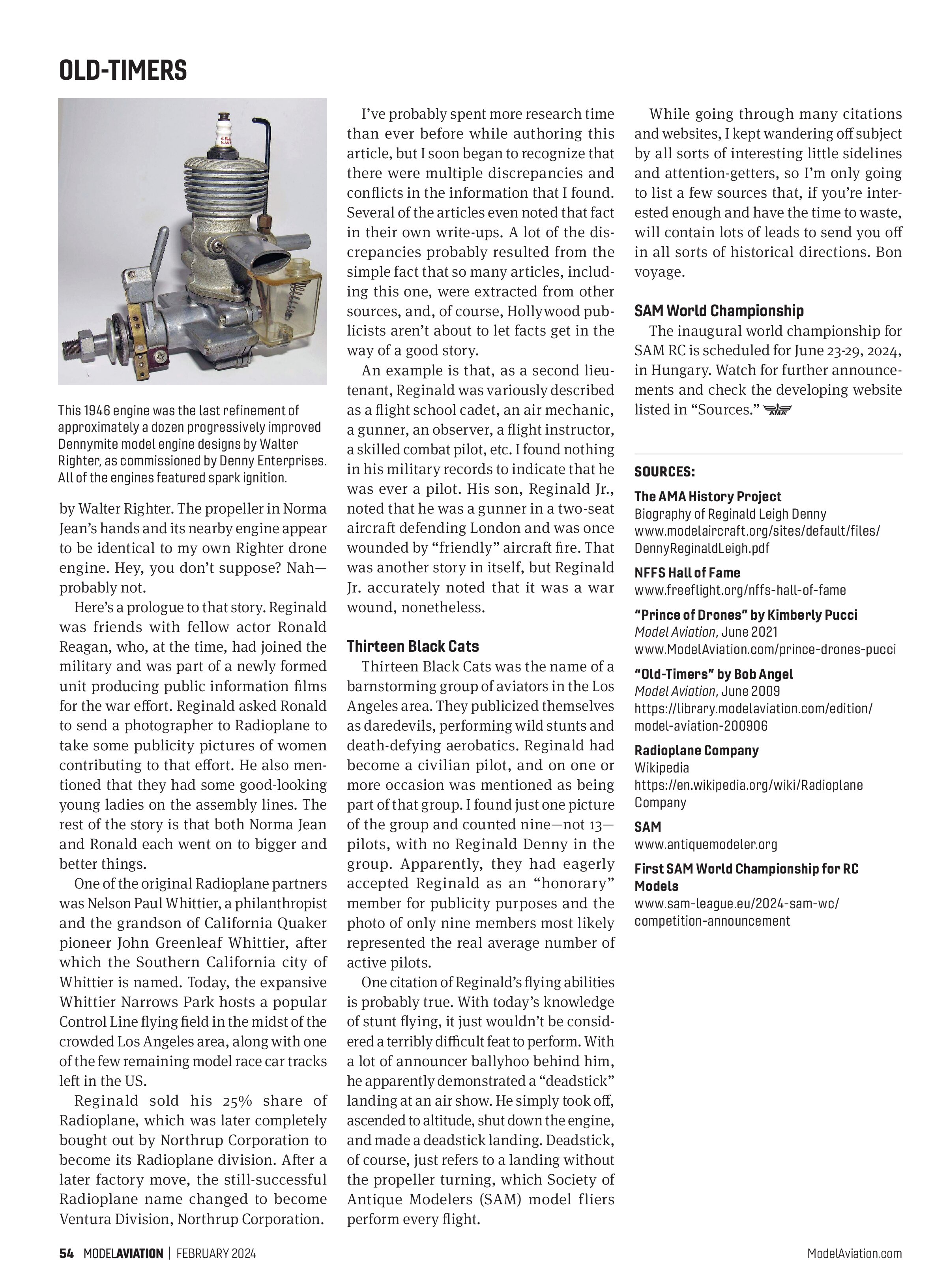
by Walter Righter. The propeller in Norma Jean’s hands and its nearby engine appear to be identical to my own Righter drone engine. Hey, you don’t suppose? Nah—probably not.
Here’s a prologue to that story. Reginald was friends with fellow actor Ronald Reagan, who, at the time, had joined the military and was part of a newly formed unit producing public information films for the war effort. Reginald asked Ronald to send a photographer to Radioplane to take some publicity pictures of women contributing to that effort. He also mentioned that they had some good-looking young ladies on the assembly lines. The rest of the story is that both Norma Jean and Ronald each went on to bigger and better things.
One of the original Radioplane partners was Nelson Paul Whittier, a philanthropist and the grandson of California Quaker pioneer John Greenleaf Whittier, after which the Southern California city of Whittier is named. Today, the expansive Whittier Narrows Park hosts a popular Control Line flying field in the midst of the crowded Los Angeles area, along with one of the few remaining model race car tracks left in the US.
Reginald sold his 25% share of Radioplane, which was later completely bought out by Northrop Corporation to become its Radioplane division. After a later factory move, the still-successful Radioplane name changed to become Ventura Division, Northrop Corporation.
I’ve probably spent more research time than ever before while authoring this article, but I soon began to recognize that there were multiple discrepancies and conflicts in the information that I found. Several of the articles even noted that fact in their own write-ups. A lot of the discrepancies probably resulted from the simple fact that so many articles, including this one, were extracted from other sources, and, of course, Hollywood publicists aren’t about to let facts get in the way of a good story.
An example is that, as a second lieutenant, Reginald was variously described as a flight school cadet, an air mechanic, a gunner, an observer, a flight instructor, a skilled combat pilot, etc. I found nothing in his military records to indicate that he was ever a pilot. His son, Reginald Jr., noted that he was a gunner in a two-seat aircraft defending London and was once wounded by “friendly” aircraft fire. That was another story in itself, but Reginald Jr. accurately noted that it was a war wound, nonetheless.
Thirteen Black Cats
Thirteen Black Cats was the name of a barnstorming group of aviators in the Los Angeles area. They publicized themselves as daredevils, performing wild stunts and death-defying aerobatics. Reginald had become a civilian pilot, and on one or more occasion was mentioned as being part of that group. I found just one picture of the group and counted nine—not 13—pilots, with no Reginald Denny in the group. Apparently, they had eagerly accepted Reginald as an “honorary” member for publicity purposes and the photo of only nine members most likely represented the real average number of active pilots.
One citation of Reginald’s flying abilities is probably true. With today’s knowledge of stunt flying, it just wouldn’t be considered a terribly difficult feat to perform. With a lot of announcer ballyhoo behind him, he apparently demonstrated a “deadstick” landing at an air show. He simply took off, ascended to altitude, shut down the engine, and made a deadstick landing. Deadstick, of course, just refers to a landing without the propeller turning, which Society of Antique Modelers (SAM) model fliers perform every flight.
While going through many citations and websites, I kept wandering off subject by all sorts of interesting little sidelines and attention-getters, so I’m only going to list a few sources that, if you’re interested enough and have the time to waste, will contain lots of leads to send you off in all sorts of historical directions. Bon voyage.
SAM World Championship
The inaugural world championship for SAM RC is scheduled for June 23-29, 2024, in Hungary. Watch for further announcements and check the developing website listed in “Sources.”
SOURCES:
The AMA History Project
Biography of Reginald Leigh Denny
www.modelaircraft.org/sites/default/files/
DennyReginaldLeigh.pdf
NFFS Hall of Fame
www.freeflight.org/nffs-hall-of-fame
“Prince of Drones” by Kimberly Pucci
Model Aviation, June 2021
www.ModelAviation.com/prince-drones-pucci
“Old-Timers” by Bob Angel
Model Aviation, June 2009
https://library.modelaviation.com/edition/
model-aviation-200906
Radioplane Company
Wikipedia
https://en.wikipedia.org/wiki/Radioplane
Company
First SAM World Championship for RC Models
www.sam-league.eu/2024-sam-wc/
competition-announcement