ELECTRICS

PROJECT UPDATES: THREE RETRO, ELECTRIC MODELS
By Terry Dunn | terrydunn74@gmail.com
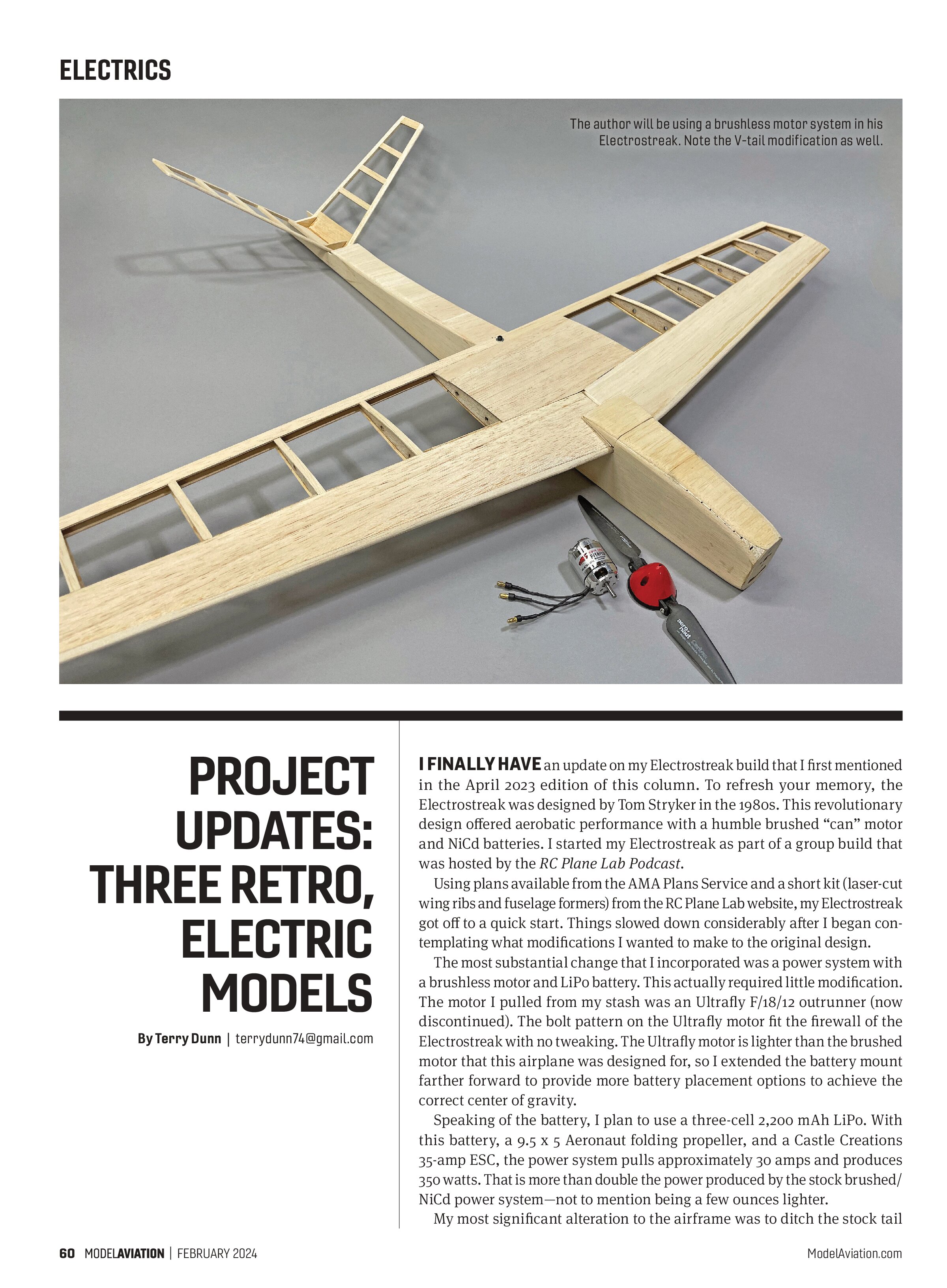
I FINALLY HAVE an update on my ElectroStreak build that I first mentioned in the April 2023 edition of this column. To refresh your memory, the ElectroStreak was designed by Tom Stryker in the 1980s. This revolutionary design offered aerobatic performance with a humble brushed “can” motor and NiCd batteries. I started my ElectroStreak as part of a group build that was hosted by the RC Plane Lab Podcast.
Using plans available from the AMA Plans Service and a short kit (laser-cut wing ribs and fuselage formers) from the RC Plane Lab website, my ElectroStreak got off to a quick start. Things slowed down considerably after I began contemplating what modifications I wanted to make to the original design.
The most substantial change that I incorporated was a power system with a brushless motor and LiPo battery. This actually required little modification. The motor I pulled from my stash was an Ultrafly F/18/12 outrunner (now discontinued). The bolt pattern on the Ultrafly motor fit the firewall of the ElectroStreak with no tweaking. The Ultrafly motor is lighter than the brushed motor that this airplane was designed for, so I extended the battery mount farther forward to provide more battery placement options to achieve the correct center of gravity.
Speaking of the battery, I plan to use a three-cell 2,200 mAh LiPo. With this battery, a 9.5 x 5 Aeronaut folding propeller, and a Castle Creations 35-amp ESC, the power system pulls approximately 30 amps and produces 350 watts. That is more than double the power produced by the stock brushed/NiCd power system—not to mention being a few ounces lighter.
My most significant alteration to the airframe was to ditch the stock tail feathers and incorporate a V-tail. I did this purely for aesthetic reasons. I had to design new tail feathers and modify the aft section of the fuselage to accept them. I am happy with the results thus far. Many people refer to the ElectroStreak as the “E-streak.” Maybe I’ll call mine the “V-streak.”
At this point, my ElectroStreak is nearly framed up. There is still a lot of work to do before the maiden flight. I will report back here when it is ready.
Retro Eagle 2
It’s no secret that I am a fan of “classic” electric flight equipment. In fact, I have several models that still use brushed motors. That collection recently grew when I was given an Astro Flight Cobalt 25 motor with a gearbox and an Astro Flight 204 ESC. All of this equipment was in like-new condition, so I decided it needed to be flown. I also wanted to use it in an airframe of the same vintage (late 1990s).
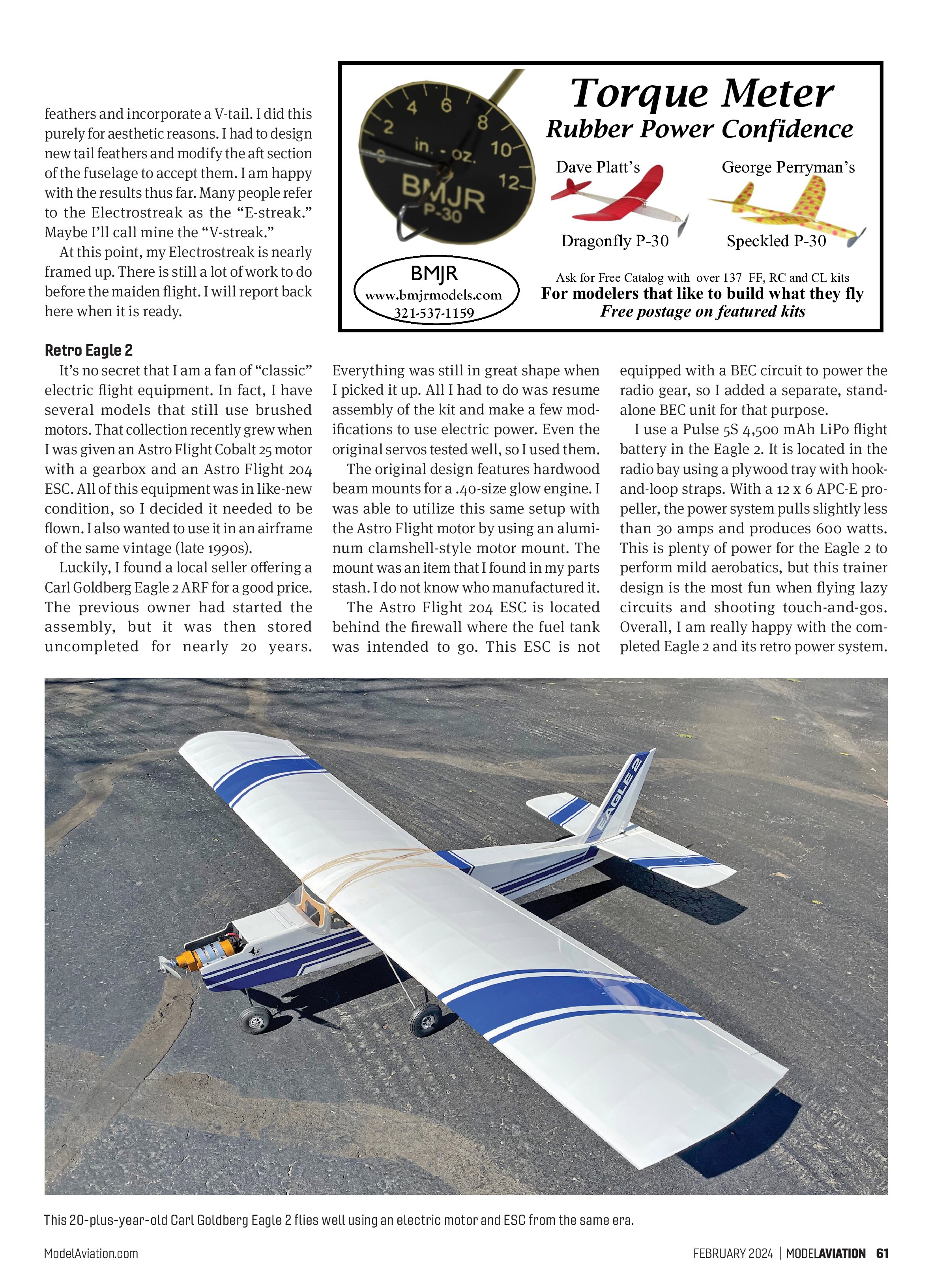
Luckily, I found a local seller offering a Carl Goldberg Eagle 2 ARF for a good price. The previous owner had started the assembly, but it was then stored uncompleted for nearly 20 years.
Everything was still in great shape when I picked it up. All I had to do was resume assembly of the kit and make a few modifications to use electric power. Even the original servos tested well, so I used them.
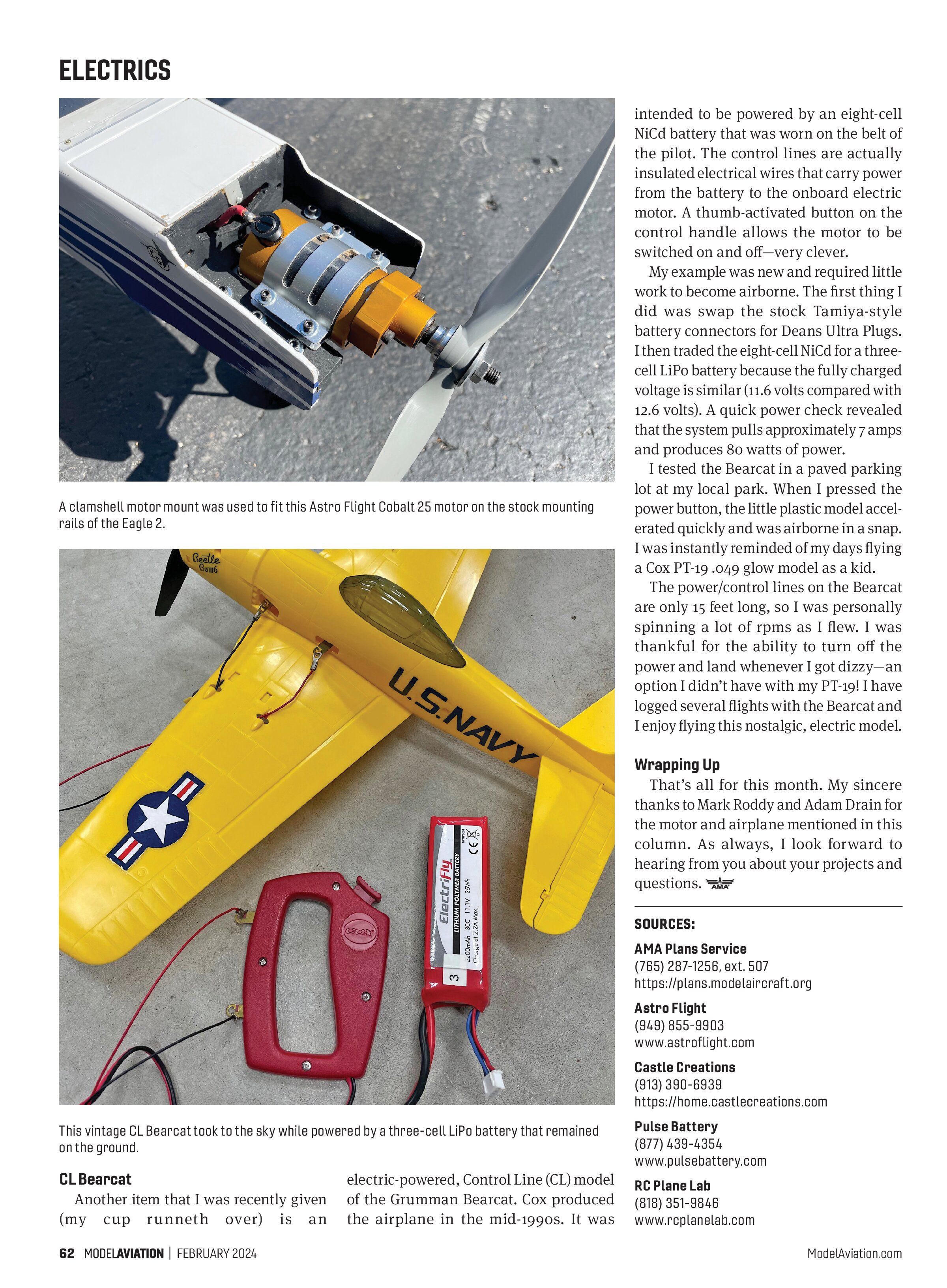
The original design features hardwood beam mounts for a .40-size glow engine. I was able to utilize this same setup with the Astro Flight motor by using an aluminum clamshell-style motor mount. The mount was an item that I found in my parts stash. I do not know who manufactured it.
The Astro Flight 204 ESC is located behind the firewall where the fuel tank was intended to go. This ESC is not equipped with a BEC circuit to power the radio gear, so I added a separate, stand-alone BEC unit for that purpose.
I use a Pulse 5S 4,500 mAh LiPo flight battery in the Eagle 2. It is located in the radio bay using a plywood tray with hook-and-loop straps. With a 12 x 6 APC-E propeller, the power system pulls slightly less than 30 amps and produces 600 watts. This is plenty of power for the Eagle 2 to perform mild aerobatics, but this trainer design is the most fun when flying lazy circuits and shooting touch-and-gos. Overall, I am really happy with the completed Eagle 2 and its retro power system.


CL Bearcat
Another item that I was recently given (my cup runneth over) is an electric-powered, Control Line (CL) model of the Grumman Bearcat. Cox produced the airplane in the mid-1990s. It was intended to be powered by an eight-cell NiCd battery that was worn on the belt of the pilot. The control lines are actually insulated electrical wires that carry power from the battery to the onboard electric motor. A thumb-activated button on the control handle allows the motor to be switched on and off—very clever.
My example was new and required little work to become airborne. The first thing I did was swap the stock Tamiya-style battery connectors for Deans Ultra Plugs. I then traded the eight-cell NiCd for a three-cell LiPo battery because the fully charged voltage is similar (11.6 volts compared with 12.6 volts). A quick power check revealed that the system pulls approximately 7 amps and produces 80 watts of power.
I tested the Bearcat in a paved parking lot at my local park. When I pressed the power button, the little plastic model accelerated quickly and was airborne in a snap. I was instantly reminded of my days flying a Cox PT-19 .049 glow model as a kid.
The power/control lines on the Bearcat are only 15 feet long, so I was personally spinning a lot of rpms as I flew. I was thankful for the ability to turn off the power and land whenever I got dizzy—an option I didn’t have with my PT-19! I have logged several flights with the Bearcat and I enjoy flying this nostalgic, electric model.
Wrapping Up
That’s all for this month. My sincere thanks to Mark Roddy and Adam Drain for the motor and airplane mentioned in this column. As always, I look forward to hearing from you about your projects and questions.
SOURCES:
AMA Plans Service
(765) 287-1256, ext. 507
https://plans.modelaircraft.org
Astro Flight
(949) 855-9903
www.astroflight.com
Castle Creations
(913) 390-6939
https://home.castlecreations.com
Pulse Battery
(877) 439-4354
www.pulsebattery.com
RC Plane Lab
(818) 351-9846
www.rcplanelab.com