THE DEAL WITH DRONES

THE NEED FOR SPEED
By Susan Smith | susankaysmith@gmail.com
“HOW DO YOU KNOW where to go? And how do you go so fast?” These are the most common questions I am asked by non-FPV pilots about drone racing.
The first question is easier to answer. How do we know where to go? Large events typically have the racecourse released in advance and placed in a computer simulator for practice and memorization.
This is occasionally a controversial topic because some racers prefer the element of surprise and being able to learn a new track as a part of the racing process. The rationale for releasing tracks in advance for these large events—which typically involve traveling out of state or sometimes out of the country—is so that pilots know the course ahead of time, allowing them to spend more time practicing and less time learning a new track.
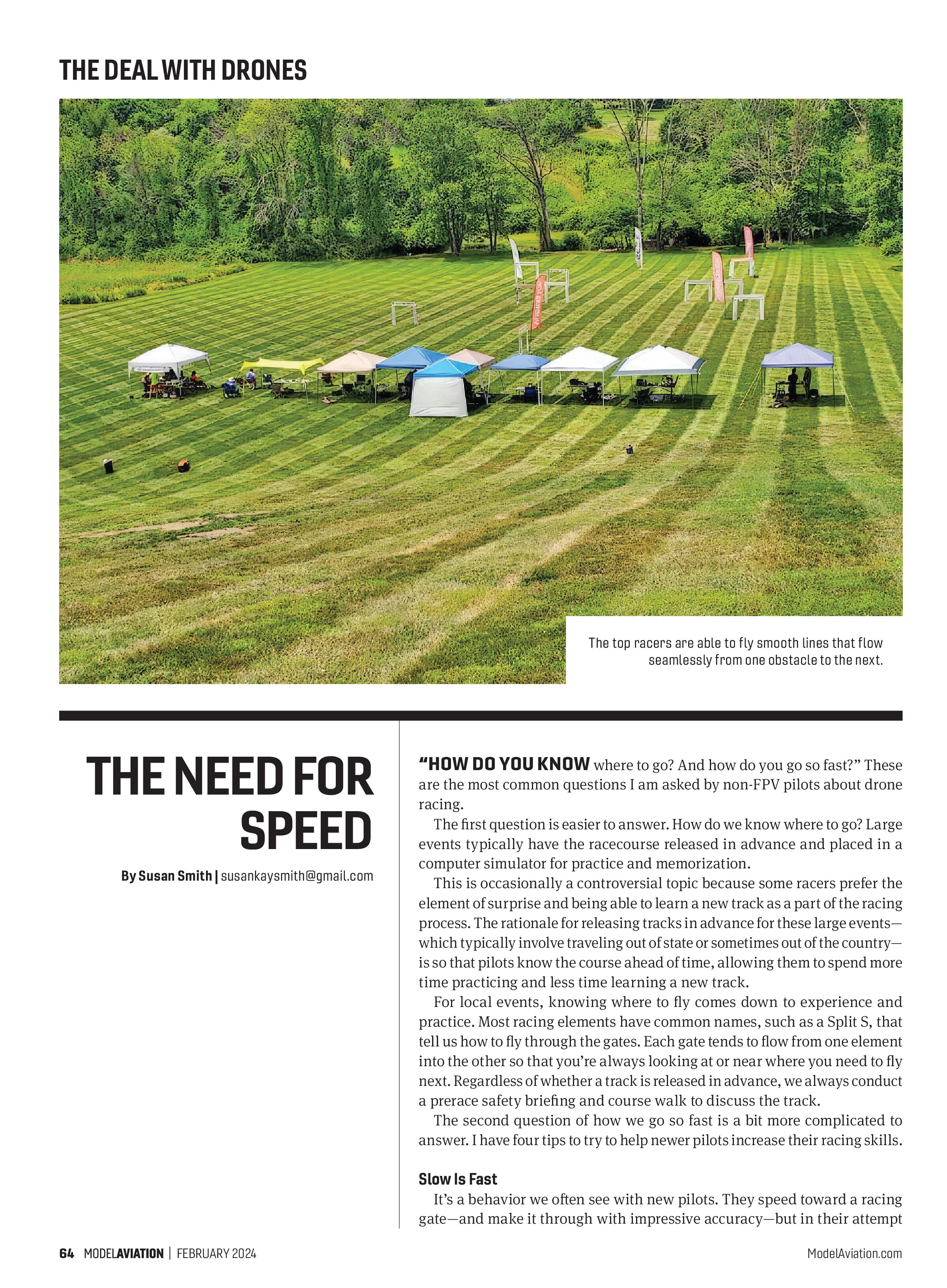
For local events, knowing where to fly comes down to experience and practice. Most racing elements have common names, such as a Split S, that tell us how to fly through the gates. Each gate tends to flow from one element into the other so that you’re always looking at or near where you need to fly next. Regardless of whether a track is released in advance, we always conduct a prerace safety briefing and course walk to discuss the track.
The second question of how we go so fast is a bit more complicated to answer. I have four tips to try to help newer pilots increase their racing skills.
Slow Is Fast
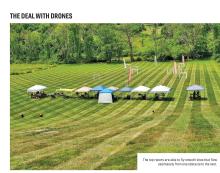
It’s a behavior we often see with new pilots. They speed toward a racing gate—and make it through with impressive accuracy—but in their attempt to be as fast as possible, they overshoot the gate by 10 or more feet. They then turn around, travel the extra 10 feet again, and head toward the next gate. This process is repeated.
The best pilots stay close to the gates without overshooting them. How? By pre-turning and managing the throttle.
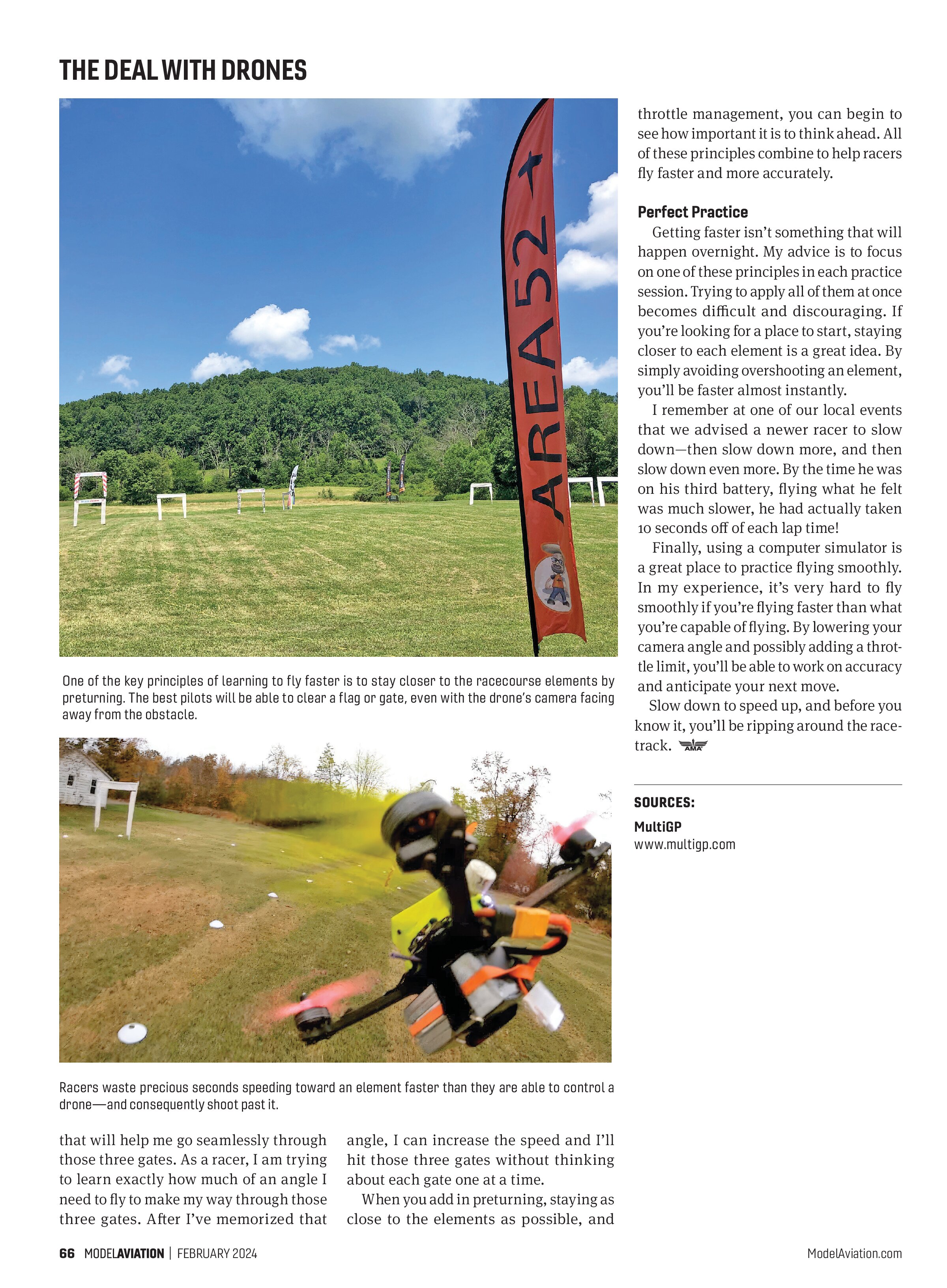
For example, if I am approaching a flag and need to turn to the left to go through a nearby gate, I will turn my drone to the left while approaching the flag, just clear the flag, and head toward the gate. The less wasted movement, the faster the travel through the racecourse. The fastest pilots can do this so effectively that once they preturn, they will not even see the race element until they’ve cleared it. It’s incredibly impressive to watch.
You might find that simply slowing down and trying to stay as close to the gates as possible will be enough to lower your lap times. As you learn the art of preturning and managing the throttle to stay tighter to elements, you will then be able to add back speed.
Another technique that I love is adding a throttle limit or rpm cap. By limiting the output of your drone’s motors, it will be harder to overshoot the element and will help teach you to fly tighter lines.
Smooth Is Fast
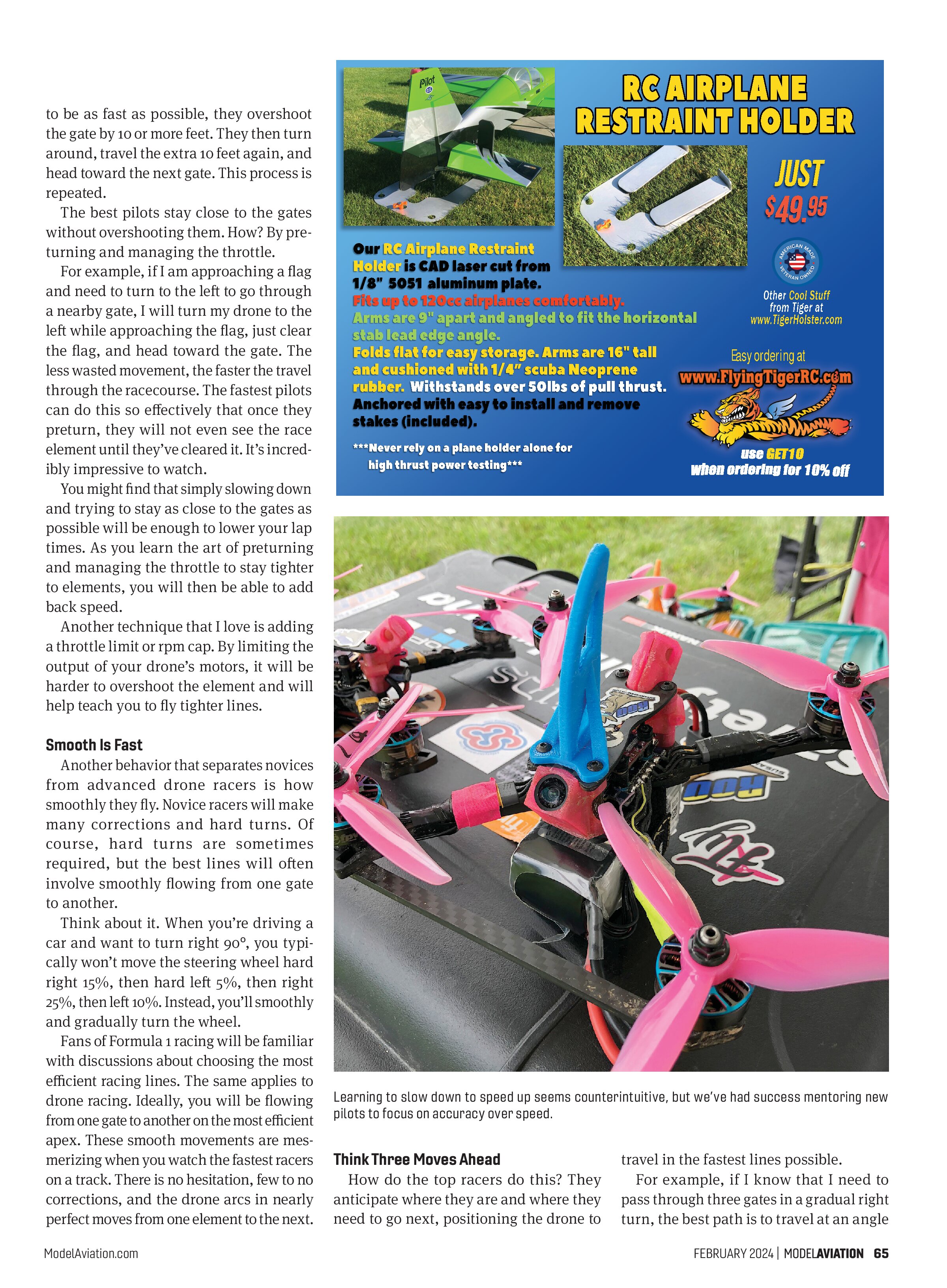
Another behavior that separates novices from advanced drone racers is how smoothly they fly. Novice racers will make many corrections and hard turns. Of course, hard turns are sometimes required, but the best lines will often involve smoothly flowing from one gate to another.
Think about it. When you’re driving a car and want to turn right 90°, you typically won’t move the steering wheel hard right 15%, then hard left 5%, then right 25%, then left 10%. Instead, you’ll smoothly and gradually turn the wheel.
Fans of Formula 1 racing will be familiar with discussions about choosing the most efficient racing lines. The same applies to drone racing. Ideally, you will be flowing from one gate to another on the most efficient apex. These smooth movements are mesmerizing when you watch the fastest racers on a track. There is no hesitation, few to no corrections, and the drone arcs in nearly perfect moves from one element to the next.

Think Three Moves Ahead
How do the top racers do this? They anticipate where they are and where they need to go next, positioning the drone to travel in the fastest lines possible.
For example, if I know that I need to pass through three gates in a gradual right turn, the best path is to travel at an angle

One of the key principles of learning to fly faster is to stay closer to the racecourse elements by preturning. The best pilots will be able to clear a flag or gate, even with the drone’s camera facing away from the obstacle.

Racers waste precious seconds speeding toward an element faster than they are able to control a drone—and consequently shoot past it.
that will help me go seamlessly through those three gates. As a racer, I am trying to learn exactly how much of an angle I need to fly to make my way through those three gates. After I’ve memorized that angle, I can increase the speed and I’ll hit those three gates without thinking about each gate one at a time.
When you add in preturning, staying as close to the elements as possible, and throttle management, you can begin to see how important it is to think ahead. All of these principles combine to help racers fly faster and more accurately.
Perfect Practice
Getting faster isn’t something that will happen overnight. My advice is to focus on one of these principles in each practice session. Trying to apply all of them at once becomes difficult and discouraging. If you’re looking for a place to start, staying closer to each element is a great idea. By simply avoiding overshooting an element, you’ll be faster almost instantly.
I remember at one of our local events that we advised a newer racer to slow down—then slow down more, and then slow down even more. By the time he was on his third battery, flying what he felt was much slower, he had actually taken 10 seconds off of each lap time!
Finally, using a computer simulator is a great place to practice flying smoothly. In my experience, it’s very hard to fly smoothly if you’re flying faster than what you’re capable of flying. By lowering your camera angle and possibly adding a throttle limit, you’ll be able to work on accuracy and anticipate your next move.
Slow down to speed up, and before you know it, you’ll be ripping around the racetrack.
SOURCES:
MultiGP
www.multigp.com