Vintage Viewpoint
MANY CONSTRUCTION ARTICLES IN JANUARY 1974 MAGAZINES
By Bob Noll | bobrc@aol.com

HERE’S ANOTHER LOOK back 50 years to find out what was going on in RC, as reported by the four magazines that were printed then.
Radio Control Modeler (RCM) had an article about the 8th RC World Championships, which was held in Gorizia, Italy. Seventy-eight of the world’s top pilots, representing 28 countries, came to Gorizia. The new world champion was Tsugataka Yoshioka of Japan. The Japanese team placed first and the US team placed second. The US team was made up of Norm Page, with his Mach I; Jim Whitley, with his Daddy Rabbit X; and Jim Martin, with his Banshee.
The cover of RCM had an eye-catching picture of Los Angeles Rams defensive tackle Merlin Olsen in his football attire.
RCM had a detailed construction article about a magnificent classic from the Golden Age of Aviation, the 1935 Aeronca C3 Master by George Nopreen. It was powered by a McCoy custom .19 RC engine.
Another construction article in RCM was “The Wizard,” written by Owen Kampen. Owen said that this rather small airplane, which was powered by a TD .049 engine, could do inside and outside loops, Cuban 8s, wild snap rolls, nearly axial rolls, and had a really frantic spin rate.
“A Quiet Revolution,” by Don Dewey, was an article that started out by stating, “Electric R/C Aircraft are here and they are practical.” Don’s airplane was powered by an Astro 10 and a three-channel radio. The third channel triggered an on/off switch, acting as the throttle.
An article by J. P. Dobyns featured a Mixture Control Meter. The gadget took the guesswork out of needle-valve settings.
World Engines advertised the new Super Tigre Bluehead .60 engine that was used by the first- through fourth-place pilots in the 1973 Expert RC Aerobatics (Pattern) class at the 1973 Nats.
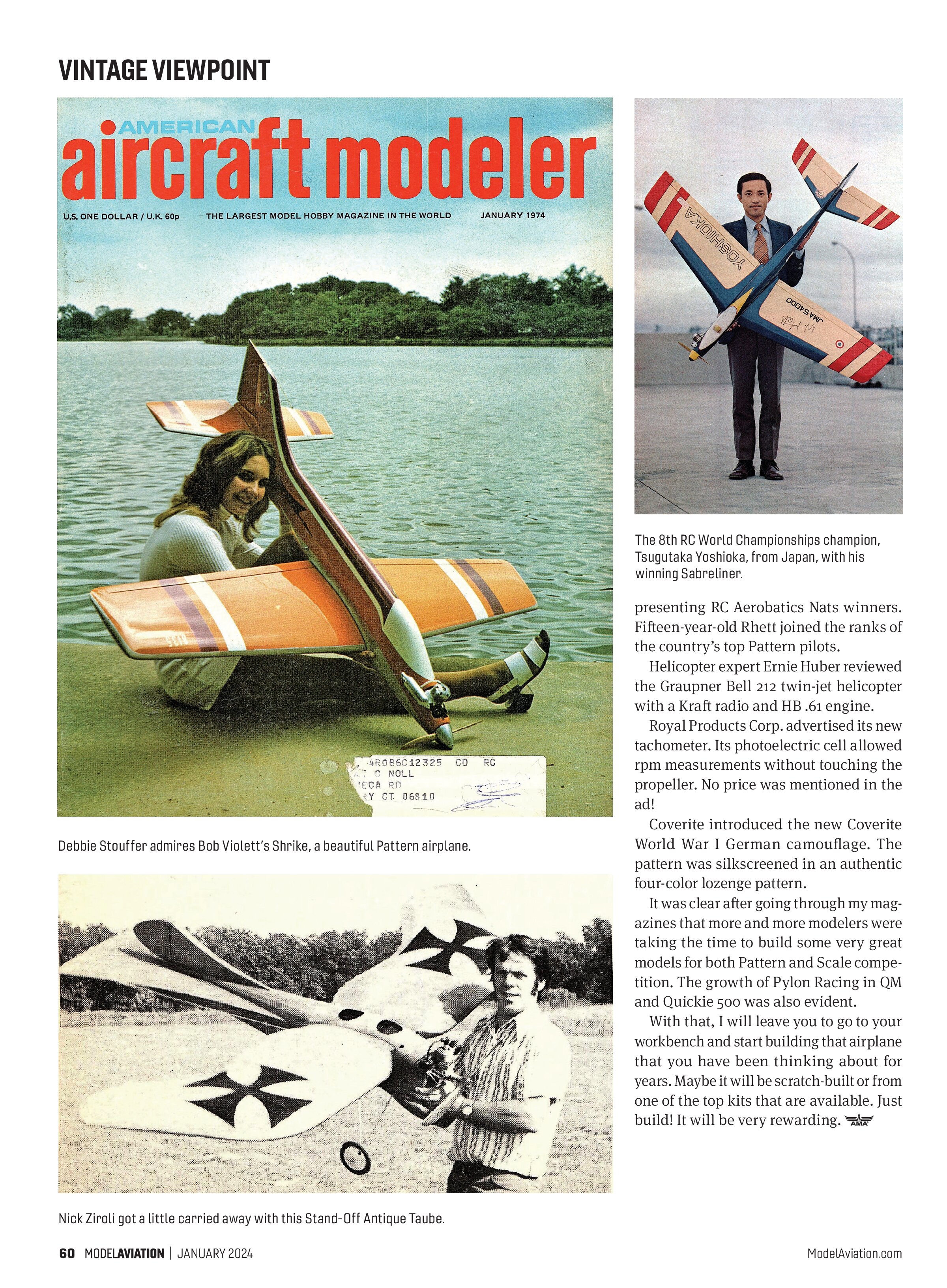
American Aircraft Modeler contained a construction article about the Shrike, Bob Violett’s Pattern aircraft. The Shrike featured a flying stabilizer, a thick fin for smoothness, and a nosewheel door that Bob stated added approximately 15 mph to the flying speed. The article contained a note that read, “This airplane is designed to be made in fiberglass. It does not lend itself to easy balsa fuselage construction.”
Gene Rock wrote an article about the Second Annual RC Helicopter Nats that was held at the Fond du Lac, Wisconsin, airport. Gene wrote that the contest was originally meant to be a set of precision maneuvers, but because of a lack of qualified judges, it was changed to a race against the clock in four events.
Having been the event director for three RC Aerobatics Nats, let me say that I would have been in deep trouble if I had made such a change. It was my job as the event director to get qualified judges. This was before contestant judging was implemented in Pattern.
Futaba introduced its FP-6DN six-channel radio system. The company’s ad stated that the FP-S5 servo was uniquely designed with Futaba custom engines and a three-wire, gold-plated 3P mini-connector for compactness, light weight, and powerful torque, with low power consumption. The FP-6DN with four servos was listed for $299.95. That would be slightly more than $1,800 today.
Sig Manufacturing Co. introduced the Sig Komander as an aileron trainer that didn’t look like a trainer. Designed by Claude McCullough for .35- to .50-cu. in. engines, it cost $29.95. That would be $186.52 in today’s market.
Quarter Midget (QM) Racing was gaining popularity, and more contests were occurring around the country. A QM association was formed within the National Miniature Pylon Racing Association.
Flying Models (FM) featured a construction article by Don Condon of the Piper Cherokee Arrow 200. This article contained a large collection of photos of the finished airplane but very few of the airplane under construction.
Neil Liptak published a report on the 1973 LSF Tournament. LSF stands for League of Silent Flight. The Special Interest Group’s annual tournament was held at Oxnard Air Force Base in California. There were 108 preregistered pilots; however, only 86 people competed. First place in Precision was Dave Shadel. Could that be the same Dave Shadel that was one of the best Formula I Pylon Racing pilots and one of the best engine men in the country?
Nick Ziroli had an article about his very large Taube. This Taube had a wingspan of 84 inches, an area of 1,260 sq. in., and weighed 8 pounds. It was powered by an O.S. Goldhead .60 engine.
The St. Paul Radio Club had a good turnout at its Scale Model Meet. Bud Atkinson took first place with his scratch-built Ryan. Bud had been a consistent winner in RC Scale for years.
Model Airplane News (MAN) had a great cover photo of Top Flite’s Sid Axelrod and the Span Aero J-3 Cub, which was an exact duplicate in MonoKote as the full-scale J-3 Cub shown at various air shows.
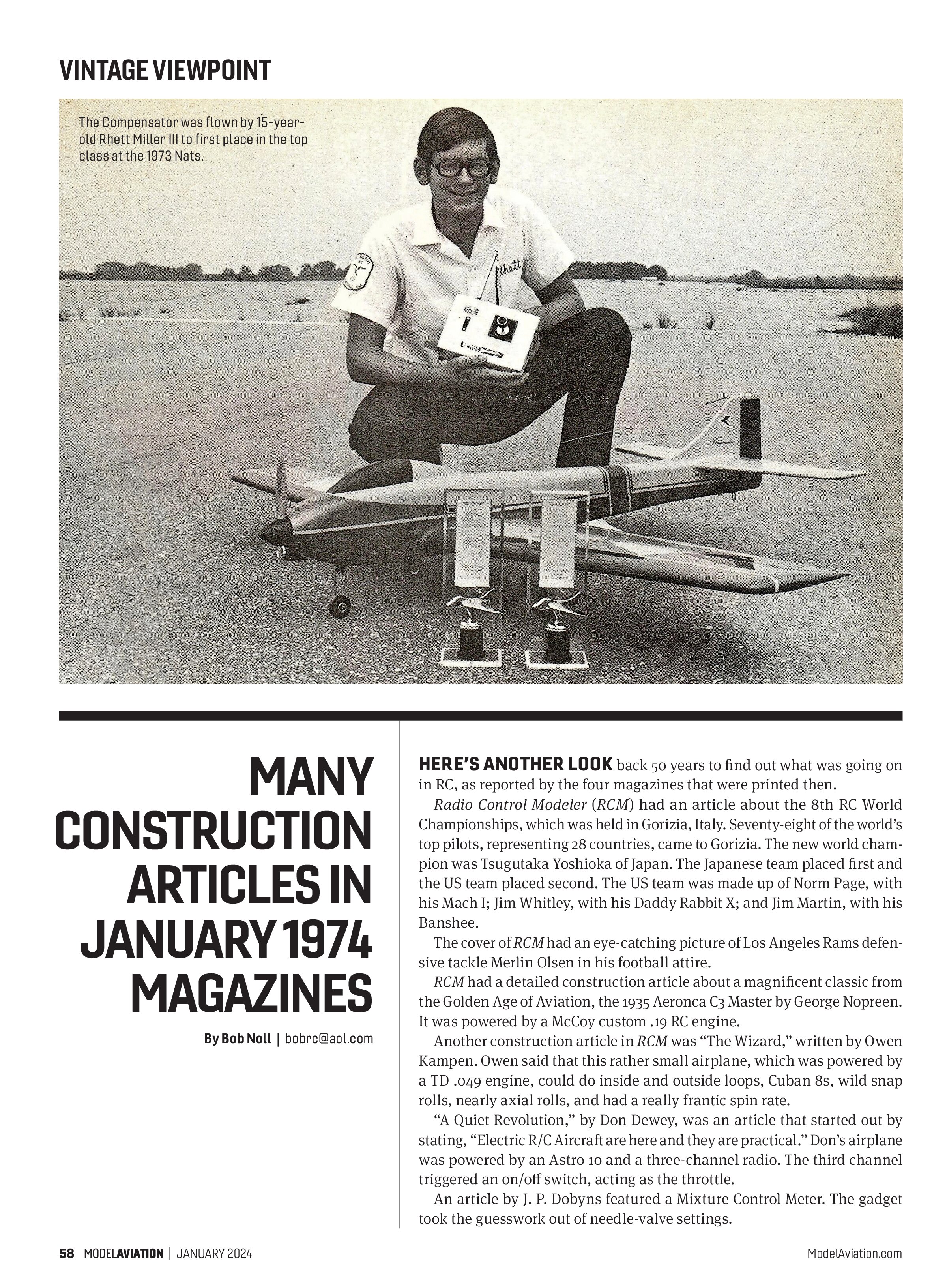
Rhett Miller III’s Compensator was published, continuing MAN’s policy of