SAFETY COMES FIRST
BURNIN’ RING O’ FIRE
By Dave Gee | safetycolumn@cs.com

EXPERIENCED MODELER Nick Miceli leads off with the following story:
“I have been charging batteries for about 5 years and never had an issue until now. I was removing a fully charged battery from my charger. The lead wire has multiple adapters. Suddenly, there was a flash and searing pain in my finger. A Deans connector that did not have a shield made contact with my wedding ring. The doctor said the third-degree burn would have been worse if the entire ring had melted, and I could have lost the finger. Needless to say, all bare connectors are now shielded.”
The photo that Nick sent was motivation enough to get me out of my chair to go double-check my charging setup. We sometimes forget just how much energy our model aircraft power systems can hold and what damage they could do if released in the wrong way. Workplaces with power tools or electrical equipment will often have rules against long hair and jewelry for just this reason.
Sadly, I no longer have the option of long hair (or any hair), but at least I can make sure to follow Nick’s advice and keep live electrical leads covered when not in use.
Pick a Plane, Any Plane
Mark Snowden sent me a harrowing close-call story. He wrote:
“When I was learning to fly at our club in Richmond, Virginia, my FM transmitter didn’t allow for a buddy box. When it was time to land, I handed the transmitter back to my instructor. Meanwhile, another pilot had flown his airplane close in beside mine. Both were high-wing, white planes. My instructor went to bank my plane for landing but picked the wrong plane. When it didn’t move, he banked the aileron over steeper. He was trying to fly the other airplane!
“I yelled, but in two seconds, my airplane dove hard into the ground. The engine was buried 6 inches in the soil and the fuselage was shattered. It was the only airplane the instructor ever destroyed. Even though he wasn’t obligated, he kindly replaced the fuselage with one from his own hangar. The wings and engine survived.
“I learned to announce my airplane’s location when switching controls between the instructor and student, especially when another airplane is nearby.”
It was fortunate that the only casualties were the model and the instructor’s pride! Good communication sure is important in our hobby. “Flying the wrong airplane” has been a popular mistake forever. It’s just one more thing to teach a newcomer as they begin their journey to safe and expert RC pilot status.
New T-Pins Get an A
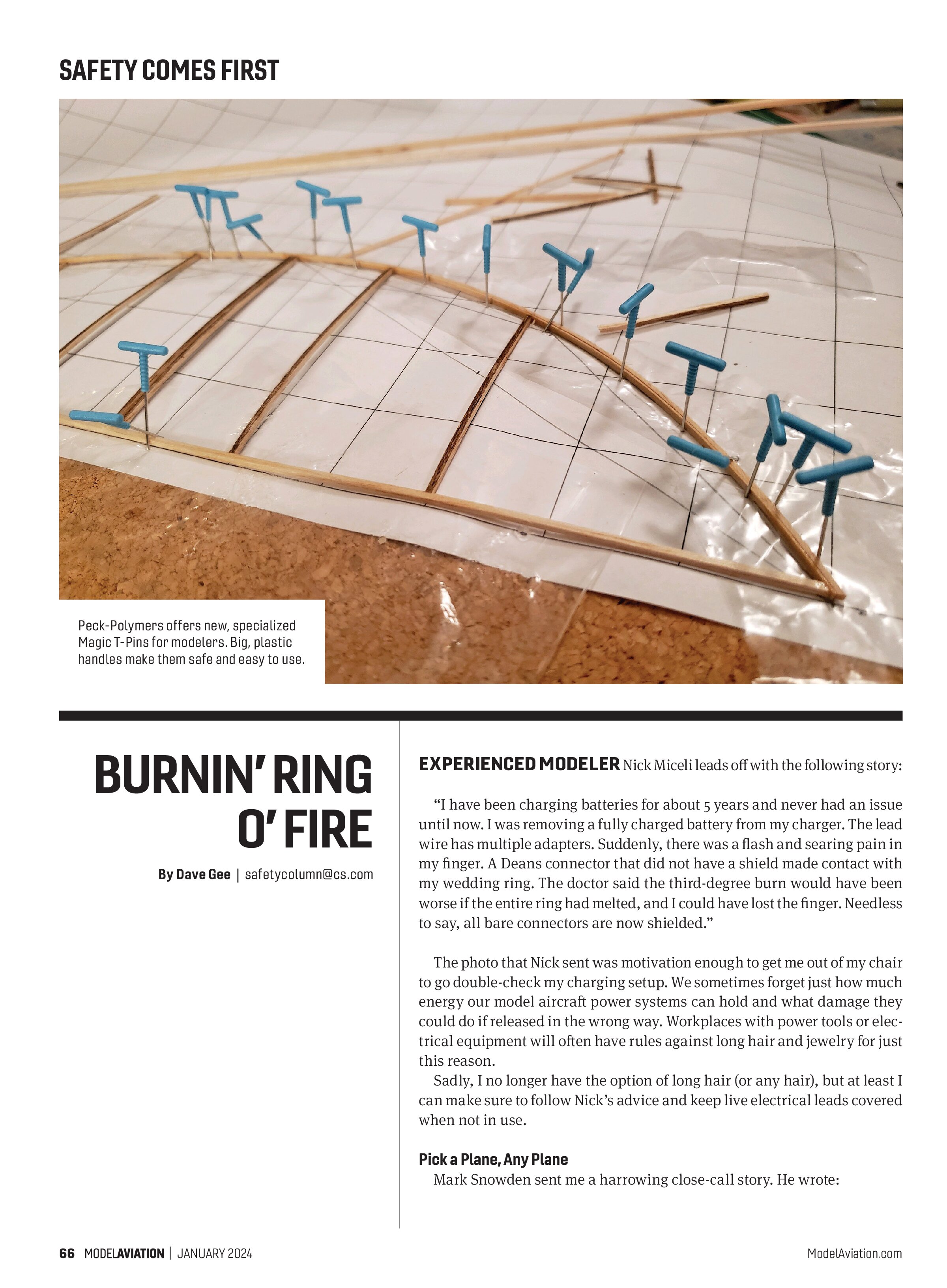
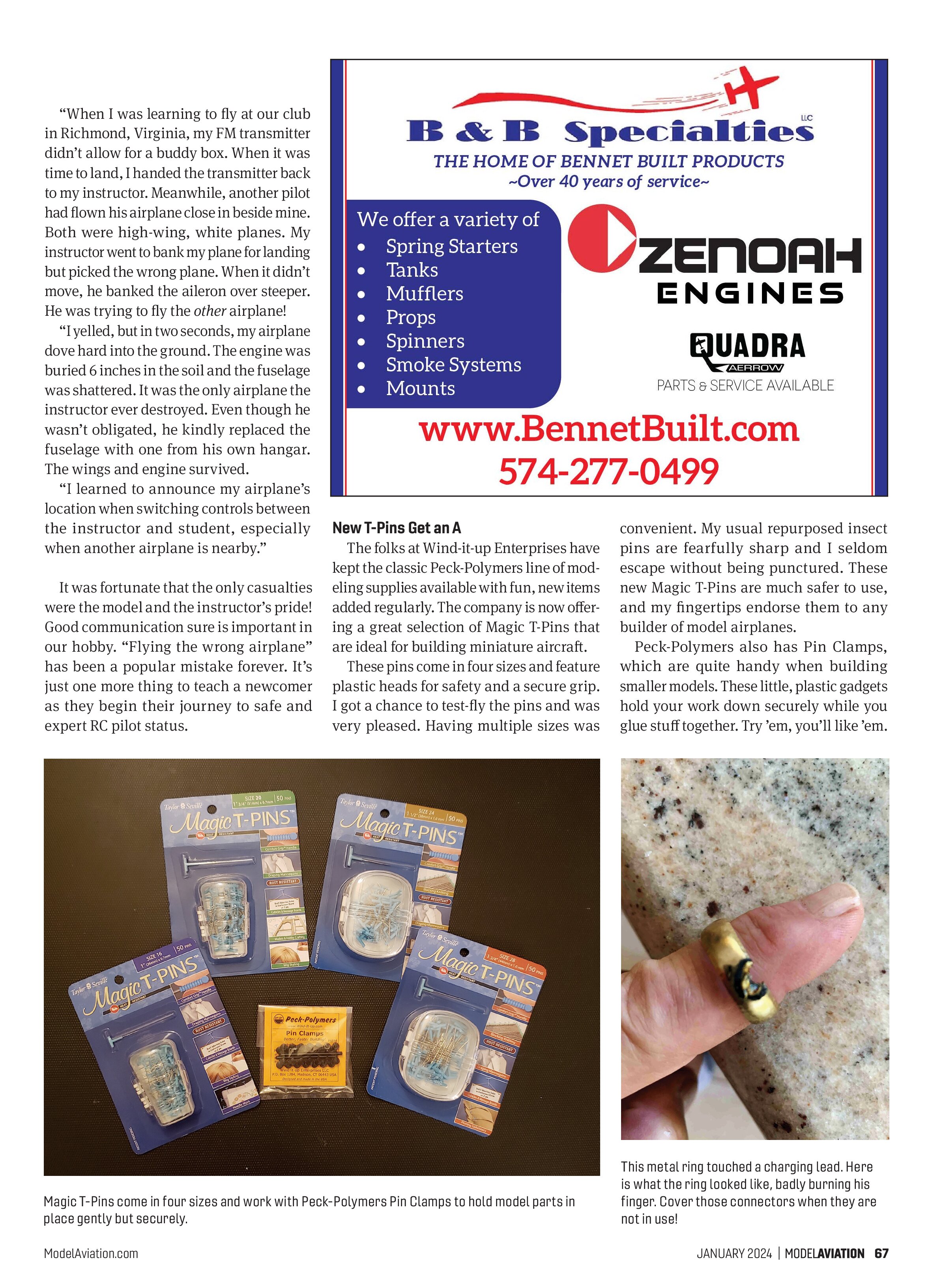
The folks at Wind-it-up Enterprises have kept the classic Peck-Polymers line of modeling supplies available with fun, new items added regularly. The company is now offering a great selection of Magic T-Pins that are ideal for building miniature aircraft. These pins come in four sizes and feature plastic heads for safety and a secure grip. I got a chance to test-fly the pins and was very pleased. Having multiple sizes was convenient. My usual repurposed insect pins are fearfully sharp and I seldom escape without being punctured. These new Magic T-Pins are much safer to use, and my fingertips endorse them to any builder of model airplanes.
Peck-Polymers also has Pin Clamps, which are quite handy when building smaller models. These little, plastic gadgets hold your work down securely while you glue stuff together. Try ’em, you’ll like ’em.


Nonstandard Standards
Safety standards in our sport have changed a lot over the years. Some things that were once considered okay are now banned or redesigned to protect the user. Certain modeling products that were sold when I was a kid could never be marketed today.
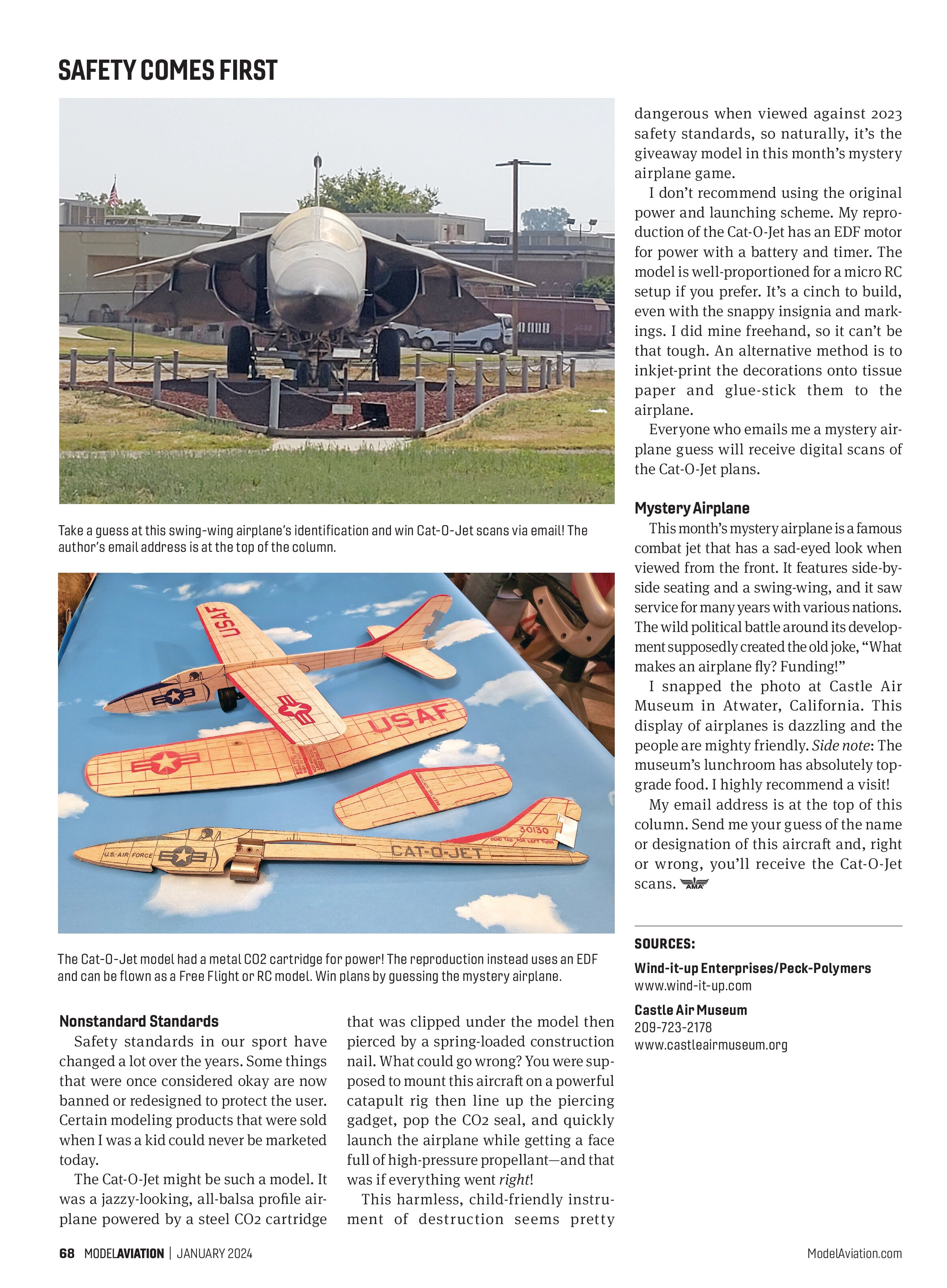
The Cat-O-Jet might be such a model. It was a jazzy-looking, all-balsa profile airplane powered by a steel CO2 cartridge that was clipped under the model then pierced by a spring-loaded construction nail. What could go wrong? You were supposed to mount this aircraft on a powerful catapult rig then line up the piercing gadget, pop the CO2 seal, and quickly launch the airplane while getting a face full of high-pressure propellant—and that was if everything went right!
This harmless, child-friendly instrument of destruction seems pretty dangerous when viewed against 2023 safety standards, so naturally, it’s the giveaway model in this month’s mystery airplane game.
I don’t recommend using the original power and launching scheme. My reproduction of the Cat-O-Jet has an EDF motor for power with a battery and timer. The model is well-proportioned for a micro RC setup if you prefer. It’s a cinch to build, even with the snappy insignia and markings. I did mine freehand, so it can’t be that tough. An alternative method is to inkjet-print the decorations onto tissue paper and glue-stick them to the airplane.
Everyone who emails me a mystery airplane guess will receive digital scans of the Cat-O-Jet plans.
Mystery Airplane
This month’s mystery airplane is a famous combat jet that has a sad-eyed look when viewed from the front. It features side-by-side seating and a swing-wing, and it saw service for many years with various nations. The wild political battle around its development supposedly created the old joke, “What makes an airplane fly? Funding!”
I snapped the photo at Castle Air Museum in Atwater, California. This display of airplanes is dazzling and the people are mighty friendly. Side note: The museum’s lunchroom has absolutely top-grade food. I highly recommend a visit!
My email address is at the top of this column. Send me your guess of the name or designation of this aircraft and, right or wrong, you’ll receive the Cat-O-Jet scans.
SOURCES:
Wind-it-up Enterprises/Peck-Polymers
www.wind-it-up.com
Castle Air Museum
209-723-2178
www.castleairmuseum.org