Around the Patch
HIGHLIGHTS OF THE NEAT FAIR
By Thayer Syme | thayer@flying-models.com
COUNTLESS MODELERS throughout the northeastern US and eastern Canada look forward to the Northeast Electric Aircraft Technology (NEAT) Fair for much of the year. Held in the Catskills of New York in mid-September, NEAT is as much a closely knit family reunion as it is a model airplane event.
This year was the 24th annual congregation of the NEAT Fair faithful, and like any large gathering with something for everyone, we all leave with a few personal highlights to define our own visits. I enjoy building just as much as flying, so I typically seek out unusual projects crafted by other like-minded modelers. Once again, this year did not disappoint.
The NEAT Fair is too large for one person to cover, so I won’t even try. What I will do, however, is recap my own highlights and refer you to Captain Joe Malinchak’s “Micro-Flying” column in this same issue.
Captain Joe not only organizes the indoor evenings at the nearby Downsville Central School gym, but he also builds some of the finest micro models around and has selflessly answered every question I’ve ever seen tossed his way.
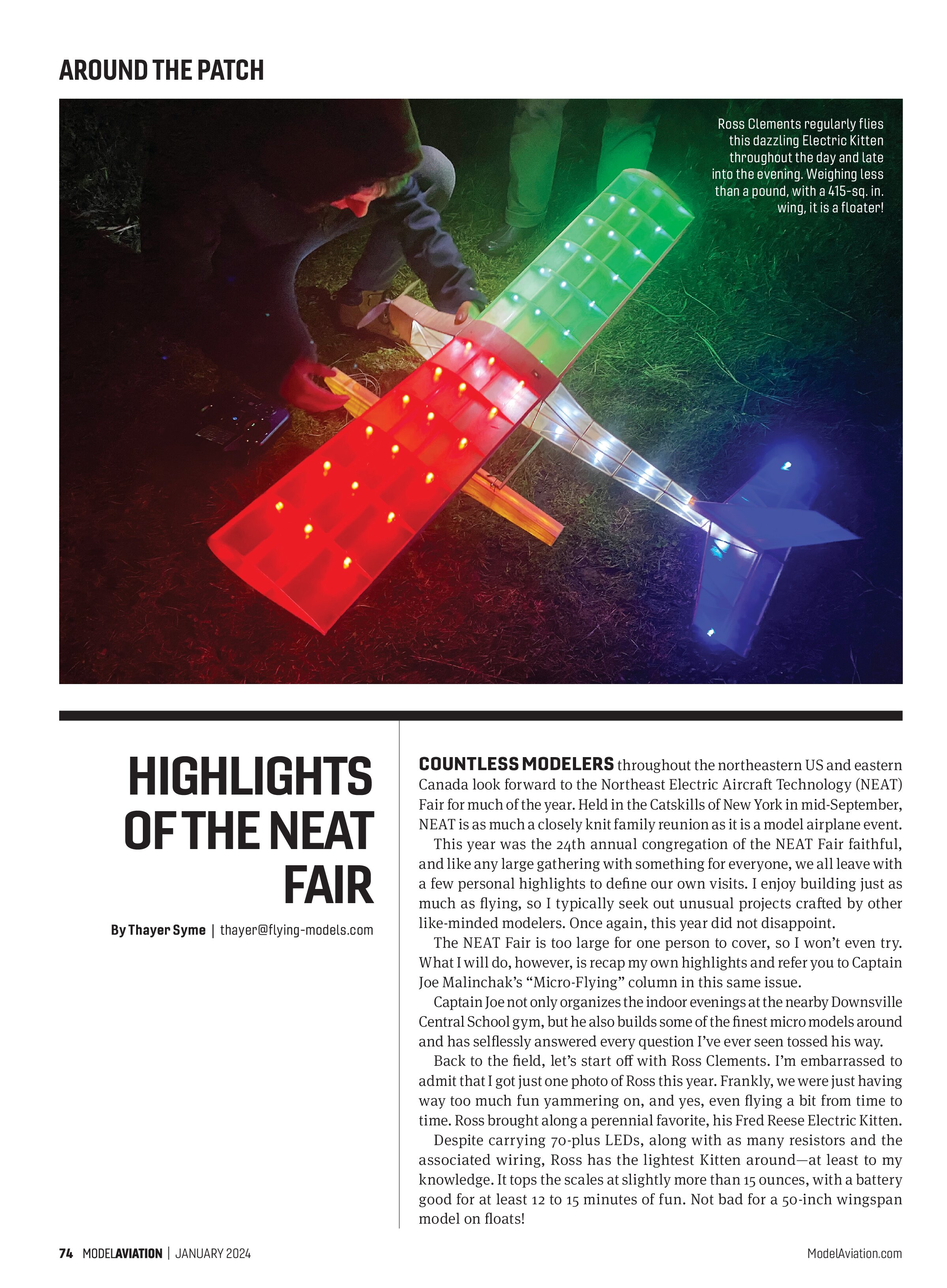
Back to the field, let’s start off with Ross Clements. I’m embarrassed to admit that I got just one photo of Ross this year. Frankly, we were just having way too much fun yammering on, and yes, even flying a bit from time to time. Ross brought along a perennial favorite, his Fred Reese Electric Kitten.
Despite carrying 70-plus LEDs, along with as many resistors and the associated wiring, Ross has the lightest Kitten around—at least to my knowledge. It tops the scales at slightly more than 15 ounces, with a battery good for at least 12 to 15 minutes of fun. Not bad for a 50-inch wingspan model on floats!

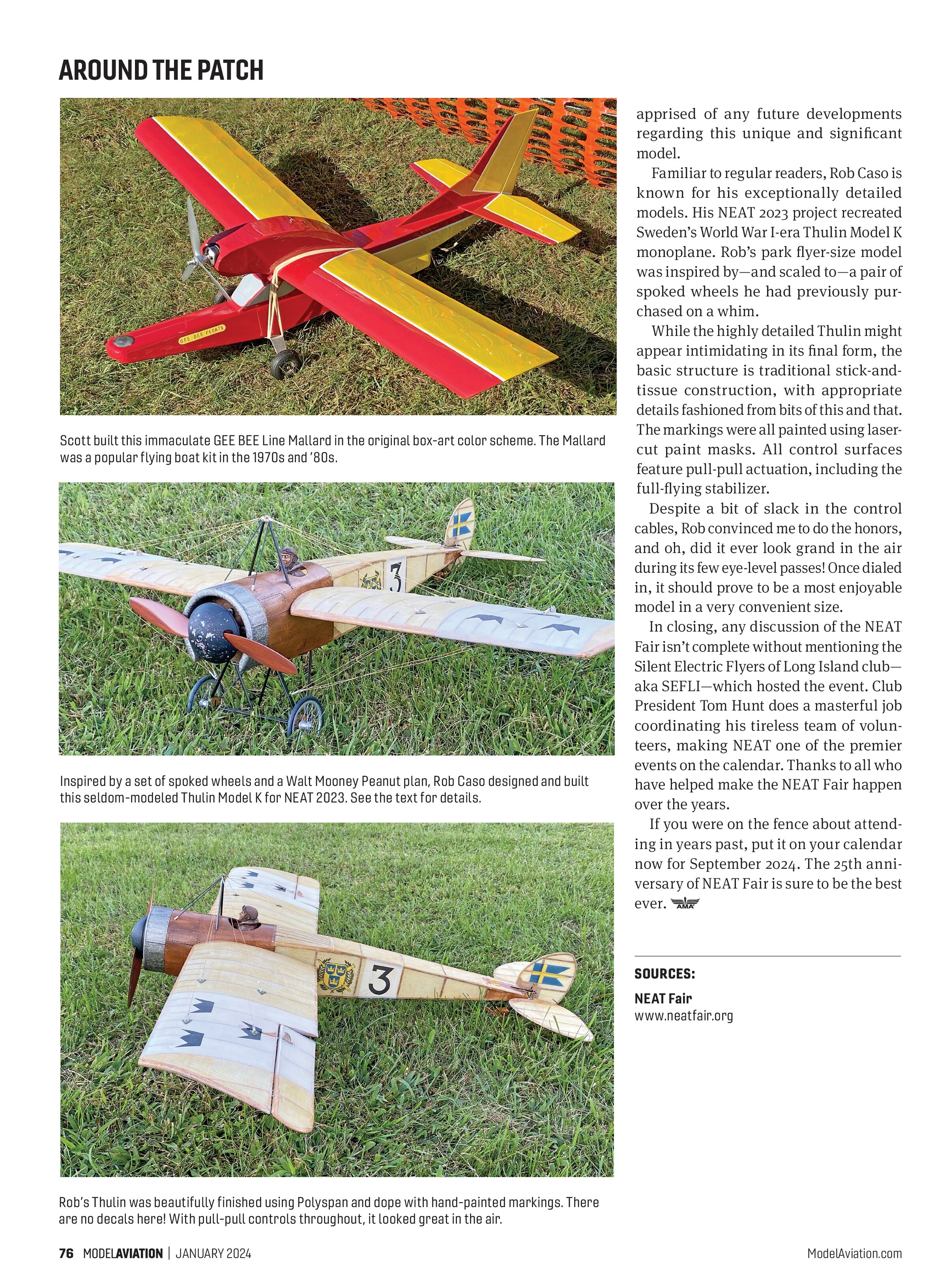
Scott Copeland is no stranger to southern New England connoisseurs of flightline craftsmanship. Among the rest of his fleet, two models in particular caught my eye this time around. First was an old friend, the GEE BEE Line Mallard.
A popular flying boat kit in the late 1970s and early ‘80s, the Mallard still turns up from time to time at swap meets and is worth a close look. It features a traditional sheet balsa cabin structure bonded to the deck of a molded plastic float. The conventional wing and tail group then mount to the cabin, giving a very convincing impression of a potential full-scale aircraft.
Scott duplicated the box art color scheme on his model. Taking another nod from the label, he also added removable landing gear, allowing operation from a hard runway, as well as from water and snow, making it a true “Tri-Phibian” (sic).
I’ve also built a GEE BEE Line Mallard, although it was years ago while I was still in high school. Rest assured, it was not nearly as nice as Scott’s version, although it did fly well before being struck from my inventory at a family yard sale several years later.
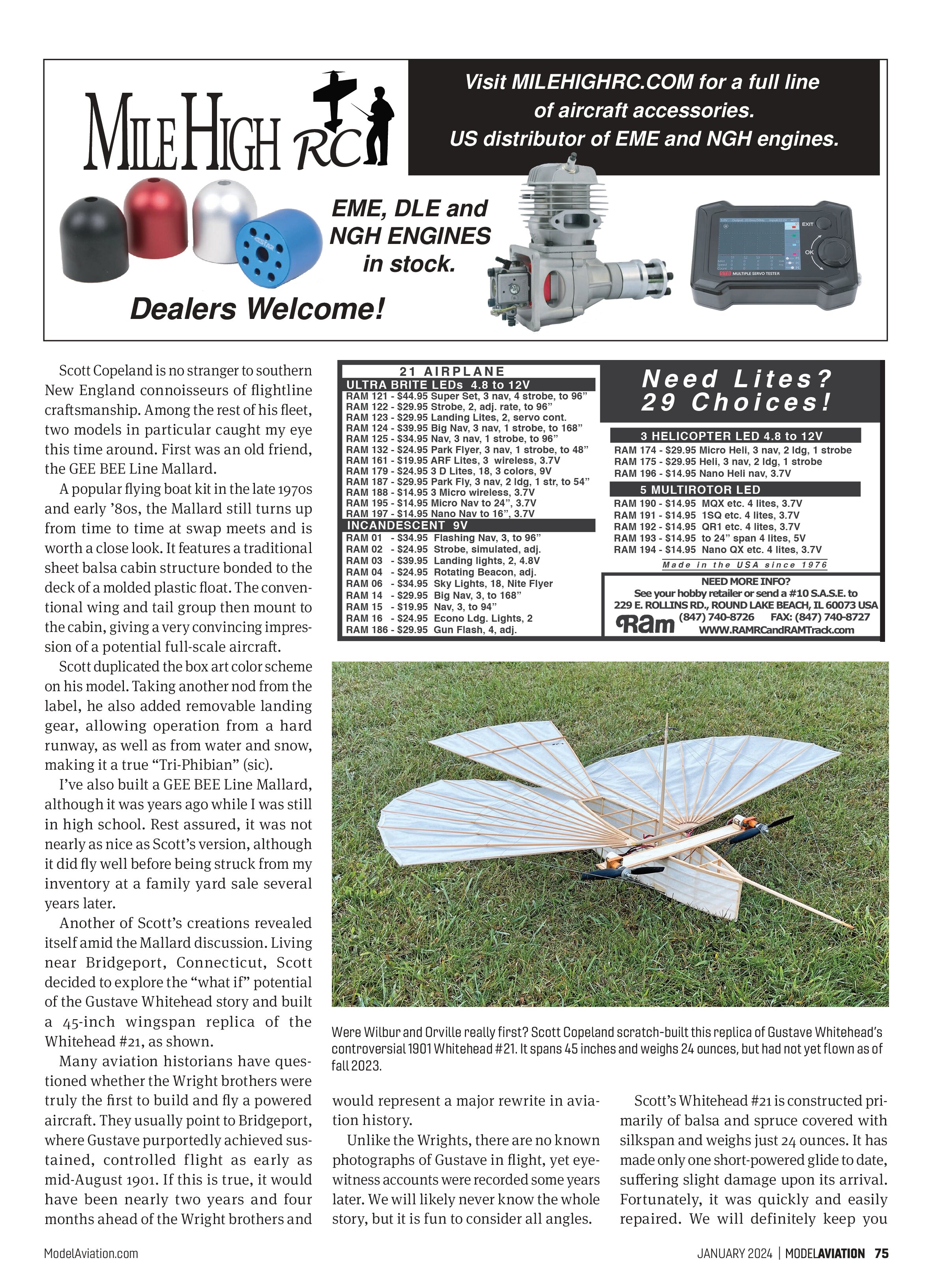
Another of Scott’s creations revealed itself amid the Mallard discussion. Living near Bridgeport, Connecticut, Scott decided to explore the “what if” potential of the Gustave Whitehead story and built a 45-inch wingspan replica of the Whitehead #21, as shown.
Many aviation historians have questioned whether the Wright brothers were truly the first to build and fly a powered aircraft. They usually point to Bridgeport, where Gustave purportedly achieved sustained, controlled flight as early as mid-August 1901. If this is true, it would have been nearly two years and four months ahead of the Wright brothers and would represent a major rewrite in aviation history.
Unlike the Wrights, there are no known photographs of Gustave in flight, yet eyewitness accounts were recorded some years later. We will likely never know the whole story, but it is fun to consider all angles.

Scott’s Whitehead #21 is constructed primarily of balsa and spruce covered with silkspan and weighs just 24 ounces. It has made only one short-powered glide to date, suffering slight damage upon its arrival. Fortunately, it was quickly and easily repaired. We will definitely keep you


apprised of any future developments regarding this unique and significant model.
Familiar to regular readers, Rob Caso is known for his exceptionally detailed models. His NEAT 2023 project recreated Sweden’s World War I-era Thulin Model K monoplane. Rob’s park flyer-size model was inspired by—and scaled to—a pair of spoked wheels he had previously purchased on a whim.
While the highly detailed Thulin might appear intimidating in its final form, the basic structure is traditional stick-and-tissue construction, with appropriate details fashioned from bits of this and that. The markings were all painted using laser-cut paint masks. All control surfaces feature pull-pull actuation, including the full-flying stabilizer.
Despite a bit of slack in the control cables, Rob convinced me to do the honors, and oh, did it ever look grand in the air during its few eye-level passes! Once dialed in, it should prove to be a most enjoyable model in a very convenient size.
In closing, any discussion of the NEAT Fair isn’t complete without mentioning the Silent Electric Flyers of Long Island club—aka SEFLI—which hosted the event. Club President Tom Hunt does a masterful job coordinating his tireless team of volunteers, making NEAT one of the premier events on the calendar. Thanks to all who have helped make the NEAT Fair happen over the years.
If you were on the fence about attending in years past, put it on your calendar now for September 2024. The 25th anniversary of NEAT Fair is sure to be the best ever.
SOURCES:
NEAT Fair
www.neatfair.org