2024 NATS, IRCHA JAMBOREE, AND WORLD CHAMPIONSHIPS SCHEDULE
ON THURSDAY, October 5, 2023, the Executive Council voted and approved the 2024 Nats, International Radio Controlled Helicopter Association (IRCHA) Jamboree, FAI Control Line (CL) F2ACD World Cup, and F2 World Championships dates.
The approved dates are as follows:
RC Combat: July 7-9
RC Pylon Racing: 7-12
RC/CL Scale: July 11-14
RC Scale Aerobatics: July 16-19
RC Soaring: July 20-28
Outdoor Free Flight: July 22-26
RC Aerobatics: July 29-August 2
RC Helicopters: August 4-7
CL (all disciplines): August 4-9
IRCHA Jamboree: August 7-11
F2ACD CL World Cup: August 8-9
F2 CL World Championships: August 11-17
Online registration will begin on February 1, 2024. If you have questions about participating in the 2024 AMA Nats, please email nats@modelaircraft.org.
AMA’S WEEKLY NEWSLETTER, AMA THIS WEEK
By Rob Kurek, AMA Director of Communications | rkurek@modelaircraft.org

AMA THIS WEEK is AMA’s first weekly newsletter. Launched on June 28, 2022, AMA This Week replaced three biweekly electronic newsletters.
The intent was to consolidate the newsletters into one weekly communication to members. AMA This Week carries a variety of stories, including organizational news, hobby and industry information, links to Model Aviation pieces, and video content from various sources. There is no additional cost to AMA members to subscribe.
Members can subscribe to and read past issues by visiting www.modelaircraft.org/newsletters/ama-this-week. All of our newsletters are archived at www.modelaircraft.org. Simply search in the “Media and Resources” menu bar tab.
In addition to stories, AMA This Week offers dynamic content, including pieces that are tailored to members who are interested in RC, Control Line, and/or Free Flight. The content is based on how members have set up their account profile by indicating discipline preferences in our association management system through the AMA website. Those who have not declared a specific discipline interest still receive a story that is internally classified as “general.” These stories could often apply to multiple disciplines.
Dynamic content offers a way to personalize each member’s experience. Every member can open their profile on the AMA website and change their interest categories at any time. Anyone seeking help to do so can contact the AMA Membership department by emailing membership@modelaircraft.org or calling (765) 287-1256, ext. 129.
“We felt the time had come to reduce the number of newsletters and offer members one source of information provided weekly,” noted the newsletter editor, Rob Kurek. “This way, we could include more timely news in a way that only social media could surpass. The intent is to provide important organizational news, informative pieces about AMA benefits and programs, and entertaining stories and contests.”
AMA This Week is your weekly newsletter. If you would like to contact the newsletter editor, you can do so at rkurek@modelaircraft.org. We’d love to hear from you about what we can do to improve it.
AMA Thanks Its Lifetime Supporters!
The Academy of Model Aeronautics recently welcomed Life Members Brady C. Ornat, Wakarusa IN; Joey B. Jones, Columbus MS; Victor Speers, Independence MO; and Gene McKay, Kilmarnock VA.
For information about becoming a Life Member, contact AMA Headquarters at (765) 287-1256, ext. 129.
—AMA Membership department
EVERYTHING YOU NEED TO KNOW ABOUT THE 2024 HEAVY LIFT CHALLENGE
By Kyle Thede, AMA Education Specialist | kyle t@modelaircraft.org
IF YOU’RE A JUNIOR HIGH or high school student who is looking for a good way to stay busy with a model aviation project this coming spring, or one who is newer to model aviation and wondering about the best ways to proceed from your beginner phase, registration is now open for the 2024 AMA Heavy Lift Challenge! Last year, the AMA Education team was thrilled to see a 300% increase in participation with this exciting program, and we can’t wait to see the entries for this year!
The challenge itself is straightforward. Your team will assist with local wildfire response efforts by modifying a Horizon Hobby S 2 1.1 AeroScout to deliver as much water as possible. To accomplish this, you will need to make engineering changes to the airframe itself, as well as a robust, removable payload delivery mechanism.
Although these parameters are relatively simple, the Heavy Lift Challenge will simultaneously develop you and your teammates in three areas:
- Flying Skills: Whether you’ve just gotten the hang of solo flight (complete with takeoffs and landings, of course) or are more experienced, learning how to maneuver a uniquely equipped and modified aircraft will put you to the test in a new way.
- Meteorology: To have the greatest success in the event, you will need to carefully measure and monitor atmospheric variables, such as humidity, barometric pressure, and wind, and account for them in your design and flying.
- Engineering: Designing a mechanism for lifting the heaviest payload, while simultaneously keeping your aircraft safe, aerodynamic, and controllable, might be a more demanding task than it first appears.
All registrants must be AMA members. If you’re not already a member, joining is quick and easy at www.modelaircraft.org/membership/enroll. You and all of your teammates will be automatically enrolled in our Ground School course upon registration, so even if you are totally new to model aviation, you will have all of the educational and safety resources that you need to succeed at your disposal! Completion of the Ground School course is mandatory prior to the competition.
Teams will consist of two to four individuals in grades 6-12 and must be sponsored by an assigned adult member. After you’ve registered, your team will receive a detailed rulebook laying out the specifics of the challenge and you are encouraged to begin designing, engineering, and testing whenever possible! Some of the best parts of the Heavy Lift Challenge are the ones that aren’t in the rules! Teams are informed of a goal, a deadline, and type of aircraft to use, but everything else involved with the contest is extremely open-ended:
- Rather than listing a long set of dates and milestones to work around, teams have the flexibility to meet as often as necessary on self-determined schedules that work for the team members!
- Unlike similar programs, such as UAS4STEM (Sponsored by Skydio), there is no travel required for the Heavy Lift Challenge. Testing and flying sites are completely at the team’s discretion, allowing for the best possible familiarity with the environment and no last-minute surprises. We like to think of the Heavy Lift Challenge as a competition in which every team has a homefield advantage!
- This flexibility gives team members the ability to develop leadership and organizational skills and provides room to share responsibilities in ways that best benefit the team.
The $199 registration fee includes access to the Ground School curriculum; however, the purchase of the required AeroScout model is not included in the cost of registration. Registration for the AMA Heavy Lift Challenge closes on April 1, 2024.
Of course, this is a competition with prizes as well! Prize money up to $10,000 is available, with the award amounts for first, second, third, etc., to be determined based on registration turnout. The more teams that compete, the better!
The Heavy Lift Challenge is a unique program among AMA’s educational materials and STE(A)M programs overall! We have great expectations for this year’s season and hope you are just as excited as we are!
If you have any questions, reach out to the AMA Education team by emailing education@modelaircraft.org. We’re happy to help! We’re very much looking forward to seeing who rises to meet the 2024 Heavy Lift Challenge!

A WORKGROUP was recently created on behalf of the AMA Safety Committee to establish rules and procedures to safely operate large model helicopters (LMH) and large model turbine helicopters (LMTH). The AMA Large Model Aircraft Program has been around for several years, but it didn’t encompass model rotorcraft, and the AMA Safety Committee had been receiving an increasing number of waiver requests to operate large model helicopters at AMA fields and sanctioned events.
Following is a quick background on why this is required. When flying a recreational UAS, FAA rules state the following: “A person may operate an unmanned aircraft weighing more than 55 pounds, including
the weight of anything attached to or carried by the aircraft, under subsection (a) if—(A), the unmanned aircraft complies with standards and limitations developed by a community-based organization and
approved by the Administrator; and (B), the aircraft is operated from a fixed site as described in FAA section 349, paragraph C, Sections 1 & 2.”
Legally, this means that in order to operate a recreational model that exceeds a 55-pound takeoff weight, it must be


certified through a safety program administered by a community-based organization (CBO) and operated from a designated, fixed site. It’s also important to note that in order to be covered under this rule, the CBO’s safety program must be reviewed and approved by the FAA.
The LMH and LMTH are further subdivided into two weight classes called Categories 1 and 2. An LMH-1 model weighs between 55 and 77 pounds, 2 ounces, and an LMH-2 model weighs between 77 pounds, 3 ounces, and 125 pounds. These seemingly random weight limits are a result of conversions from the FAI international weight standards of 25 and 35 kilograms, respectively.
Large helicopter models are nothing new in Europe, and the demand in the US has been rising to allow European pilots to fly here. Additionally, seeing such amazing models at our events has naturally made our pilots request a program to own and operate large models in the US. The subcommittee used the European requirements as a starting point for the AMA program.
The full documentation is available on the AMA website at www.modelaircraft.org. They can be found by visiting the Media & Resources tab, followed by AMA Documents, and finally, the “Large Model Aircraft Program” header. These should be reviewed in detail by any potential LMH owner/pilot.
LMH paperwork is required to be filed any time there is a new LMH model or when an LMH model is repaired from damage or materially modified, and the paperwork must be renewed every 3 years or when ownership is changed. When paperwork is completed, it must be sent to AMA Headquarters within 30 days, along with the $25 application fee. After all documentation is verified and recorded, the pilot will receive documentation that the aircraft is approved. This registration is good for 3 years and must be renewed prior to the given expiration date.
LMH-1 models that are built from a commercially available kit can be inspected and certified by the builder/owner of the model. The weigh-in and test flights need to be witnessed and signed off by an AMA Leader Member, contest director (CD), or LMH inspector. For LMH-2 models, the
weight, inspection, and flight demonstrations must be witnessed by an AMA-credentialed LMH inspector.
Scratch-built models need to follow the same guidelines, but the model needs to have an additional 10 hours of test and developmental flight time without a mishap to prove the design before it can be certified to fly at events or in front of spectators. Turbine-powered model helicopters follow the same weight requirements as non-turbine-powered helicopters.
Pilot Requirements
To fly an LMH-1 model, a pilot must have a minimum of 50 flights with a model helicopter that has a dry weight of 25 pounds or greater. An LMH-2 pilot must have a minimum of 50 flights with a model that has a dry weight of 40 pounds or greater. Additionally, in order to fly a turbine-powered LMTH helicopter, the pilot needs to be a current holder of a rotary turbine waiver.


Flight Requirements
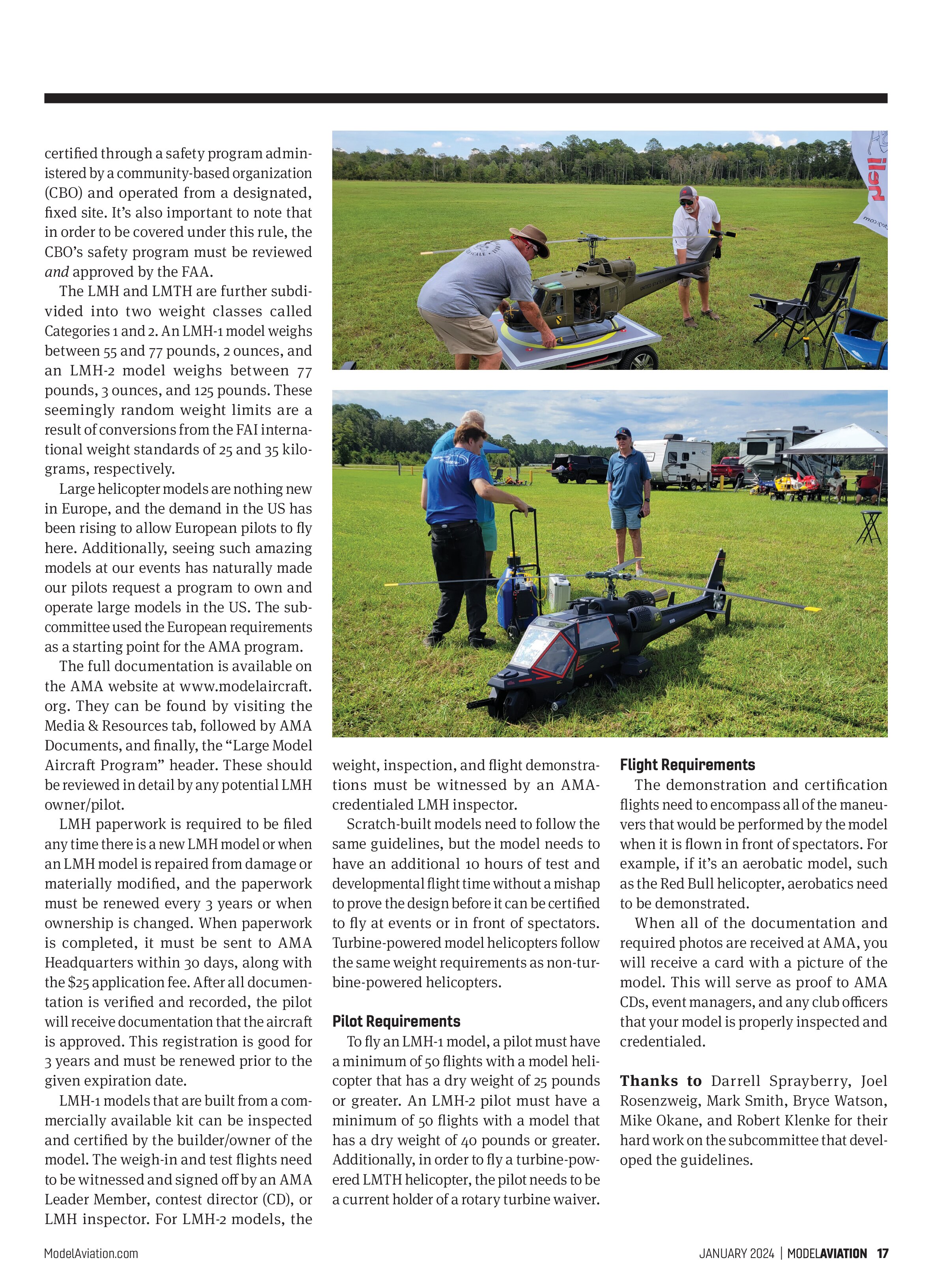
The demonstration and certification flights need to encompass all of the maneuvers that would be performed by the model when it is flown in front of spectators. For example, if it’s an aerobatic model, such as the Red Bull helicopter, aerobatics need to be demonstrated.
When all of the documentation and required photos are received at AMA, you will receive a card with a picture of the model. This will serve as proof to AMA CDs, event managers, and any club officers that your model is properly inspected and credentialed.
Thanks to Darrell Sprayberry, Joel Rosenzweig, Mark Smith, Bryce Watson, Mike Okane, and Robert Klenke for their hard work on the subcommittee that developed the guidelines.
SOMETIMES IDEAS or general topics for the articles that I write for this column come from brainstorming sessions (either on my own or with coworkers) or from suggestions by readers. I’ve been keeping a Word document of those ideas—a document now at roughly seven pages in length!
I can’t tell you how many times I’ve started an article for this column with one idea but changed paths midstream because there was too little information to make a complete piece. Those ideas don’t go to waste. They go into the Word document!
For this month’s column, I thought I’d pull a few of those smaller ideas—just because they don’t make an entire article doesn’t make them unworthy of a place here. Sometimes, it’s the little things that count.
A Brief History of “History Preserved”
The National Model Aviation Museum’s “History Preserved” column has been a part of the “In the Air” section of this magazine for roughly 13 years. Before then, the museum still produced material for the magazine, but this particular column began with the February 2010 issue and has been going strong ever since (give or take a few issues where we took a pause or limited magazine space bumped us to the next issue).
Museum staff and even some museum interns have written articles for the column. The first article for “History Preserved” was written by the museum’s registrar at the time, Maria VanVreede, and focused on Dr. Walt Good’s 1978 donation of his Kurwi Radio Control model sailplane. (A description and images of the Kurwi can be found in the museum’s Digital Collections at https://modelaircraft.pastperfectonline.com. Use “Kurwi” in the keyword search to find it.) If I’m counting right, this will be the museum’s 159th “History Preserved” column. That’s a lot of writing!
By the time you read this, an index of “History Preserved” articles from 2010 to 2023 will be linked in the “History Hub” section of the AMA History Project page at www.modelaircraft.org/museum/history-recognition/ama-history-project. You can read some of our early “History Preserved” articles in the Model Aviation Digital Library at https://library.ModelAviation.com.
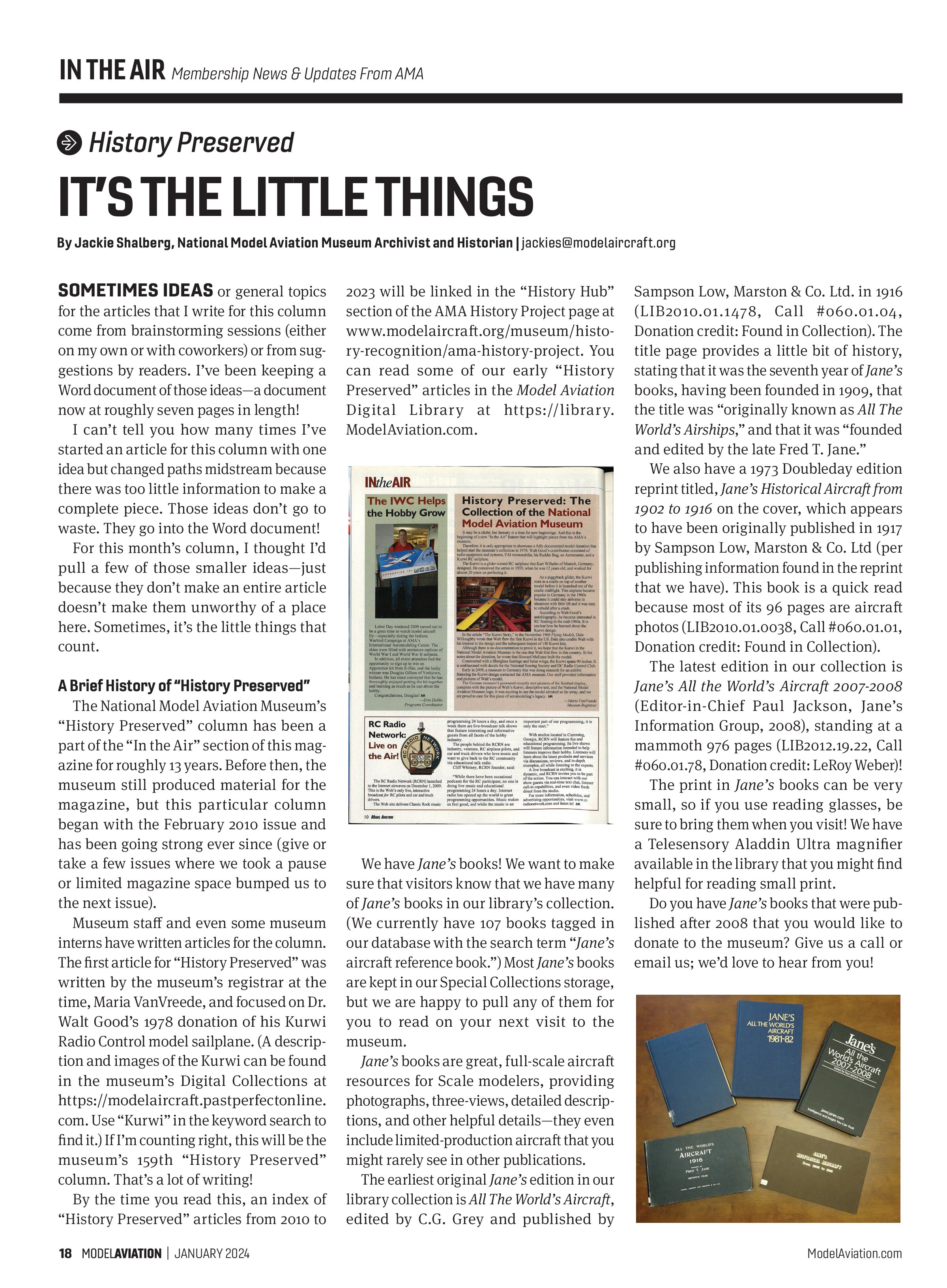
We have Jane’s books! We want to make sure that visitors know that we have many of Jane’s books in our library’s collection. (We currently have 107 books tagged in our database with the search term “Jane’s aircraft reference book.”) Most Jane’s books are kept in our Special Collections storage, but we are happy to pull any of them for you to read on your next visit to the museum.
Jane’s books are great, full-scale aircraft resources for Scale modelers, providing photographs, three-views, detailed descriptions, and other helpful details—they even include limited-production aircraft that you might rarely see in other publications.
The earliest original Jane’s edition in our library collection is All The World’s Aircraft, edited by C.G. Grey and published by Sampson Low, Marston & Co. Ltd. in 1916 (LIB2010.01.1478, Call #060.01.04, Donation credit: Found in Collection). The title page provides a little bit of history, stating that it was the seventh year of Jane’s books, having been founded in 1909, that the title was “originally known as All The World’s Airships,” and that it was “founded and edited by the late Fred T. Jane.”
We also have a 1973 Doubleday edition reprint titled, Jane’s Historical Aircraft from 1902 to 1916 on the cover, which appears to have been originally published in 1917 by Sampson Low, Marston & Co. Ltd (per publishing information found in the reprint that we have). This book is a quick read because most of its 96 pages are aircraft photos (LIB2010.01.0038, Call #060.01.01, Donation credit: Found in Collection).
The latest edition in our collection is Jane’s All the World’s Aircraft 2007-2008 (Editor-in-Chief Paul Jackson, Jane’s Information Group, 2008), standing at a mammoth 976 pages (LIB2012.19.22, Call #060.01.78, Donation credit: LeRoy Weber)!
The print in Jane’s books can be very small, so if you use reading glasses, be sure to bring them when you visit. We have a Telesensory Aladdin Ultra magnifier available in the library that you might find helpful for reading small print.
Do you have Jane’s books that were published after 2008 that you would like to donate to the museum? Give us a call or email us; we’d love to hear from you!


Periodical Humor
I process all of our library donations, and sometimes figuring out the volume number, issue number, month, year (or other type of dating structure of a magazine or newsletter), or determining their variable publication patterns and naming conventions, can be quite a chore. Typographical errors, lack of editorial time, or lack of necessity at the time of creation can lead to issues being misdated, misnumbered, or misnamed, or they’re missing any dates/numbers/names completely.
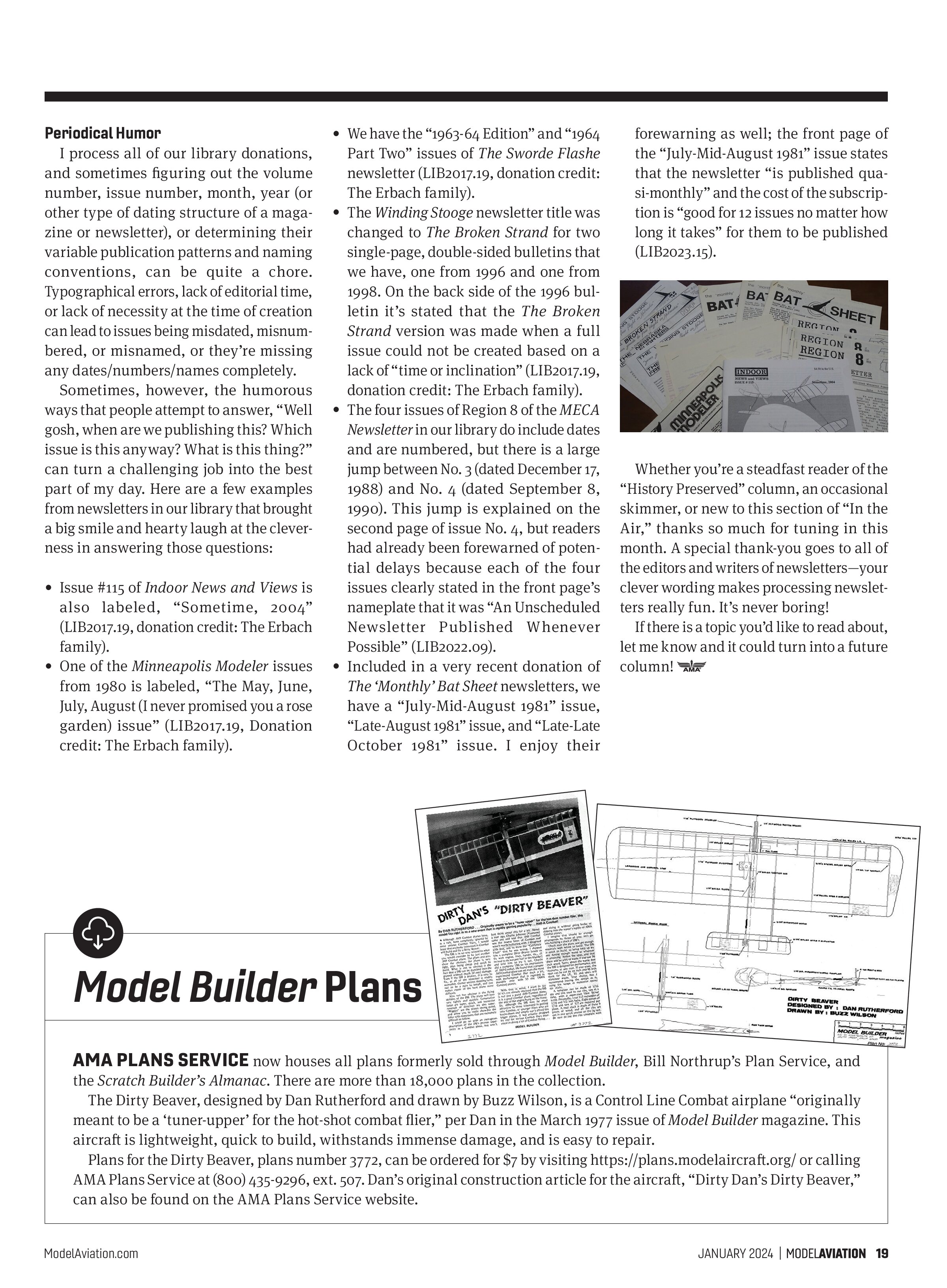
Sometimes, however, the humorous ways that people attempt to answer, “Well gosh, when are we publishing this? Which issue is this anyway? What is this thing?” can turn a challenging job into the best part of my day. Here are a few examples from newsletters in our library that brought a big smile and hearty laugh at the cleverness in answering those questions:
- Issue #115 of Indoor News and Views is also labeled, “Sometime, 2004” (LIB2017.19, donation credit: The Erbach family).
- One of the Minneapolis Modeler issues from 1980 is labeled, “The May, June, July, August (I never promised you a rose garden) issue” (LIB2017.19, Donation credit: The Erbach family).
- We have the “1963-64 Edition” and “1964 Part Two” issues of The Sworde Flashe newsletter (LIB2017.19, donation credit: The Erbach family).
- The Winding Stooge newsletter title was changed to The Broken Strand for two single-page, double-sided bulletins that we have, one from 1996 and one from 1998. On the back side of the 1996 bulletin it’s stated that the The Broken Strand version was made when a full issue could not be created based on a lack of “time or inclination” (LIB2017.19, donation credit: The Erbach family).
- The four issues of Region 8 of the MECA Newsletter in our library do include dates and are numbered, but there is a large jump between No. 3 (dated December 17, 1988) and No. 4 (dated September 8, 1990). This jump is explained on the second page of issue No. 4, but readers had already been forewarned of potential delays because each of the four issues clearly stated in the front page’s nameplate that it was “An Unscheduled Newsletter Published Whenever Possible” (LIB2022.09).
- Included in a very recent donation of The ‘Monthly’ Bat Sheet newsletters, we have a “July-Mid-August 1981” issue, “Late-August 1981” issue, and “Late-Late October 1981” issue. I enjoy their forewarning as well; the front page of the “July-Mid-August 1981” issue states that the newsletter “is published quasi-monthly” and the cost of the subscription is “good for 12 issues no matter how long it takes” for them to be published (LIB2023.15).

Whether you’re a steadfast reader of the “History Preserved” column, an occasional skimmer, or new to this section of “In the Air,” thanks so much for tuning in this month. A special thank-you goes to all of the editors and writers of newsletters—your clever wording makes processing newsletters really fun. It’s never boring!
If there is a topic you’d like to read about, let me know and it could turn into a future column!
Model Builder Plans
AMA PLANS SERVICE now houses all plans formerly sold through Model Builder, Bill Northrup’s Plan Service, and the Scratch Builder’s Almanac. There are more than 18,000 plans in the collection.
The Dirty Beaver, designed by Dan Rutherford and drawn by Buzz Wilson, is a Control Line Combat airplane “originally meant to be a ‘tuner-upper’ for the hot-shot combat flier,” per Dan in the March 1977 issue of Model Builder magazine. This aircraft is lightweight, quick to build, withstands immense damage, and is easy to repair.
Plans for the Dirty Beaver, plans number 3772, can be ordered for $7 by visiting https://plans.modelaircraft.org/ or calling AMA Plans Service at (800) 435-9296, ext. 507. Dan’s original construction article for the aircraft, “Dirty Dan’s Dirty Beaver,” can also be found on the AMA Plans Service website.