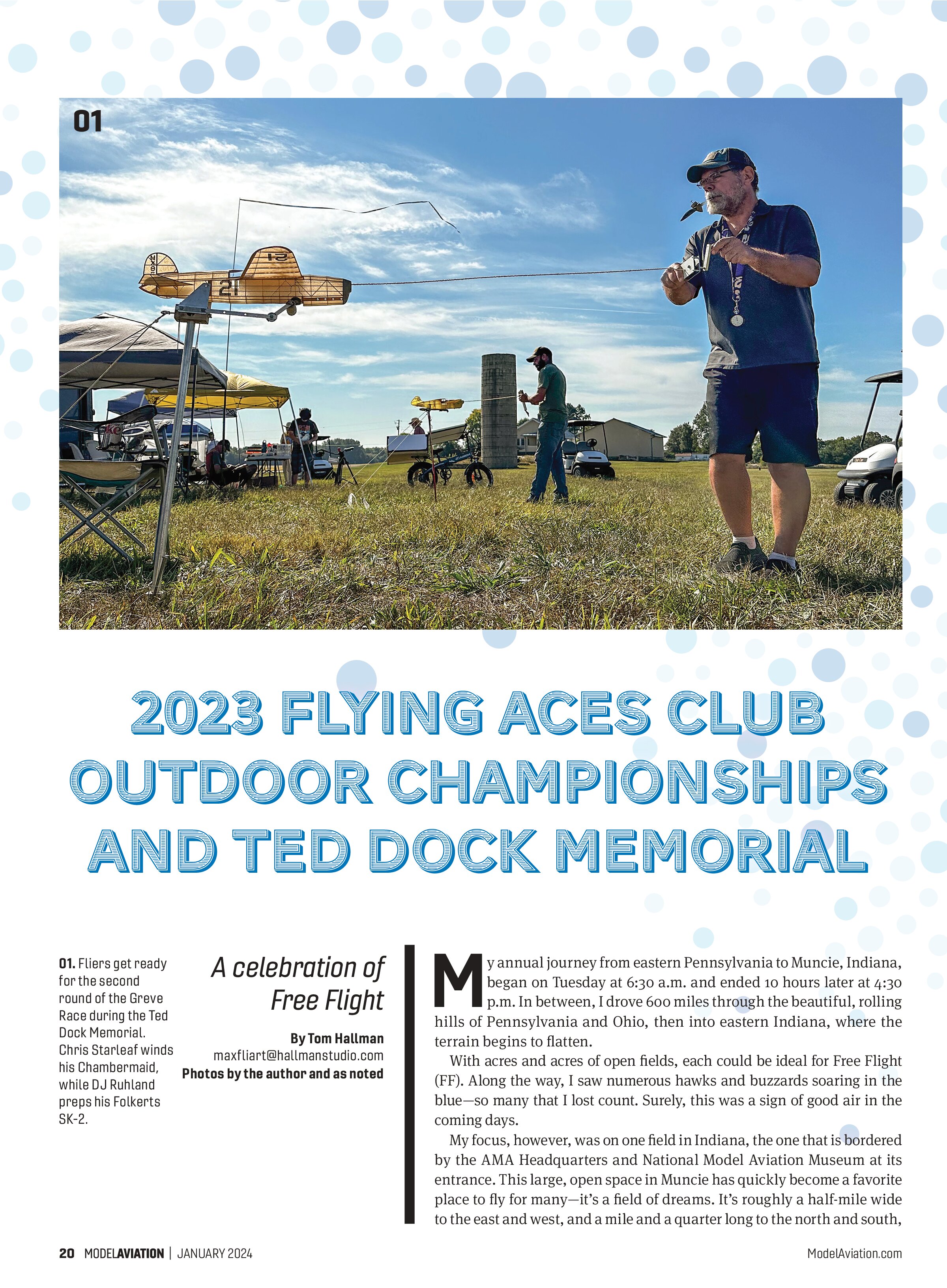

2023 FLYING ACES CLUB OUTDOOR CHAMPIONSHIPS AND TED DOCK MEMORIAL
A celebration of
Free Flight
By Tom Hallman
maxfliart@hallmanstudio.com
Photos by the author and as noted
My annual journey from eastern Pennsylvania to Muncie, Indiana, began on Tuesday at 6:30 a.m. and ended 10 hours later at 4:30 p.m. In between, I drove 600 miles through the beautiful, rolling hills of Pennsylvania and Ohio, then into eastern Indiana, where the terrain begins to flatten.
With acres and acres of open fields, each could be ideal for Free Flight (FF). Along the way, I saw numerous hawks and buzzards soaring in the blue—so many that I lost count. Surely, this was a sign of good air in the coming days.
My focus, however, was on one field in Indiana, the one that is bordered by the AMA Headquarters and National Model Aviation Museum at its entrance. This large, open space in Muncie has quickly become a favorite place to fly for many—it’s a field of dreams. It’s roughly a half-mile wide to the east and west, and a mile and a quarter long to the north and south, with soft, rolling hills of thick 6- to 8-inch grass.
A paved road conveniently borders the field, giving you quick access to all of the areas. Your FF models now have a much better chance of staying on the field because you can easily adjust to the prevailing wind anywhere on it.
Not all is perfect though, because this is farmland, and you will need to deal with various crops and tall, bordering tree lines should your models decide to go on a much longer ride than expected. The beauty of this field is multiplied by some of the best lift that I have ever experienced.
Call it thermal city, which begins at 8 a.m., only to fade just before sunset. Densely planted 10-foot high corn and thick soybeans will be your challenge if you’re flying there in mid-September, so come prepared to enter into the unknown. Planning your chase in the moment will be the key to retrieval success.
This was the setting for the Cloudbusters annual Flying Aces Club (FAC) Outdoor Championships, a two-day event on September 21-22, celebrating rubber-powered FF models through a competition of 23 events, including Scale judging, Duration, and mass-launch categories. It was all part of the competition that played out among 43 fliers from across the US, including California, Colorado, Florida, and Texas.
After the FAC Outdoor Champs, half of the fliers stayed to do it all again on the same field with 22 events at the annual Ted Dock Memorial contest held on September 23-24, making it four days of rubber-powered FF fun.
Thursday: Let the Games Begin!
Around sunrise, the flightline from the previous day of practice at the far southern end of the field was moved to the southeastern corner to accommodate the forecasted wind drift. Contest Director (CD) Winn Moore and co-CD Pat Murray set up the new location, handing out keys to a dozen retrieval golf carts that had been delivered to the field the day before.


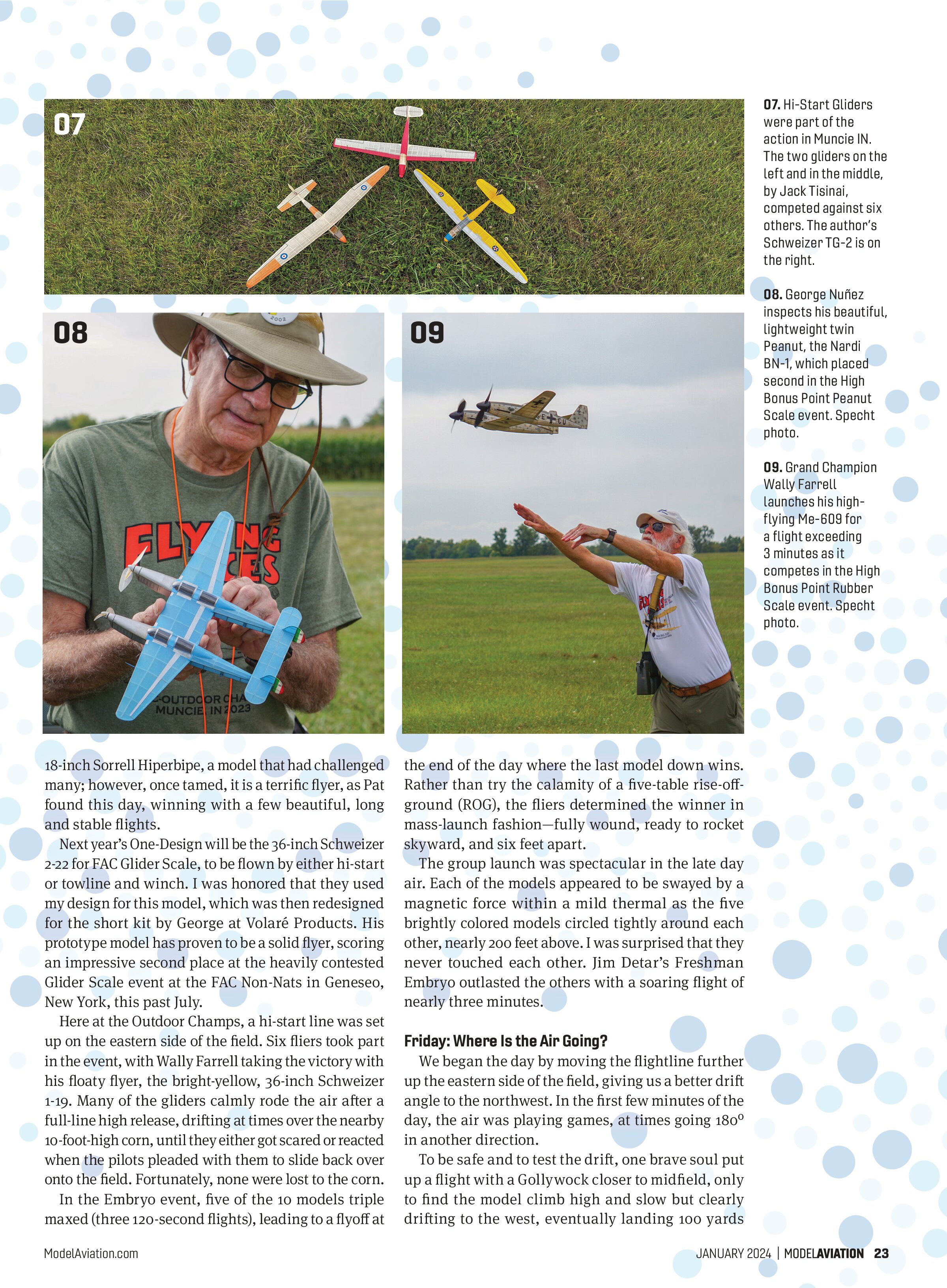
04. DJ attaches the propeller to his Folkerts before the Flying Horde event. His classic vertical takeoff launch helped him gain his 16th FAC victory and the Blue Max Award!
05. Mike Kelly’s beautiful Sky Rocket III Embryo heads off on another max flight of more than 2 minutes. A short kit is available from Volaré Products. Photo by Eric Specht.
06. The author’s 13-inch Blériot XXVI soared to victory in the High Bonus Point Peanut event at the Outdoor Champs. The triplane/pusher/canard configuration gave this model 30 bonus points.


The drift was to the north-northwest, so for many without electric bikes or scooters, the carts would become handy throughout the long weekend. With a blue and white cloud-filled sky, a mild breeze, and temperatures in the high 70s, this day was surely going to be a good one—ideal for FF.
The action began at 8 a.m., continuing until 5 p.m. each day. Official flights were attempted and posted on the score sheets at the flightline headquarters for all to see. This was classic, old-school flight time recording. Fliers could quickly see where they stood and what to shoot for.
The four mass-launch events (Greve Race for in-line racers from the 1930s, Goodyear Peanut Race, World War I, and Low-Wing Military Trainer) started at 9 a.m. then continued throughout the day every two hours. This gave the fliers plenty of time to post flight times in other Scale and nonscale Duration events.
New this year was an adjustment to the bonus points scoring in both FAC Rubber Scale and Peanut Scale. Rather than having the dominating high Bonus Points models competing with the much lower Bonus Points models, two divisions within each of these major Scale events were created.
Models would fly in either the zero to 20 Bonus Points category or the 21 and over Bonus Points category. This brilliant move, to address a long-standing concern of fairness within the Scale-judged events, worked out
07. Hi-Start Gliders were part of the action in Muncie IN. The two gliders on the left and in the middle, by Jack Tisinai, competed against six others. The author’s Schweizer TG-2 is on the right.
08. George Nuñez inspects his beautiful, lightweight twin Peanut, the Nardi BN-1, which placed second in the High Bonus Point Peanut Scale event. Specht photo.
09. Grand Champion Wally Farrell launches his high-flying Me-609 for a flight exceeding 3 minutes as it competes in the High Bonus Point Rubber Scale event. Specht photo.


quite well. In fact, the number of total entries in each event doubled over the previous year’s contest.
It’s my hope that the FAC Council considers the same option for other major FAC contests because this approach comes much closer to leveling the playing field, while at the same time, it gets more models into the air. Additionally, if the numbers support it, you could take it a step further by giving high-wing, parasol, and mid-wing models a standalone event within the Scale category since they receive only zero to five bonus points.
Throughout the first day, mass launches were hotly contested with eight to 10 fliers in each, launching on a line six feet apart. The models seemed to fly in tight formation, and, surprisingly, there weren’t any midair collisions.
The WW I event showed visions of the actual dogfights from a century ago, while the Goodyear racers only needed a checkerboard pylon to complete the nostalgic flight stories from the 1930s and ’40s. Flights of more than 2 minutes were commonplace during the three rounds in each mass launch, so competition was fierce. A few even went out of sight or drifted far into the trees or crops.
Each year, the Outdoor Champs premieres the following year’s One-Design selection by handing out a short kit for that model, via the generosity of George Bredehoft and Volaré Products. This year, we flew the 18-inch Sorrell Hiperbipe, a model that had challenged many; however, once tamed, it is a terrific flyer, as Pat found this day, winning with a few beautiful, long and stable flights.
Next year’s One-Design will be the 36-inch Schweizer 2-22 for FAC Glider Scale, to be flown by either hi-start or towline and winch. I was honored that they used my design for this model, which was then redesigned for the short kit by George at Volaré Products. His prototype model has proven to be a solid flyer, scoring an impressive second place at the heavily contested Glider Scale event at the FAC Non-Nats in Geneseo, New York, this past July.
Here at the Outdoor Champs, a hi-start line was set up on the eastern side of the field. Six fliers took part in the event, with Wally Farrell taking the victory with his floaty flyer, the bright-yellow, 36-inch Schweizer 1-19. Many of the gliders calmly rode the air after a full-line high release, drifting at times over the nearby 10-foot-high corn, until they either got scared or reacted when the pilots pleaded with them to slide back over onto the field. Fortunately, none were lost to the corn.
In the Embryo event, five of the 10 models triple maxed (three 120-second flights), leading to a flyoff at the end of the day where the last model down wins. Rather than try the calamity of a five-table rise-off-ground (ROG), the fliers determined the winner in mass-launch fashion—fully wound, ready to rocket skyward, and six feet apart.
The group launch was spectacular in the late day air. Each of the models appeared to be swayed by a magnetic force within a mild thermal as the five brightly colored models circled tightly around each other, nearly 200 feet above. I was surprised that they never touched each other. Jim Detar’s Freshman Embryo outlasted the others with a soaring flight of nearly three minutes.
Friday: Where Is the Air Going?
We began the day by moving the flightline further up the eastern side of the field, giving us a better drift angle to the northwest. In the first few minutes of the day, the air was playing games, at times going 180° in another direction.
To be safe and to test the drift, one brave soul put up a flight with a Gollywock closer to midfield, only to find the model climb high and slow but clearly drifting to the west, eventually landing 100 yards

deep in the high corn by the distant farm that borders the field. After hours of searching, and even with the assistance of Model Aviation Executive Editor Jay Smith and AMA Creative Director Matt Ruddick with his drone, we could not locate the lost airplane from above ... but more on that later.
The rest of the contestants eagerly began their new day of flying, which held three more mass launches and 10 other Duration events. The air continued to be “thermalistic” and warmer, with a bright-blue sky as a canvas background—the very best for FF. This was the final chance to fly your FAC Rubber Scale or Peanut Scale models, so the flightline was going to be active.
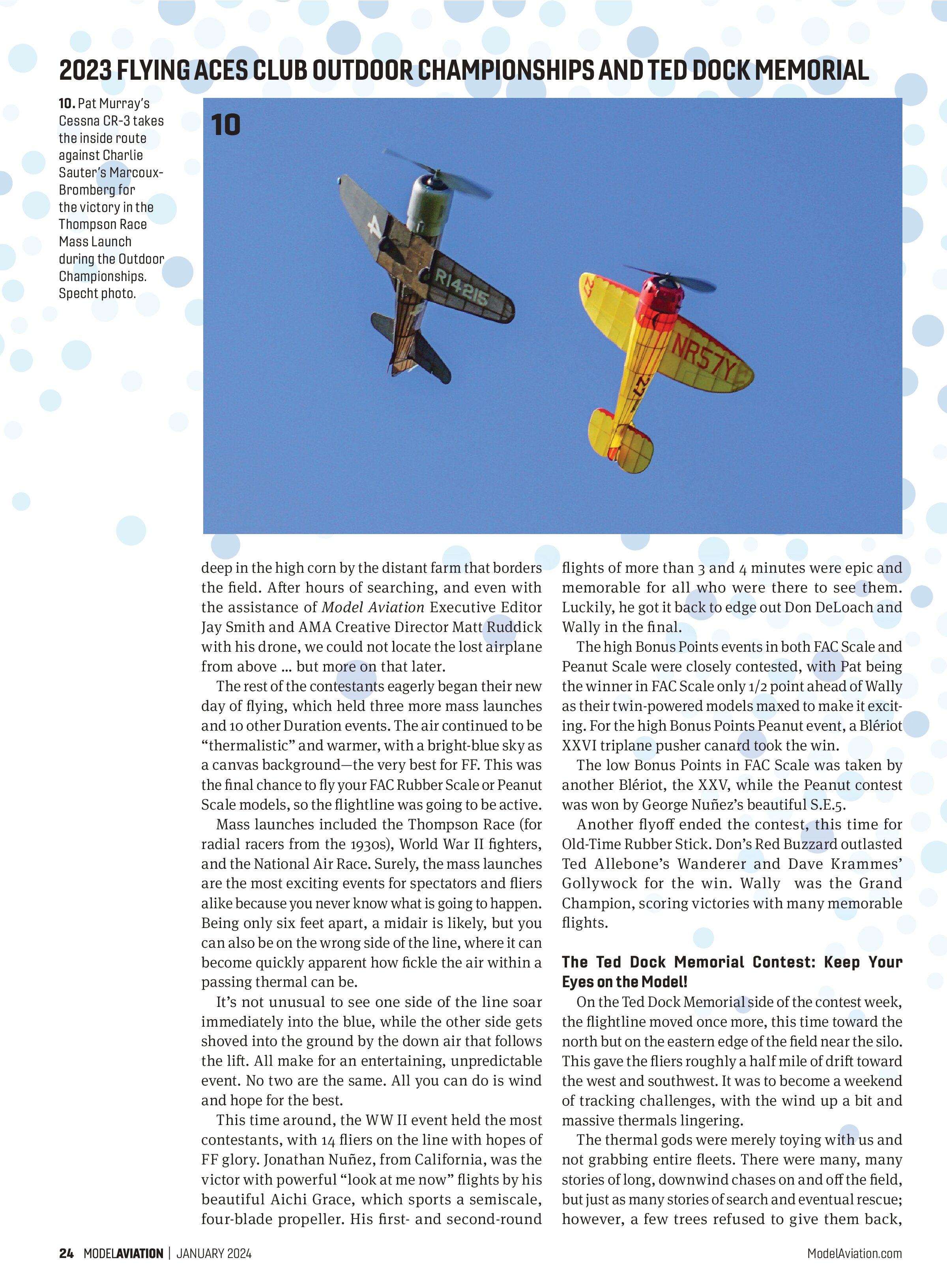
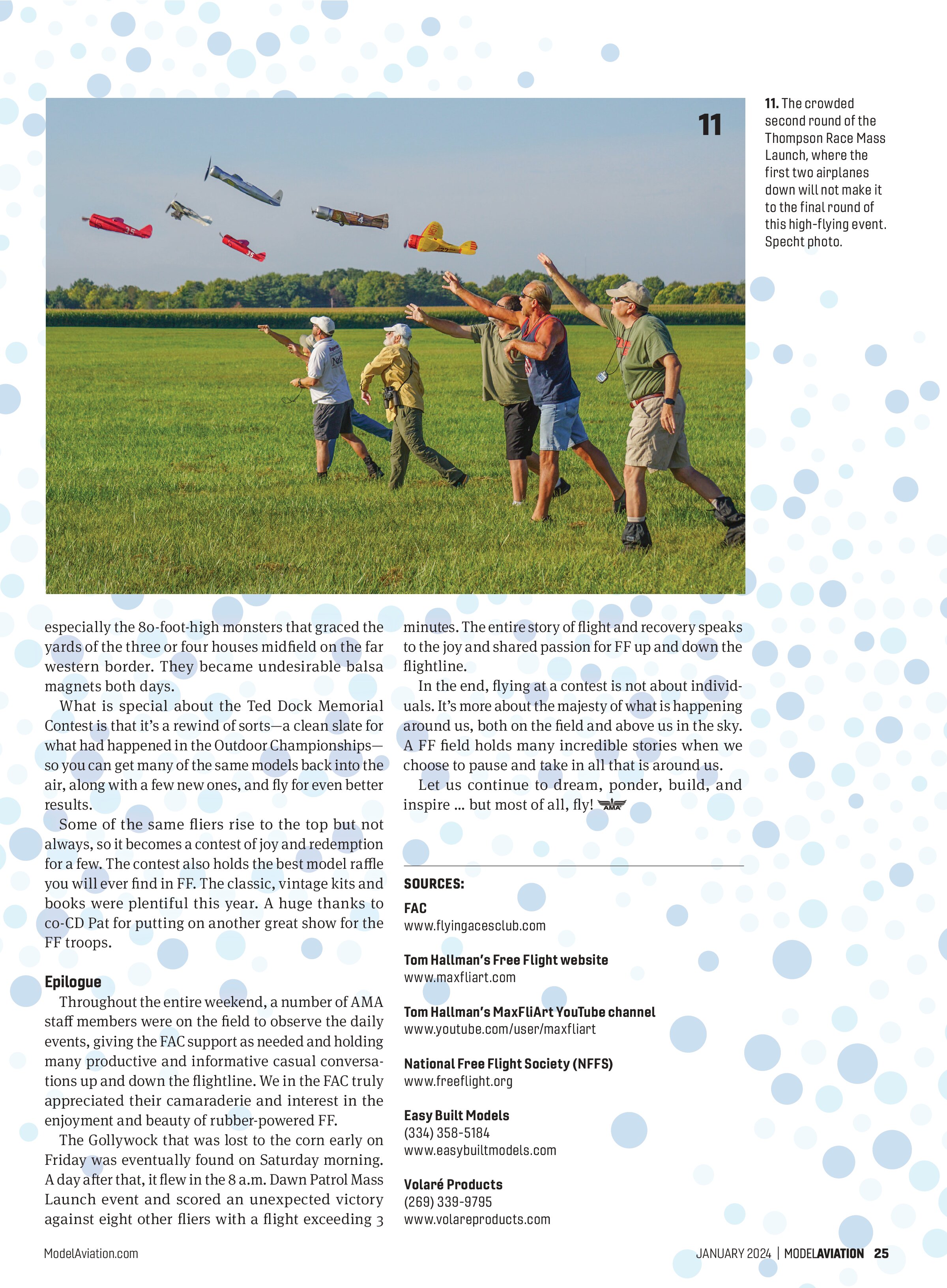
Mass launches included the Thompson Race (for radial racers from the 1930s), World War II fighters, and the National Air Race. Surely, the mass launches are the most exciting events for spectators and fliers alike because you never know what is going to happen. Being only six feet apart, a midair is likely, but you can also be on the wrong side of the line, where it can become quickly apparent how fickle the air within a passing thermal can be.
It’s not unusual to see one side of the line soar immediately into the blue, while the other side gets shoved into the ground by the down air that follows the lift. All make for an entertaining, unpredictable event. No two are the same. All you can do is wind and hope for the best.
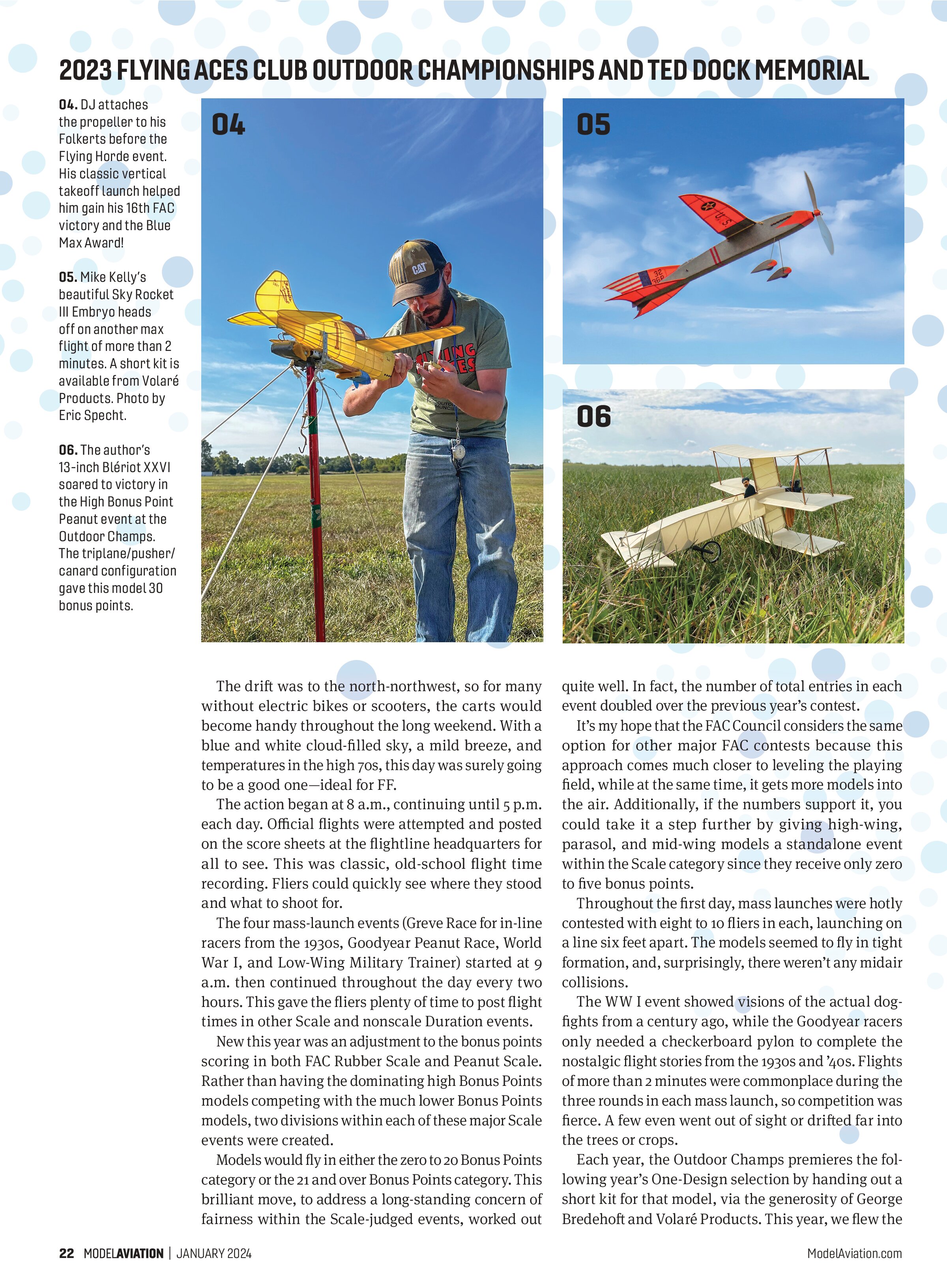
This time around, the WW II event held the most contestants, with 14 fliers on the line with hopes of FF glory. Jonathan Nuñez, from California, was the victor with powerful “look at me now” flights by his beautiful Aichi Grace, which sports a semiscale, four-blade propeller. His first- and second-round
flights of more than 3 and 4 minutes were epic and memorable for all who were there to see them. Luckily, he got it back to edge out Don DeLoach and Wally in the final.
The high Bonus Points events in both FAC Scale and Peanut Scale were closely contested, with Pat being the winner in FAC Scale only 1/2 point ahead of Wally as their twin-powered models maxed to make it exciting. For the high Bonus Points Peanut event, a Blériot XXVI triplane pusher canard took the win.
The low Bonus Points in FAC Scale was taken by another Blériot, the XXV, while the Peanut contest was won by George Nuñez’s beautiful S.E.5.
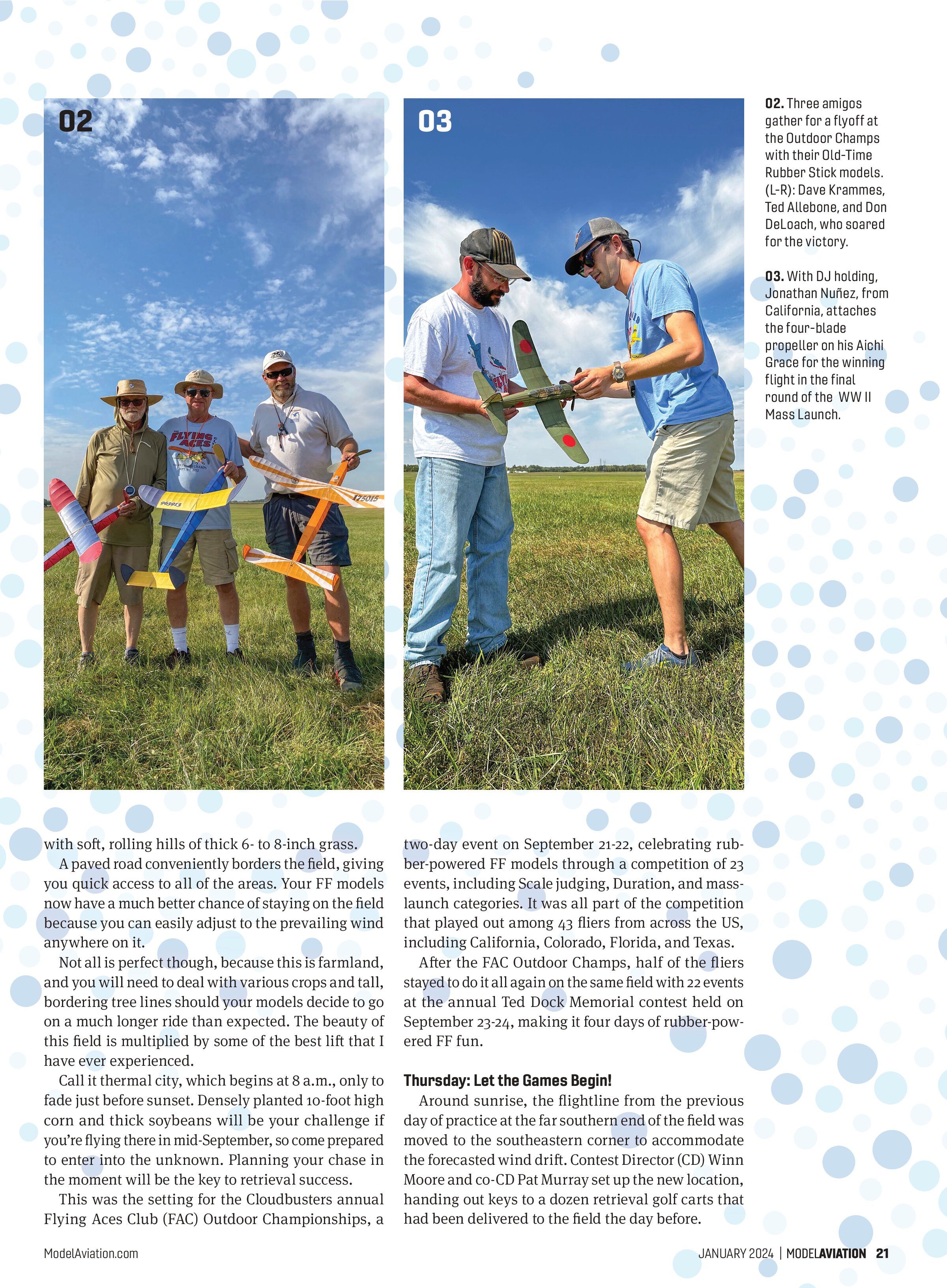
Another flyoff ended the contest, this time for Old-Time Rubber Stick. Don’s Red Buzzard outlasted Ted Allebone’s Wanderer and Dave Krammes’ Gollywock for the win. Wally was the Grand Champion, scoring victories with many memorable flights.
The Ted Dock Memorial Contest: Keep Your Eyes on the Model!
On the Ted Dock Memorial side of the contest week, the flightline moved once more, this time toward the north but on the eastern edge of the field near the silo. This gave the fliers roughly a half mile of drift toward the west and southwest. It was to become a weekend of tracking challenges, with the wind up a bit and massive thermals lingering.
The thermal gods were merely toying with us and not grabbing entire fleets. There were many, many stories of long, downwind chases on and off the field, but just as many stories of search and eventual rescue; however, a few trees refused to give them back, especially the 80-foot-high monsters that graced the yards of the three or four houses midfield on the far western border. They became undesirable balsa magnets both days.
What is special about the Ted Dock Memorial Contest is that it’s a rewind of sorts—a clean slate for what had happened in the Outdoor Championships—so you can get many of the same models back into the air, along with a few new ones, and fly for even better results.
Some of the same fliers rise to the top but not always, so it becomes a contest of joy and redemption for a few. The contest also holds the best model raffle you will ever find in FF. The classic, vintage kits and books were plentiful this year. A huge thanks to co-CD Pat for putting on another great show for the FF troops.
Epilogue
Throughout the entire weekend, a number of AMA staff members were on the field to observe the daily events, giving the FAC support as needed and holding many productive and informative casual conversations up and down the flightline. We in the FAC truly appreciated their camaraderie and interest in the enjoyment and beauty of rubber-powered FF.
The Gollywock that was lost to the corn early on Friday was eventually found on Saturday morning. A day after that, it flew in the 8 a.m. Dawn Patrol Mass Launch event and scored an unexpected victory against eight other fliers with a flight exceeding 3

minutes. The entire story of flight and recovery speaks to the joy and shared passion for FF up and down the flightline.
In the end, flying at a contest is not about individuals. It’s more about the majesty of what is happening around us, both on the field and above us in the sky. A FF field holds many incredible stories when we choose to pause and take in all that is around us.
Let us continue to dream, ponder, build, and inspire ... but most of all, fly!
SOURCES:
Tom Hallman’s Free Flight website
www.maxfliart.com
Tom Hallman’s MaxFliart YouTube channel
www.youtube.com/user/maxfliart
National Free Flight Society (NFFS)
www.freeflight.org
Easy Built Models
(334) 358-5184
www.easybuiltmodels.com
Volaré Products
(269) 339-9795
www.volareproducts.com