WILLIT
Photos provided by Joe Hass | joehass@gmail.com

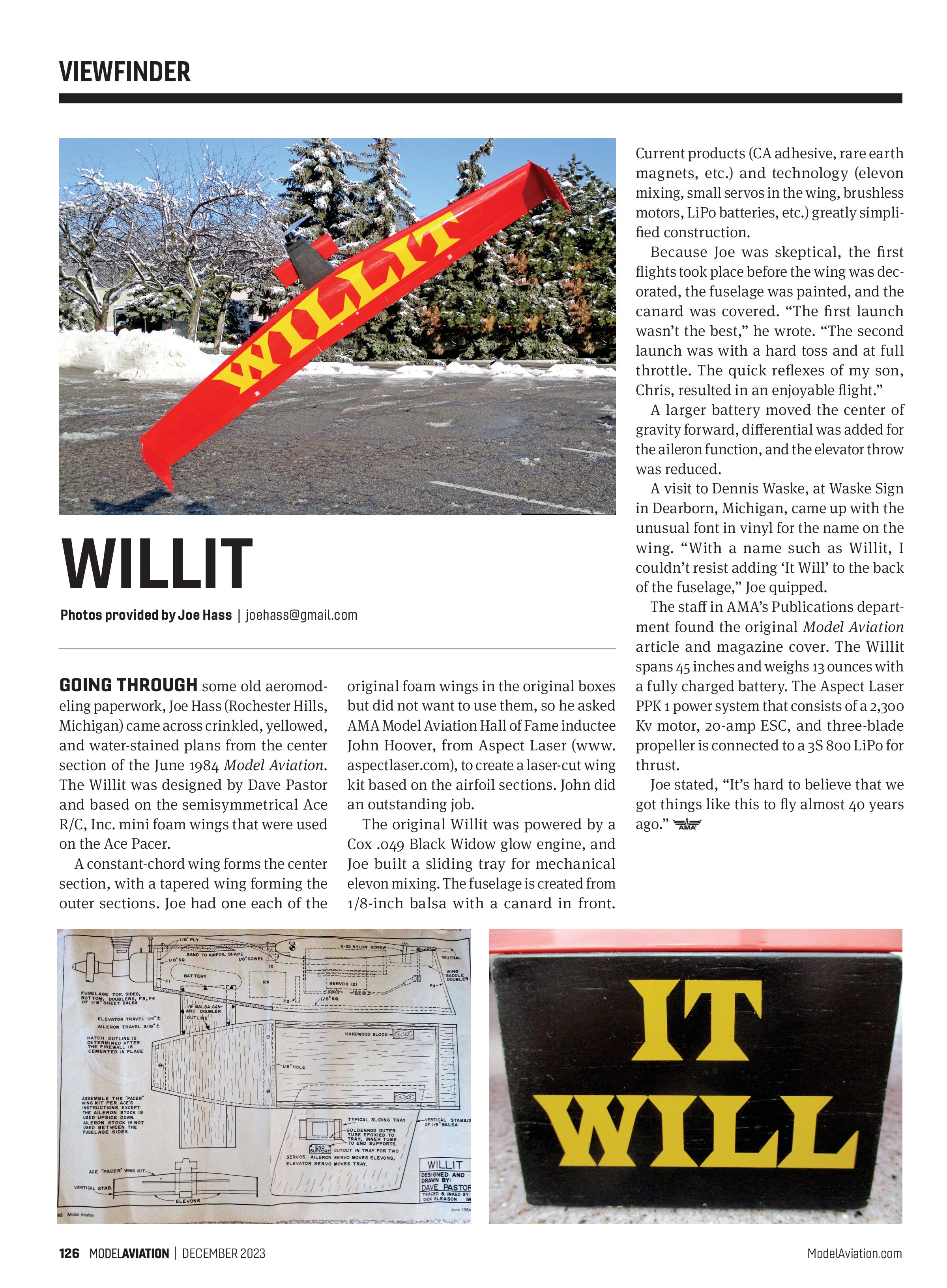
GOING THROUGH some old aeromodeling paperwork, Joe Hass (Rochester Hills, Michigan) came across crinkled, yellowed, and water-stained plans from the center section of the June 1984 Model Aviation. The Willit was designed by Dave Pastor and based on the semisymmetrical Ace R/C, Inc. mini foam wings that were used on the Ace Pacer.
A constant-chord wing forms the center section, with a tapered wing forming the outer sections. Joe had one each of the original foam wings in the original boxes but did not want to use them, so he asked AMA Model Aviation Hall of Fame inductee John Hoover, from Aspect Laser (www.aspectlaser.com), to create a laser-cut wing kit based on the airfoil sections. John did an outstanding job.
The original Willit was powered by a Cox .049 Black Widow glow engine, and Joe built a sliding tray for mechanical elevon mixing. The fuselage is created from 1/8-inch balsa with a canard in front.


Current products (CA adhesive, rare earth magnets, etc.) and technology (elevon mixing, small servos in the wing, brushless motors, LiPo batteries, etc.) greatly simplified construction.
Because Joe was skeptical, the first flights took place before the wing was decorated, the fuselage was painted, and the canard was covered. “The first launch wasn’t the best,” he wrote. “The second launch was with a hard toss and at full throttle. The quick reflexes of my son, Chris, resulted in an enjoyable flight.”
A larger battery moved the center of gravity forward, differential was added for the aileron function, and the elevator throw was reduced.
A visit to Dennis Waske, at Waske Sign in Dearborn, Michigan, came up with the unusual font in vinyl for the name on the wing. “With a name such as Willit, I couldn’t resist adding ‘It Will’ to the back of the fuselage,” Joe quipped.
The staff in AMA’s Publications department found the original Model Aviation article and magazine cover. The Willit spans 45 inches and weighs 13 ounces with a fully charged battery. The Aspect Laser PPK 1 power system that consists of a 2,300 Kv motor, 20-amp ESC, and three-blade propeller is connected to a 3S 800 LiPo for thrust.
Joe stated, “It’s hard to believe that we got things like this to fly almost 40 years ago.”
SCALE AGUSTA 119 KOALA BUILD
Photos provided by Marty Levinstein | dopt@aol.com


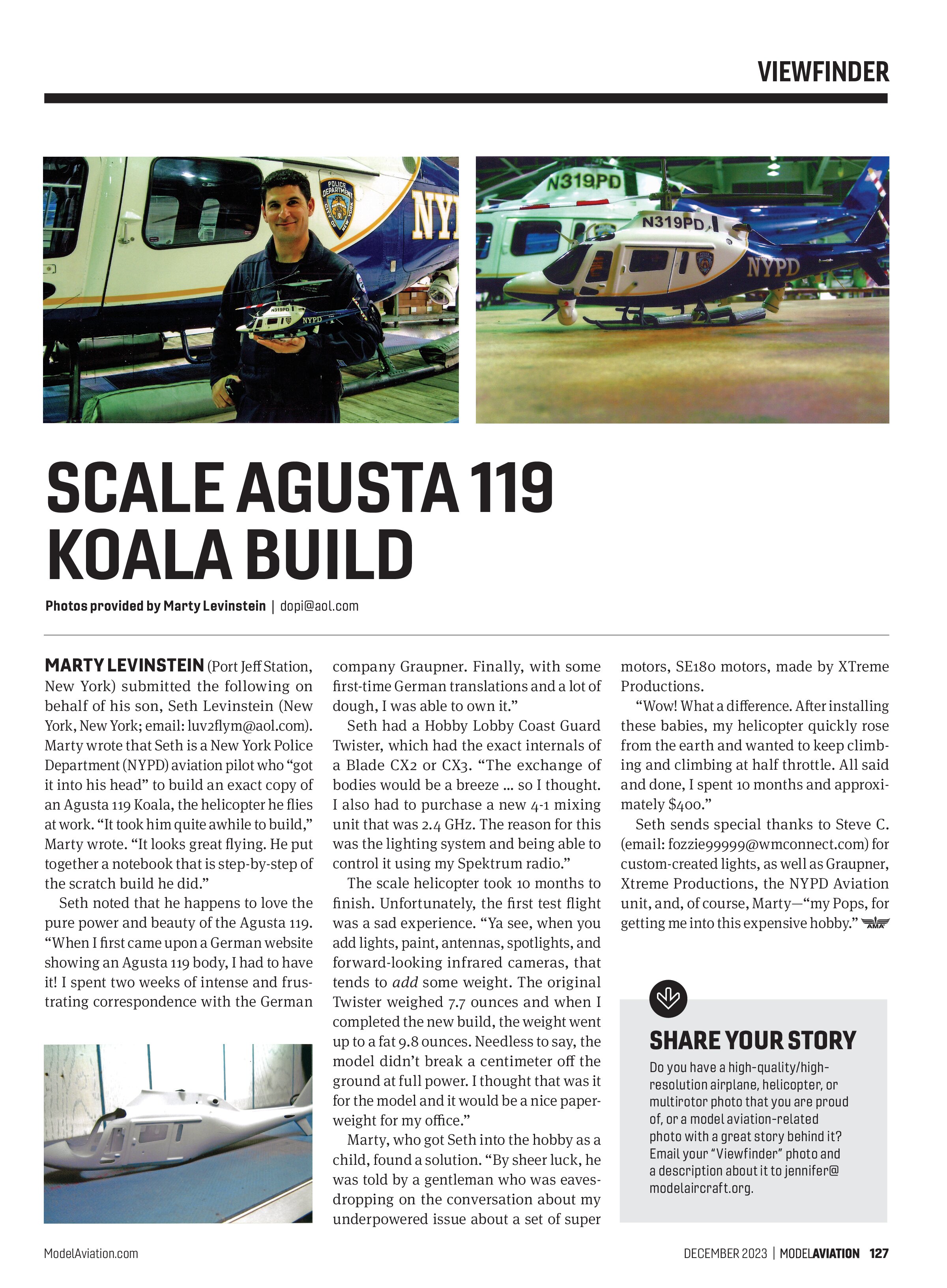
MARTY LEVINSTEIN (Port Jeff Station, New York) submitted the following on behalf of his son, Seth Levinstein (New York, New York; email: luv2flym@aol.com). Marty wrote that Seth is a New York Police Department (NYPD) aviation pilot who “got it into his head” to build an exact copy of an Agusta 119 Koala, the helicopter he flies at work. “It took him quite awhile to build,” Marty wrote. “It looks great flying. He put together a notebook that is step-by-step of the scratch build he did.”
Seth noted that he happens to love the pure power and beauty of the Agusta 119. “When I first came upon a German website showing an Agusta 119 body, I had to have it! I spent two weeks of intense and frustrating correspondence with the German company Graupner. Finally, with some first-time German translations and a lot of dough, I was able to own it.”
Seth had a Hobby Lobby Coast Guard Twister, which had the exact internals of a Blade CX2 or CX3. “The exchange of bodies would be a breeze ... so I thought. I also had to purchase a new 4-1 mixing unit that was 2.4 GHz. The reason for this was the lighting system and being able to control it using my Spektrum radio.”
The scale helicopter took 10 months to finish. Unfortunately, the first test flight was a sad experience. “Ya see, when you add lights, paint, antennas, spotlights, and forward-looking infrared cameras, that tends to add some weight. The original Twister weighed 7.7 ounces and when I completed the new build, the weight went up to a fat 9.8 ounces. Needless to say, the model didn’t break a centimeter off the ground at full power. I thought that was it for the model and it would be a nice paperweight for my office.”

Marty, who got Seth into the hobby as a child, found a solution. “By sheer luck, he was told by a gentleman who was eavesdropping on the conversation about my underpowered issue about a set of super motors, SE180 motors, made by XTreme Productions.
“Wow! What a difference. After installing these babies, my helicopter quickly rose from the earth and wanted to keep climbing and climbing at half throttle. All said and done, I spent 10 months and approximately $400.”
Seth sends special thanks to Steve C. (email: fozzie99999@wmconnect.com) for custom-created lights, as well as Graupner, Xtreme Productions, the NYPD Aviation unit, and, of course, Marty—“my Pops, for getting me into this expensive hobby.”