SMALL-FIELD FLYING
NIEUPORT PROJECT COMPLETED
By Pat Tritle | patscustommodels@gmail.com

WE ARE LESS than a month away from Christmas. Where did the year go? Our flying season in the desert Southwest was unusually hot and windy, which ultimately gave way to a wet and windy monsoon season. Although we did spend some time at the field, we didn’t log a lot of flight hours this year. During the downtime, when temperatures were hovering in the 110° range, I was able to button up a couple of projects that I had been wanting to finish—literally, for years!
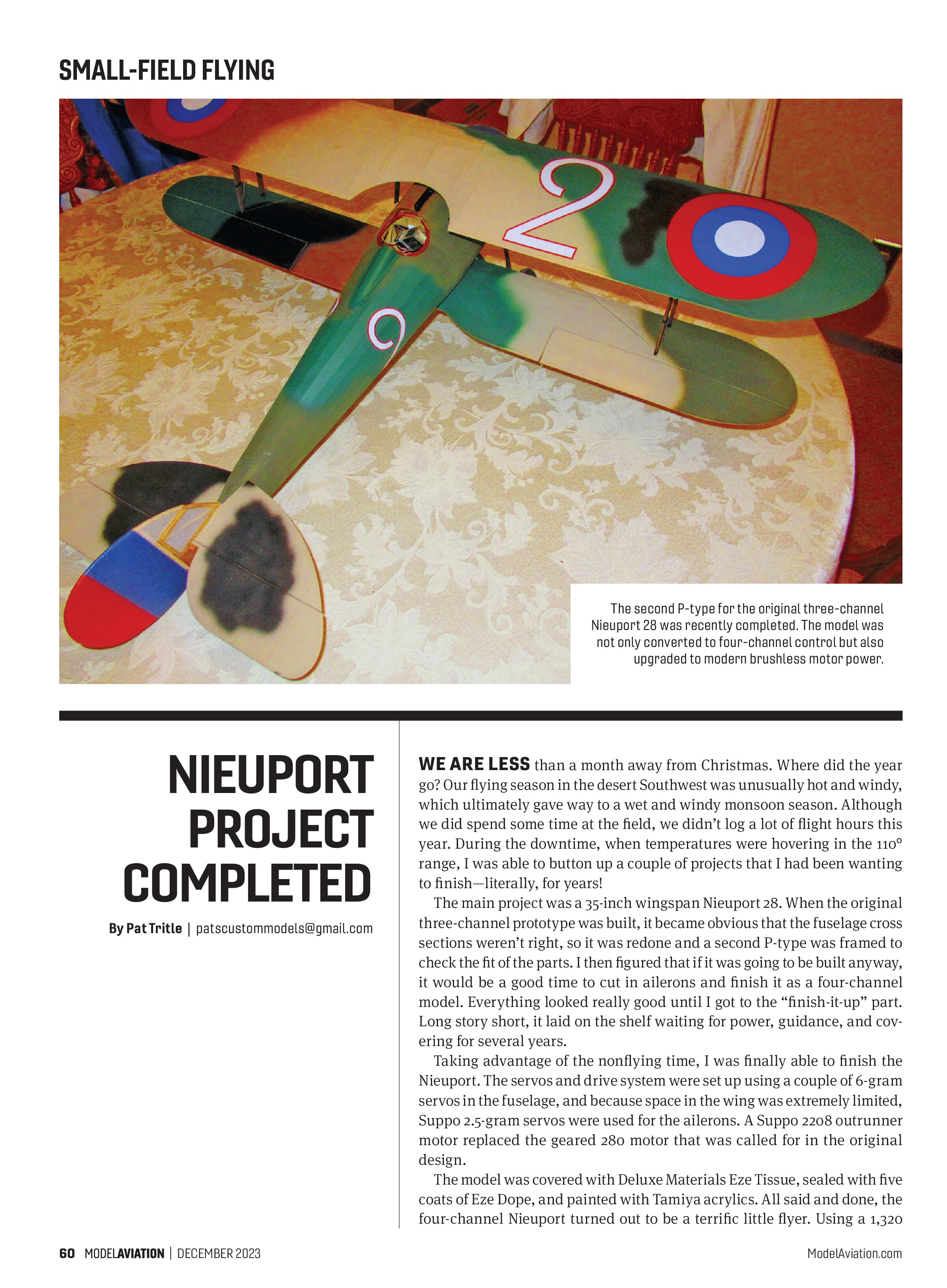
The main project was a 35-inch wingspan Nieuport 28. When the original three-channel prototype was built, it became obvious that the fuselage cross sections weren’t right, so it was redone and a second P-type was framed to check the fit of the parts. I then figured that if it was going to be built anyway, it would be a good time to cut in ailerons and finish it as a four-channel model. Everything looked really good until I got to the “finish-it-up” part. Long story short, it laid on the shelf waiting for power, guidance, and covering for several years.
Taking advantage of the nonflying time, I was finally able to finish the Nieuport. The servos and drive system were set up using a couple of 6-gram servos in the fuselage, and because space in the wing was extremely limited, Suppo 2.5-gram servos were used for the ailerons. A Suppo 2208 outrunner motor replaced the geared 280 motor that was called for in the original design.
The model was covered with Deluxe Materials Eze Tissue, sealed with five coats of Eze Dope, and painted with Tamiya acrylics. All said and done, the four-channel Nieuport turned out to be a terrific little flyer. Using a 1,320 mAh 2S LiPo battery, it tips the scales at 13.2 ounces.
Now that all of the super-light iron-on covering materials are gone for park flyer aircraft such as this, Eze Tissue is looking more and more like a terrific alternative. It’s slightly more robust than Japanese tissue and handles much like oooo silk-span. When it comes to wet handling, I’ve never found anything better and, as skeptical as I am regarding water-based paints and sealers (not all of them have worked as advertised), Eze Dope, I’m happy to say, has proven itself over time.
Good Ideas Come on Large Rolls
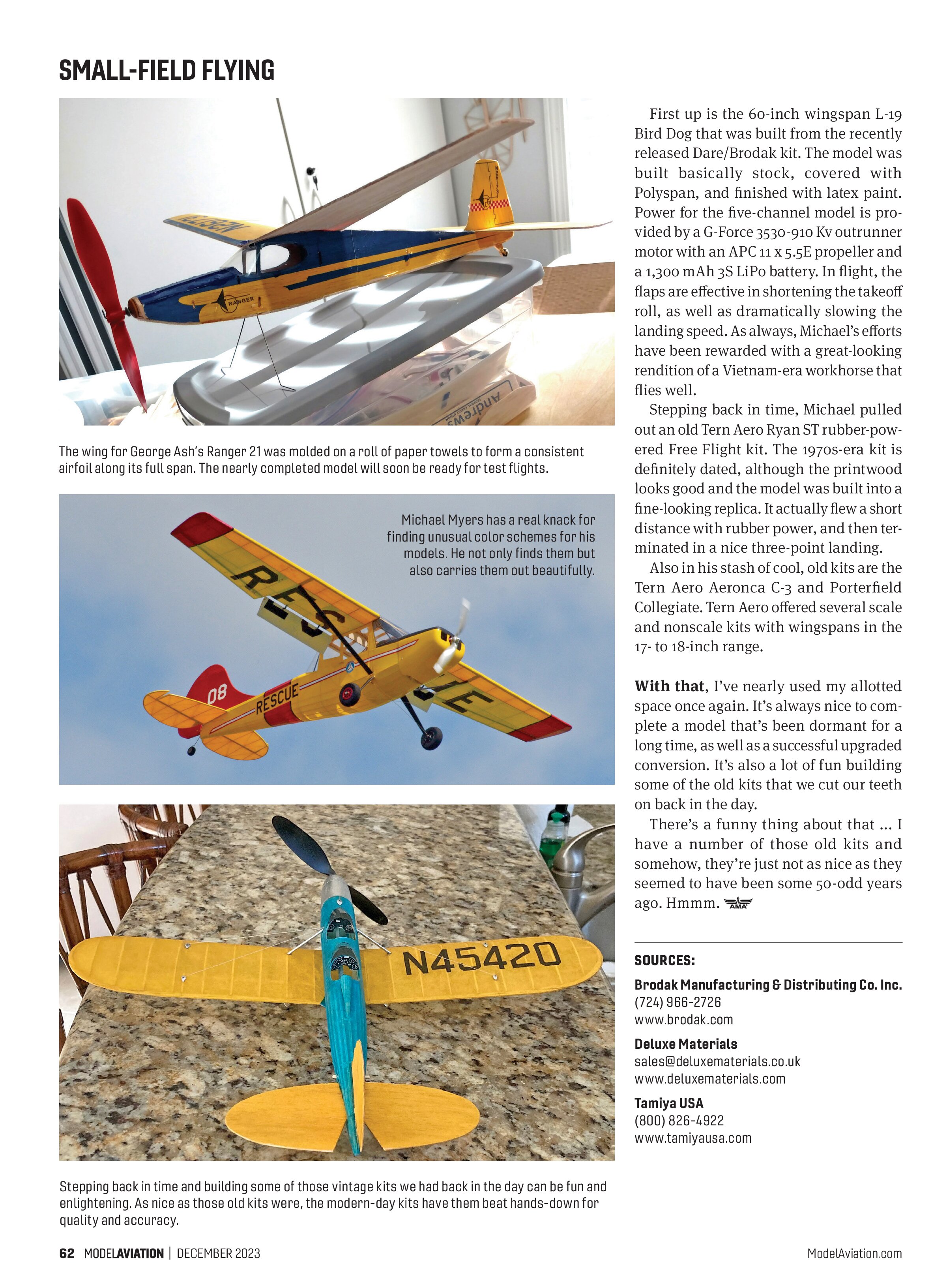
I love it when modelers write to me with ideas. This time around, George Ash has checked in with a great way to form the airfoil curvature into sheet balsa wings.
Case in point, George is building the Carl Goldberg Ranger 21. To maintain a consistent airfoil, he wet the wood, slipped it into a roll of paper towels, and then wrapped it with tape to hold it in place. The wing was allowed to dry overnight, which molded a permanent curvature into the wood.

Using the same thought process, this basic technique can be expanded into other areas, such as molding windshields for open cockpit biplanes. To start, cut the windshield from clear stock, wrap it around a glass jar of approximately the right diameter, and tape it in place. Fill the jar with water and (without the lid) put it in the microwave until it almost boils. Pull the jar out, let it cool, and when the plastic comes off, it’ll be permanently curved to the shape of the jar.
Our old friend Michael Myers is at it again with some really cool projects. His diversity came out in spades this time around with a couple of models ranging widely in both age and size.


First up is the 60-inch wingspan L-19 Bird Dog that was built from the recently released Dare/Brodak kit. The model was built basically stock, covered with Polyspan, and finished with latex paint. Power for the five-channel model is provided by a G-Force 3530-910 Kv outrunner motor with an APC 11 x 5.5E propeller and a 1,300 mAh 3S LiPo battery. In flight, the flaps are effective in shortening the takeoff roll, as well as dramatically slowing the landing speed. As always, Michael’s efforts have been rewarded with a great-looking rendition of a Vietnam-era workhorse that flies well.
Stepping back in time, Michael pulled out an old Tern Aero Ryan ST rubber-powered Free Flight kit. The 1970s-era kit is definitely dated, although the printwood looks good and the model was built into a fine-looking replica. It actually flew a short distance with rubber power, and then terminated in a nice three-point landing.
Also in his stash of cool, old kits are the Tern Aero Aeronca C-3 and Porterfield Collegiate. Tern Aero offered several scale and nonscale kits with wingspans in the 17- to 18-inch range.
With that, I’ve nearly used my allotted space once again. It’s always nice to complete a model that’s been dormant for a long time, as well as a successful upgraded conversion. It’s also a lot of fun building some of the old kits that we cut our teeth on back in the day.
There’s a funny thing about that ... I have a number of those old kits and somehow, they’re just not as nice as they seemed to have been some 50-odd years ago. Hmmm.
SOURCES:
Brodak Manufacturing & Distributing Co. Inc.
(724) 966-2726
www.brodak.com
Deluxe Materials
sales@deluxematerials.co.uk
www.deluxematerials.com
Tamiya USA
(800) 826-4922
www.tamiyausa.com