THE DEAL WITH DRONES


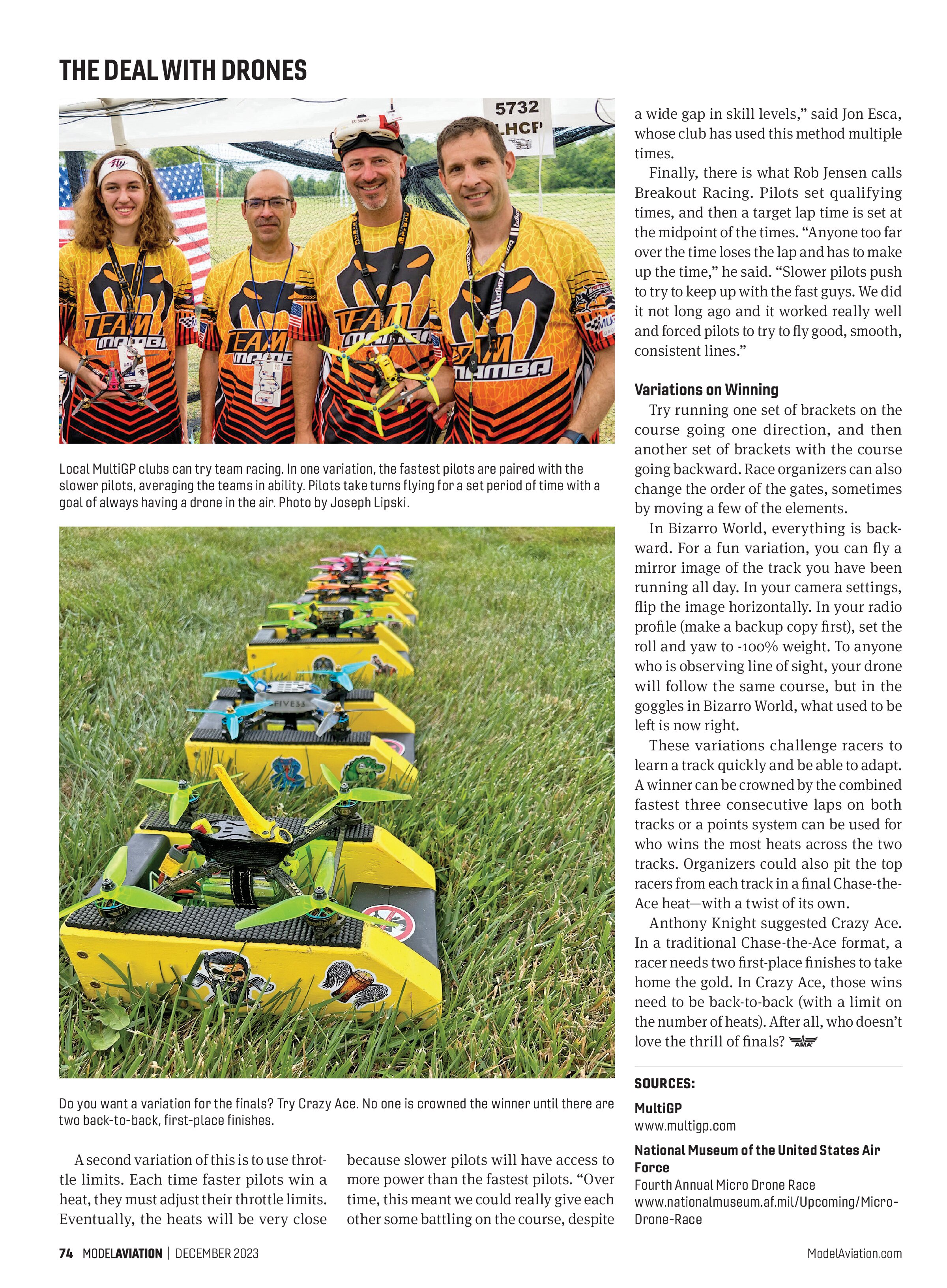
A second variation of this is to use throttle limits. Each time faster pilots win a heat, they must adjust their throttle limits. Eventually, the heats will be very close because slower pilots will have access to more power than the fastest pilots. “Over time, this meant we could really give each other some battling on the course, despite a wide gap in skill levels,” said Jon Esca, whose club has used this method multiple times.
Finally, there is what Rob Jensen calls Breakout Racing. Pilots set qualifying times, and then a target lap time is set at the midpoint of the times. “Anyone too far over the time loses the lap and has to make up the time,” he said. “Slower pilots push to try to keep up with the fast guys. We did it not long ago and it worked really well and forced pilots to try to fly good, smooth, consistent lines.”
Variations on Winning
Try running one set of brackets on the course going one direction, and then another set of brackets with the course going backward. Race organizers can also change the order of the gates, sometimes by moving a few of the elements.
In Bizarro World, everything is backward. For a fun variation, you can fly a mirror image of the track you have been running all day. In your camera settings, flip the image horizontally. In your radio profile (make a backup copy first), set the roll and yaw to -100% weight. To anyone who is observing line of sight, your drone will follow the same course, but in the goggles in Bizarro World, what used to be left is now right.
These variations challenge racers to learn a track quickly and be able to adapt. A winner can be crowned by the combined fastest three consecutive laps on both tracks or a points system can be used for who wins the most heats across the two tracks. Organizers could also pit the top racers from each track in a final Chase-the-Ace heat—with a twist of its own.
Anthony Knight suggested Crazy Ace. In a traditional Chase-the-Ace format, a racer needs two first-place finishes to take home the gold. In Crazy Ace, those wins need to be back-to-back (with a limit on the number of heats). After all, who doesn’t love the thrill of finals?
SOURCES:
MultiGP
www.multigp.com
National Museum of the United States Air Force
Fourth Annual Micro Drone Race
www.nationalmuseum.af.mil/Upcoming/Micro-Drone-Race

MICRO FASTENERS
SCREW AND
NUT GAUGE
By Sal Calvagna | rcgiants@optonline.net
WELCOME BACK. Happy holiday season to all of my readers and your families.
Featured in this column are a few recently completed and flown Giant Scale models, a great stocking stuffer we can all use, and two world-famous modelers who share the same name.
Anyone who builds and flies model airplanes has acquired an assortment of screws and nuts throughout time. Unless you’re neat and organized, they all usually end up in the same bin, jar, etc., so when you’re looking for the right size of threaded bolt or nut, it can be frustrating.
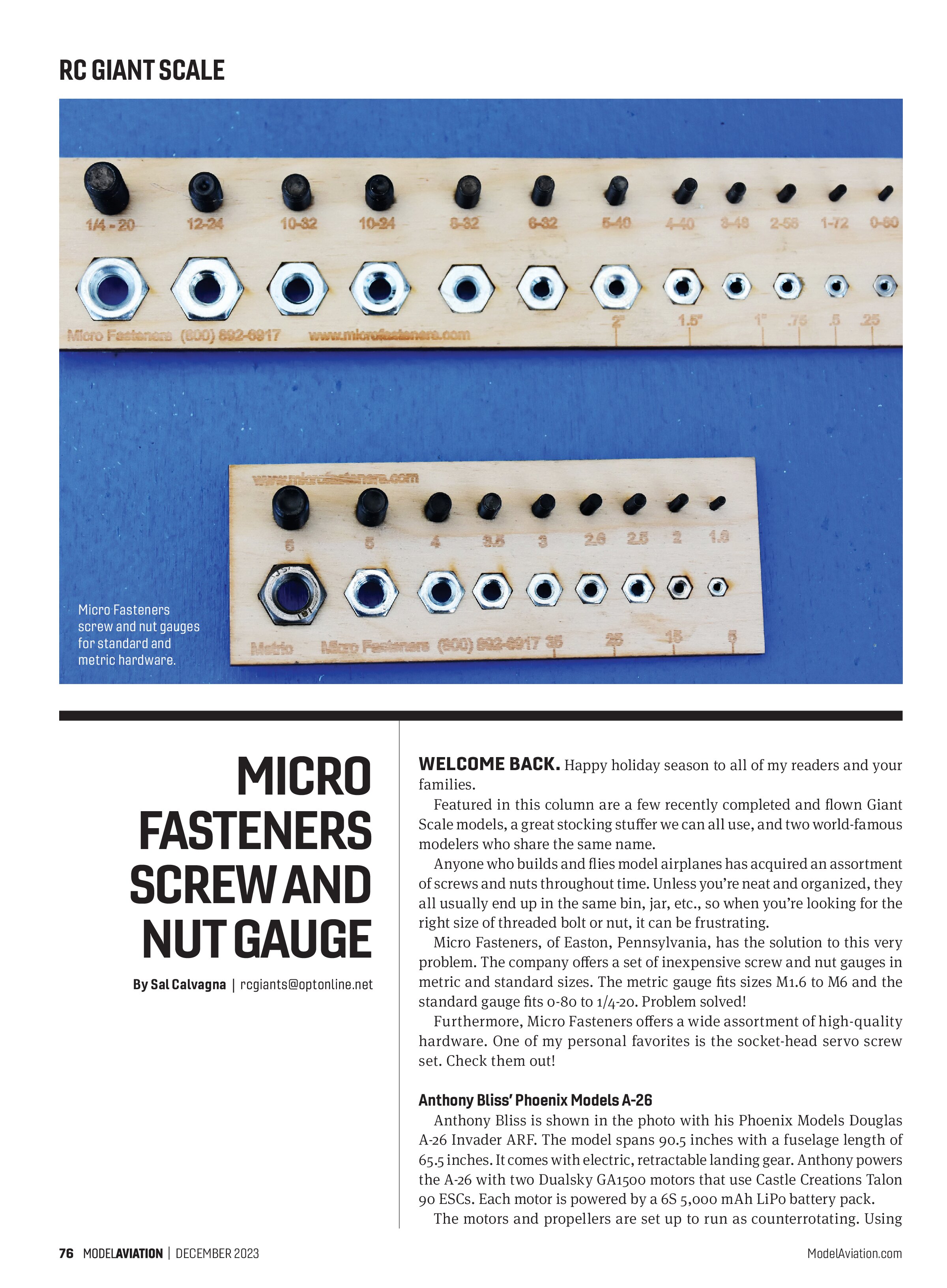
Micro Fasteners, of Easton, Pennsylvania, has the solution to this very problem. The company offers a set of inexpensive screw and nut gauges in metric and standard sizes. The metric gauge fits sizes M1.6 to M6 and the standard gauge fits 0-80 to 1/4-20. Problem solved!
Furthermore, Micro Fasteners offers a wide assortment of high-quality hardware. One of my personal favorites is the socket-head servo screw set. Check them out!
Anthony Bliss’ Phoenix Models A-26
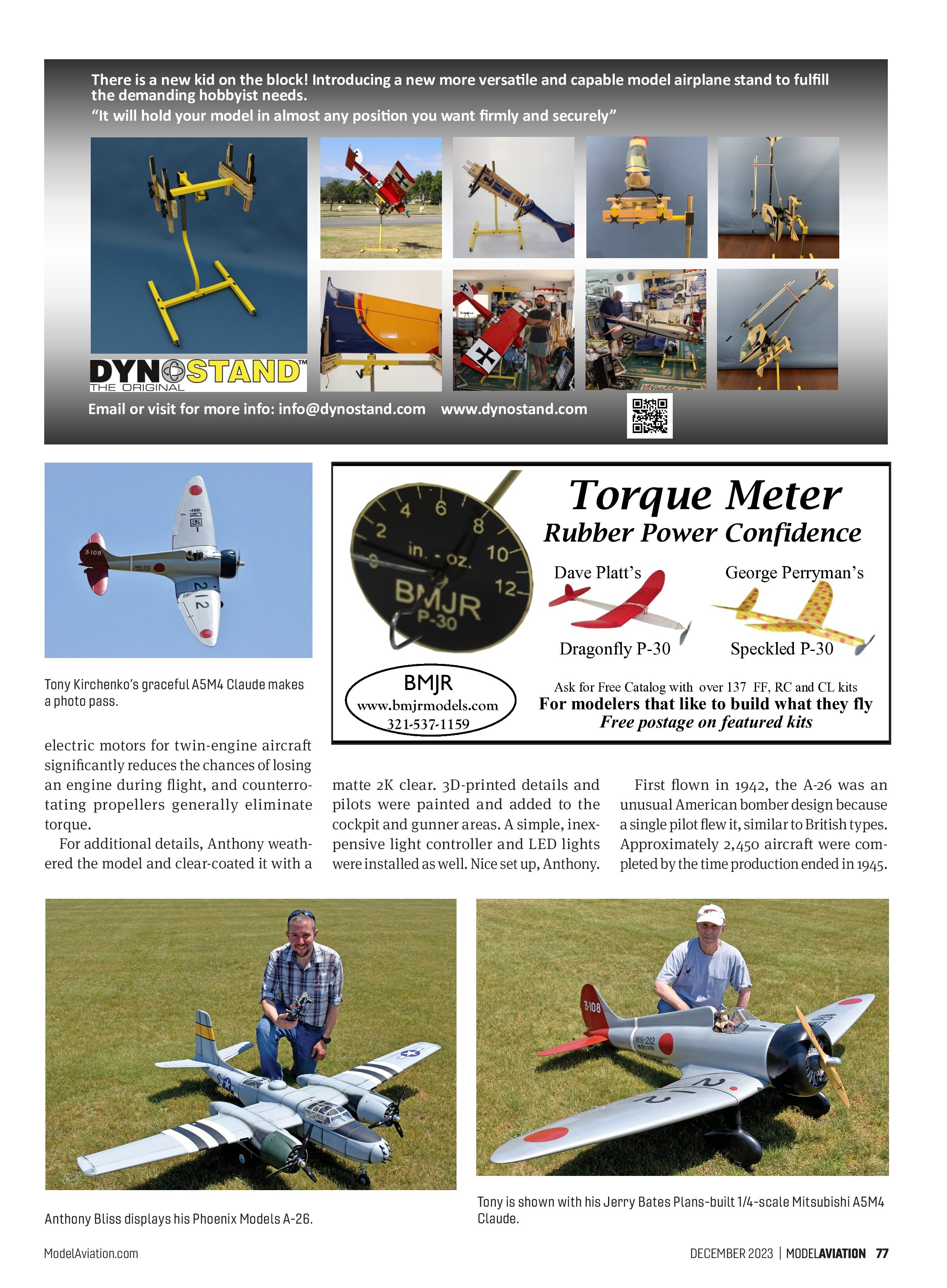
Anthony Bliss is shown in the photo with his Phoenix Models Douglas A-26 Invader ARF. The model spans 90.5 inches with a fuselage length of 65.5 inches. It comes with electric, retractable landing gear. Anthony powers the A-26 with two Dualsky GA1500 motors that use Castle Creations Talon 90 ESCs. Each motor is powered by a 6S 5,000 mAh LiPo battery pack.
The motors and propellers are set up to run as counterrotating. Using

electric motors for twin-engine aircraft significantly reduces the chances of losing an engine during flight, and counterrotating propellers generally eliminate torque.
For additional details, Anthony weathered the model and clear-coated it with a

matte 2K clear. 3D-printed details and pilots were painted and added to the cockpit and gunner areas. A simple, inexpensive light controller and LED lights were installed as well. Nice set up, Anthony.

First flown in 1942, the A-26 was an unusual American bomber design because a single pilot flew it, similar to British types. Approximately 2,450 aircraft were completed by the time production ended in 1945.