HOW MANY
PEOPLE MAKE
AN EVENT
FUN AND
INTERESTING?
By Bob Angel | samrcflier@verizon.net

HOW MANY CONTESTANTS do we need in order to have the most fun? There’s no simple answer to that philosophical question. For those with strong competitive instincts, there’s hardly an upper limit for contestants or, in some cases, for the audience. Sporting events, such as the Indy 500, the Boston Marathon, or the Olympics, all see a thriving interest based on huge numbers either competing and/or attending.
If you’ve flown models for 10 years or more, you’ve probably seen more than one competitive event newly introduced and thriving while others shrink or fade completely. Within the Old-Timer (OT) movement (the Society of Antique Modelers [SAM], in particular), we’re a little past the peak of the bell curve and sliding down the other side in terms of contest participation and membership numbers. That seems to be the natural order of things, so we might as well recognize and plan for it.
The period of most interest usually comes after initial startup problems have been worked out and participation is growing a little at every event. Once we’re over the hump in participation, however, the amount of fun depends a lot on the reasons causing the decline.
Within SAM, for example, I see just two main reasons for decline, and there’s little we can do to fix either. First, we’re simply aging out because those of us who grew up during our particular era of interest aren’t being replaced. But hey—isn’t it neat to know that you are irreplaceable?
The second and greater problem affects SAM and all forms of outdoor model aviation. Population growth relentlessly paves over the space that is needed to conduct our hobby and raises the price on any space that remains. Free

Flight (FF), of course, is affected the most, simply because it requires the most space. OT RC and RC sailplanes closely follow in their space requirements because they overfly larger areas more than regular RC
while chasing thermals. Conventional RC not only requires less space, but that space is also often a little more affordable to rent or buy because of the larger number of participants who are available to contribute.
Finally, Control Line usually requires the least amount of space, but even those spaces are usually found in parks or green areas where we compete with ball teams, loose dogs, and other random users of the same area.
I joined SAM at about the time that participation was beginning to peak. For several years, we held four or more OT RC contests per year at the spacious flying site in Taft, California. Each event drew approximately 35 to 50 fliers or more. FF, on that same site, often drew more than 50 competitors.
Running a contest was a lot of work and required more equipment and more people to help. The number of available radio frequencies was limited, and only one transmitter at a time could use any given frequency. At least one full-time worker was assigned to monitor frequencies while impounding and reissuing transmitters to only one person at a time on a given frequency.
As a competitor, someone else would quite often be using your frequency during the best thermal activity, and despite the discipline, “shoot-downs” (crashes) still occasionally occurred when a second transmitter would accidentally get turned on while using the same frequency as an aircraft in flight.
So, what’s the minimum number of contestants needed to make an event the most interesting or the most fun? If we again compare it to general sporting events, that number would have to be just two. Consider boxing, tennis, fencing, etc. as examples.

Currently, our SAM RC events sometimes draw as few as 15 contestants, but it seems to be just as much fun while being more laid-back and sociable. With modern radios, we can fly at any time of our choice, leaving more time for timing other people’s flights, troubleshooting, adjusting trims, or socializing. The contest director and other helpers can usually put in flights themselves without creating a problem.
With generally the same people in attendance, the pecking order has pretty much been established to the point where we are competing against ourselves and our past performances as much as against each other. Pilot briefings are shorter, and if an overall meet champion is selected, adding the scores is simpler and more accurate. In short, the social life has improved and running a contest has become easier.
Introducing Youth to Modeling
Introducing young people to the hobby gets tougher all the time because of the ever-increasing activities that compete for any and all spare time. It often requires a parent/child relationship to get it started.
Here are a pair of such stories that are closely related while spanning a period of more than 60 years. After the Sal Taibi Fun-Fly last April, the story was written by Joe Jones and appeared in the newsletter of the Southern California Antique Model Plane Society, the host of the event. Editor Clint Brooks gave me permission to take excerpts, and photographer Tyler Jones (Joe Jones’ grandson) gave permission to use some of his pictures.
In 1962, Sal Taibi’s son, Mike, at just four years of age, wanted to build a model airplane. Sal was a prolific designer, so he designed the Starbuster for Mike. It was a simple aircraft to build and it also flew well. It was published in the July 1962 edition of Model Airplane News.
Sal said this in the article: “There are countless fathers throughout the country in the same position as I am. At the age of two, their son will start spending time with dad in the workshop, and then start needling him. When am I going to build a model? The fact that they can’t read or trim a leading edge seems to pose no problem for them, but it is enough to convince dad that they need the very simplest type of model to build if they are to have any success at all.”
Sal, no doubt, became a “helicopter dad” while the model was built and successfully flown. It was later kitted by Competition Models.
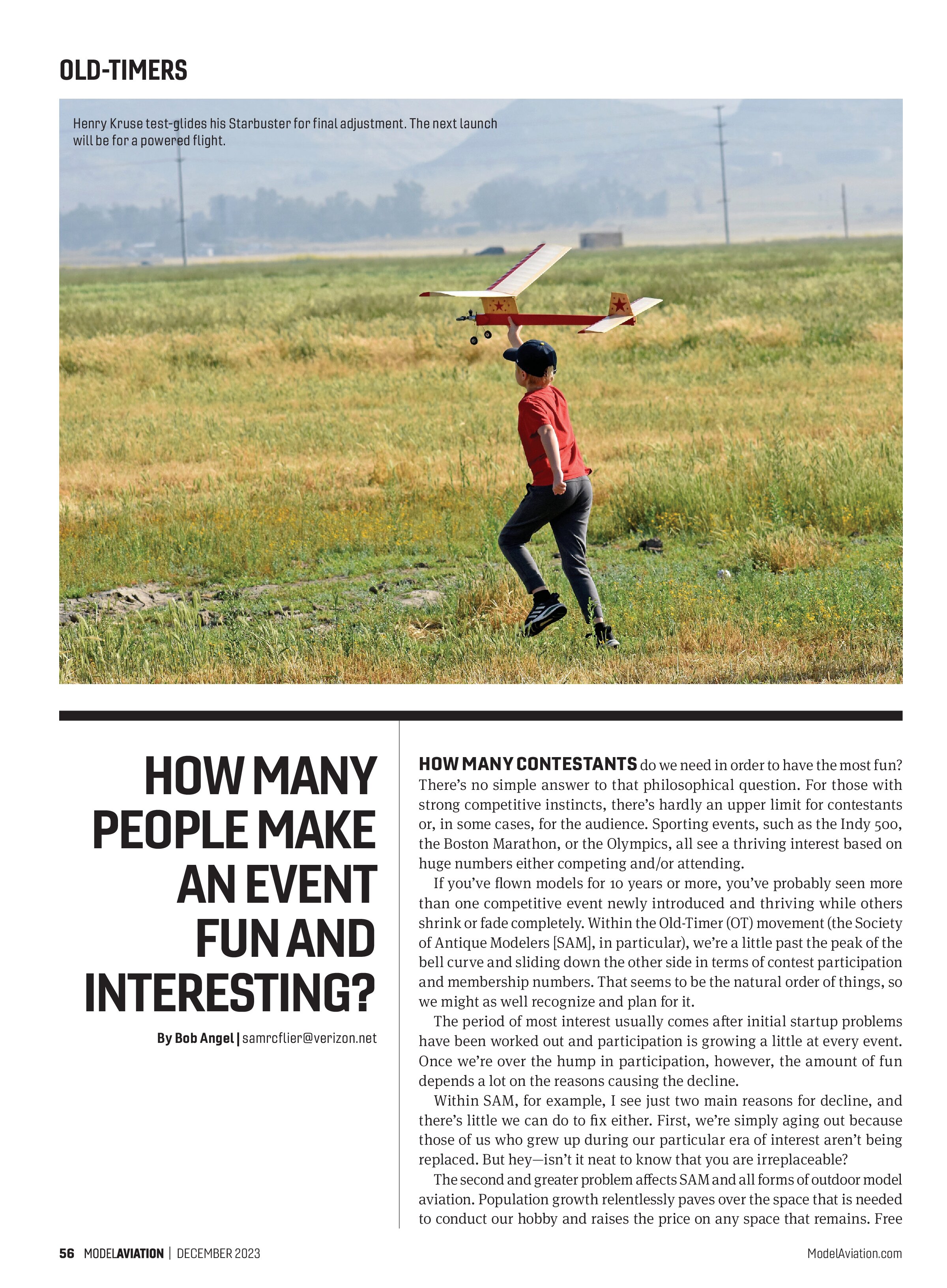
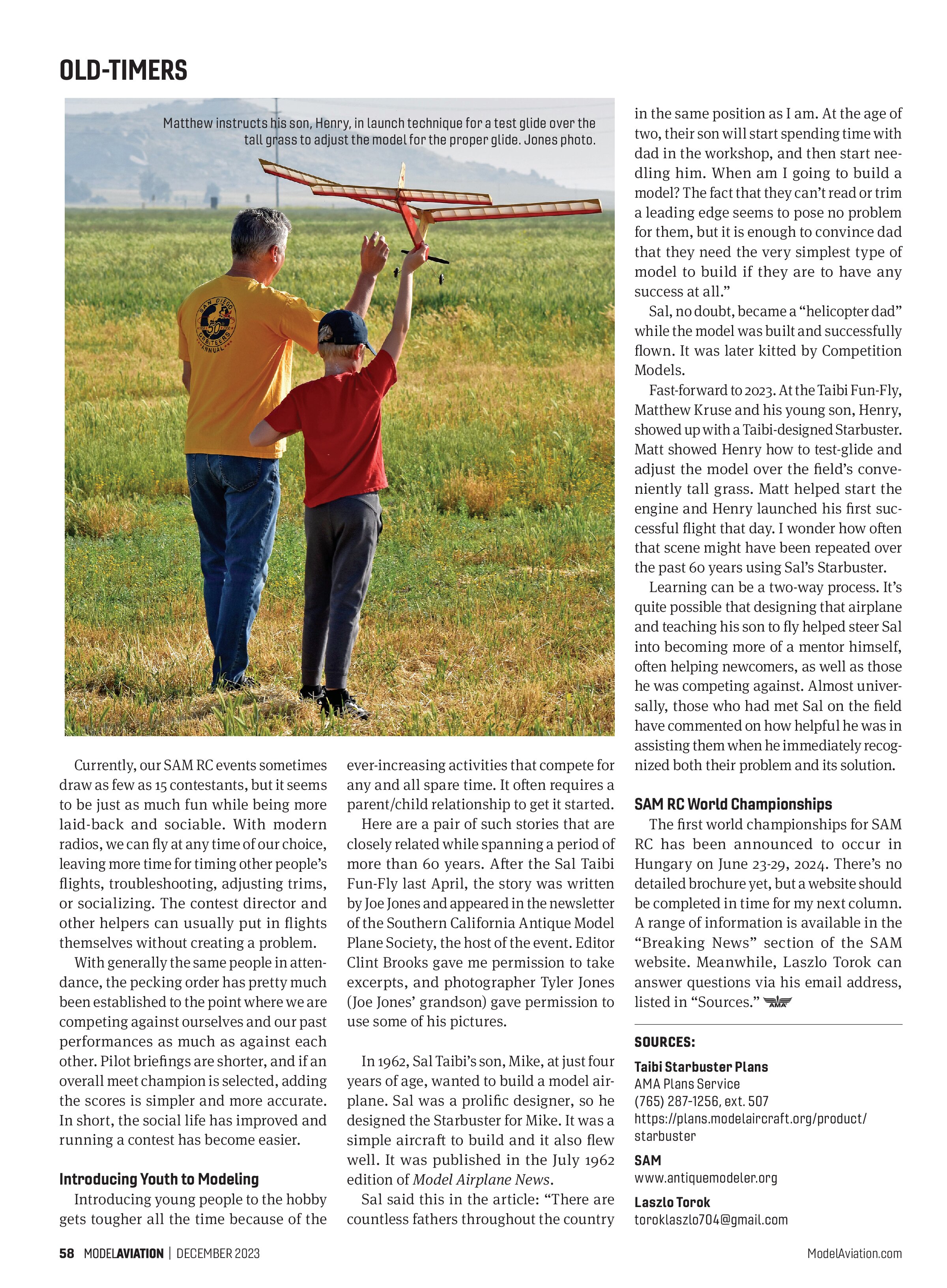
Fast-forward to 2023. At the Taibi Fun-Fly, Matthew Kruse and his young son, Henry, showed up with a Taibi-designed Starbuster. Matt showed Henry how to test-glide and adjust the model over the field’s conveniently tall grass. Matt helped start the engine and Henry launched his first successful flight that day. I wonder how often that scene might have been repeated over the past 60 years using Sal’s Starbuster.
Learning can be a two-way process. It’s quite possible that designing that airplane and teaching his son to fly helped steer Sal into becoming more of a mentor himself, often helping newcomers, as well as those he was competing against. Almost universally, those who had met Sal on the field have commented on how helpful he was in assisting them when he immediately recognized both their problem and its solution.
SAM RC World Championships
The first world championships for SAM RC has been announced to occur in Hungary on June 23-29, 2024. There’s no detailed brochure yet, but a website should be completed in time for my next column. A range of information is available in the “Breaking News” section of the SAM website. Meanwhile, Laszlo Torok can answer questions via his email address, listed in “Sources.”
SOURCES:
Taibi Starbuster Plans
AMA Plans Service
(765) 287-1256, ext. 507
https://plans.modelaircraft.org/product/starbuster
Laszlo Torok
toroklaszlo704@gmail.com