WILLIT
Photos provided by Joe Hass | joehass@gmail.com

GOING THROUGH
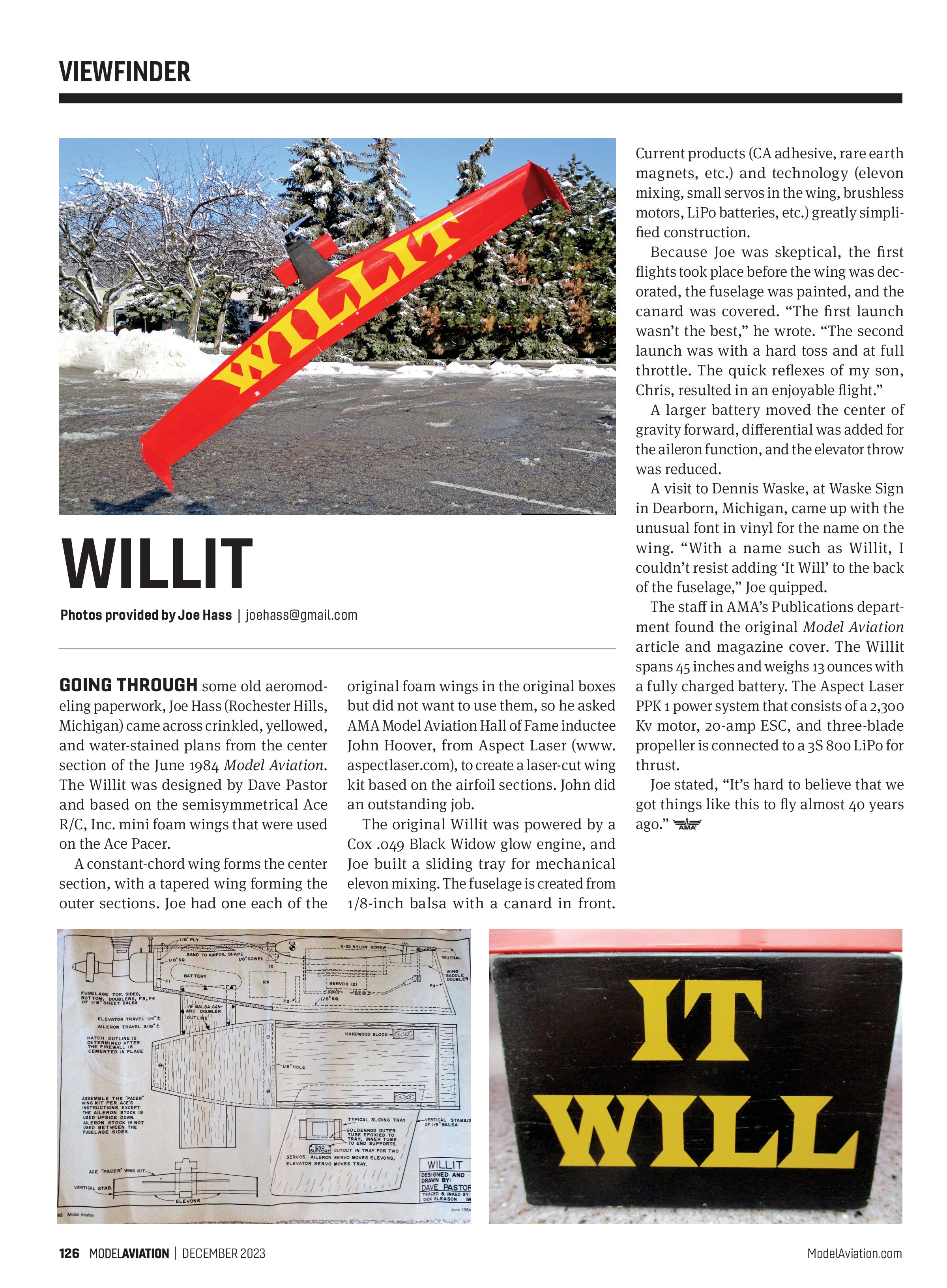
some old aeromodeling paperwork, Joe Hass (Rochester Hills, Michigan) came across crinkled, yellowed, and water-stained plans from the center section of the June 1984 Model Aviation. The Willit was designed by Dave Pastor and based on the semisymmetrical Ace R/C, Inc. mini foam wings that were used on the Ace Pacer.
A constant-chord wing forms the center section, with a tapered wing forming the outer sections. Joe had one each of the original foam wings in the original boxes but did not want to use them, so he asked AMA Model Aviation Hall of Fame inductee John Hoover, from Aspect Laser (www.aspectlaser.com), to create a laser-cut wing kit based on the airfoil sections. John did an outstanding job.
The original Willit was powered by a Cox .049 Black Widow glow engine, and Joe built a sliding tray for mechanical elevon mixing. The fuselage is created from 1/8-inch balsa with a canard in front.
Current products (CA adhesive, rare earth magnets, etc.) and technology (elevon mixing, small servos in the wing, brushless motors, LiPo batteries, etc.) greatly simplified construction.
Because Joe was skeptical, the first flights took place before the wing was decorated, the fuselage was painted, and the canard was covered. “The first launch wasn’t the best,” he wrote. “The second launch was with a hard toss and at full throttle. The quick reflexes of my son, Chris, resulted in an enjoyable flight.”
A larger battery moved the center of gravity forward, differential was added for the aileron function, and the elevator throw was reduced.
A visit to Dennis Waske, at Waske Sign in Dearborn, Michigan, came up with the unusual font in vinyl for the name on the wing. “With a name such as Willit, I couldn’t resist adding ‘It Will’ to the back of the fuselage,” Joe quipped.
The staff in AMA’s Publications department found the original Model Aviation article and magazine cover. The Willit spans 45 inches and weighs 13 ounces with a fully charged battery. The Aspect Laser PPK 1 power system that consists of a 2,300 Kv motor, 20-amp ESC, and three-blade propeller is connected to a 3S 800 LiPo for thrust.
Joe stated, “It’s hard to believe that we got things like this to fly almost 40 years ago.”


RICH JORN
Executive Director of the Paramount Theatre
By Jay Smith | jays@modelaircraft.org
JAY SMITH: How did you become involved with model aviation?
RICH JORN: I was born into the hobby. My dad got involved in his early teens, so it’s always been a part of my life. We did HO-scale trains, fishing, and building and flying RC airplanes. My brothers and I enjoyed them all, but RC airplanes were by far our favorite. We still bond over model aviation to this day.
JS: How has model aviation impacted your life and/or career?
RJ: I started my career in theater, building scenery for plays and musicals. I got put in charge of the sets in high school because I could read a tape measure, read plans, follow instructions, understood scale, was good at choosing color schemes, and had basic knowledge of tools ... all of which I learned from building train layouts and balsa airplanes—mostly airplanes. I often joke that if it weren’t for model aviation, I probably wouldn’t have a career in entertainment.
JS: What disciplines of modeling do you currently participate in?
RJ: I absolutely love the Old-Timer (OT) airplanes. Although my dad never competed in or was a member of the Society of Antique Modelers, his passion for OT designs has certainly been passed on to me. When I was a kid, I thought he liked them because they were slow and his eyesight was bad, but now I get it. I also have a couple of gliders that I love to fly, and I look forward to being good at it someday.
JS: What other hobbies do you have?
RJ: Some aspects of my career could be considered a hobby to others. I am in an executive role these days, but I’ve made my living painting backdrops, building and designing sets, lighting design, and even some acting. Acting has always been a big thrill, but the older I get, the harder it is to memorize the lines. Also, I have recently decided to do more fishing.
JS: Who or what has influenced you the most?
RJ: Obviously, my dad was my biggest influence. My brothers inspire me. We sometimes turn into excited kids when talking about building or flying an airplane. Seeing my kids enjoy the hobby is always a thrill. My friend, Johnny Berlin, got me hooked on gliders.
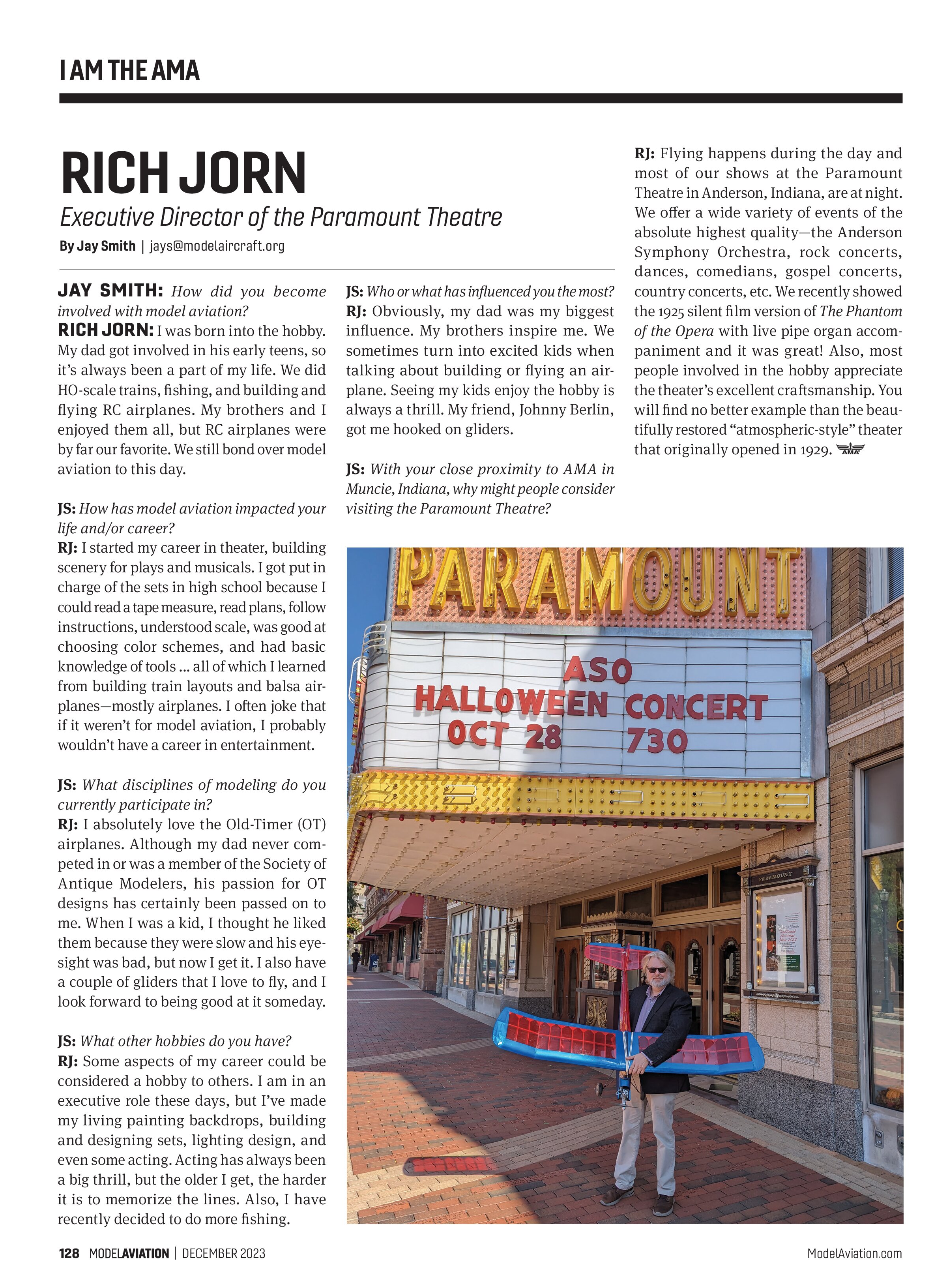
JS: With your close proximity to AMA in Muncie, Indiana, why might people consider visiting the Paramount Theatre?

RJ: Flying happens during the day and most of our shows at the Paramount Theatre in Anderson, Indiana, are at night. We offer a wide variety of events of the absolute highest quality—the Anderson Symphony Orchestra, rock concerts, dances, comedians, gospel concerts, country concerts, etc. We recently showed the 1925 silent film version of The Phantom of the Opera with live pipe organ accompaniment and it was great! Also, most people involved in the hobby appreciate the theater’s excellent craftsmanship. You will find no better example than the beautifully restored “atmospheric-style” theater that originally opened in 1929.