FOCAL POINT
Interested in sharing your handiwork? Visit www.ModelAviation.com for submission guidelines.

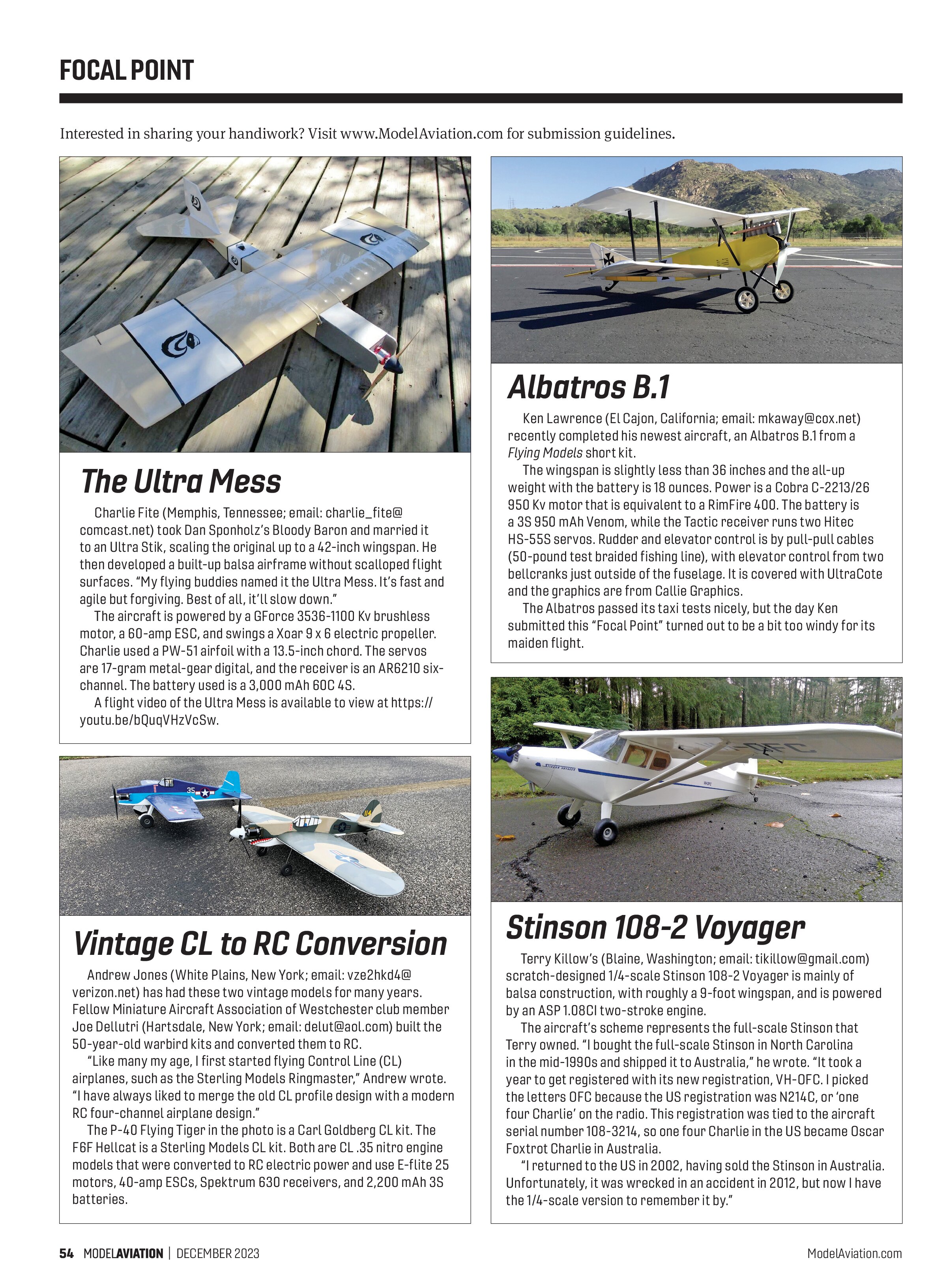
The Ultra Mess
Charlie Fite (Memphis, Tennessee; email: charlie_fite@comcast.net) took Dan Sponholz’s Bloody Baron and married it to an Ultra Stik, scaling the original up to a 42-inch wingspan. He then developed a built-up balsa airframe without scalloped flight surfaces. “My flying buddies named it the Ultra Mess. It’s fast and agile but forgiving. Best of all, it’ll slow down.”
The aircraft is powered by a GForce 3536-1100 Kv brushless motor, a 60-amp ESC, and swings a Xoar 9 x 6 electric propeller. Charlie used a PW-51 airfoil with a 13.5-inch chord. The servos are 17-gram metal-gear digital, and the receiver is an AR6210 six-channel. The battery used is a 3,000 mAh 60C 4S.
A flight video of the Ultra Mess is available to view at https://youtu.be/bQuqVHzVcSw.

Vintage CL to RC Conversion
Andrew Jones (White Plains, New York; email: vze2hkd4@verizon.net) has had these two vintage models for many years. Fellow Miniature Aircraft Association of Westchester club member Joe Dellutti (Hartsdale, New York; email: delut@aol.com) built the 50-year-old warbird kits and converted them to RC.
“Like many my age, I first started flying Control Line (CL) airplanes, such as the Sterling Models Ringmaster,” Andrew wrote. “I have always liked to merge the old CL profile design with a modern RC four-channel airplane design.”
The P-40 Flying Tiger in the photo is a Carl Goldberg CL kit. The F6F Hellcat is a Sterling Models CL kit. Both are CL .35 nitro engine models that were converted to RC electric power and use E-flite 25 motors, 40-amp ESCs, Spektrum 630 receivers, and 2,200 mAh 3S batteries.

Albatros B.1
Ken Lawrence (El Cajon, California; email: mkaway@cox.net) recently completed his newest aircraft, an Albatros B.1 from a Flying Models short kit.
The wingspan is slightly less than 36 inches and the all-up weight with the battery is 18 ounces. Power is a Cobra C-2213/26 950 Kv motor that is equivalent to a RimFire 400. The battery is a 3S 950 mAh Venom, while the Tactic receiver runs two Hitec HS-55 servos. Rudder and elevator control is by pull-pull cables (50-pound test braided fishing line), with elevator control from two bellcranks just outside of the fuselage. It is covered with UltraCote and the graphics are from Callie Graphics.
The Albatros passed its taxi tests nicely, but the day Ken submitted this “Focal Point” turned out to be a bit too windy for its maiden flight.

Stinson 108-2 Voyager
Terry Killow’s (Blaine, Washington; email: tikillow@gmail.com) scratch-designed 1/4-scale Stinson 108-2 Voyager is mainly of balsa construction, with roughly a 9-foot wingspan, and is powered by an ASP 1.08CI two-stroke engine.
The aircraft’s scheme represents the full-scale Stinson that Terry owned. “I bought the full-scale Stinson in North Carolina in the mid-1990s and shipped it to Australia,” he wrote. “It took a year to get registered with its new registration, VH-OFC. I picked the letters OFC because the US registration was N214C, or ‘one four Charlie’ on the radio. This registration was tied to the aircraft serial number 108-3214, so one four Charlie in the US became Oscar Foxtrot Charlie in Australia.
“I returned to the US in 2002, having sold the Stinson in Australia. Unfortunately, it was wrecked in an accident in 2012, but now I have the 1/4-scale version to remember it by.”

Fokker-DR-I Triplane
David Kern (Huntertown, Indiana; email: dkern7@comcast.net) submitted a photo of master builder Joel Maxwell’s (Garrett, Indiana; email: maxwell6217@aol.com) 2023 winter build project, a Balsa USA 1/3-scale Fokker DR-I Triplane.
Powered by a DA-100 gas engine that swings a 28 x 10 propeller, the DR-I uses Futaba electronics with a Great War aviator pilot from Aces of Iron Productions. The aircraft is covered with Oratex and Behr latex paint. The 30-plus-pound airplane has a 94-inch wingspan and a total wing area of 3,260 sq. in.
“Always the educator, Joel would bring the construction in progress to the Fort Wayne Flying Circuits monthly member meeting to explain construction techniques and the build process,” David wrote. “Attention to detail pays off; the first flight resulted in a safe landing.”

Ryan STA Special 2007
Joe Portera’s (Sykesville, Maryland; email: joe_portera@outlook.com) Ryan STA Special 2007 is from a 1970 Sig Mfg. Craftsman kit. It features a 72-inch wingspan, is powered by a Saito 100 four-stroke engine, and weighs 9 pounds, 5 ounces.
Joe stated that the firewall required modification to accept a modern engine. Turnbuckles hold the wing wires to the fuselage and make assembly and disassembly easier. A pilot was added to further the realism of the aircraft. The Ryan’s original colors were used with MonoKote covering. “Fifteen years ago, a checkerboard covering was not available to cover the underside of wings, so 287 squares were cut by hand and applied over white MonoKote,” he stated.
Noting that an intermediate pilot would find it enjoyable to fly, Joe built the second Sig Ryan for his friend, Hank Damask, who is the South Carroll AeroModelers club secretary.

Calypso Mk2
The Calypso Mk2 was kitted by Aviomodelli in the 1980s following Hanno Prettner’s international aerobatic win with the airplane. This particular kit was “handed around” unfinished until Culpeper Model Barnstormers’ member Bill Varney passed it on for the final time to Gordon Collyer (Culpeper, Virginia; email: gl.collyer@gmail.com) to tackle its completion.
Only the kit box and the rudder were missing. The Aviomodelli Mk2 features a plastic fuselage and foam core aerosurfaces. “I found a construction review online in French and translated parts of it for some clues on construction,” Gordon stated. He completed it with electric power via a Hacker A50-16S turning a 16 x 10 propeller. A Castle Creations 75-amp Edge Lite ESC fits within the cowling, leaving space for a 6S 5,000 mAh battery to be inserted through the canopy opening to fit up against the firewall, along with the needed foam packing.
The airplane weighs 152 ounces ready to fly with fixed landing gear and provides flight times of 8 to 9 minutes. “Similar to many members who rejoined the hobby late in life, I missed out on flying many of the classic airplanes of the past,” noted Gordon. “The Calypso is a joy to fly. It is smooth and sure, just like all the old magazine reviews said it would be.”
4 x 4 x 2
Daniel Mitchell (Sparks, Nevada; email: labrat_air@1st.net) submitted an airplane that he calls the 4 x 4 x 2. “The ‘4 x 4’ part of this aircraft’s name indicates that the fuselage cross section measures 4 inches by 4 inches,” he wrote. “The ‘x 2’ was added because I had a previous airplane named 4 x 4. I designed this airplane primarily for fun-fly competition.”
The 60-inch wingspan 4 x 4 x 2 has a wing area of 720 sq. in., with an all-up weight (without the (unshown) aerotow release package) of 7.3 pounds. The wood construction is fully sheeted and features a nearly all-balsa, box-style main spar. A 6S power system (more than 200 watts per pound) provides an aggressive climb, while the traditional NACA 2415 airfoil allows the airplane to slow down quickly and land easily.