2023 FAI F3CN WORLD CHAMPIONSHIPS FOR MODEL HELICOPTERS
TEAM USA TAKES FIRST PLACE IN F3N
By Tim DiPeri
timdiperi@caseco-inc.com
Photos courtesy of the author
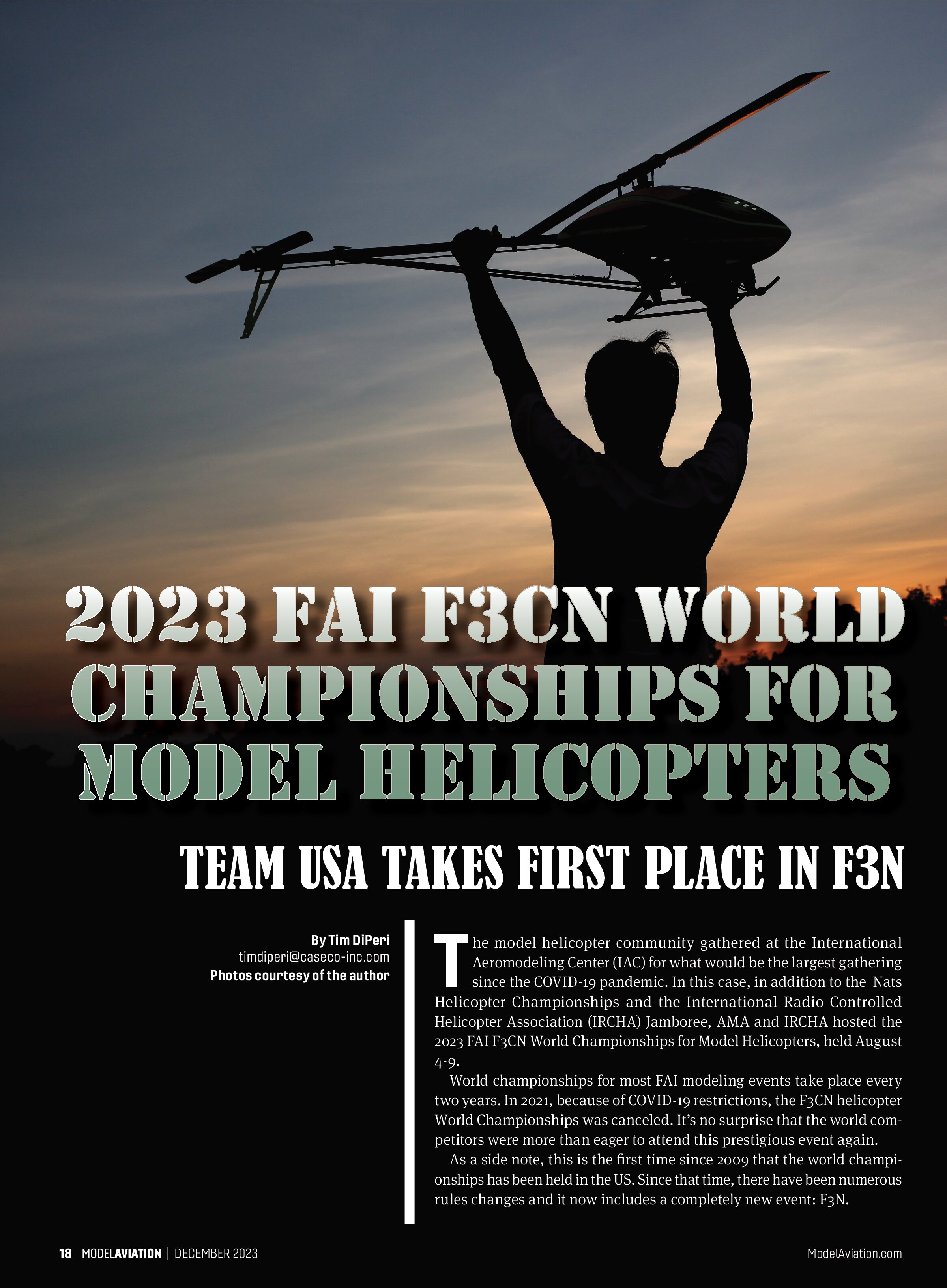
The model helicopter community gathered at the International Aeromodeling Center (IAC) for what would be the largest gathering since the COVID-19 pandemic. In this case, in addition to the Nats Helicopter Championships and the International Radio Controlled Helicopter Association (IRCHA) Jamboree, AMA and IRCHA hosted the 2023 FAI F3CN World Championships for Model Helicopters, held August 4-9.
World championships for most FAI modeling events take place every two years. In 2021, because of COVID-19 restrictions, the F3CN helicopter World Championships was canceled. It’s no surprise that the world competitors were more than eager to attend this prestigious event again.
As a side note, this is the first time since 2009 that the world championships has been held in the US. Since that time, there have been numerous rules changes and it now includes a completely new event: F3N.

For those who are unfamiliar with the competition, F3C is closely related to RC Aerobatics (Pattern) and must follow a clear and specific schedule. Everyone flies the same pattern, and contestants are judged by several judges. There is no deviation from the expected flights.
F3N is more what people would see as freestyle flying. There are multiple “different” rounds and they combine published maneuvers chosen (by each pilot) with K factors and exciting demonstration-style flying. One round includes music. This aggressive style of flying is judged by symmetry, precision, consistency, and overall impression, in addition to other parameters.
On to the Contest
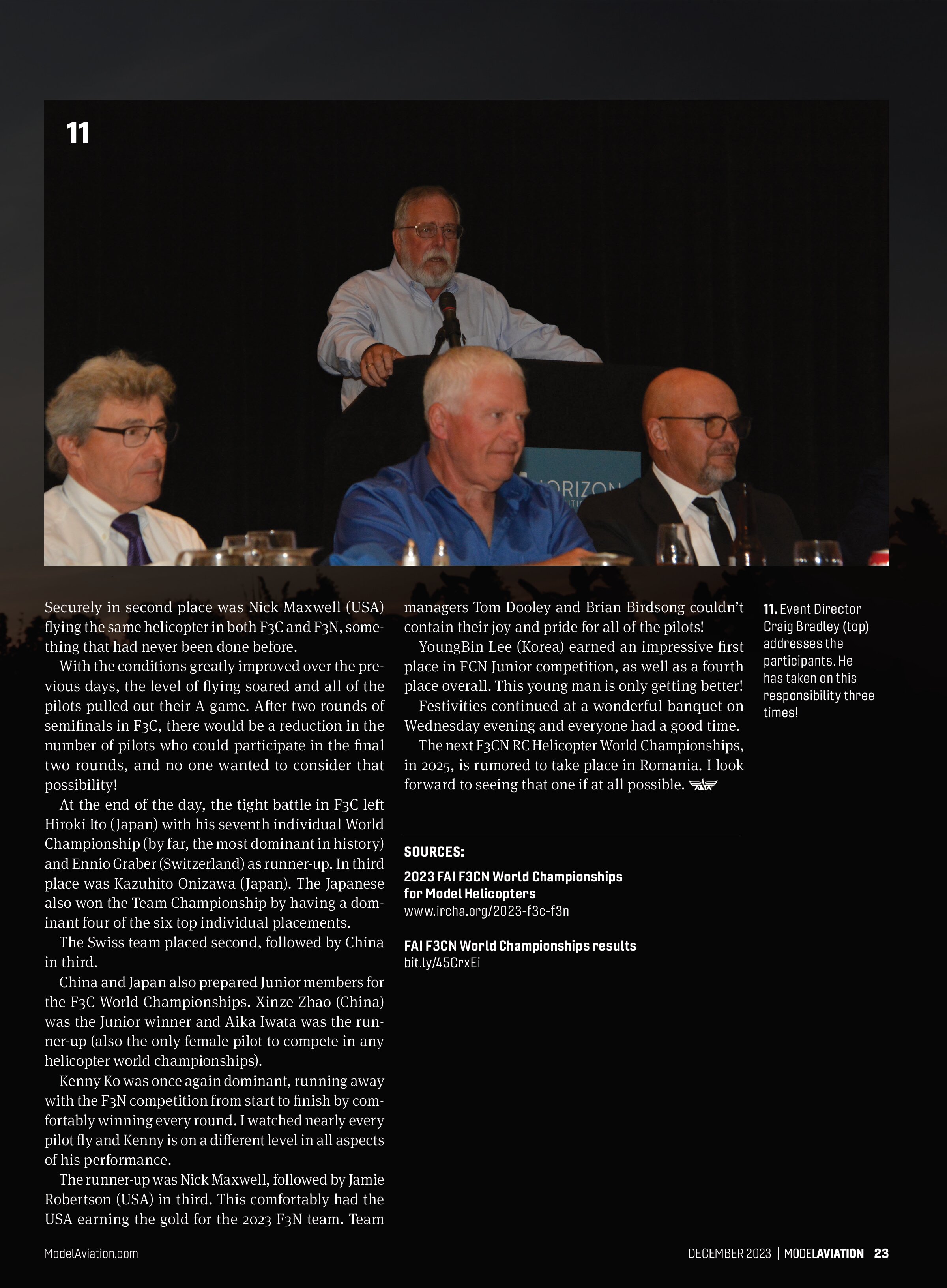
Event Director Craig Bradley has taken on this responsibility the three times that the World Championships have been held at the IAC—in 2001, 2009, and 2023. I don’t think any event director at any world championships has been involved for this long. Craig is a dedicated person, has been involved in IRCHA for many years, and has done a great job.
Teams from around the world began arriving at the beginning of August. Having been involved in a number of world championships, it’s typical for teams to want to get a feel for the conditions near the actual event site.
Although members of each team are permitted one “official” practice flight on the actual competition flightline, it’s normal for pilots to practice many, many flights in dedicated practice areas.
Model Processing
Teams began arriving at the competition site up to a week early. This allowed for practice and to get past the jet lag before the competition began. Actual

processing is relatively simple but time consuming. Each team is required (at a set time slot) to bring the model to be used in competition to an inspection area and to provide a declaration for the pilot and model.
The organizers (IRCHA) inspect some FAI-required parameters of each helicopter and endorse or reject the pilot’s paperwork (the pilot can fix something if needed) for the entry model. Items such as the total weight (ready to fly) and the rotor disk area are required to meet a particular criterion. To my knowledge, all passed without modification.
Official Practice
Again, for those who have never experienced a world championship, there are some interesting processes. Although any pilot can practice for as long as they choose, each contestant is entitled to only “official” practice flights on the actual competition flightline. All other practice flights must take place at another location. The practice day for all competitors was the Saturday before the first day of the competition.
Opening Ceremony
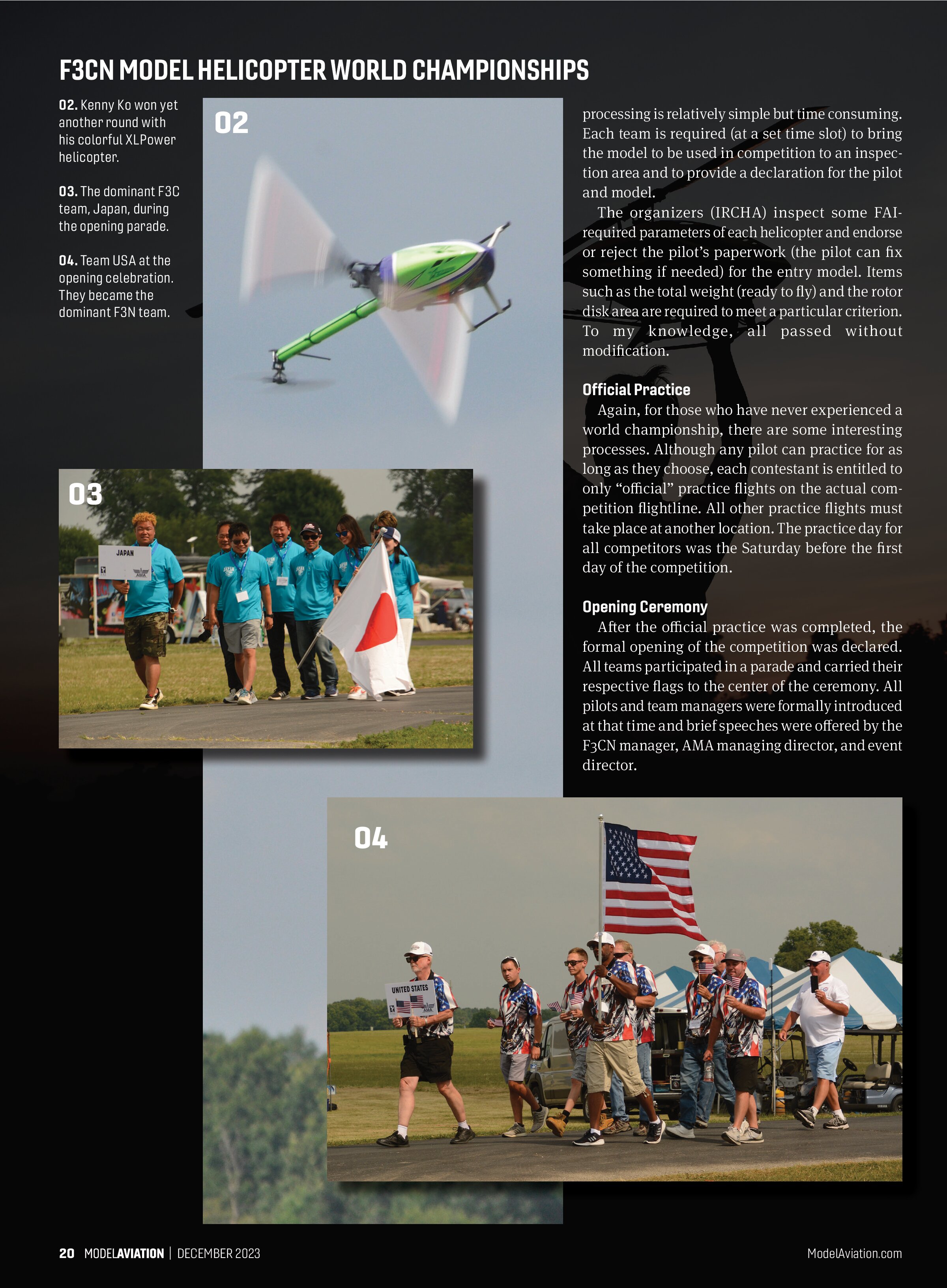
After the official practice was completed, the formal opening of the competition was declared. All teams participated in a parade and carried their respective flags to the center of the ceremony. All pilots and team managers were formally introduced at that time and brief speeches were offered by the F3CN manager, AMA managing director, and event director.


Preliminary Rounds
All contestants are entitled to a fixed number of initial flight rounds of competition for F3C and F3N. At the end of the four preliminary rounds, a percentage of top-scoring pilots continue to the final competition rounds.
Sunday morning began the competitions for F3C and F3N (two separate flightlines and two different sets of judges). Calibration flights are required beforehand to help judges understand where each one discovers mistakes and provide a formal score.
This is normally the only time (other than when


there is a “zero” recommended that the judges will formally discuss scoring during a round.
Competition flight-time slots are precisely documented to allow for smooth and timely operation of the event. Having a time slot also makes it possible to know a daily schedule so that pilots and team managers can most efficiently utilize their time and efforts.
Finals Rounds
We ducked and dodged rain during the preliminary rounds but finished them all on time. On Tuesday morning, we were delighted to see the sun and a blue sky for the beginning of the final flight schedules. F3C competitors moved to the semifinal rounds, flying the final schedule maneuvers.
At the end of the preliminary rounds, the top two pilots were separated by less than six normalized points out of 3,000! Very few points separated third through seventh places, so the finals were sure to be an exciting competition in F3C.
Kenny Ko (Taiwan) dominated the F3N preliminary rounds with a perfect score, winning all rounds.

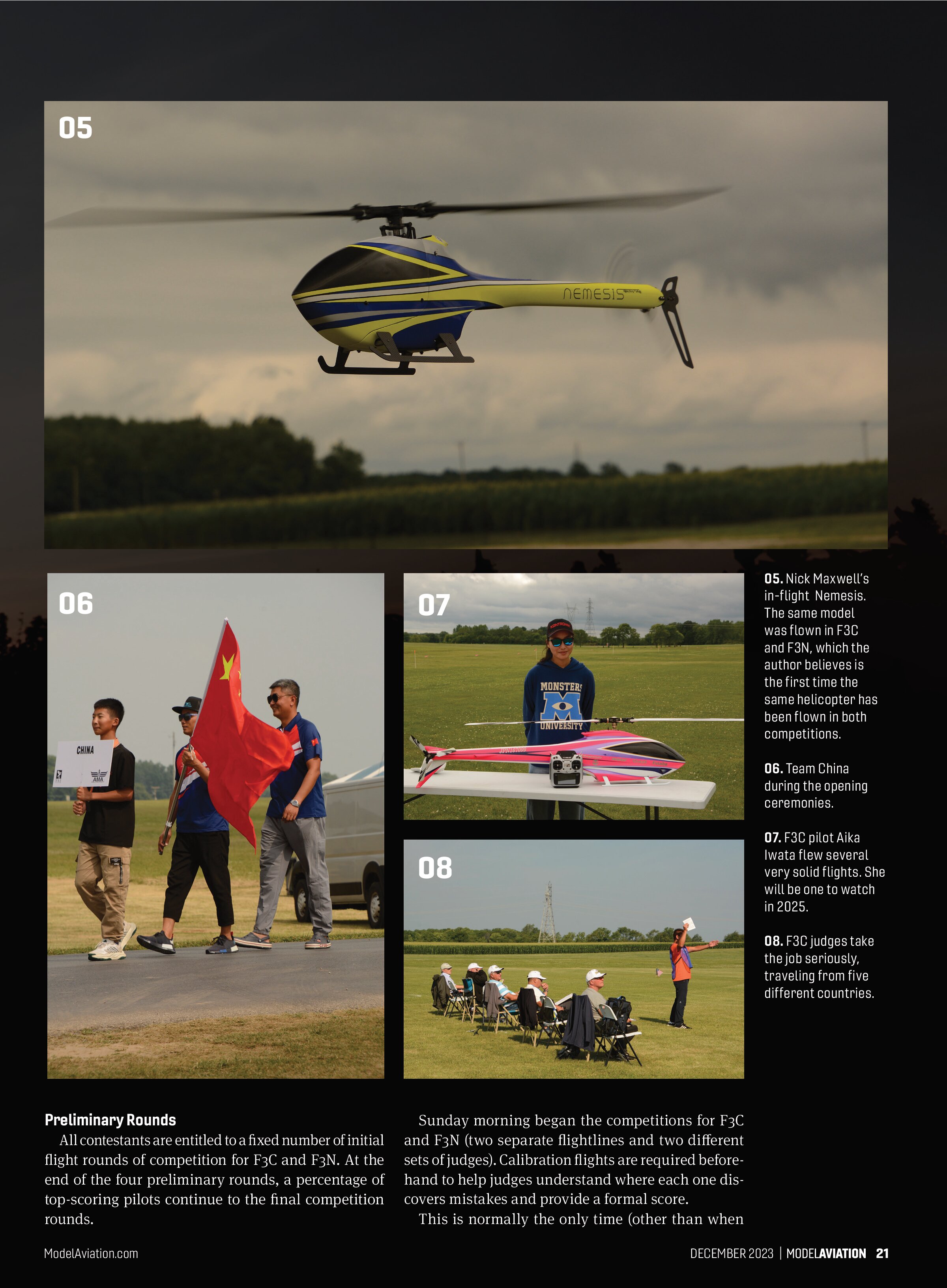
Securely in second place was Nick Maxwell (USA) flying the same helicopter in both F3C and F3N, something that had never been done before.
With the conditions greatly improved over the previous days, the level of flying soared and all of the pilots pulled out their A game. After two rounds of semifinals in F3C, there would be a reduction in the number of pilots who could participate in the final two rounds, and no one wanted to consider that possibility!
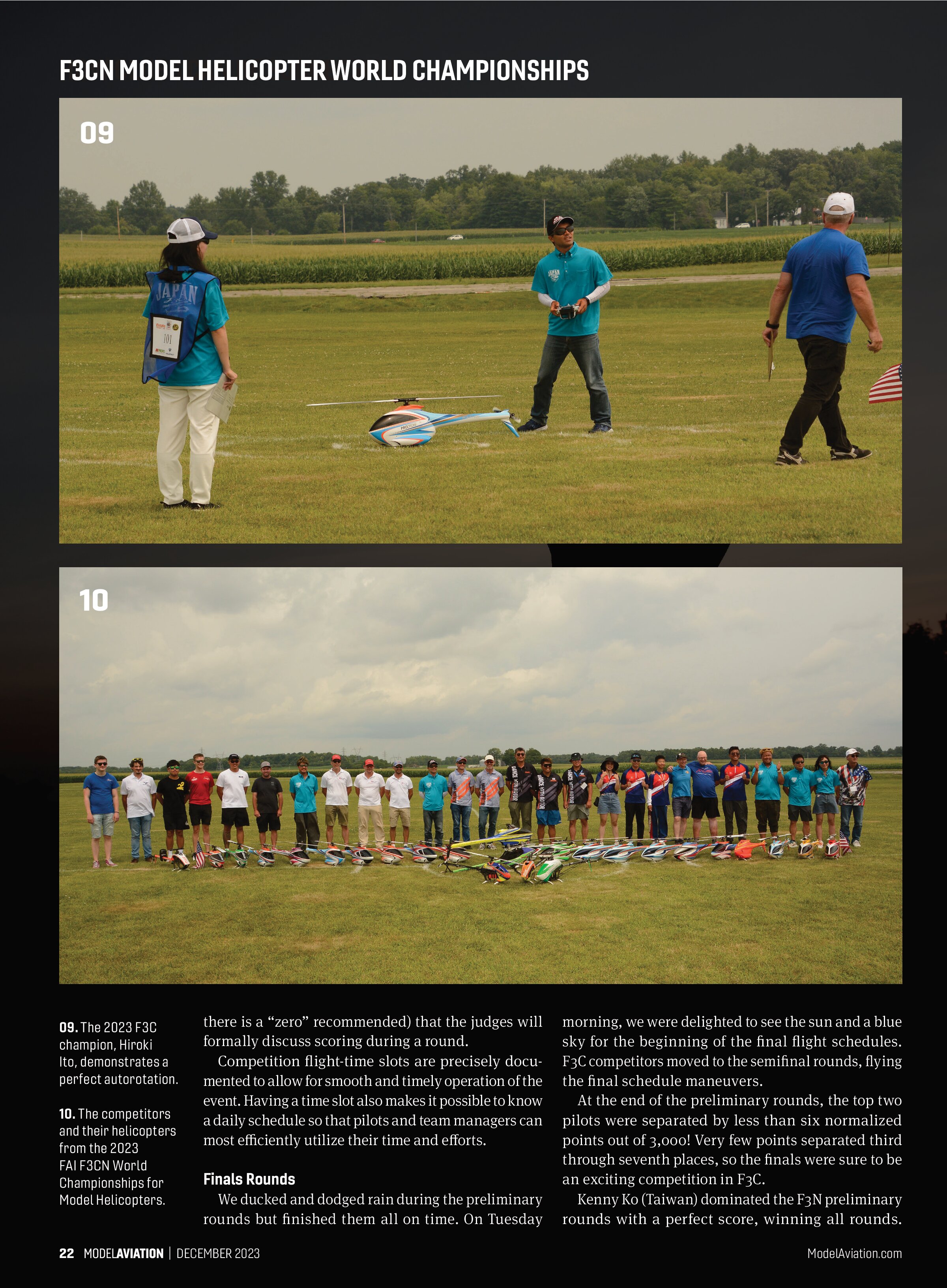
At the end of the day, the tight battle in F3C left Hiroki Ito (Japan) with his seventh individual World Championship (by far, the most dominant in history) and Ennio Graber (Switzerland) as runner-up. In third place was Kazuhito Onizawa (Japan). The Japanese also won the Team Championship by having a dominant four of the six top individual placements.
The Swiss team placed second, followed by China in third.
China and Japan also prepared Junior members for the F3C World Championships. Xinze Zhao (China) was the Junior winner and Aika Iwata was the runner-up (also the only female pilot to compete in any helicopter world championships).
Kenny Ko was once again dominant, running away with the F3N competition from start to finish by comfortably winning every round. I watched nearly every pilot fly and Kenny is on a different level in all aspects of his performance.
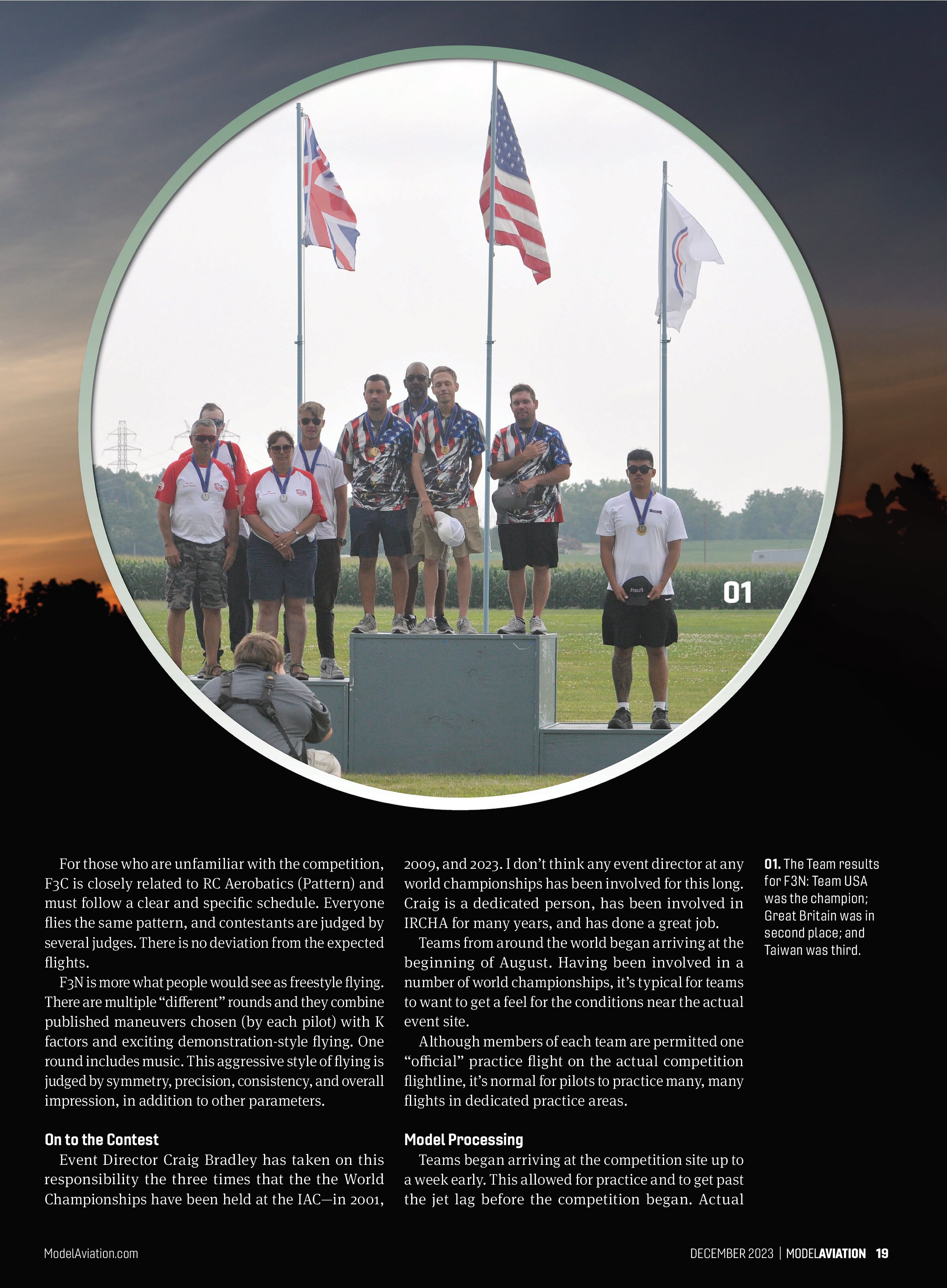
The runner-up was Nick Maxwell, followed by Jamie Robertson (USA) in third. This comfortably had the USA earning the gold for the 2023 F3N team. Team managers Tom Dooley and Brian Birdsong couldn’t contain their joy and pride for all of the pilots!
YoungBin Lee (Korea) earned an impressive first place in FCN Junior competition, as well as a fourth place overall. This young man is only getting better!
Festivities continued at a wonderful banquet on Wednesday evening and everyone had a good time.
The next F3CN RC Helicopter World Championships, in 2025, is rumored to take place in Romania. I look forward to seeing that one if at all possible.
Sources:
2023 FAI F3CN World Championships for Model Helicopters
www.ircha.org/2023-f3c-f3n
FAI F3CN World Championships results
bit.ly/45CrxEi