SKY’S THE LIMIT

of you have also alluded to changes in my personal life via emails; yes, there have been. I’m grateful to have had the past experiences I have, which led me down a path of true discovery. People and life change.
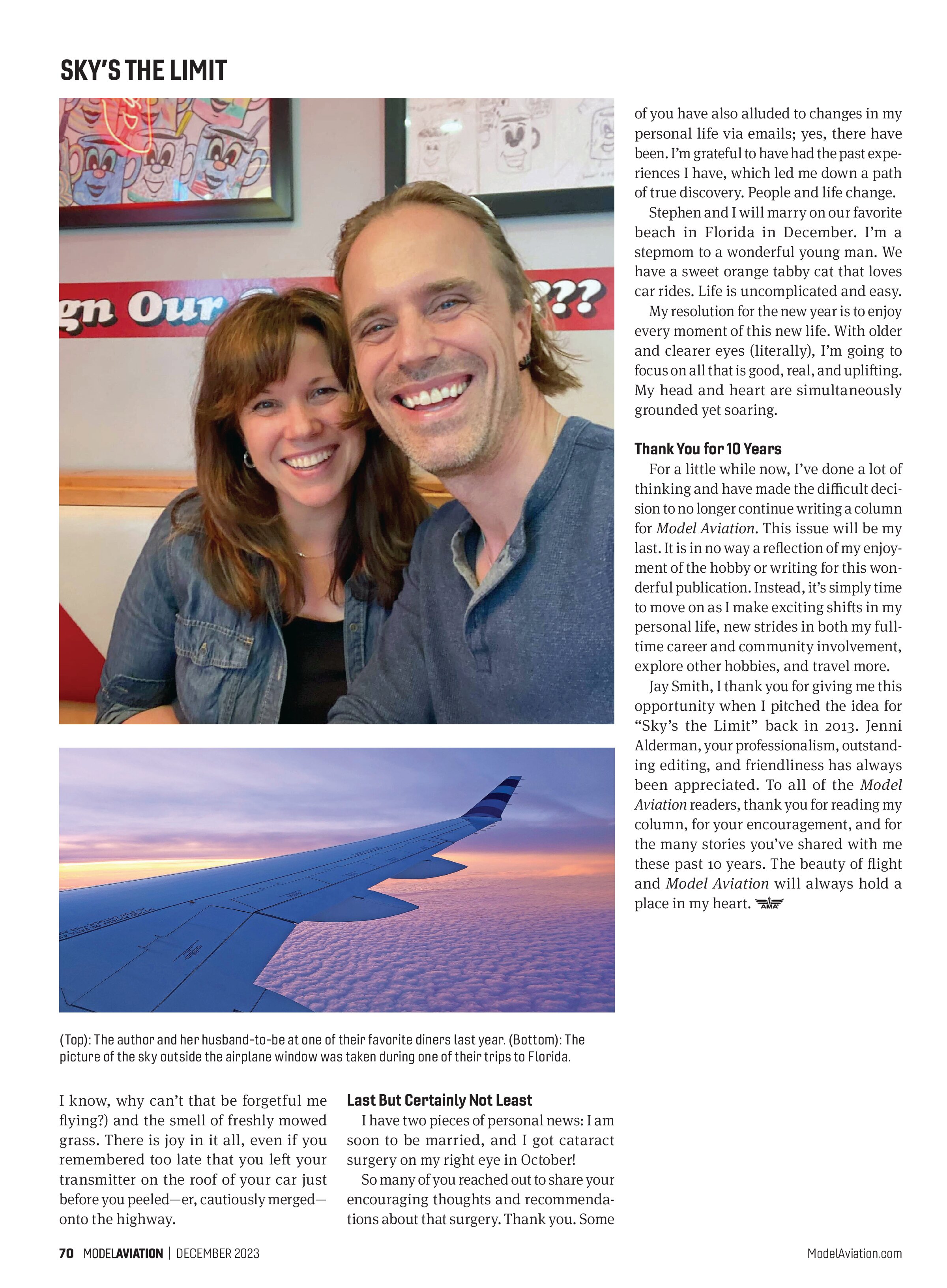
Stephen and I will marry on our favorite beach in Florida in December. I’m a stepmom to a wonderful young man. We have a sweet orange tabby cat that loves car rides. Life is uncomplicated and easy.
My resolution for the new year is to enjoy every moment of this new life. With older and clearer eyes (literally), I’m going to focus on all that is good, real, and uplifting. My head and heart are simultaneously grounded yet soaring.
Thank You for 10 Years
For a little while now, I’ve done a lot of thinking and have made the difficult decision to no longer continue writing a column for Model Aviation. This issue will be my last. It is in no way a reflection of my enjoyment of the hobby or writing for this wonderful publication. Instead, it’s simply time to move on as I make exciting shifts in my personal life, new strides in both my full-time career and community involvement, explore other hobbies, and travel more.
Jay Smith, I thank you for giving me this opportunity when I pitched the idea for “Sky’s the Limit” back in 2013. Jenni Alderman, your professionalism, outstanding editing, and friendliness has always been appreciated. To all of the Model Aviation readers, thank you for reading my column, for your encouragement, and for the many stories you’ve shared with me these past 10 years. The beauty of flight and Model Aviation will always hold a place in my heart.

I know, why can’t that be forgetful me flying?) and the smell of freshly mowed grass. There is joy in it all, even if you remembered too late that you left your transmitter on the roof of your car just before you peeled—er, cautiously merged—onto the highway.
Last But Certainly Not Least
I have two pieces of personal news: I am soon to be married, and I got cataract surgery on my right eye in October!
So many of you reached out to share your encouraging thoughts and recommendations about that surgery. Thank you. Some

IT’S PART LUCK AND IT’S PART SKILL.
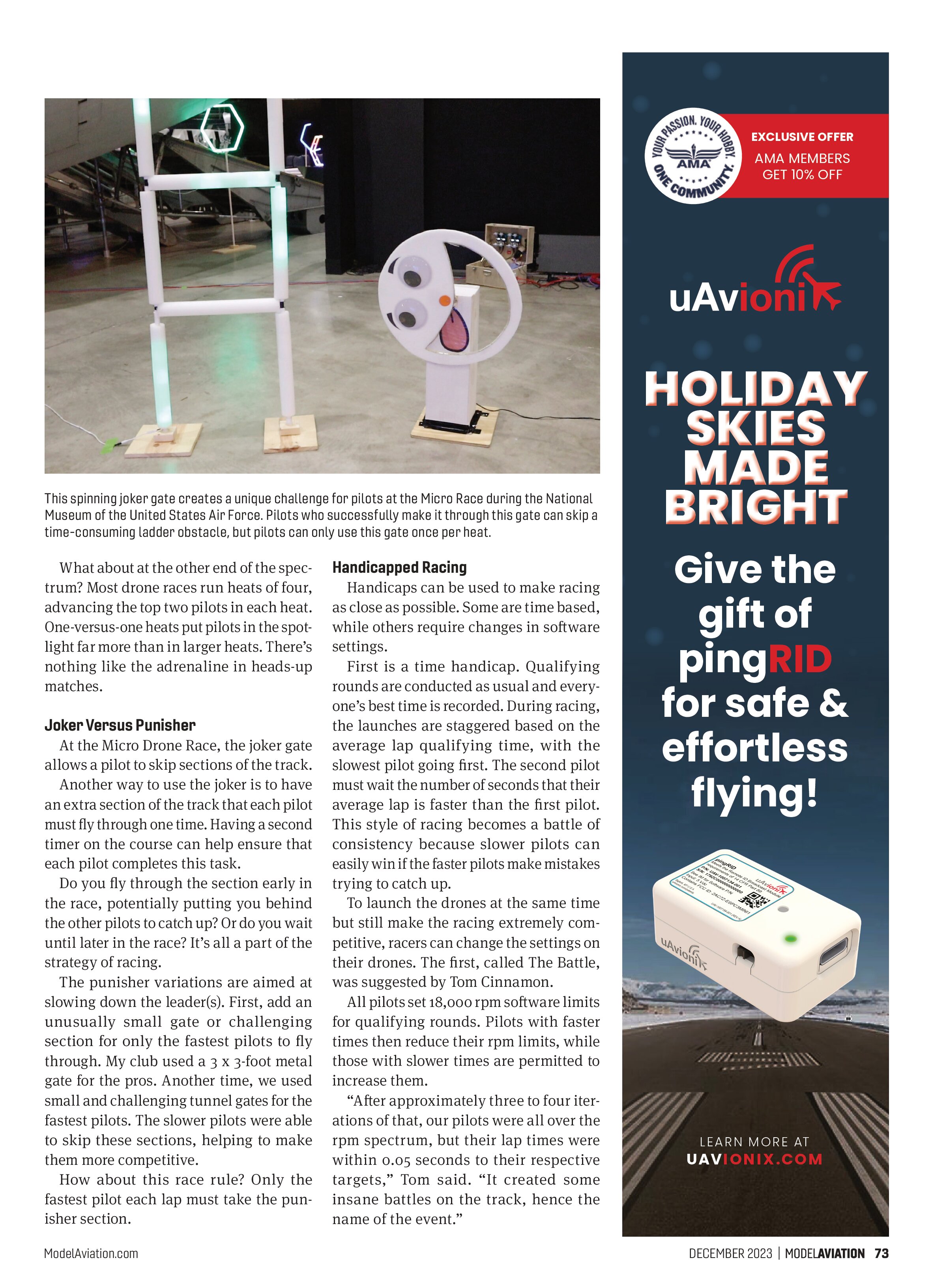
The googly-eyed, spinning smiley face gate taunts pilots in every heat at the Micro Drone Race that was held at the National Museum of the United States Air Force in Dayton, Ohio.
Pilots get one chance in their three-lap run to use the gate to bypass a time-consuming ladder gate. Make the gate and that shortened lap can move you up a spot. Miss the gate and you’ve squandered an opportunity. Accidentally doing the gate twice disqualifies you from that run.
Joker gates are one variation in drone racing, but there are many other ways to change it up, with the goal of creating closer races that are enjoyable for all skill levels.
From Teams to Individuals
Traditional team racing pairs four or more pilots. The aim is to have a drone in the air at all times. Because pilots can turn their video on and off with their radio controllers, drones are plugged in and ready to go when the previous pilot lands.
But what about at local races? How can we include slower or newer pilots so that they can also experience the fun of team racing?
Some clubs run individual qualifying rounds before pairing the fastest pilots with the slowest. Every pilot needs to fly in order. The result is that, across the teams, the skill level averages out. The teams are more evenly matched and the slower pilots are just as important to team results. Consistency—not speed alone—is king.

What about at the other end of the spectrum? Most drone races run heats of four, advancing the top two pilots in each heat. One-versus-one heats put pilots in the spotlight far more than in larger heats. There’s nothing like the adrenaline in heads-up matches.
Joker Versus Punisher
At the Micro Drone Race, the joker gate allows a pilot to skip sections of the track.
Another way to use the joker is to have an extra section of the track that each pilot must fly through one time. Having a second timer on the course can help ensure that each pilot completes this task.
Do you fly through the section early in the race, potentially putting you behind the other pilots to catch up? Or do you wait until later in the race? It’s all a part of the strategy of racing.
The punisher variations are aimed at slowing down the leader(s). First, add an unusually small gate or challenging section for only the fastest pilots to fly through. My club used a 3 x 3-foot metal gate for the pros. Another time, we used small and challenging tunnel gates for the fastest pilots. The slower pilots were able to skip these sections, helping to make them more competitive.
How about this race rule? Only the fastest pilot each lap must take the punisher section.
Handicapped Racing
Handicaps can be used to make racing as close as possible. Some are time based, while others require changes in software settings.
First is a time handicap. Qualifying rounds are conducted as usual and everyone’s best time is recorded. During racing, the launches are staggered based on the average lap qualifying time, with the slowest pilot going first. The second pilot must wait the number of seconds that their average lap is faster than the first pilot. This style of racing becomes a battle of consistency because slower pilots can easily win if the faster pilots make mistakes trying to catch up.
To launch the drones at the same time but still make the racing extremely competitive, racers can change the settings on their drones. The first, called the Battle, was suggested by Tom Cinnamon.
All pilots set 18,000 rpm software limits for qualifying rounds. Pilots with faster times then reduce their rpm limits, while those with slower times are permitted to increase them.
“After approximately three to four iterations of that, our pilots were all over the rpm spectrum, but their lap times were within 0.05 seconds to their respective targets,” Tom said. “It created some insane battles on the track, hence the name of the event.”