1973 NATS
WITHOUT
U.S. NAVY
SUPPORT
By Bob Noll | bobrc@aol.com

I FOUND FOUR MAGAZINES in my files from November 1973 that I will take a look at to see what was going on in RC 50 years ago. They are Model Airplane News (MAN), Flying Models (FM), American Aircraft Modeler (AAM) and Radio Control Modeler (RCM).
A construction article in MAN was about the Miss Crescent City, written by Allen Wiltz. It was a beautiful, medium-size trainer. This airplane put the lie to the belief that all of our trainers must be ugly boxes. Miss Crescent City had classic lines—it was smooth, sleek, and quite slim.
The 1973 version of the Nats was AMA’s first effort in 25 years without U.S. Navy support. As John Worth, AMA’s former executive director, pointed out at the event’s RC banquet, “It’s remarkable we were even able to pull it off.”
The first Nats that I attended was hosted and staffed by the Navy. At that time, the competitions rotated throughout the country on a four-year cycle, moving from Naval Air Engineering Station Lakehurst in New Jersey to Naval Air Station Glenview in Illinois, Naval Air Station Los Alamitos in California, and Naval Air Station Dallas in Texas. I attended the Nats at Lakehurst, Glenview, and Los Alamitos. Not liking heat because I am a northerner, I decided not to attend the Nats in Dallas.
All of the events were held in one week. I remember flying Pylon Racing in the morning and RC Aerobatics (Pattern) in the afternoon during the week. When the weekend came, it was time for RC Scale. This format gave me a chance to see all of the other events in one week, something not possible at today’s Nats, which takes place throughout a month.

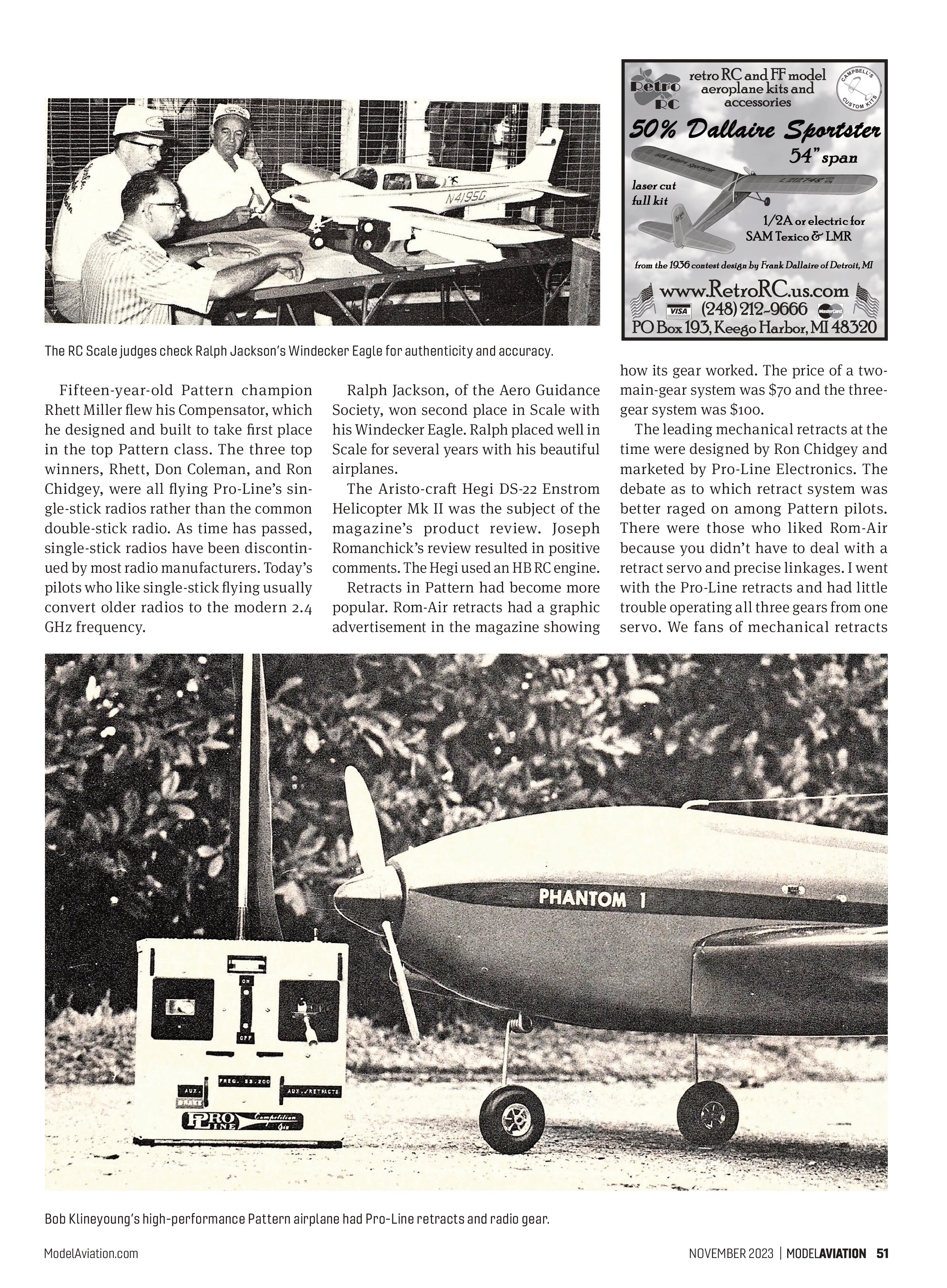
Fifteen-year-old Pattern champion Rhett Miller flew his Compensator, which he designed and built to take first place in the top Pattern class. The three top winners, Rhett, Don Coleman, and Ron Chidgey, were all flying Pro-Line’s single-stick radios rather than the common double-stick radio. As time has passed, single-stick radios have been discontinued by most radio manufacturers. Today’s pilots who like single-stick flying usually convert older radios to the modern 2.4 GHz frequency.
Ralph Jackson, of the Aero Guidance Society, won second place in Scale with his Windecker Eagle. Ralph placed well in Scale for several years with his beautiful airplanes.
The Aristo-craft Hegi DS-22 Enstrom Helicopter Mk II was the subject of the magazine’s product review. Joseph Romanchick’s review resulted in positive comments. The Hegi used an HB RC engine.
Retracts in Pattern had become more popular. Rom-Air retracts had a graphic advertisement in the magazine showing how its gear worked. The price of a two-main-gear system was $70 and the three-gear system was $100.
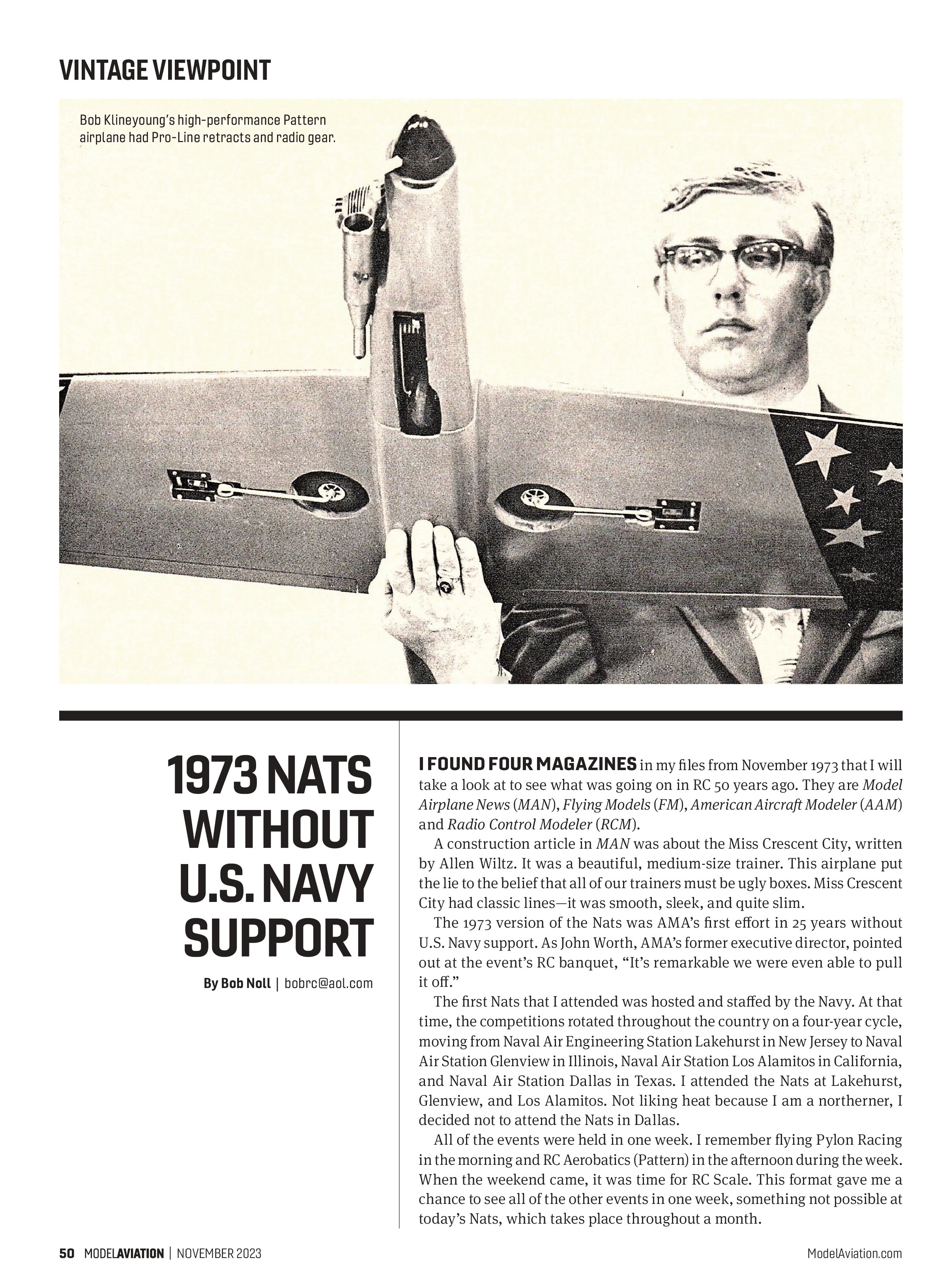
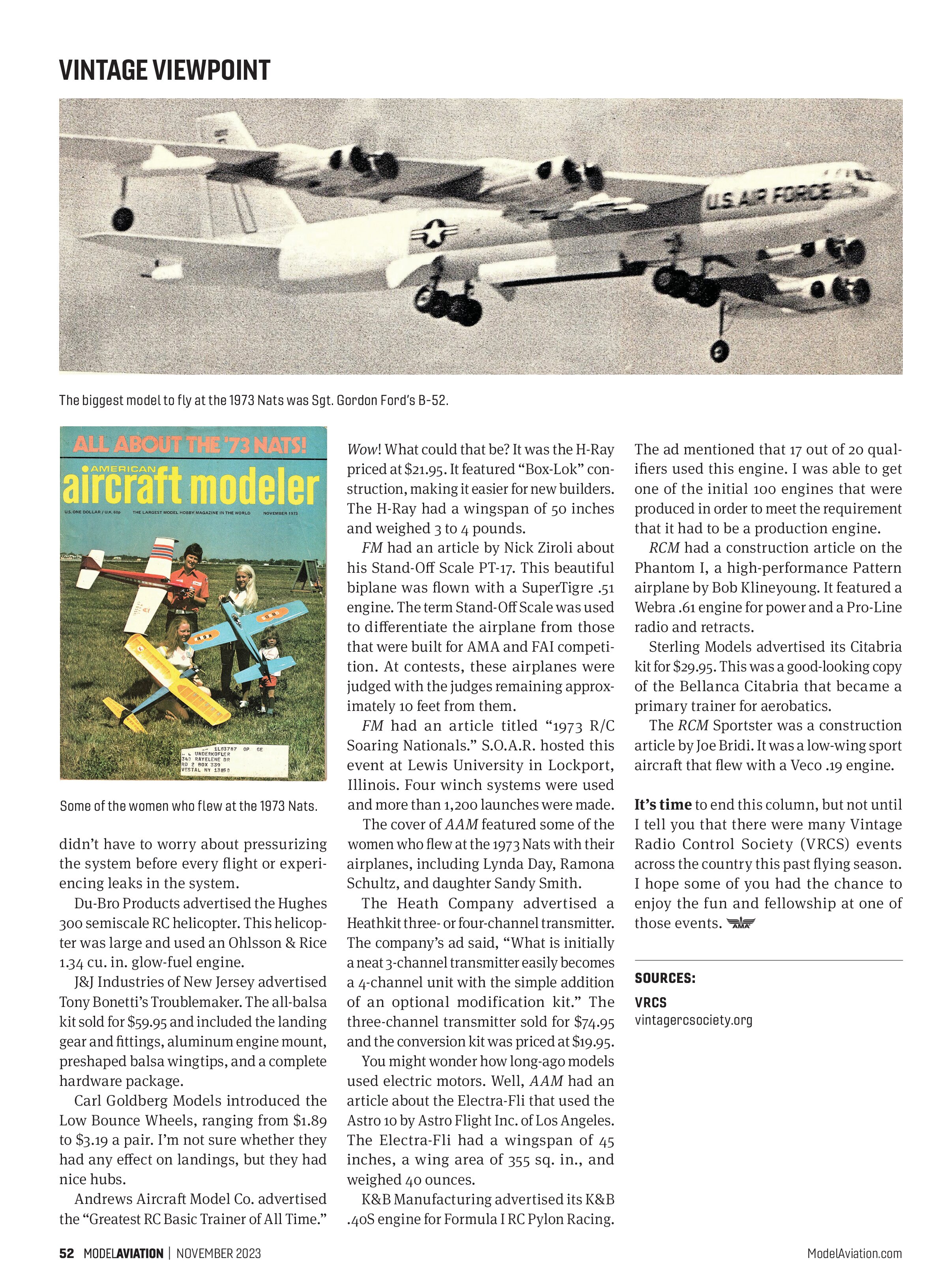
The leading mechanical retracts at the time were designed by Ron Chidgey and marketed by Pro-Line Electronics. The debate as to which retract system was better raged on among Pattern pilots. There were those who liked Rom-Air because you didn’t have to deal with a retract servo and precise linkages. I went with the Pro-Line retracts and had little trouble operating all three gears from one servo. We fans of mechanical retracts


The biggest model to fly at the 1973 Nats was Sgt. Gordon Ford’s B-52.

didn’t have to worry about pressurizing the system before every flight or experiencing leaks in the system.
Du-Bro Products advertised the Hughes 300 semiscale RC helicopter. This helicopter was large and used an Ohlsson & Rice 1.3/4 cu. in. glow-fuel engine.
J&J Industries of New Jersey advertised Tony Bonetti’s Troublemaker. The all-balsa kit sold for $59.95 and included the landing gear and fittings, aluminum engine mount, preshaped balsa wingtips, and a complete hardware package.
Carl Goldberg Models introduced the Low Bounce Wheels, ranging from $1.89 to $3.19 a pair. I’m not sure whether they had any effect on landings, but they had nice hubs.
Andrews Aircraft Model Co. advertised the “Greatest RC Basic Trainer of All Time.”
Wow! What could that be? It was the H-Ray priced at $21.95. It featured “Box-Lok” construction, making it easier for new builders. The H-Ray had a wingspan of 50 inches and weighed 3 to 4 pounds.
FM had an article by Nick Ziroli about his Stand-Off Scale PT-17. This beautiful biplane was flown with a SuperTigre .51 engine. The term Stand-Off Scale was used to differentiate the airplane from those that were built for AMA and FAI competition. At contests, these airplanes were judged with the judges remaining approximately 10 feet from them.
FM had an article titled “1973 R/C Soaring Nationals.” S.O.A.R. hosted this event at Lewis University in Lockport, Illinois. Four winch systems were used and more than 1,200 launches were made.
The cover of AAM featured some of the women who flew at the 1973 Nats with their airplanes, including Lynda Day, Ramona Schultz, and daughter Sandy Smith.
The Heath Company advertised a Heathkit three- or four-channel transmitter. The company’s ad said, “What is initially a neat 3-channel transmitter easily becomes a 4-channel unit with the simple addition of an optional modification kit.” The three-channel transmitter sold for $74.95 and the conversion kit was priced at $19.95.
You might wonder how long-ago models used electric motors. Well, AAM had an article about the Electra-Fli that used the Astro 10 by Astro Flight Inc. of Los Angeles. The Electra-Fli had a wingspan of 45 inches, a wing area of 355 sq. in., and weighed 40 ounces.
K&B Manufacturing advertised its K&B .40S engine for Formula I RC Pylon Racing.
The ad mentioned that 17 out of 20 qualifiers used this engine. I was able to get one of the initial 100 engines that were produced in order to meet the requirement that it had to be a production engine.
RCM had a construction article on Phantom I, a high-performance Pattern airplane by Bob Klineyoung. It featured a Webra .61 engine for power and a Pro-Line radio and retracts.
Sterling Models advertised its Citabria kit for $29.95. This was a good-looking copy of the Bellanca Citabria that became a primary trainer for aerobatics.
The RCM Sportster was a construction article by Joe Bridi. It was a low-wing sport aircraft that flew with a Veco .19 engine.
It’s time to end this column, but not until I tell you that there were many Vintage Radio Control Society (VRCS) events across the country this past flying season. I hope some of you had the chance to enjoy the fun and fellowship at one of those events.