REMEMBERING THE GOLDBERGS
Photo provided by Norm Clark | flier55@yahoo.com

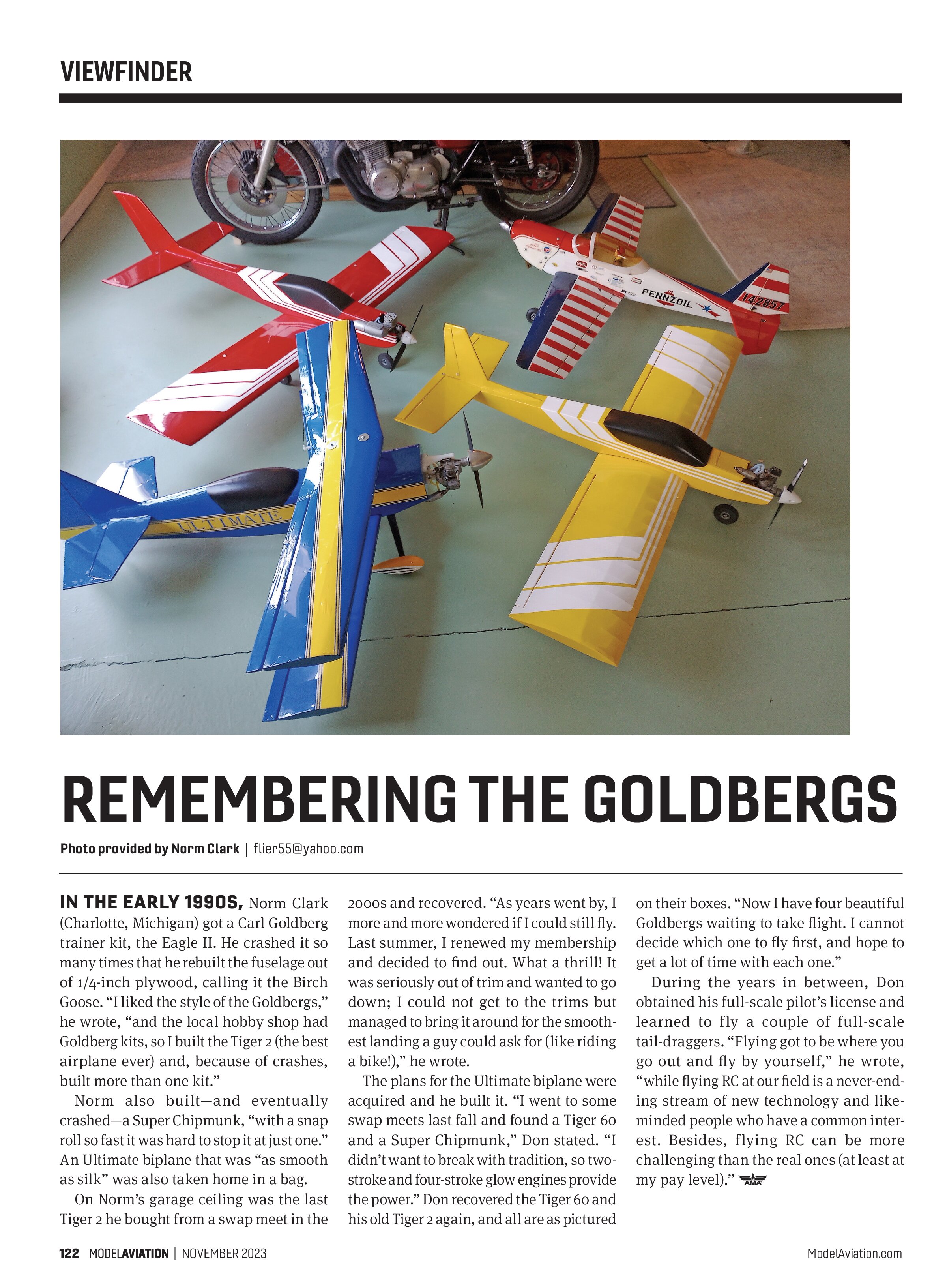
IN THE EARLY 1990S, Norm Clark (Charlotte, Michigan) got a Carl Goldberg trainer kit, the Eagle II. He crashed it so many times that he rebuilt the fuselage out of 1/4-inch plywood, calling it the Birch Goose. “I liked the style of the Goldbergs,” he wrote, “and the local hobby shop had Goldberg kits, so I built the Tiger 2 (the best airplane ever) and, because of crashes, built more than one kit.”
Norm also built—and eventually crashed—a Super Chipmunk, “with a snap roll so fast it was hard to stop it at just one.” An Ultimate biplane that was “as smooth as silk” was also taken home in a bag.
On Norm’s garage ceiling was the last Tiger 2 he bought from a swap meet in the 2000s and recovered. “As years went by, I more and more wondered if I could still fly. Last summer, I renewed my membership and decided to find out. What a thrill! It was seriously out of trim and wanted to go down; I could not get to the trims but managed to bring it around for the smoothest landing a guy could ask for (like riding a bike!),” he wrote.
The plans for the Ultimate biplane were acquired and he built it. “I went to some swap meets last fall and found a Tiger 60 and a Super Chipmunk,” Don stated. “I didn’t want to break with tradition, so two-stroke and four-stroke glow engines provide the power.” Don recovered the Tiger 60 and his old Tiger 2 again, and all are as pictured on their boxes. “Now I have four beautiful Goldbergs waiting to take flight. I cannot decide which one to fly first, and hope to get a lot of time with each one.”
During the years in between, Don obtained his full-scale pilot’s license and learned to fly a couple of full-scale tail-draggers. “Flying got to be where you go out and fly by yourself,” he wrote, “while flying RC at our field is a never-ending stream of new technology and like-minded people who have a common interest. Besides, flying RC can be more challenging than the real ones (at least at my pay level).”
MY RC AIRPLANE STORY
Photos provided by Andrew P. Jones | email: a.p.jones@verizon.net

ANDREW P. JONES (White Plains, New York) grew up in the small town of Port Chester, New York. He wrote the following:
“At the age of about 12 years old, I remember my good friend and I would walk all the way downtown to the airplane hobby store run by an elderly widow and purchase a stick-and-tissue airplane kit for $1 and a tube of Ambroid glue. We later bought an OK Cub .049 engine and had unsuccessful attempts trying to fly a Free Flight model plane that we built. We eventually graduated to U-Control [Control Line] models like the famous Ringmaster.
“As teenagers, we moved on to a deBolt Livewire RC airplane with a Galloping Ghost radio system. If the airplane didn’t crash, it was considered a successful flight.
“There was a period of college, marriage, and starting a family, but we got back together again, this time with our small children, and flew trainer-type RC airplanes that we built at a nearby field, which would later become the site of the junior high school. The 72 MHz radios at that time were much more reliable.
“As time went on, I joined an RC club near the Bronx Throgs Neck bridge called the Blue Angels. After moving to my home in White Plains in the late 1970s, I joined my current club, the Miniature Airplane Association of Westchester.
“I have always liked RC airplanes that were a little different. That is why I designed and built some of my own. Some flew good; some not so good. In the 1980s, my favorites were Combat and Pattern RC airplanes.
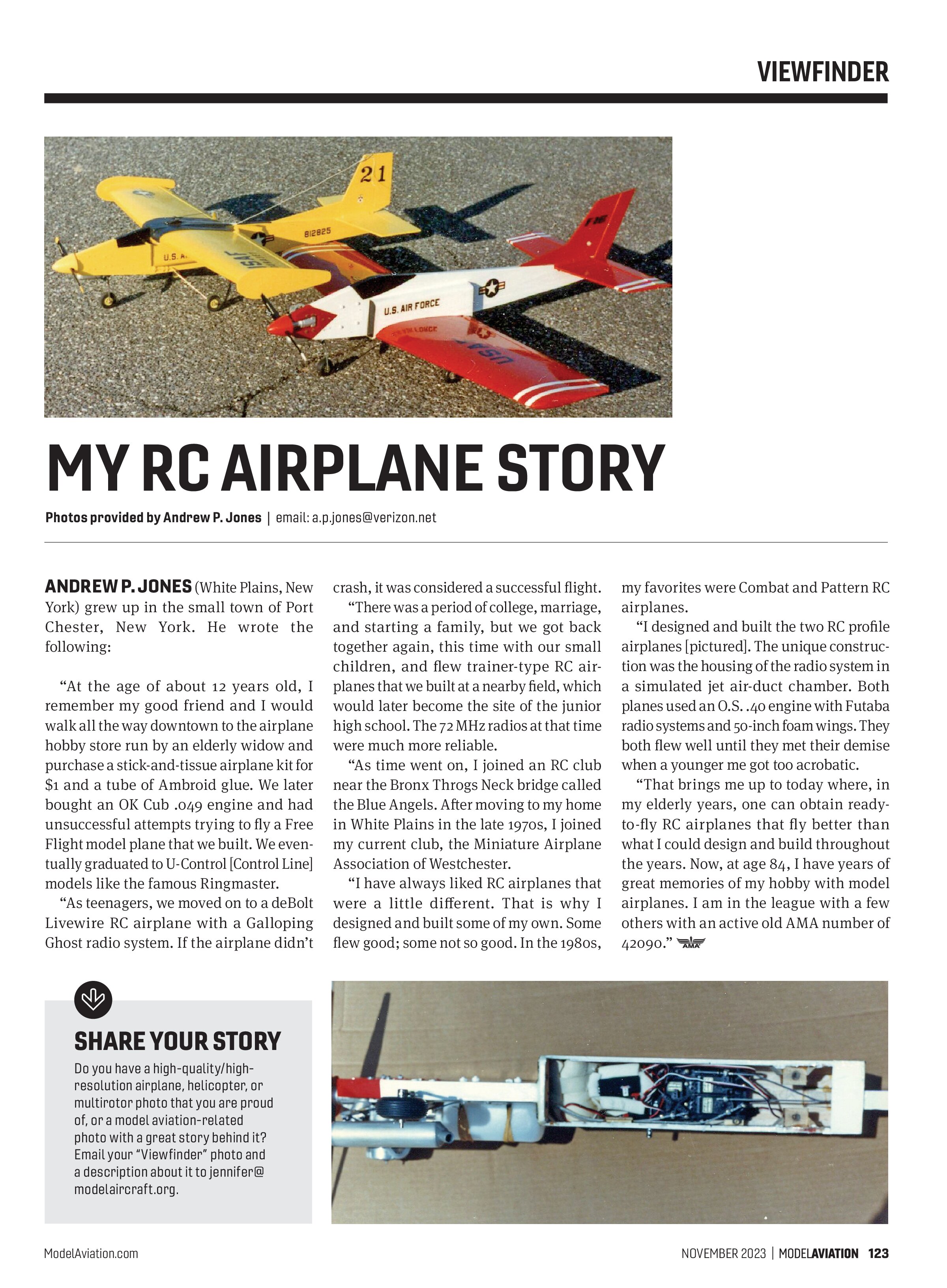
“I designed and built the two RC profile airplanes [pictured]. The unique construction was the housing of the radio system in a simulated jet air-duct chamber. Both planes used an O.S. .40 engine with Futaba radio systems and 50-inch foam wings. They both flew well until they met their demise when a younger me got too acrobatic.
“That brings me up to today where, in my elderly years, one can obtain ready-to-fly RC airplanes that fly better than what I could design and build throughout the years. Now, at age 84, I have years of great memories of my hobby with model airplanes. I am in the league with a few others with an active old AMA number of 42090.”
SHARE YOUR STORY
Do you have a high-quality/high-resolution airplane, helicopter, or multirotor photo that you are proud of, or a model aviation-related photo with a great story behind it? Email your “Viewfinder” photo and a description about it to jennifer@modelaircraft.org.