SAFETY COMES FIRST
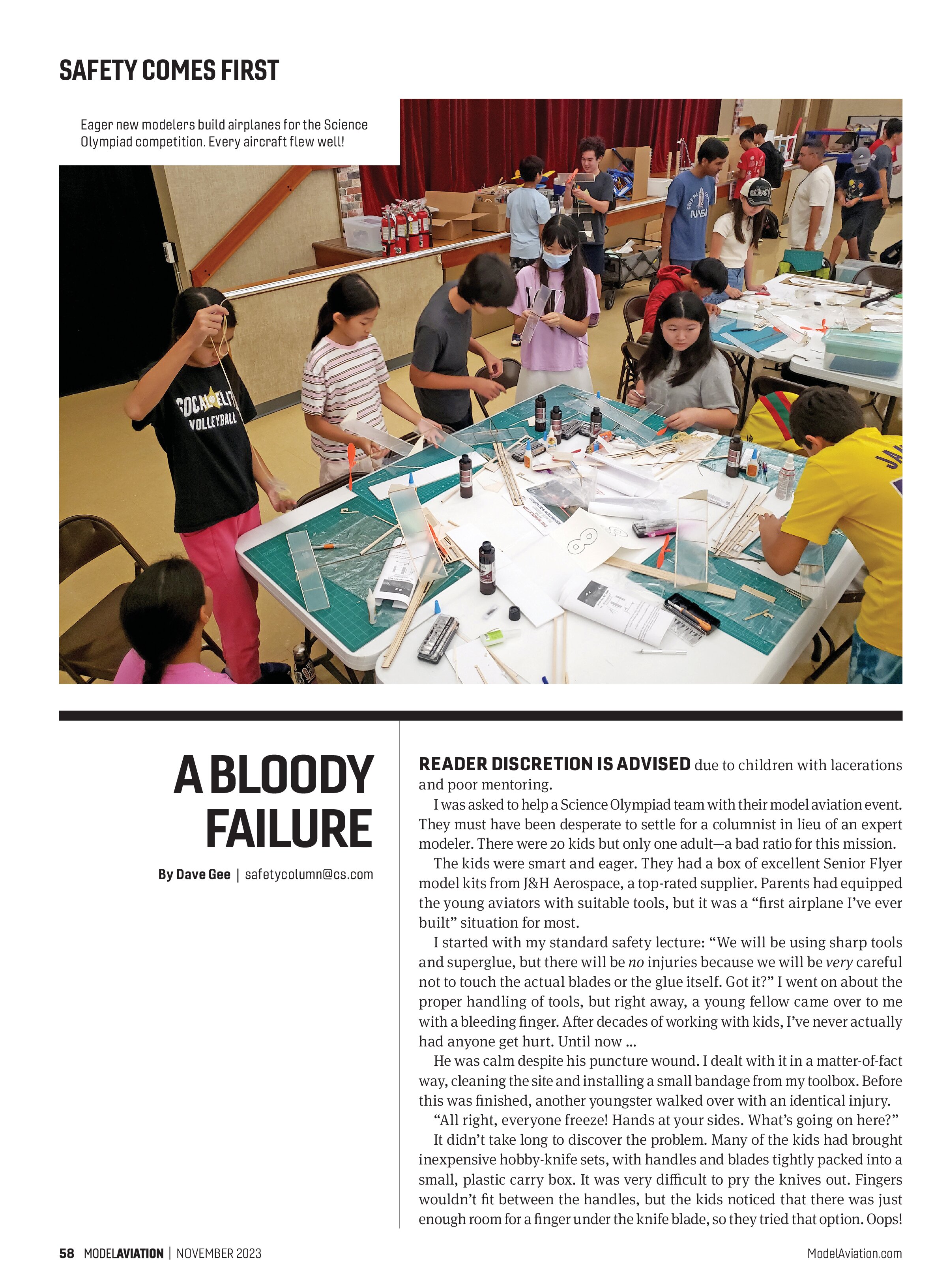
Eager new modelers build airplanes for the Science Olympiad competition. Every aircraft flew well!

A BLOODY FAILURE
By Dave Gee | safetycolumn@cs.com
READER DISCRETION IS ADVISED due to children with lacerations and poor mentoring.
I was asked to help a Science Olympiad team with their model aviation event. They must have been desperate to settle for a columnist in lieu of an expert modeler. There were 20 kids but only one adult—a bad ratio for this mission.
The kids were smart and eager. They had a box of excellent Senior Flyer model kits from J&H Aerospace, a top-rated supplier. Parents had equipped the young aviators with suitable tools, but it was a “first airplane I’ve ever built” situation for most.
I started with my standard safety lecture: “We will be using sharp tools and superglue, but there will be no injuries because we will be very careful not to touch the actual blades or the glue itself. Got it?” I went on about the proper handling of tools, but right away, a young fellow came over to me with a bleeding finger. After decades of working with kids, I’ve never actually had anyone get hurt. Until now …
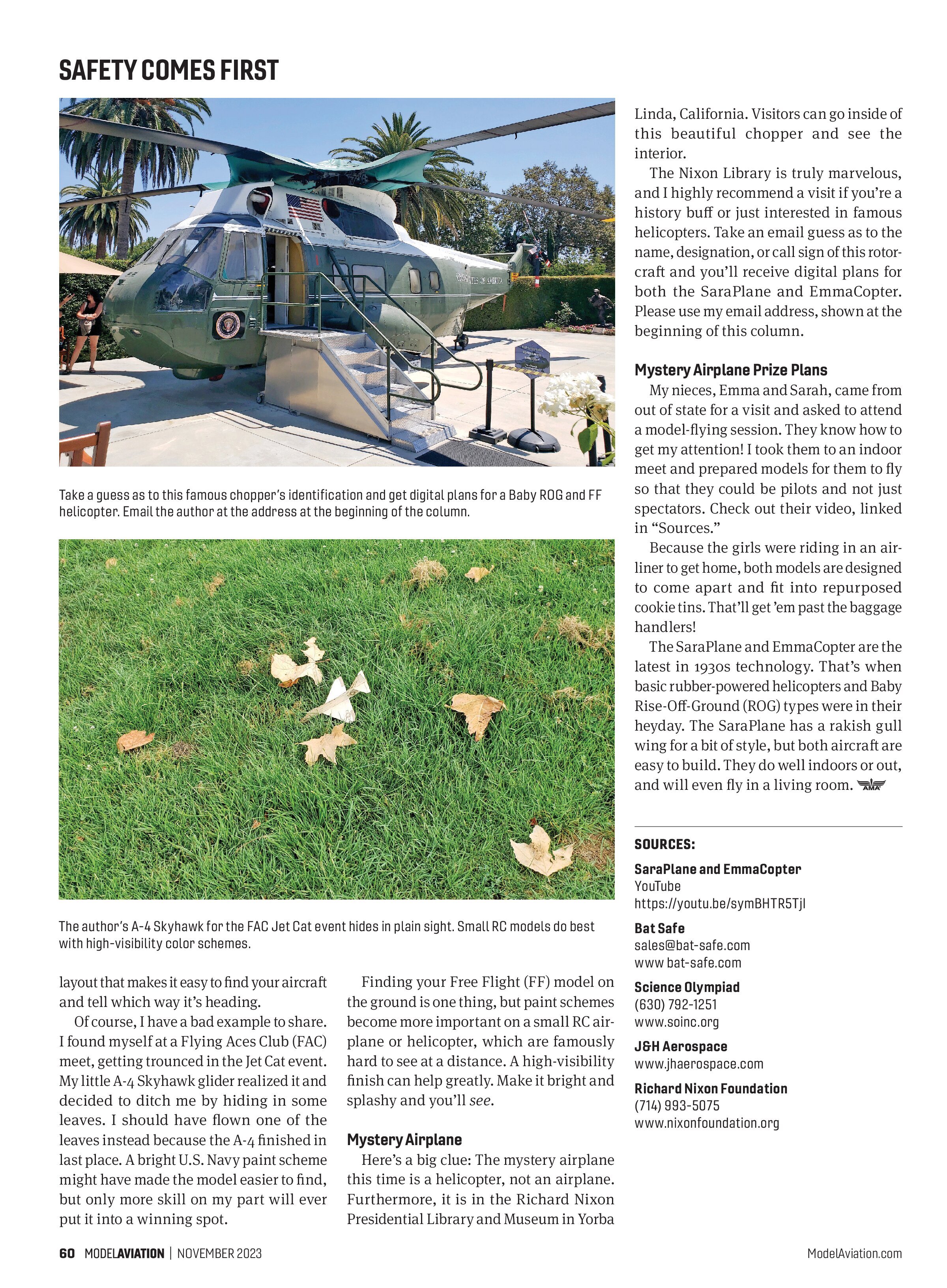
He was calm despite his puncture wound. I dealt with it in a matter-of-fact way, cleaning the site and installing a small bandage from my toolbox. Before this was finished, another youngster walked over with an identical injury.
“All right, everyone freeze! Hands at your sides. What’s going on here?”
It didn’t take long to discover the problem. Many of the kids had brought inexpensive hobby-knife sets, with handles and blades tightly packed into a small, plastic carry box. It was very difficult to pry the knives out. Fingers wouldn’t fit between the handles, but the kids noticed that there was just enough room for a finger under the knife blade, so they tried that option. Oops!

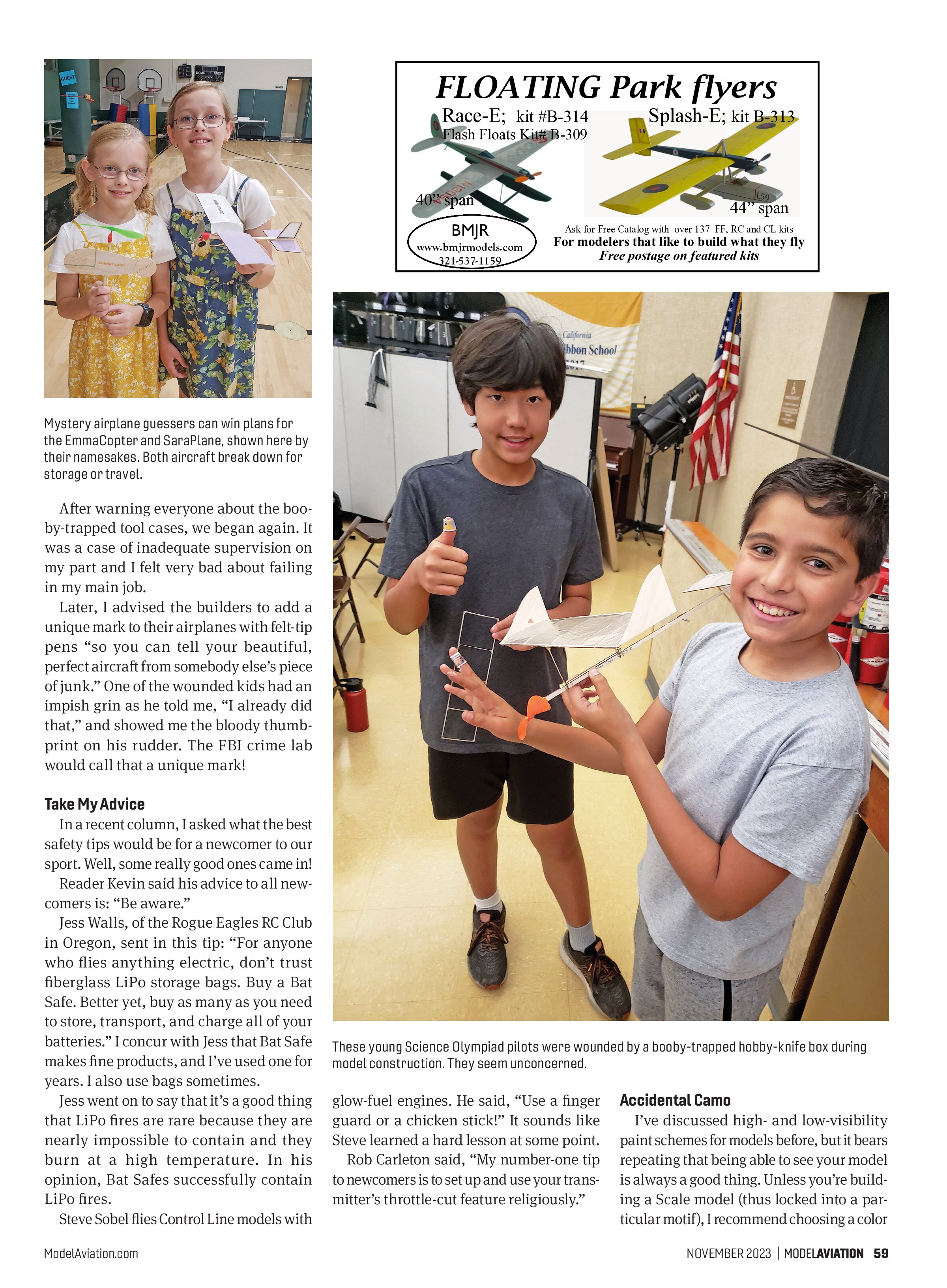
Mystery airplane guessers can win plans for the EmmaCopter and SaraPlane, shown here by their namesakes. Both aircraft break down for storage or travel.
After warning everyone about the boo-by-trapped tool cases, we began again. It was a case of inadequate supervision on my part and I felt very bad about failing in my main job.
Later, I advised the builders to add a unique mark to their airplanes with felt-tip pens “so you can tell your beautiful, perfect aircraft from somebody else’s piece of junk.” One of the wounded kids had an impish grin as he told me, “I already did that,” and showed me the bloody thumb-print on his rudder. The FBI crime lab would call that a unique mark!
Take My Advice
In a recent column, I asked what the best safety tips would be for a newcomer to our sport. Well, some really good ones came in!
Reader Kevin said his advice to all newcomers is: “Be aware.”
Jess Walls, of the Rogue Eagles RC Club in Oregon, sent in this tip: “For anyone who flies anything electric, don’t trust fiberglass LiPo storage bags. Buy a Bat Safe. Better yet, buy as many as you need to store, transport, and charge all of your batteries.” I concur with Jess that Bat Safe makes fine products, and I’ve used one for years. I also use bags sometimes.
Jess went on to say that it’s a good thing that LiPo fires are rare because they are nearly impossible to contain and they burn at a high temperature. In his opinion, Bat Safes successfully contain LiPo fires.
Steve Sobel flies Control Line models with glow-fuel engines. He said, “Use a finger guard or a chicken stick.” It sounds like Steve learned a hard lesson at some point.
Rob Carleton said, “My number-one tip to newcomers is to set up and use your transmitter’s throttle-cut feature religiously.”

Accidental Camo
I’ve discussed high- and low-visibility paint schemes for models before, but it bears repeating that being able to see your model is always a good thing. Unless you’re building a Scale model (thus locked into a particular motif), I recommend choosing a color


layout that makes it easy to find your aircraft and tell which way it’s heading.
Of course, I have a bad example to share. I found myself at a Flying Aces Club (FAC) meet, getting trounced in the Jet Cat event. My little A-4 Skyhawk glider realized it and decided to ditch me by hiding in some leaves. I should have flown one of the leaves instead because the A-4 finished in last place. A bright U.S. Navy paint scheme might have made the model easier to find, but only more skill on my part will ever put it into a winning spot.
Finding your Free Flight (FF) model on the ground is one thing, but paint schemes become more important on a small RC airplane or helicopter, which are famously hard to see at a distance. A high-visibility finish can help greatly. Make it bright and splashy and you’ll see.
Mystery Airplane
Here’s a big clue: The mystery airplane this time is a helicopter, not an airplane. Furthermore, it is in the Richard Nixon Presidential Library and Museum in Yorba Linda, California. Visitors can go inside of this beautiful chopper and see the interior.
The Nixon Library is truly marvelous, and I highly recommend a visit if you’re a history buff or just interested in famous helicopters. Take an email guess as to the name, designation, or call sign of this rotorcraft and you’ll receive digital plans for both the SaraPlane and EmmaCopter. Please use my email address, shown at the beginning of this column.
Mystery Airplane Prize Plans
My nieces, Emma and Sarah, came from out of state for a visit and asked to attend a model-flying session. They know how to get my attention! I took them to an indoor meet and prepared models for them to fly so that they could be pilots and not just spectators. Check out their video, linked in “Sources.”
Because the girls were riding in an airliner to get home, both models are designed to come apart and fit into repurposed cookie tins. That’ll get ’em past the baggage handlers!
The SaraPlane and EmmaCopter are the latest in 1930s technology. That’s when basic rubber-powered helicopters and Baby Rise-Off-Ground (ROG) types were in their heyday. The SaraPlane has a rakish gull wing for a bit of style, but both aircraft are easy to build. They do well indoors or out, and will even fly in a living room.
SOURCES:
SaraPlane and EmmaCopter
YouTube
https://youtu.be/symBHTR5TjI
Bat Safe
Sales@bat-safe.com
www.bat-safe.com
Science Olympiad
(630) 792-1251
www.soinc.org
J&H Aerospace
www.jhaerospace.com
Richard Nixon Foundation
(714) 993-5075
www.nixonfoundation.org