RC PYLON RACING

REFLECTING
ON PAST
PYLON
RACING
AIRCRAFT
By Tim Lampe | tim.lampe@hotmail.com
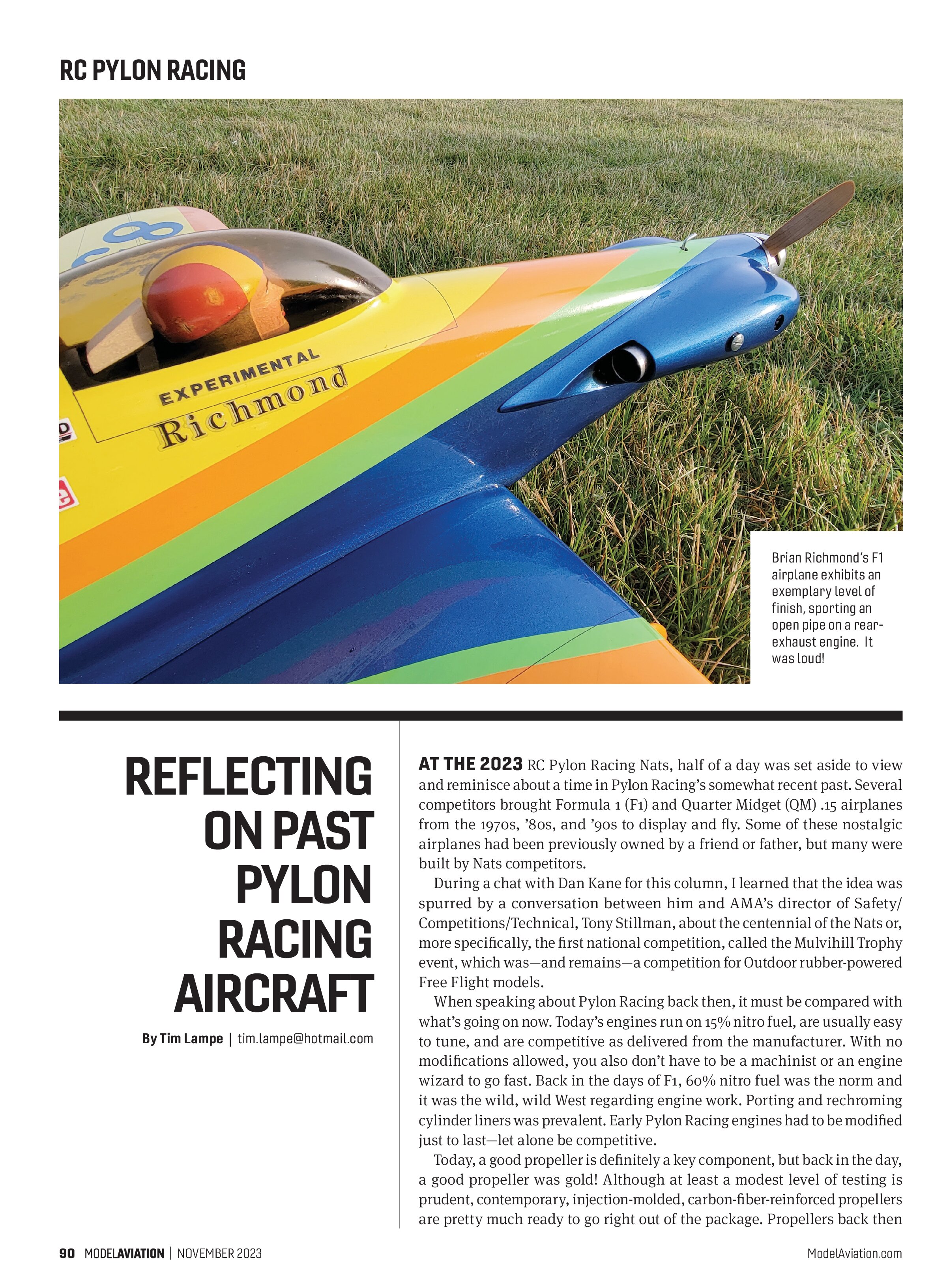
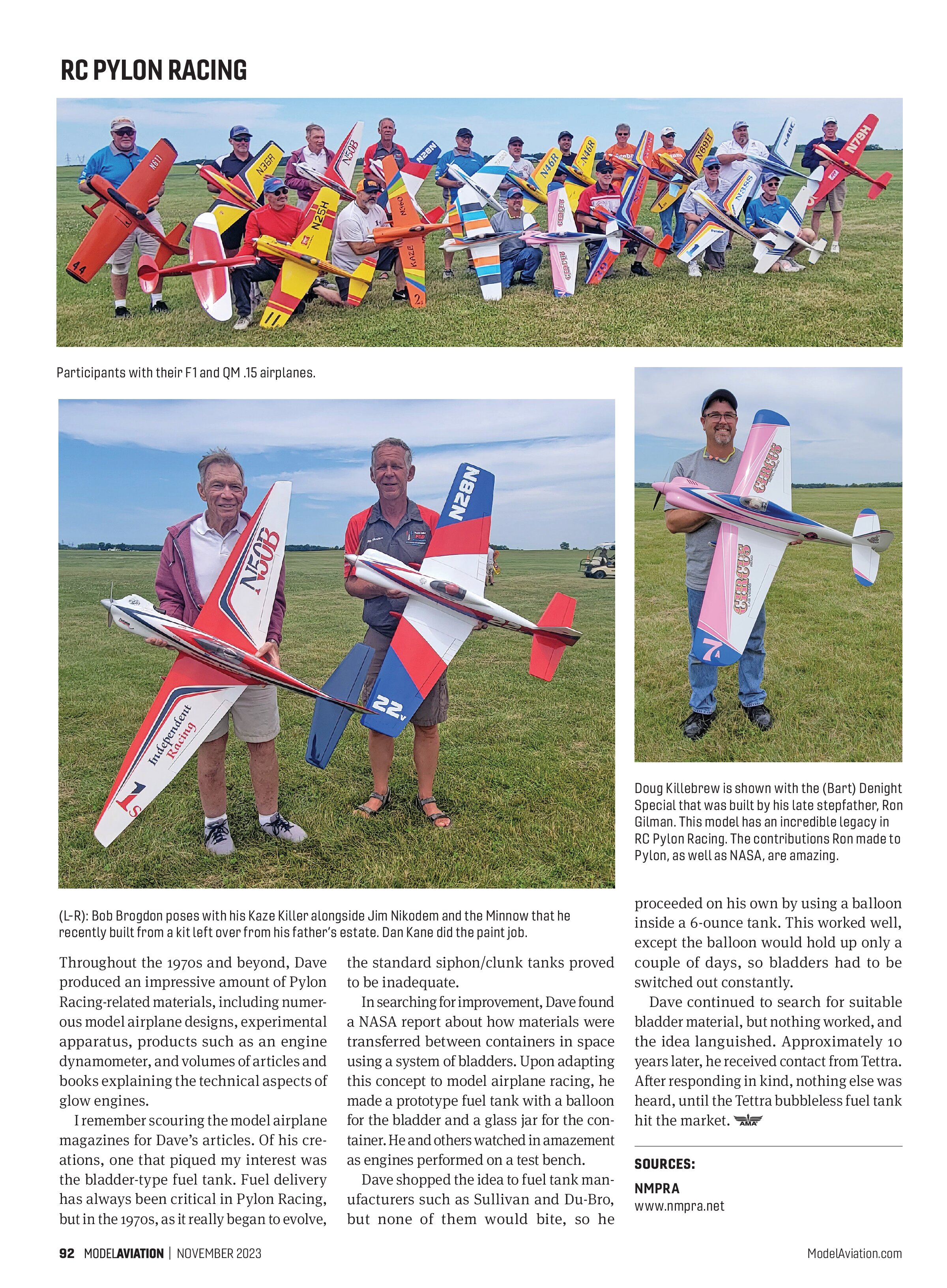
AT THE 2023 RC Pylon Racing Nats, half of a day was set aside to view and reminisce about a time in Pylon Racing’s somewhat recent past. Several competitors brought Formula 1 (F1) and Quarter Midget (QM) .15 airplanes from the 1970s, ’80s, and ’90s to display and fly. Some of these nostalgic airplanes had been previously owned by a friend or father, but many were built by Nats competitors.
During a chat with Dan Kane for this column, I learned that the idea was spurred by a conversation between him and AMA’s director of Safety/Competitions/Technical, Tony Stillman, about the centennial of the Nats or, more specifically, the first national competition, called the Mulvihill Trophy event, which was—and remains—a competition for Outdoor rubber-powered Free Flight models.
When speaking about Pylon Racing back then, it must be compared with what’s going on now. Today’s engines run on 15% nitro fuel, are usually easy to tune, and are competitive as delivered from the manufacturer. With no modifications allowed, you also don’t have to be a machinist or an engine wizard to go fast. Back in the days of F1, 60% nitro fuel was the norm and it was the wild, wild West regarding engine work. Porting and rechroming cylinder liners was prevalent. Early Pylon Racing engines had to be modified just to last—let alone be competitive.
Today, a good propeller is definitely a key component, but back in the day, a good propeller was gold! Although at least a modest level of testing is prudent, contemporary, injection-molded, carbon-fiber-reinforced propellers are pretty much ready to go right out of the package. Propellers back then began as commercially available wood propellers from the likes of Rev Up, Top Flite, and Zinger. They were then transformed into competitive, bona fide racing propellers by being hand-carved to the magic specification, so there was much ado about propellers.
I had an entertaining and enlightening conversation with Ray Brown about his propeller carving business, where he supplied race-ready propellers to nearly all of the Pylon Racing pilots on the circuit, earning him the moniker “Rocket.” Rocket Ray is still always among the fastest pilots, but a story about his propeller carving days is definitely worthy of a separate “RC Pylon Racing” column in the future!
Today’s QM-40 airplanes are better than their F1 predecessors. The minimum weight of a QM-40 airplane is 4 pounds, while the minimum weight of an F1 was 5 pounds. The evolution of today’s designs with improved materials, including carbon fiber and advanced molding and layup techniques, provides competitors with a much more robust and lighter-weight airplane that flies better and is more durable. Today’s airplanes are still made by hand
by boutique manufacturers, but most are painted in the mold, needing only the engine and radio installation before being ready to win.
F1 and QM .15 airplanes typically enlisted a foam-core wing that required balsa sheeting and fiberglass cloth. The fuselage was a fiberglass or epoxy glass shell needing the installation of an internal structure before being ready to fit out—and then you’re talking about filling, sanding, more filling, more sanding, and painting, typically with automotive equipment. A good fit and finish were critical because it determined the takeoff order!
Is today’s simpler state of Pylon Racing better? Who says there’s anything wrong with working hard and devoting the time required to excel at engine development, propeller carving, and finishing out an airplane to the highest degree? It’s good to reflect and at least partially understand what it took, and appreciate those who laid the groundwork for what we enjoy today.
NMPRA Hall of Fame Induction
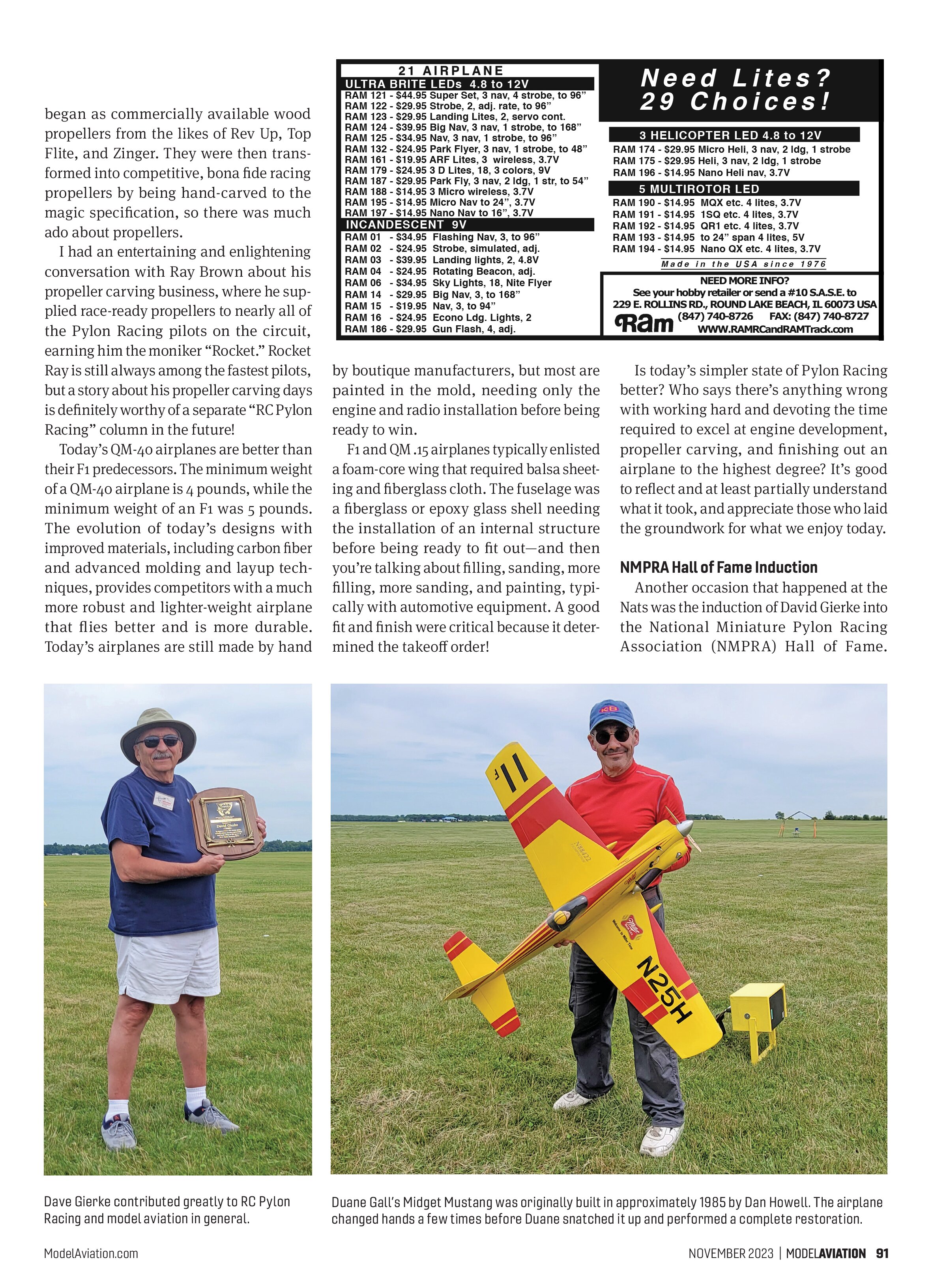
Another occasion that happened at the Nats was the induction of David Gierke into the National Miniature Pylon Racing Association (NMPRA) Hall of Fame.


Throughout the 1970s and beyond, Dave produced an impressive amount of Pylon Racing-related materials, including numerous model airplane designs, experimental apparatus, products such as an engine dynamometer, and volumes of articles and books explaining the technical aspects of glow engines.
I remember scouring the model airplane magazines for Dave’s articles. Of his creations, one that piqued my interest was the bladder-type fuel tank. Fuel delivery has always been critical in Pylon Racing, but in the 1970s, as it really began to evolve,
the standard siphon/clunk tanks proved to be inadequate.
In searching for improvement, Dave found a NASA report about how materials were transferred between containers in space using a system of bladders. Upon adapting this concept to model airplane racing, he made a prototype fuel tank with a balloon for the bladder and a glass jar for the container. He and others watched in amazement as engines performed on a test bench.
Dave shopped the idea to fuel tank manufacturers such as Sullivan and Du-Bro, but none of them would bite, so he
proceeded on his own by using a balloon inside a 6-ounce tank. This worked well, except the balloon would hold up only a couple of days, so bladders had to be switched out constantly.
Dave continued to search for suitable bladder material, but nothing worked, and the idea languished. Approximately 10 years later, he received contact from Tetra. After responding in kind, nothing else was heard, until the Tetra bubbleless fuel tank hit the market.
SOURCES:
NMPRA
www.nmpra.net