RC AEROBATICS

POINT ROLLS
AND SLOW
ROLLS
By Justin Wells | justinwells@mac.com
IN MY LAST COLUMN, we ventured into perfecting rolls. How did you do? Let’s look at a few things a judge might see and help you further perfect your roll. Have a buddy at the field watch for the following. These are downgrades as defined by the National Society of Radio Controlled Aerobatics (NSRCA):
- Changes in track during a roll.
- Changes in altitude during a roll.
- Roll rate not constant.
- Roll not centered.
- Model does not perform exactly one roll.
Consider these points when executing your rolls; it can be difficult at first. Good precision pilots know their own errors when they see them. It’s hard to swallow at times.
Okay, it’s time to dive in and add a few more roll types to your bag of tricks.
Point Rolls
You’ll make your way through various point rolls, but the most common are four-point and two-point rolls. These are the easiest to execute. You might see more-advanced versions of this as you move up through the classes in RC Aerobatics (Pattern).
Two-Point Roll
I tricked you a little in my last article. If you did the down-elevator test, you’ve already performed what we refer to as a “two-of-two” roll. Let’s revisit the scenario.
From upright, roll the airplane inverted, pause, then roll it upright. That’s it. You did a two-point roll. Congratulations! Remember, you don’t want to lose your track or altitude, so make elevator and rudder adjustments as needed.
Four-Point Roll
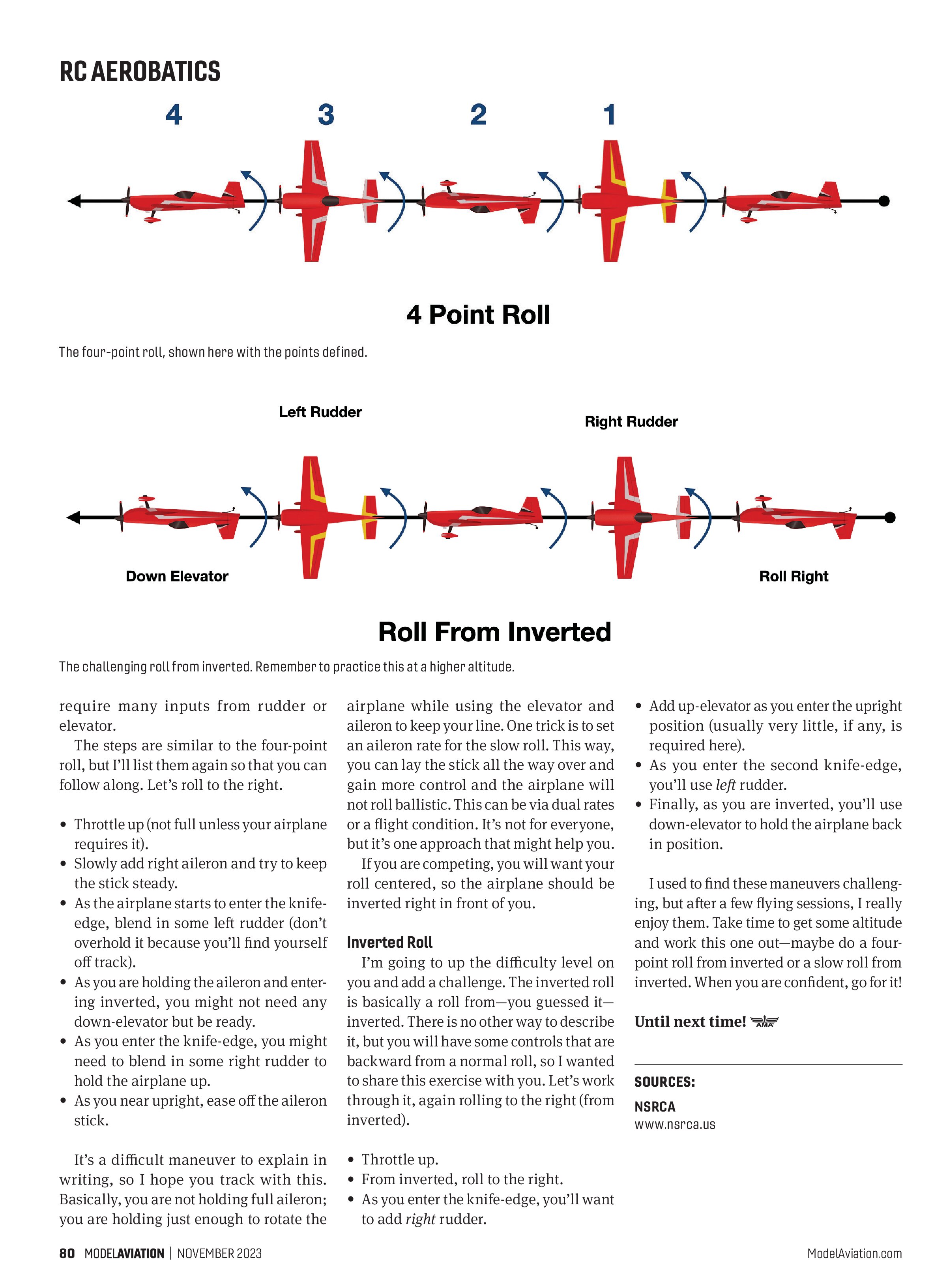
To execute a four-point roll, it will be a combination of knife-edge and inverted flight. Stretch this maneuver out across the box and you’ll have the judges thinking that you are ready for the next class. Let’s step through it together. For this illustration, we are going to roll to the right.
- Throttle up (not full but enough to keep the airplane stable).
- Right aileron to Point 1 (knife-edge); add some left rudder to hold your line.
- Short pause.

2 Point Roll
The two-point roll, or two-of-two, as it can be referred to.
- Right aileron to Point 2 (inverted); add some down-elevator (the center of the maneuver).
- Short pause.
- Right aileron to Point 3 (knife-edge); add some right rudder.
- Short pause.
- Right aileron to Point 4 (upright).
- Reduce speed as needed.
Because you are adding a lot of inputs, speed is the key. If you find the airplane sinking, or you are adding more dramatic inputs to keep your line, you need to try the maneuver again with more speed. Each time you do a point, you are slowing the airplane down.
Slow Roll
The slow roll is very impressive in my book. When it’s well-executed, it can show complete control of the airplane and how steady of a hand the pilot has. It can also cause you headaches because it requires a lot of finesse to get right.
The slow roll is basically a four-point roll, except you are not stopping and defining the points as I previously described. The roll is gradual, and you’ll do more blending of the controls, aileron, rudder, and elevator instead of “jabbing” them in to show the point.
I will say that if the airplane is going the correct speed, regardless of the airplane type, I find the slow roll doesn’t


require many inputs from rudder or elevator.
The steps are similar to the four-point roll, but I’ll list them again so that you can follow along. Let’s roll to the right.
- Throttle up (not full unless your airplane requires it).
- Slowly add right aileron and try to keep the stick steady.
- As the airplane starts to enter the knife-edge, blend in some left rudder (don’t overhold it because you’ll find yourself off track).
- As you are holding the aileron and entering inverted, you might not need any down-elevator but be ready.
- As you enter the knife-edge, you might need to blend in some right rudder to hold the airplane up.
- As you near upright, ease off the aileron stick.
It’s a difficult maneuver to explain in writing, so I hope you track with this. Basically, you are not holding full aileron; you are holding just enough to rotate the airplane while using the elevator and aileron to keep your line. One trick is to set an aileron rate for the slow roll. This way, you can lay the stick all the way over and gain more control and the airplane will not roll ballistic. This can be via dual rates or a flight condition. It’s not for everyone, but it’s one approach that might help you.
If you are competing, you will want your roll centered, so the airplane should be inverted right in front of you.
Inverted Roll
I’m going to up the difficulty level on you and add a challenge. The inverted roll is basically a roll from—you guessed it—inverted. There is no other way to describe it, but you will have some controls that are backward from a normal roll, so I wanted to share this exercise with you. Let’s work through it, again rolling to the right (from inverted).
- Throttle up.
- From inverted, roll to the right.
- As you enter the knife-edge, you’ll want to add right rudder.
- Add up-elevator as you enter the upright position (usually very little, if any, is required here).
- As you enter the second knife-edge, you’ll use left rudder.
- Finally, as you are inverted, you’ll use down-elevator to hold the airplane back in position.
I used to find these maneuvers challenging, but after a few flying sessions, I really enjoy them. Take time to get some altitude and work this one out—maybe do a four-point roll from inverted or a slow roll from inverted. When you are confident, go for it!
Until next time! ✈
SOURCES:
NSRCA
www.nsrca.us