ADVANCED FLIGHT TECHNOLOGIES

MEET THE SNOTBOT
By Patrick Sherman
lucidity@roswellflighttestcrew.com
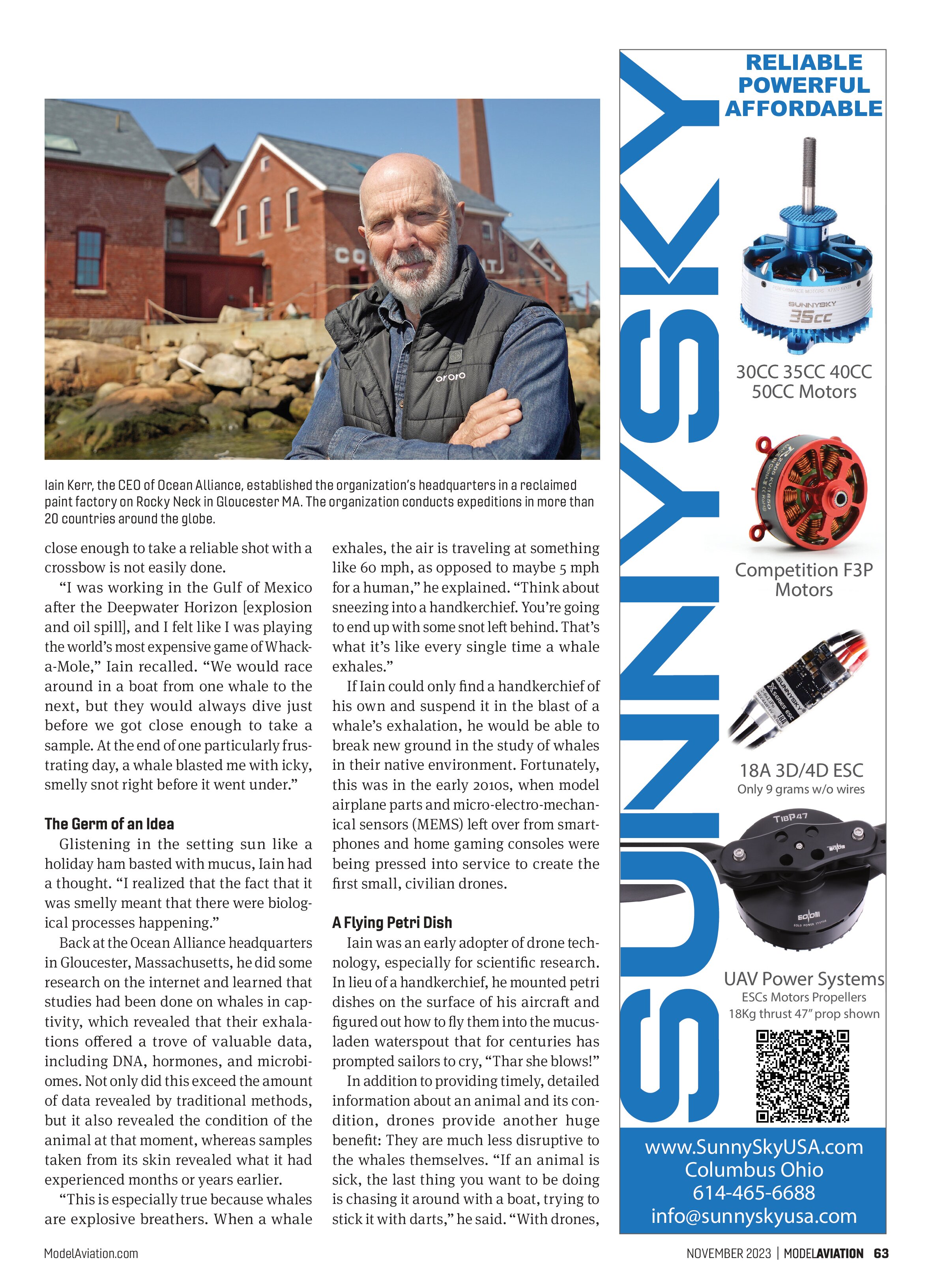
IF NECESSITY is the mother of invention, then a face full of whale snot is likely a distant cousin—at least if your name is Iain Kerr. As the CEO of Ocean Alliance, a conservation science nonprofit organization, Iain is always looking for ways to do a better job of developing scientific insight into the health of whales.
“The problem with this kind of work is that most wildlife won’t show any outward signs of sickness because it makes them more vulnerable to predators,” Iain told me. “I always joke with people that if I’ve got a hangnail, everybody is going to hear about it, but that’s not how whales are. They do their best to keep it hidden.”
Just like a physician, Iain and his colleagues can learn a lot by drawing a blood sample from an animal, but this is a dangerous, expensive, and time-consuming process, not to mention that it involves shooting the whale with a crossbow bolt that retrieves a tissue sample about the size of a pencil eraser. How often would you go to the doctor’s office if that were the standard of care for humans?
Beyond the impact on the whales themselves, this approach has other important limitations. “First of all, you have to understand that oceanography is a really expensive game,” Iain explained. “If you want to learn about rhinos, you drive out into the Serengeti in a Land Rover and do your thing. If the truck gets a flat tire, it doesn’t sink beneath the plains. In a boat, that’s a real possibility.”
He added that because whales only visit the surface for a few moments to breathe and spend the rest of their time submerged underwater, getting close enough to take a reliable shot with a crossbow is not easily done.
“I was working in the Gulf of Mexico after the Deepwater Horizon [explosion and oil spill], and I felt like I was playing the world’s most expensive game of Whack-a-Mole,” Iain recalled. “We would race around in a boat from one whale to the next, but they would always dive just before we got close enough to take a sample. At the end of one particularly frustrating day, a whale blasted me with icky, smelly snot right before it went under.”
The Germ of an Idea
Glistening in the setting sun like a holiday ham basted with mucus, Iain had a thought. “I realized that the fact that it was smelly meant that there were biological processes happening.”
Back at the Ocean Alliance headquarters in Gloucester, Massachusetts, he did some research on the internet and learned that studies had been done on whales in captivity, which revealed that their exhalations offered a trove of valuable data, including DNA, hormones, and microbiomes. Not only did this exceed the amount of data revealed by traditional methods, but it also revealed the condition of the animal at that moment, whereas samples taken from its skin revealed what it had experienced months or years earlier.
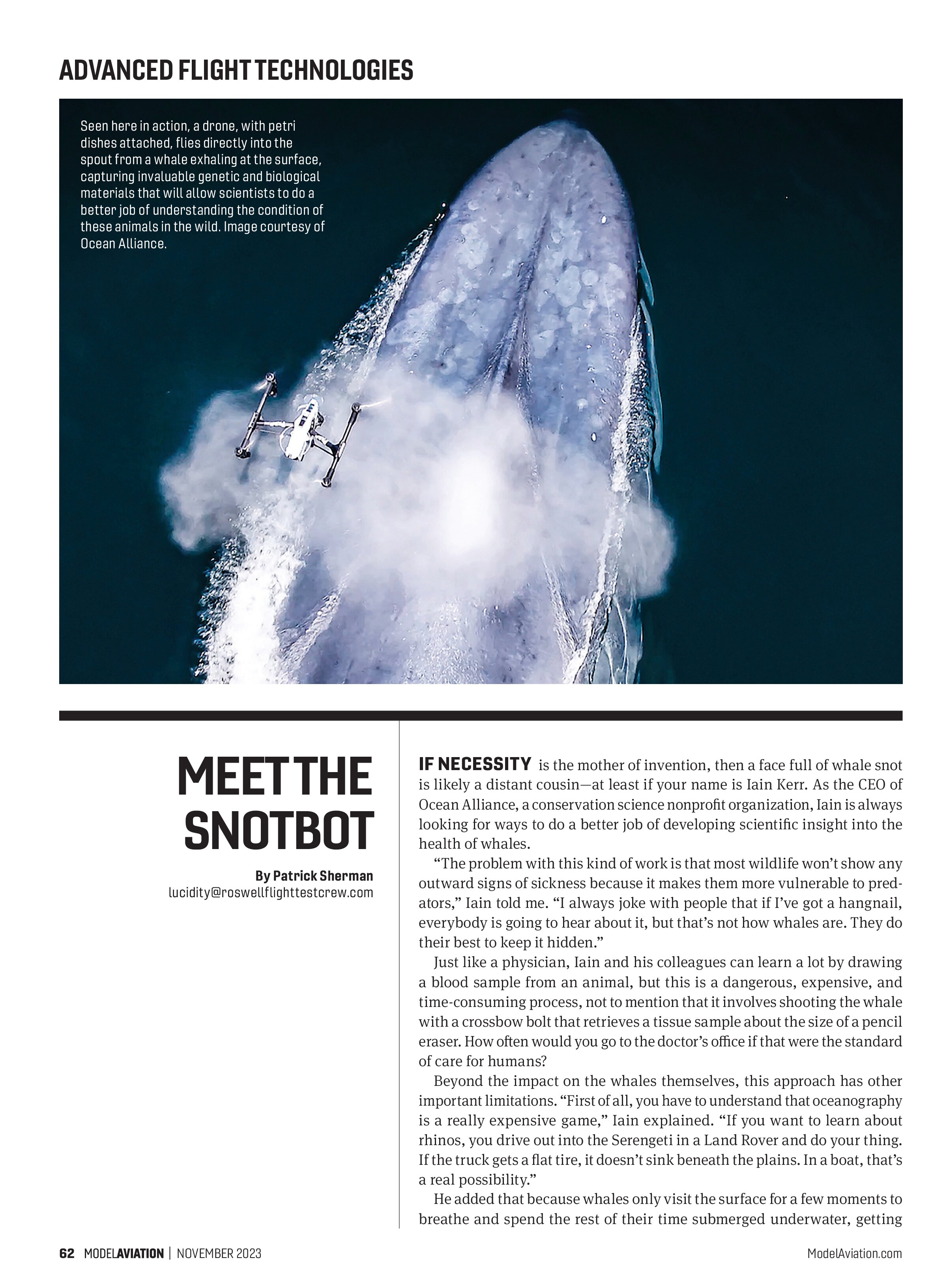
“This is especially true because whales are explosive breathers. When a whale exhales, the air is traveling at something like 60 mph, as opposed to maybe 5 mph for a human,” he explained. “Think about sneezing into a handkerchief. You’re going to end up with some snot left behind. That’s what it’s like every single time a whale exhales.”
If Iain could only find a handkerchief of his own and suspend it in the blast of a whale’s exhalation, he would be able to break new ground in the study of whales in their native environment. Fortunately, this was in the early 2010s, when model airplane parts and micro-electro-mechanical sensors (MEMS) left over from smartphones and home gaming consoles were being pressed into service to create the first small, civilian drones.
A Flying Petri Dish
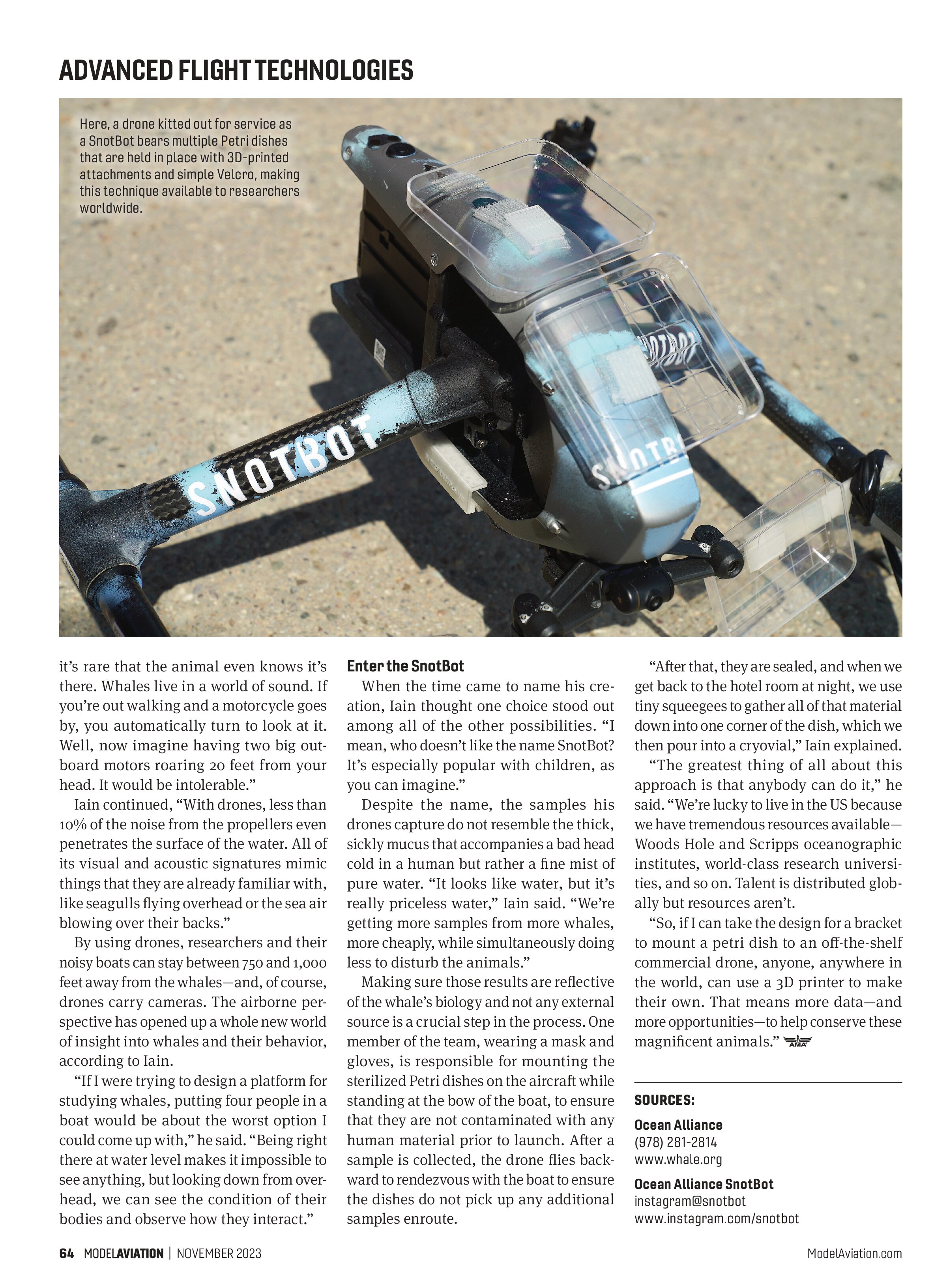
Iain was an early adopter of drone technology, especially for scientific research. In lieu of a handkerchief, he mounted petri dishes on the surface of his aircraft and figured out how to fly them into the mucus-laden waterspout that for centuries has prompted sailors to cry, “Thar she blows!”
In addition to providing timely, detailed information about an animal and its condition, drones provide another huge benefit: They are much less disruptive to the whales themselves. “If an animal is sick, the last thing you want to be doing is chasing it around with a boat, trying to stick it with darts,” he said. “With drones,


it’s rare that the animal even knows it’s there. Whales live in a world of sound. If you’re out walking and a motorcycle goes by, you automatically turn to look at it. Well, now imagine having two big outboard motors roaring 20 feet from your head. It would be intolerable.”
Iain continued, “With drones, less than 10% of the noise from the propellers even penetrates the surface of the water. All of its visual and acoustic signatures mimic things that they are already familiar with, like seagulls flying overhead or the sea air blowing over their backs.”
By using drones, researchers and their noisy boats can stay between 750 and 1,000 feet away from the whales—and, of course, drones carry cameras. The airborne perspective has opened up a whole new world of insight into whales and their behavior, according to Iain.
“If I were trying to design a platform for studying whales, putting four people in a boat would be about the worst option I could come up with,” he said. “Being right there at water level makes it impossible to see anything, but looking down from overhead, we can see the condition of their bodies and observe how they interact.”
Enter the SnotBot
When the time came to name his creation, Iain thought one choice stood out among all of the other possibilities. “I mean, who doesn’t like the name SnotBot? It’s especially popular with children, as you can imagine.”
Despite the name, the samples his drones capture do not resemble the thick, sickly mucus that accompanies a bad head cold in a human but rather a fine mist of pure water. “It looks like water, but it’s really priceless water,” Iain said. “We’re getting more samples from more whales, more cheaply, while simultaneously doing less to disturb the animals.”
Making sure those results are reflective of the whale’s biology and not any external source is a crucial step in the process. One member of the team, wearing a mask and gloves, is responsible for mounting the sterilized Petri dishes on the aircraft while standing at the bow of the boat, to ensure that they are not contaminated with any human material prior to launch. After a sample is collected, the drone flies backward to rendezvous with the boat to ensure the dishes do not pick up any additional samples enroute.
“After that, they are sealed, and when we get back to the hotel room at night, we use tiny squeegees to gather all of that material down into one corner of the dish, which we then pour into a cryovial,” Iain explained.
“The greatest thing of all about this approach is that anybody can do it,” he said. “We’re lucky to live in the US because we have tremendous resources available—Woods Hole and Scripps oceanographic institutes, world-class research universities, and so on. Talent is distributed globally but resources aren’t.
“So, if I can take the design for a bracket to mount a petri dish to an off-the-shelf commercial drone, anyone, anywhere in the world, can use a 3D printer to make their own. That means more data—and more opportunities—to help conserve these magnificent animals.”
SOURCES:
Ocean Alliance
(978) 281-2814
www.whale.org
Ocean Alliance SnotBot
instagram@snotbot
www.instagram.com/snotbot