A TALE OF TWO FRANKENSTICKS
Photos by Don Ford


DON FORD (Bacliff, Texas) got into RC airplanes when a friend took him to a hobby shop to buy parts for a scratch-built catamaran sailboat that he was building. “I went back to the hobby shop the next day and bought a foam Stearman PT-17,” he wrote. “I thought to myself, ‘I can fly this,’ having been in a U.S. Navy air squadron and having seen just about every airplane movie made. I understood how airplanes fly.” Don took the PT-17 out to fly and immediately, in his own words, “screwed it into the ground.” He noted that the salvageable parts from the crash are still being used in a friend’s airplane.
SHARE YOUR STORY
Do you have a high-quality/high-resolution airplane, helicopter, or multirotor photo that you are proud of, or a model aviation-related photo with a great story behind it? Email your “Viewfinder” photo and a description about it to jennifer@modelaircraft.org.
As a self-taught RC pilot, Don has learned a lot about building and rebuilding airplanes. He first learned to fly on wrecks that he rebuilt but with limited luck. It wasn’t until he started flying the BMJR Models version of an Ugly Stick that things started coming together. “I now have eight airplanes that are ready to fly and as many kits in boxes or as projects that I have bought at swap meets,” he stated.
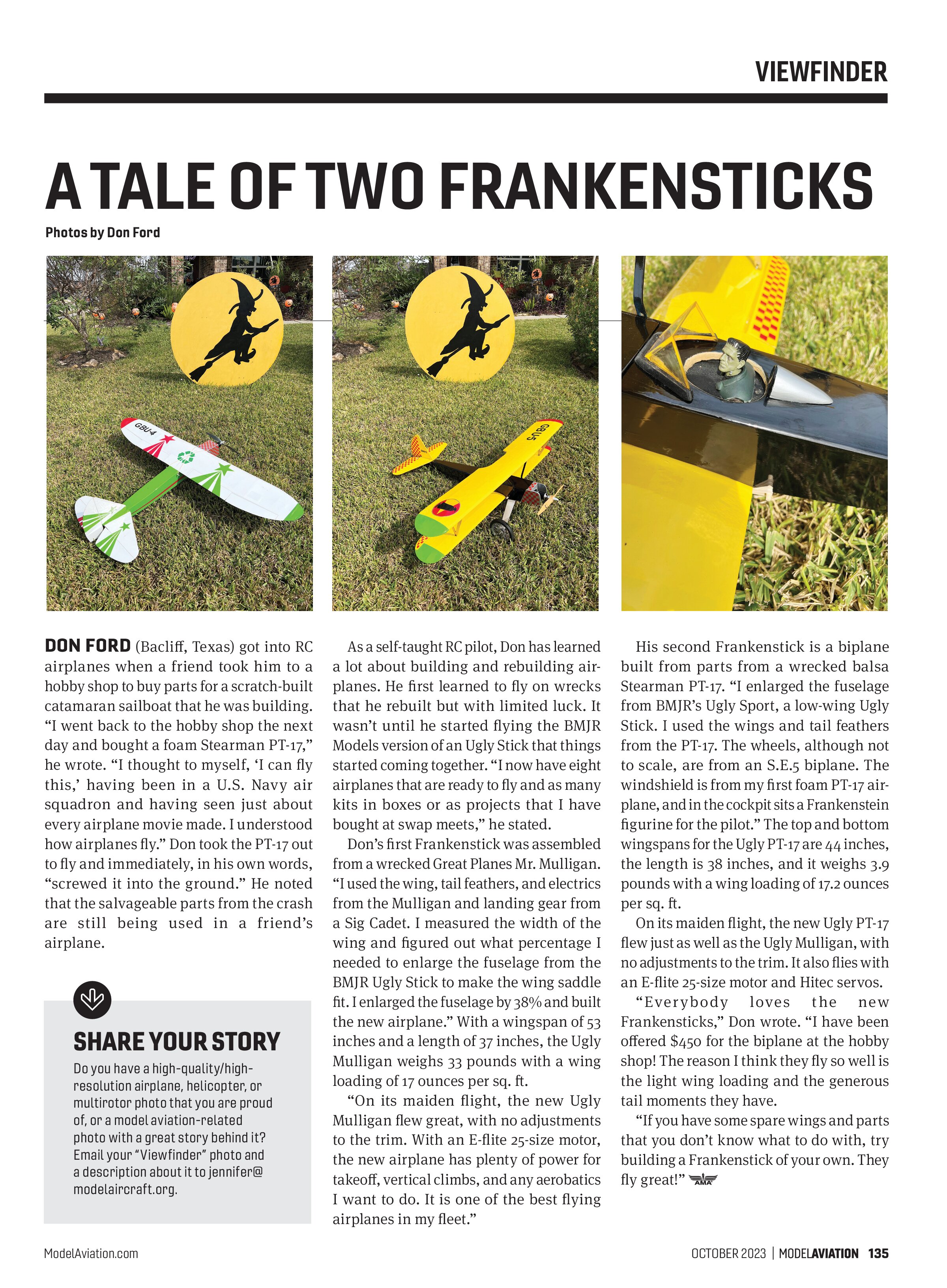
Don’s first Frankenstein was assembled from a wrecked Great Planes Mr. Mulligan. “I used the wing, tail feathers, and electrics from the Mulligan and landing gear from a Sig Cadet. I measured the width of the wing and figured out what percentage I needed to enlarge the fuselage from the BMJR Ugly Stick to make the wing saddle fit. I enlarged the fuselage by 38% and built the new airplane.” With a wingspan of 53 inches and a length of 37 inches, the Ugly Mulligan weighs 33 pounds with a wing loading of 17 ounces per sq. ft.
“On its maiden flight, the new Ugly Mulligan flew great, with no adjustments to the trim. With an E-flite 25-size motor, the new airplane has plenty of power for takeoff, vertical climbs, and any aerobatics I want to do. It is one of the best flying airplanes in my fleet.”
His second Frankenstein is a biplane built from parts from a wrecked balsa Stearman PT-17. “I enlarged the fuselage from BMJR’s Ugly Sport, a low-wing Ugly Stick. I used the wings and tail feathers from the PT-17. The wheels, although not to scale, are from an S.E.5 biplane. The windshield is from my first foam PT-17 airplane, and in the cockpit sits a Frankenstein figurine for the pilot.” The top and bottom wingspans for the Ugly PT-17 are 44 inches, the length is 38 inches, and it weighs 3.9 pounds with a wing loading of 17.2 ounces per sq. ft.
On its maiden flight, the new Ugly PT-17 flew just as well as the Ugly Mulligan, with no adjustments to the trim. It also flies with an E-flite 25-size motor and Hitec servos.
“Everybody loves the new Frankensticks,” Don wrote. “I have been offered $450 for the biplane at the hobby shop! The reason I think they fly so well is the light wing loading and the generous tail moments they have.
“If you have some spare wings and parts that you don’t know what to do with, try building a Frankenstick of your own. They fly great!”