RC SLOPE SOARING

CONCEPT
EVOLUTION
By Greg Schutte | gshooty@yahoo.com
FOR THE LAST COUPLE OF YEARS, I’ve been on cruise-control with my Slope flying. Building more than flying has become my reality.
A couple of years ago, I was looking for a small, single-stick radio to use with my Sparrow concept. The idea was to have a small, portable, lightweight Slope Soaring airplane, but packing around a full-size, pricey computer radio didn’t really go with it. The small EPP Sparrow filled the airplane part of that equation.
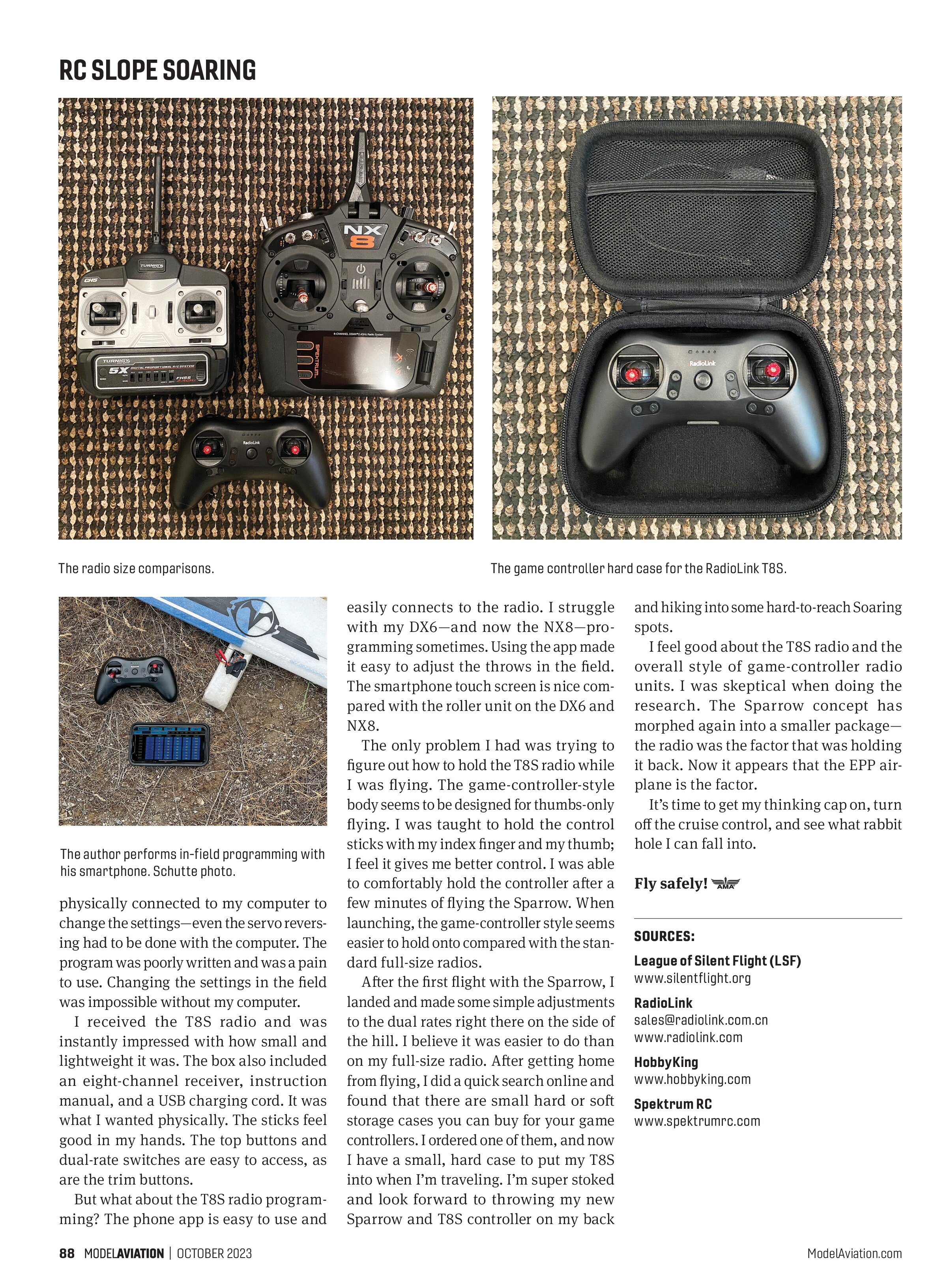
The Spektrum DX6 Gen 2 has been my go-to radio for the last 10 years. HobbyKing had a small radio online that I thought would possibly fill the void. The Turnigy 5X radio system is basically a current radio system that was shrunk in half. I bought one and it’s a very simple radio.
There are mixing, servo-reversing, and dual rates on the radio, but they are physical switches and are not programmable. This radio system worked well with a conventional airplane, but the dual rates were not compatible with my plank-style Sparrow, which I fly with 15% throw on the elevator and 75% throw on the aileron settings. The standard dual-rate throws on the radio are approximately 50% and 100%.
This made the Sparrow a handful to fly, and my enjoyment was replaced with serious concentration. I had thought about putting some type of physical covers over the sticks to limit their movements, but why go through all of that trouble?
I recently replaced my DX6 transmitter with the new NX8 model after upgrading my helicopter. While doing some research on that radio system, I stumbled upon the game controllers that most drone pilots use now. I’m not a video gamer, so this type of radio controller was foreign to me, but it did catch my eye because of how small it was.

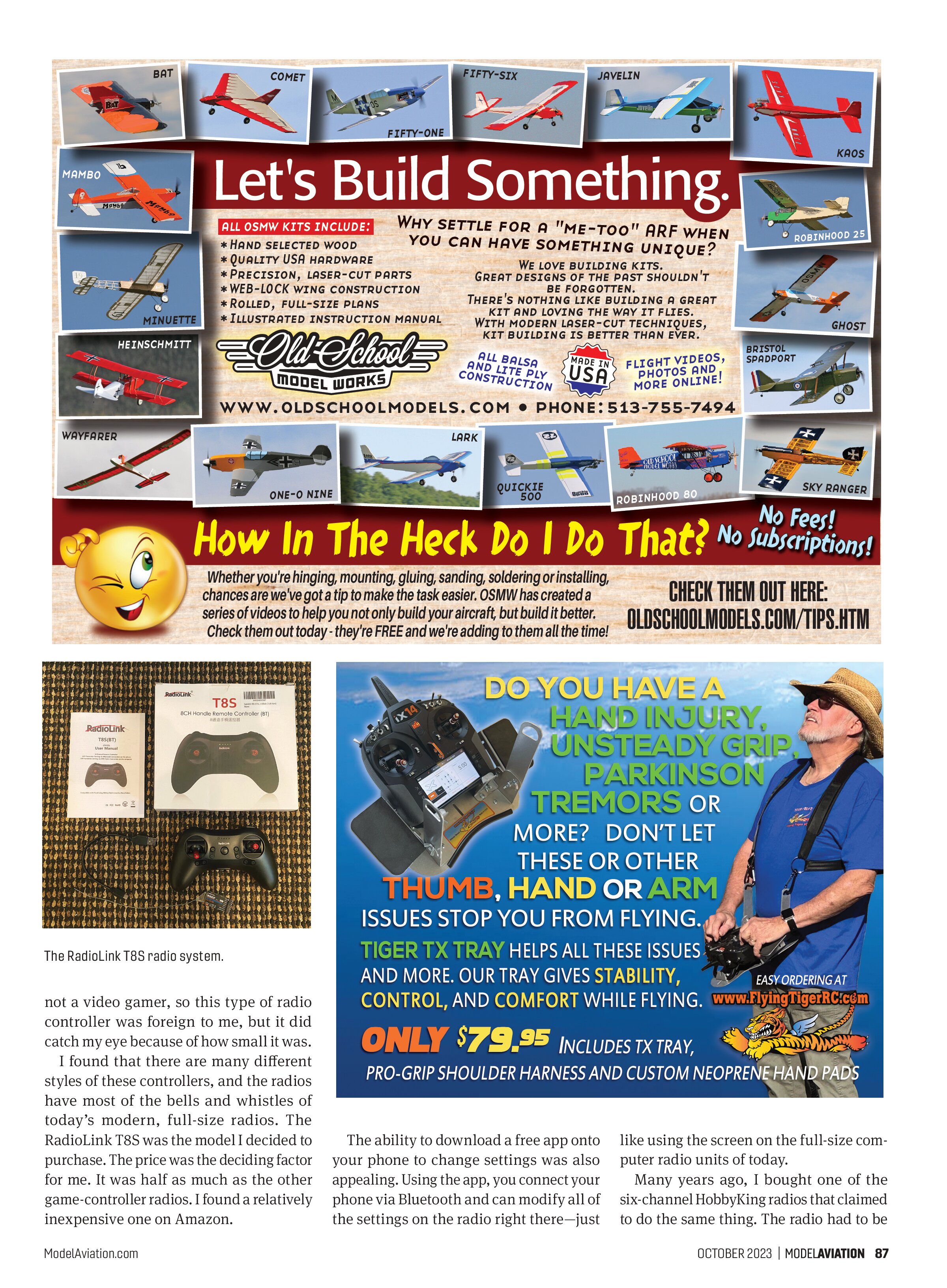
I found that there are many different styles of these controllers, and the radios have most of the bells and whistles of today’s modern, full-size radios. The RadioLink T8S was the model I decided to purchase. The price was the deciding factor for me. It was half as much as the other game-controller radios. I found a relatively inexpensive one on Amazon.
The ability to download a free app onto your phone to change settings was also appealing. Using the app, you connect your phone via Bluetooth and can modify all of the settings on the radio right there—just like using the screen on the full-size computer radio units of today.
Many years ago, I bought one of the six-channel HobbyKing radios that claimed to do the same thing. The radio had to be
physically connected to my computer to change the settings—even the servo reversing had to be done with the computer. The program was poorly written and was a pain to use. Changing the settings in the field was impossible without my computer.
I received the T8S radio and was instantly impressed with how small and lightweight it was. The box also included an eight-channel receiver, instruction manual, and a USB charging cord. It was what I wanted physically. The sticks feel good in my hands. The top buttons and dual-rate switches are easy to access, as are the trim buttons.
But what about the T8S radio programming? The phone app is easy to use and

easily connects to the radio. I struggle with my DX6—and now the NX8—programming sometimes. Using the app made it easy to adjust the throws in the field. The smartphone touch screen is nice compared with the roller unit on the DX6 and NX8.
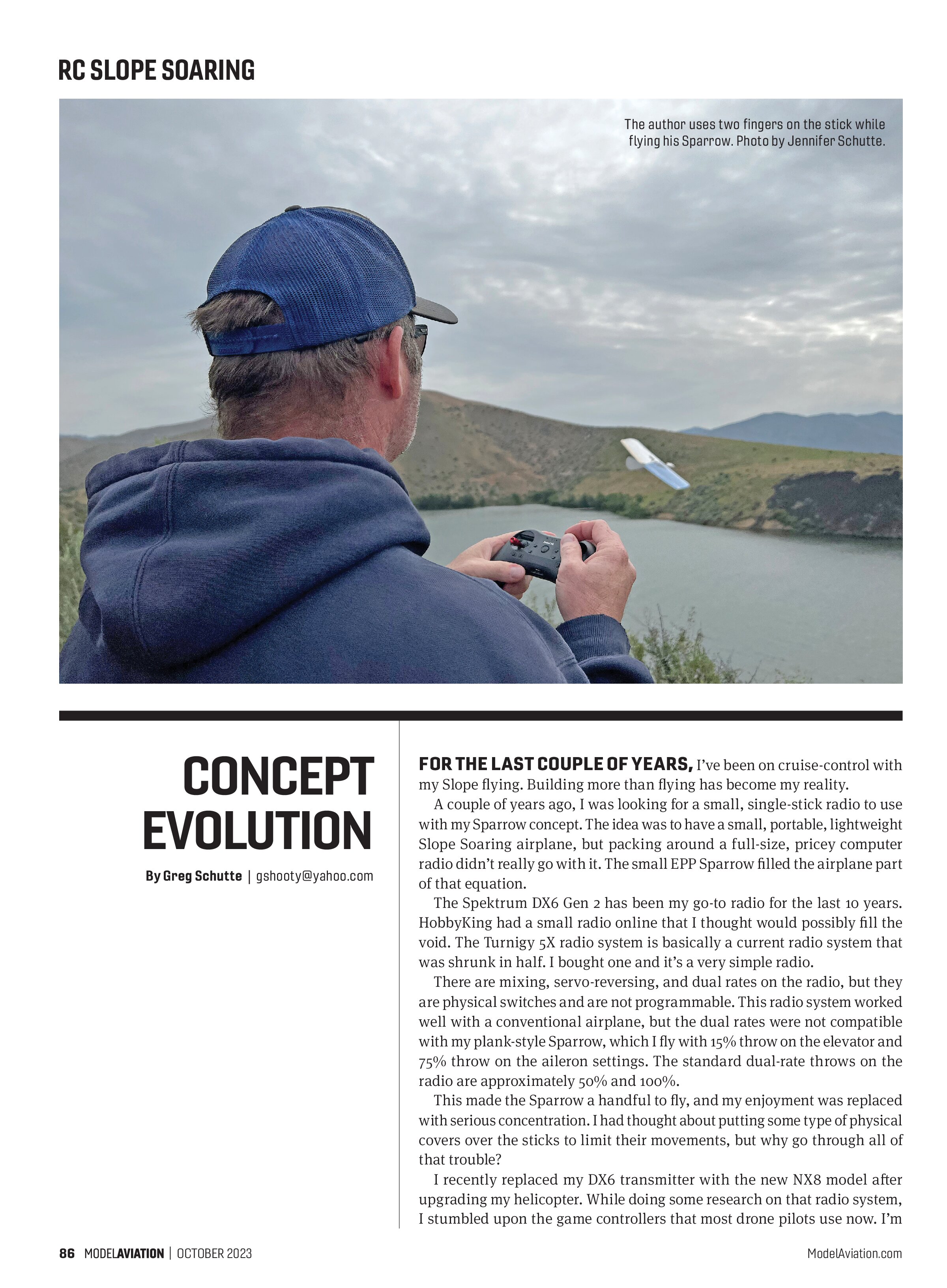
The only problem I had was trying to figure out how to hold the T8S radio while I was flying. The game-controller-style body seems to be designed for thumbs-only flying. I was taught to hold the control sticks with my index finger and my thumb; I feel it gives me better control. I was able to comfortably hold the controller after a few minutes of flying the Sparrow. When launching, the game-controller style seems easier to hold onto compared with the standard full-size radios.
After the first flight with the Sparrow, I landed and made some simple adjustments to the dual rates right there on the side of the hill. I believe it was easier to do than on my full-size radio. After getting home from flying, I did a quick search online and found that there are small hard or soft storage cases you can buy for your game controllers. I ordered one of them, and now I have a small, hard case to put my T8S into when I’m traveling. I’m super stoked and look forward to throwing my new Sparrow and T8S controller on my back

and hiking into some hard-to-reach soaring spots.
I feel good about the T8S radio and the overall style of game-controller radio units. I was skeptical when doing the research. The Sparrow concept has morphed again into a smaller package—the radio was the factor that was holding it back. Now it appears that the EPP airplane is the factor.
It’s time to get my thinking cap on, turn off the cruise control, and see what rabbit hole I can fall into.
Fly safely!
SOURCES:
League of Silent Flight (LSF)
www.silentflight.org
RadioLink
sales@radiolink.com.cn
www.radiolink.com
HobbyKing
www.hobbyking.com
Spektrum RC
www.spektrumrc.com