TESTING THE YGE 205 HVT ESC
By James Wang | heloeditor@gmail.com
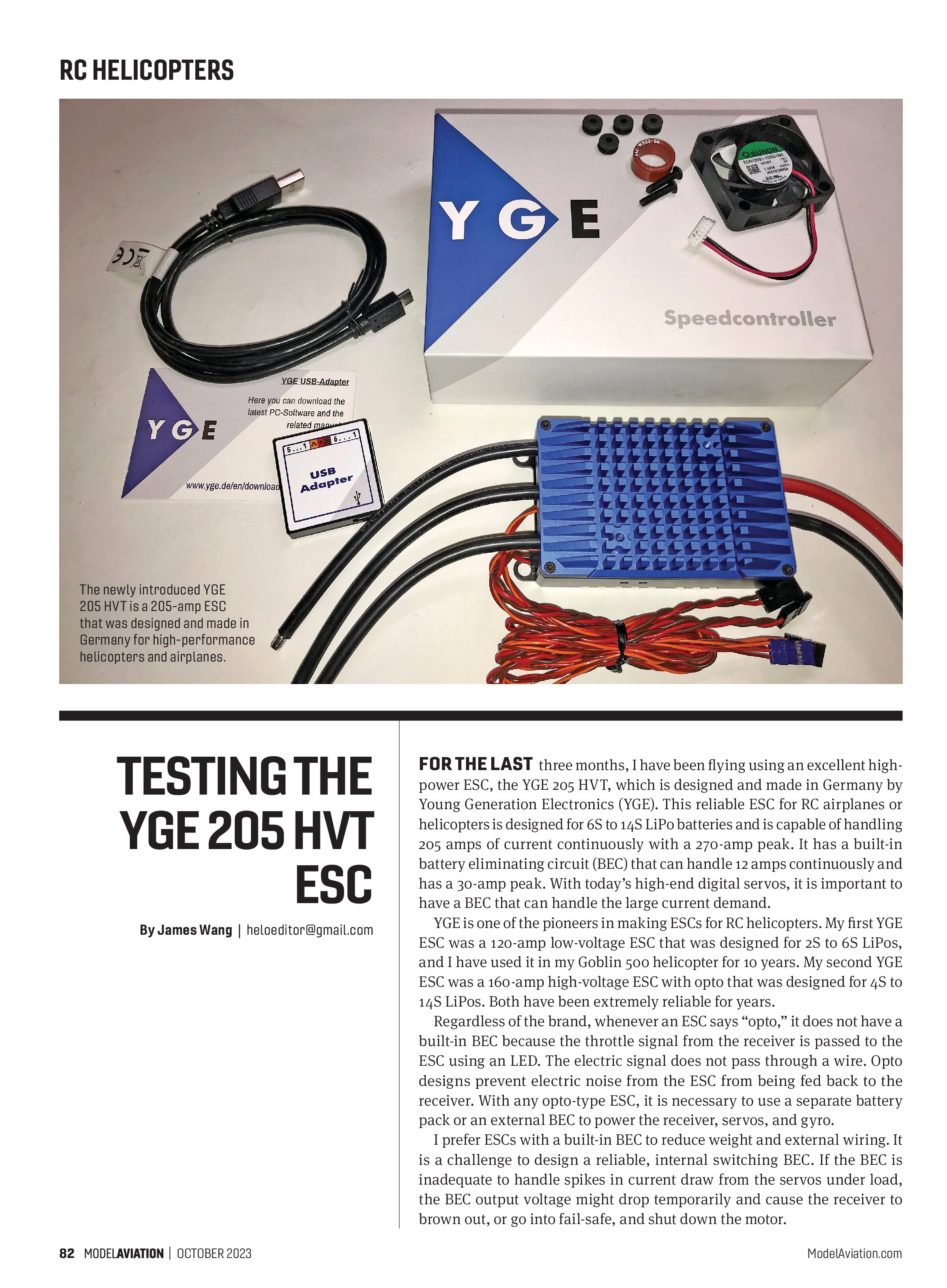
FOR THE LAST three months, I have been flying using an excellent high-power ESC, the YGE 205 HVT, which is designed and made in Germany by Young Generation Electronics (YGE). This reliable ESC for RC airplanes or helicopters is designed for 6S to 14S LiPo batteries and is capable of handling 205 amps of current continuously with a 270-amp peak. It has a built-in battery eliminating circuit (BEC) that can handle 12 amps continuously and has a 30-amp peak. With today’s high-end digital servos, it is important to have a BEC that can handle the large current demand.
YGE is one of the pioneers in making ESCs for RC helicopters. My first YGE ESC was a 120-amp low-voltage ESC that was designed for 2S to 6S LiPos, and I have used it in my Goblin 500 helicopter for 10 years. My second YGE ESC was a 160-amp high-voltage ESC with opto that was designed for 4S to 14S LiPos. Both have been extremely reliable for years.
Regardless of the brand, whenever an ESC says “opto,” it does not have a built-in BEC because the throttle signal from the receiver is passed to the ESC using an LED. The electric signal does not pass through a wire. Opto designs prevent electric noise from the ESC from being fed back to the receiver. With any opto-type ESC, it is necessary to use a separate battery pack or an external BEC to power the receiver, servos, and gyro.
I prefer ESCs with a built-in BEC to reduce weight and external wiring. It is a challenge to design a reliable, internal switching BEC. If the BEC is inadequate to handle spikes in current draw from the servos under load, the BEC output voltage might drop temporarily and cause the receiver to brown out, or go into fail-safe, and shut down the motor.
My YGE 205 has never caused an in-flight motor shutdown because of the motor controller portion of the ESC overheating or the built-in BEC overloading.
Although every mechanical and electrical component on an RC helicopter is critical, I believe the ESC is the most critical, and I recommend investing in the best one you can afford. The helicopter mechanics are mainly under your control because mechanical reliability depends on how you assemble it and perform maintenance.
Most helicopter servos are pretty reliable, and their differences in price are because of torque, speed, and precision. Electric motors usually do not fail if you choose the right size and you don’t overheat them, but an ESC is a black box, and you are at its mercy if it does suddenly shut down.
Beginners are unlikely to stress the ESC and cause it to shut down because, during
a hover, a 700-size helicopter using a 12S LiPo draws approximately 20 amps, which is much lower than the ESC-rated limit. The power used in a hover is only 20 amps x 48 volts, equaling 960 watts, which is close to 1.3 hp.
For intermediate and advanced pilots, I recommend splurging on a slightly higher-rated ESC than required. I suggest 120- to 150-amp low-voltage ESCs for 500- to 600-size 6S LiPo-powered helicopters and 130- to 200-amp high-voltage ESCs for 700- to 800-size 12S LiPo-powered helicopters. YGE has a complete line of 130-, 205-, 255-, and 405-amp ESCs to suit any need.
A high-performance, 700-size motor can deliver 5,000 watts continuously during 3D flight, meaning a consumption of 104 amps. Hence, a 130-amp ESC should be enough even for 3D flying on a 700-size helicopter if there is adequate cooling for the ESC.


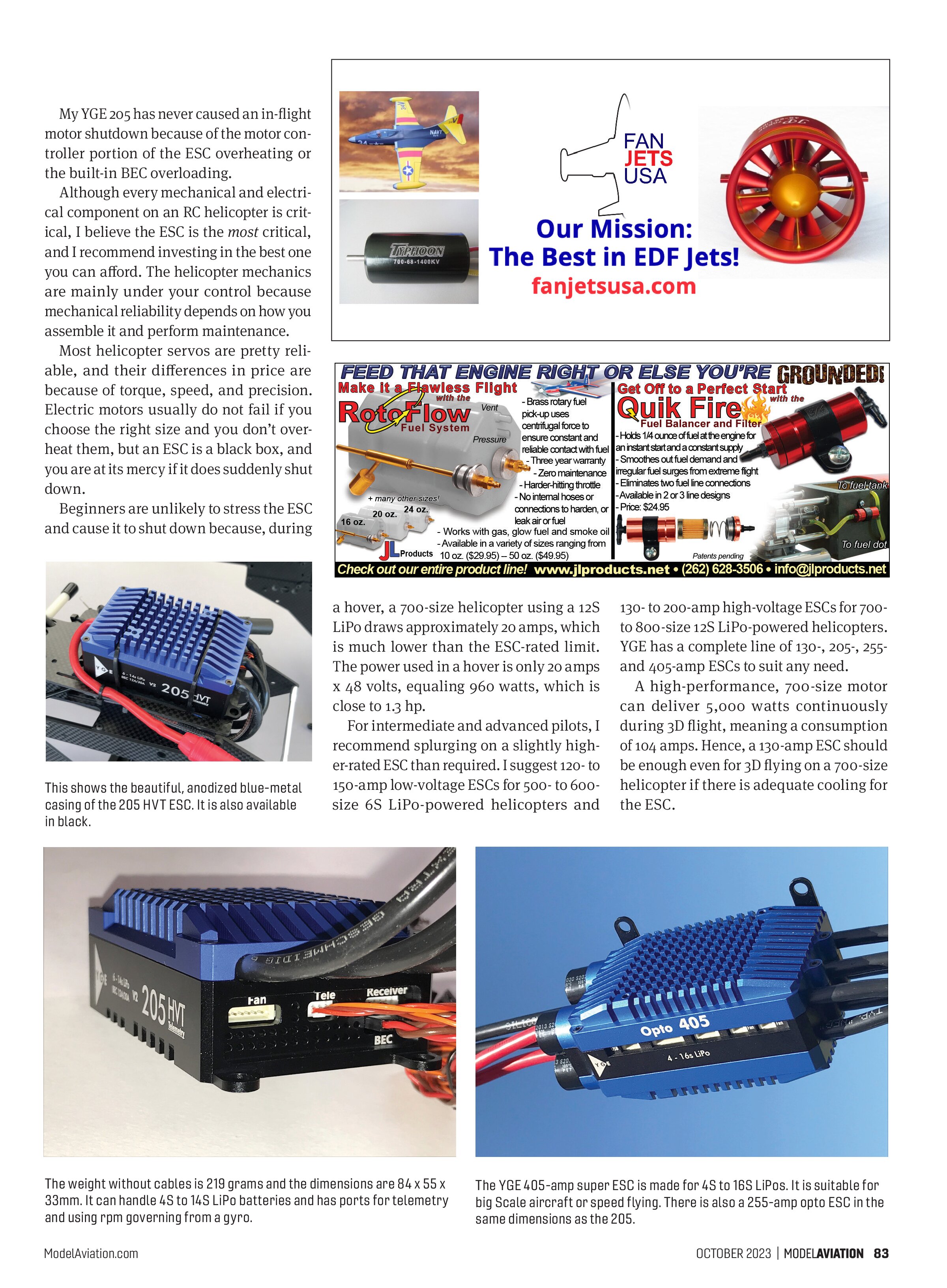
This shows the beautiful, anodized blue-metal casing of the 205 HVT ESC. It is also available in black.

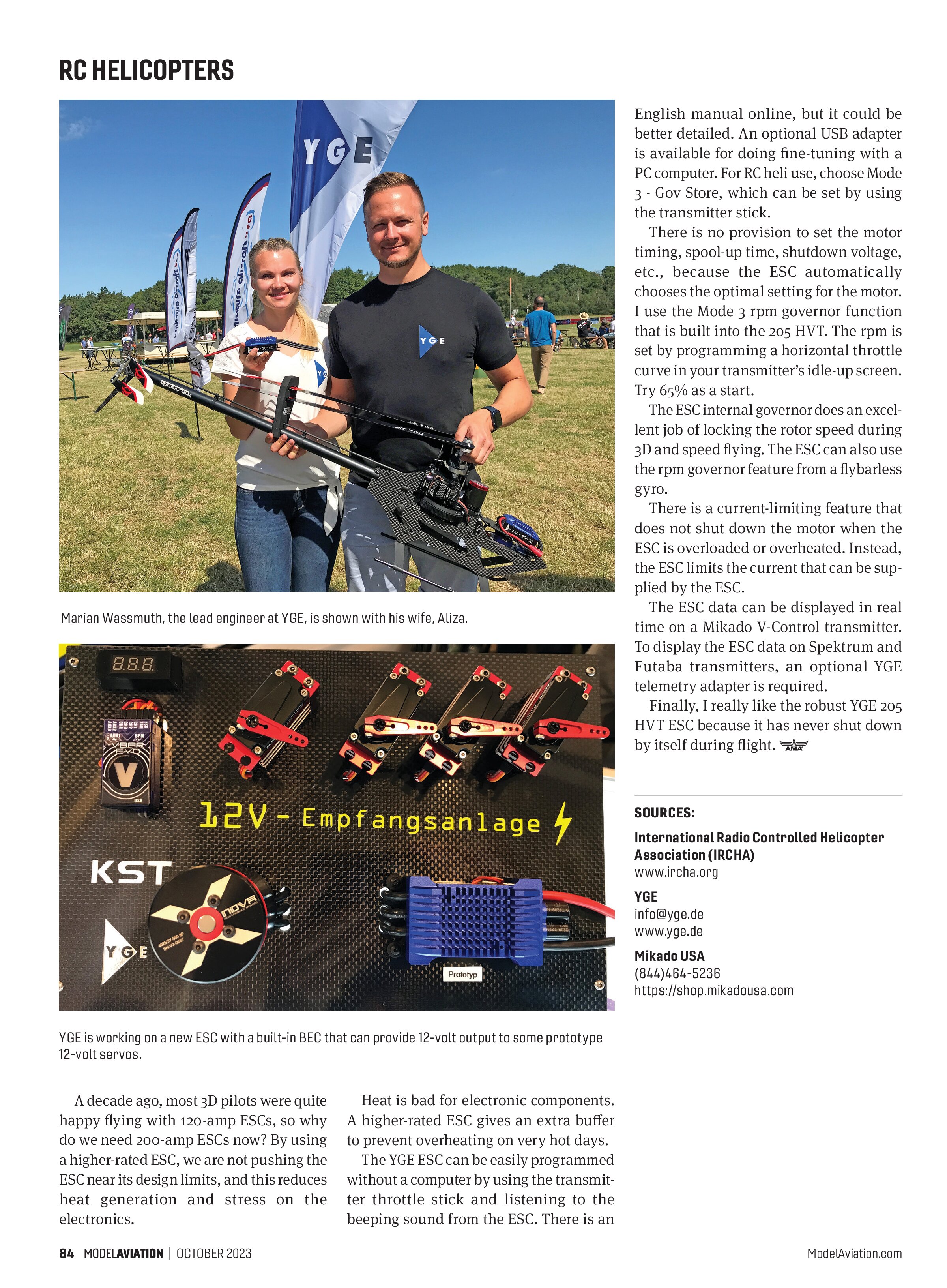
The weight without cables is 219 grams and the dimensions are 84 x 55 x 33mm. It can handle 4S to 14S LiPo batteries and has ports for telemetry and using rpm governing from a gyro.

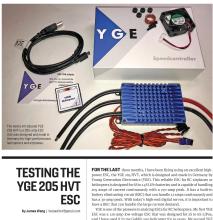
The YGE 405-amp super ESC is made for 4S to 16S LiPos. It is suitable for big Scale aircraft or speed flying. There is also a 255-amp opto ESC in the same dimensions as the 205.
English manual online, but it could be better detailed. An optional USB adapter is available for doing fine-tuning with a PC computer. For RC heli use, choose Mode 3 - Gov Store, which can be set by using the transmitter stick.
There is no provision to set the motor timing, spool-up time, shutdown voltage, etc., because the ESC automatically chooses the optimal setting for the motor. I use the Mode 3 rpm governor function that is built into the 205 HVT. The rpm is set by programming a horizontal throttle curve in your transmitter’s idle-up screen. Try 65% as a start.
The ESC internal governor does an excellent job of locking the rotor speed during 3D and speed flying. The ESC can also use the rpm governor feature from a flybarless gyro.
There is a current-limiting feature that does not shut down the motor when the ESC is overloaded or overheated. Instead, the ESC limits the current that can be supplied by the ESC.
The ESC data can be displayed in real time on a Mikado V-Control transmitter. To display the ESC data on Spektrum and Futaba transmitters, an optional YGE telemetry adapter is required.
Finally, I really like the robust YGE 205 HVT ESC because it has never shut down by itself during flight.


A decade ago, most 3D pilots were quite happy flying with 120-amp ESCs, so why do we need 200-amp ESCs now? By using a higher-rated ESC, we are not pushing the ESC near its design limits, and this reduces heat generation and stress on the electronics.
Heat is bad for electronic components. A higher-rated ESC gives an extra buffer to prevent overheating on very hot days. The YGE ESC can be easily programmed without a computer by using the transmitter throttle stick and listening to the beeping sound from the ESC. There is an
SOURCES:
International Radio Controlled Helicopter Association (IRCHA)
www.ircha.org
Mikado USA
(844)464-5236
https://shop.mikadousa.com