LEN MOUNT TRIBUTE
AN RC HELICOPTER LEGEND REMEMBERED
By Michael Coveney

Len Mount, who passed away on June 14, 2023, was an exceptional modeler and pioneer in Scale RC helicopters. He was one of the first people to build and fly an RC helicopter back in the early 1970s, when no one thought that such a thing was possible.
He was among the first to fly an RC helicopter inverted, the first to power one using a gas-powered turbine engine, and the first to fly one across the English Channel. But there was far more to Len than breaking records, as the many hundreds of people he taught to fly and build championship-winning models will testify.
Len was a self-taught engineer and model maker who started out in the hobby of RC airplanes back in the 1960s when models were mainly controlled through single-channel rubber-band escapements. Proportional RC was only for the rich then, and Len certainly didn’t fit that category.
His early models included a Keil Kraft Super 60, which he learned to fly by himself. As he mentioned in later life, he wasn’t about to put his money, time, and effort into the hands of a stranger.
Building and flying RC airplanes from kits soon became boring, so he branched out by creating large, scratch-built Scale models and novelty items such as a flying lawnmower, but even this became drudgery to him.
When a friend suggested that he build an RC helicopter (a feat no one had achieved at the time), his interest was rekindled and he embarked on a quest that would define the rest of his life.


Early Helicopters
His first helicopter was based on a Hughes 300 and powered by a Merco .61 engine with two glow plugs. He decided to copy a full-scale helicopter, which meant machining his own swashplate with full collective pitch, ball links, and making the gear box from spare parts he had laying around (the clutch came from a lawnmower).
The tail drive was ordinary piano wire, which, given its shape (oval and not round), caused all sorts of vibration problems. The main rotor blades had a hardwood leading edge and a balsa trailing edge. This was sanded, sealed, and covered in Fablon—a popular self-adhesive covering used on kitchen work surfaces. Finally, he made a mold from which he fabricated a scalelike fiberglass body.

After it was built, he had to learn to fly it. (Remember, there were no gyros or computer transmitters at the time.) To begin with, it wouldn’t get off the ground, so he spent time drilling holes to make it lighter and experimenting with different profile rotor blades—which, of course, he had to make himself.
It took a few years, but Len persevered and was soon demonstrating the model, hovering at his local flying club.
By this time, basic helicopter kits became available from early pioneers such as Kavan, Graupner, and Schlüter, and so Len abandoned his Hughes and started building kits. His first was a Schlüter Cobra.
One day, while flying his Kavan Jet Ranger, a man asked him how much he wanted for the helicopter and radio as a complete package. Len quoted him a price and a few moments later, he had a check in his back pocket. With that money, he purchased and built another helicopter kit, which someone else bought, and so on, until he was selling one ready-made helicopter a month.
One thing that Len noticed was that the different kit manufacturers each had strengths and weaknesses, and no one seemed to have an ideal model. Consequently, he regularly modified the kits to make them better and to match the way he liked to fly; however, he was also only barely covering his costs and couldn’t even afford basic machine tools such as a lathe.
Fortunately, Len had become quite an expert in performing aerobatics, loops, and rolls, which led him to winning many competitions, first at local events, and then at UK national events. Max Coote, of Ripmax, noticed and sponsored him by supplying parts, radios, and covering travel costs.
Going Inverted
In the late 1970s, Schlüter launched a model that was to change Len’s life and open up the way for making a full-time living from RC helicopters. The Schlüter Heliboy was advertised as being aerobatic,
and it certainly was. The main reason for that was its pod-and-boom design that made it lightweight and mechanically simple. It was also easy to modify. With a few tweaks, you could increase the throw on the paddles and rotor blades, making it very maneuverable, which suited Len’s style of flying.
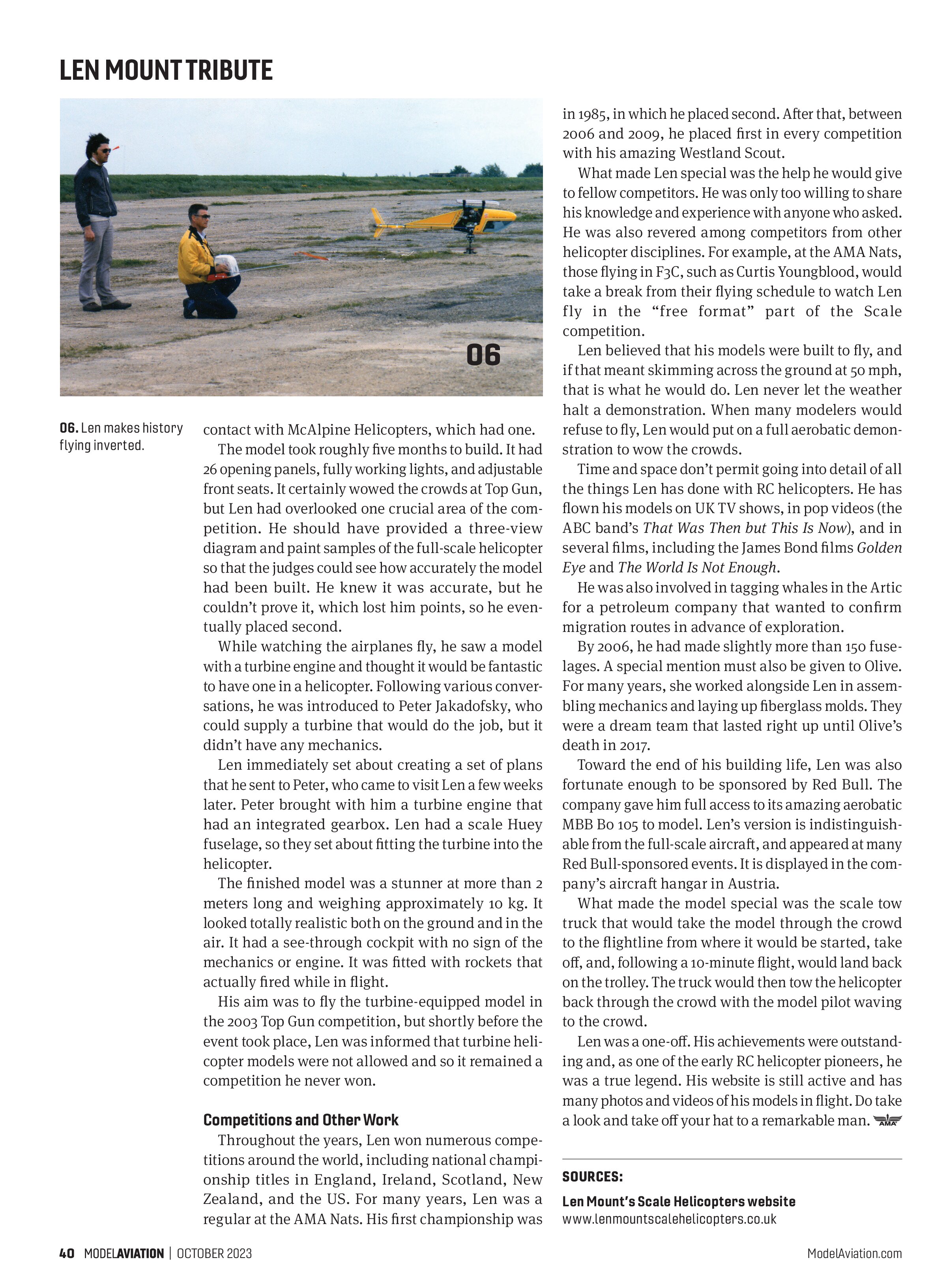
One day, a friend of Len’s said, “Why don’t you fly inverted?” This was the one maneuver that most people thought was impossible because of the many technical challenges involved, such as reversing blade pitch and avoiding fuel starvation.
But Len, in his normal way, loved a challenge and soon overcame the obstacles by modifying both the transmitter and mechanical controls. You have to remember that this was in the days of nitro-fueled helicopters that had no gyros or stabilizing systems of any kind, and when radios consisted of six simple channels with no electronic mixers.
Before long, Len was able to fly inverted, which he found quite simple, “provided you remember to reverse the appropriate controls and no one spoke to you.” At the time, he wasn’t aware of anyone else who had done this, although he learned later that Mike Mas and Ernie Huber in the US had also managed to achieve inverted flight. He was not sure who was first, but Len certainly was the first in Europe.
Helicopter Blades and Scale Fuselages
During this time, Len started to make his own tail and rotor blades because he felt that the commercial ones just weren’t good enough for his style of flying. As success came, others asked him if he could make them a set, and so the business grew. Before long, both Len and his wife, Olive, were making a living out of building and selling rotor blades—sometimes as many as 50 sets a month.
Between 1977 and 1997, Len won a number of national F3C aerobatic championships, including the UK, Scottish, Irish, and New Zealand titles. Competition at this level wasn’t boring but it was repetitious. To win, it was essential to keep practicing and that meant being out in all types of weather. As he grew older, Len noticed that his reactions were getting slower.
He still wanted to make a living from RC helicopters, so he decided to go back into Scale modeling. He was making scale fuselages for his own pleasure and people would often ask him to make one for them. Because he built his own molds, it soon became apparent that he could make a living from this side of the hobby. In 1998, Len stopped making blades (except for those on his own models) and focused on creating and selling scale fuselages.
For those who don’t know, Len’s fuselages were extremely accurate. He would typically take approximately 1,000 photographs of the full-scale subject, and then build in all of the features, right down to rivet placement and seat belt mechanisms within the cockpit. This led him to entering and dominating Scale RC helicopter championships.
Len later commented, “With aerobatics, you can buy a model that is capable of winning, but in Scale, winning requires something special that money can’t buy. It requires an eye for detail, patience in making things in miniature, dedication, and, above all, perseverance. Interestingly, it needn’t be expensive. All of the scale details on my models are made from scrap or everyday objects that cost pennies, but it is hard work and does take time.”
Over an eight-year period, he produced a range of fuselages including an N4 Dauphin, an AS 355, a BK117, an Airwolf, a Huey, a Cobra, a Rotorway, a Kiowa, a Scout, a Bo 105, a Hiller J10, a Puma, and a Westland

Lynx. Each kit would take roughly three to four months to develop. Some would be available as a straightforward fuselage, while others would come with retracts and Len’s own mechanics preinstalled.
Jet Engines
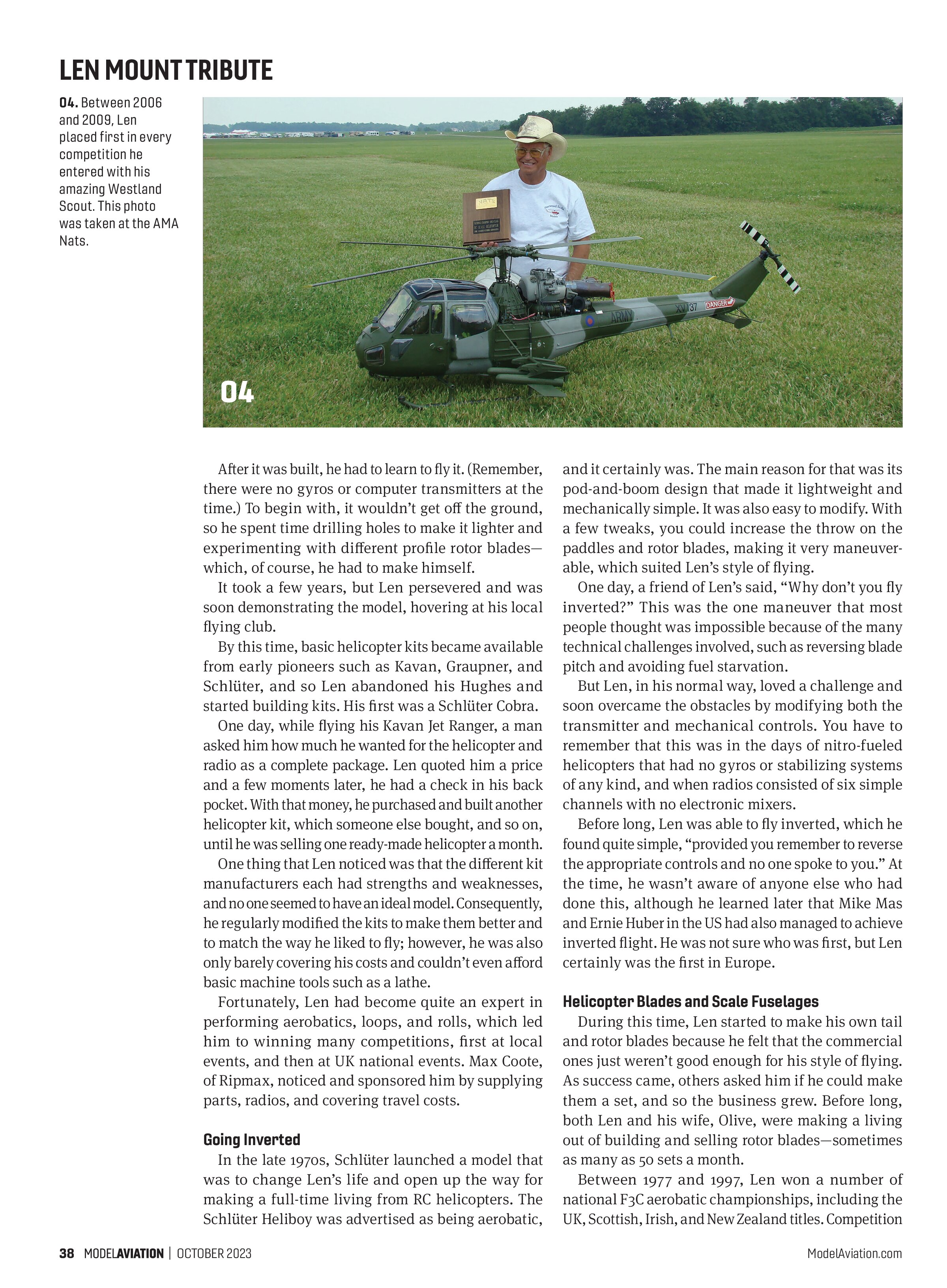
One of the first international competitions that Len entered in this new era of Scale modeling was the Top Gun contest in the US in 2002. Len wanted to build something special, so he settled on the N4 Dauphin, which no one had modeled before.
What made this helicopter special was the fenestron tail (where the tail blades are completely enclosed), which makes the model look exciting in the air. Researching the full-scale aircraft brought him in

contact with McAlpine Helicopters, which had one. The model took roughly five months to build. It had 26 opening panels, fully working lights, and adjustable front seats. It certainly wowed the crowds at Top Gun, but Len had overlooked one crucial area of the competition. He should have provided a three-view diagram and paint samples of the full-scale helicopter so that the judges could see how accurately the model had been built. He knew it was accurate, but he couldn’t prove it, which lost him points, so he eventually placed second.
While watching the airplanes fly, he saw a model with a turbine engine and thought it would be fantastic to have one in a helicopter. Following various conversations, he was introduced to Peter Jakadosfky, who could supply a turbine that would do the job, but it didn’t have any mechanics.
Len immediately set about creating a set of plans that he sent to Peter, who came to visit Len a few weeks later. Peter brought with him a turbine engine that had an integrated gearbox. Len had a scale Huey fuselage, so they set about fitting the turbine into the helicopter.
The finished model was a stunner at more than 2 meters long and weighing approximately 10 kg. It looked totally realistic both on the ground and in the air. It had a see-through cockpit with no sign of the mechanics or engine. It was fitted with rockets that actually fired while in flight.
His aim was to fly the turbine-equipped model in the 2003 Top Gun competition, but shortly before the event took place, Len was informed that turbine helicopter models were not allowed and so it remained a competition he never won.
Competitions and Other Work
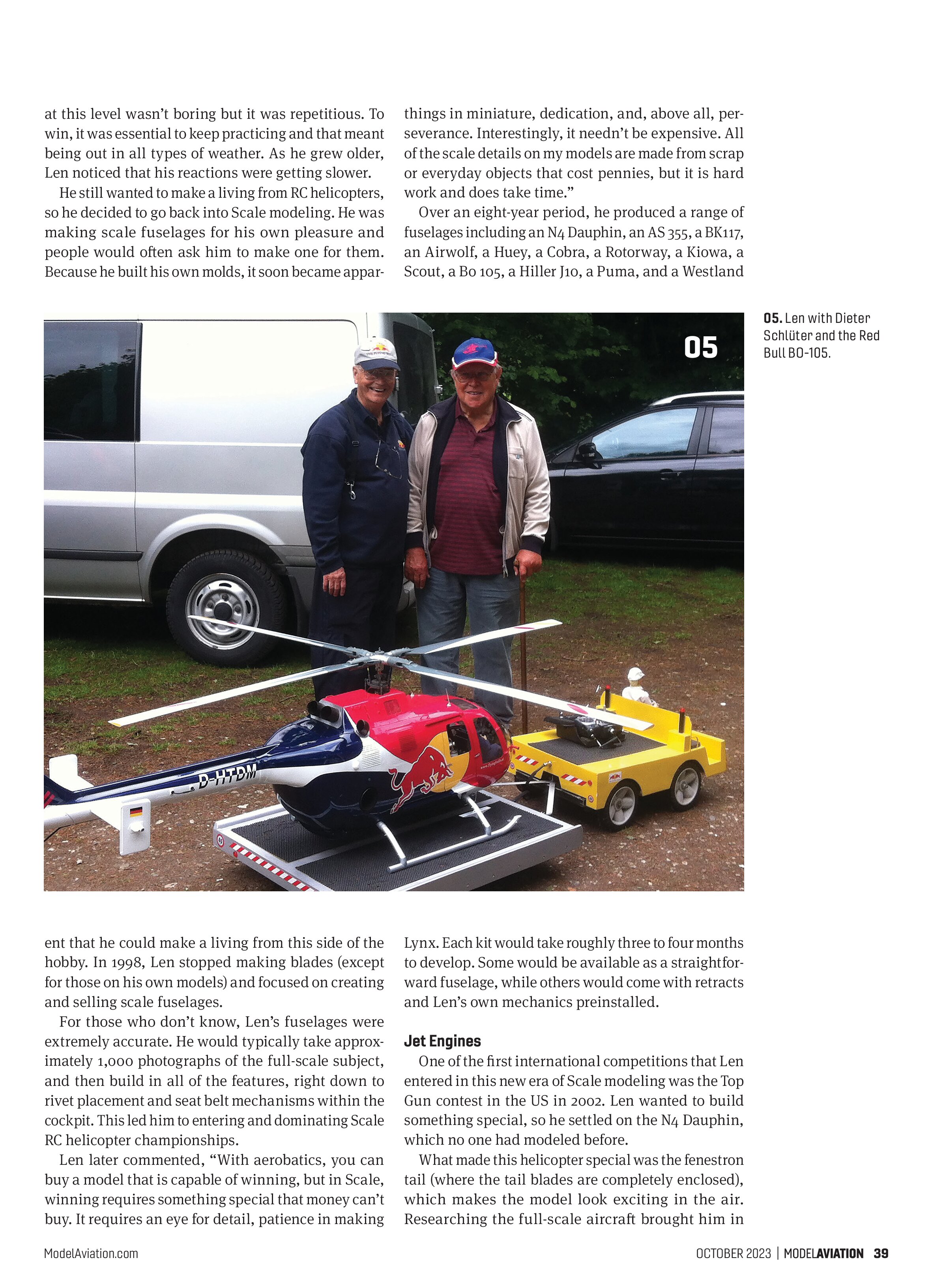
Throughout the years, Len won numerous competitions around the world, including national championship titles in England, Ireland, Scotland, New Zealand, and the US. For many years, Len was a regular at the AMA Nats. His first championship was in 1985, in which he placed second. After that, between 2006 and 2009, he placed first in every competition with his amazing Westland Scout.
What made Len special was the help he would give to fellow competitors. He was only too willing to share his knowledge and experience with anyone who asked. He was also revered among competitors from other helicopter disciplines. For example, at the AMA Nats, those flying in F3C, such as Curtis Youngblood, would take a break from their flying schedule to watch Len fly in the “free format” part of the Scale competition.
Len believed that his models were built to fly, and if that meant skimming across the ground at 50 mph, that is what he would do. Len never let the weather halt a demonstration. When many modelers would refuse to fly, Len would put on a full aerobatic demonstration to wow the crowds.
Time and space don’t permit going into detail of all the things Len has done with RC helicopters. He has flown his models on UK TV shows, in pop videos (the ABC band’s That Was Then but This Is Now), and in several films, including the James Bond films Golden Eye and The World Is Not Enough.
He was also involved in tagging whales in the Artic for a petroleum company that wanted to confirm migration routes in advance of exploration.
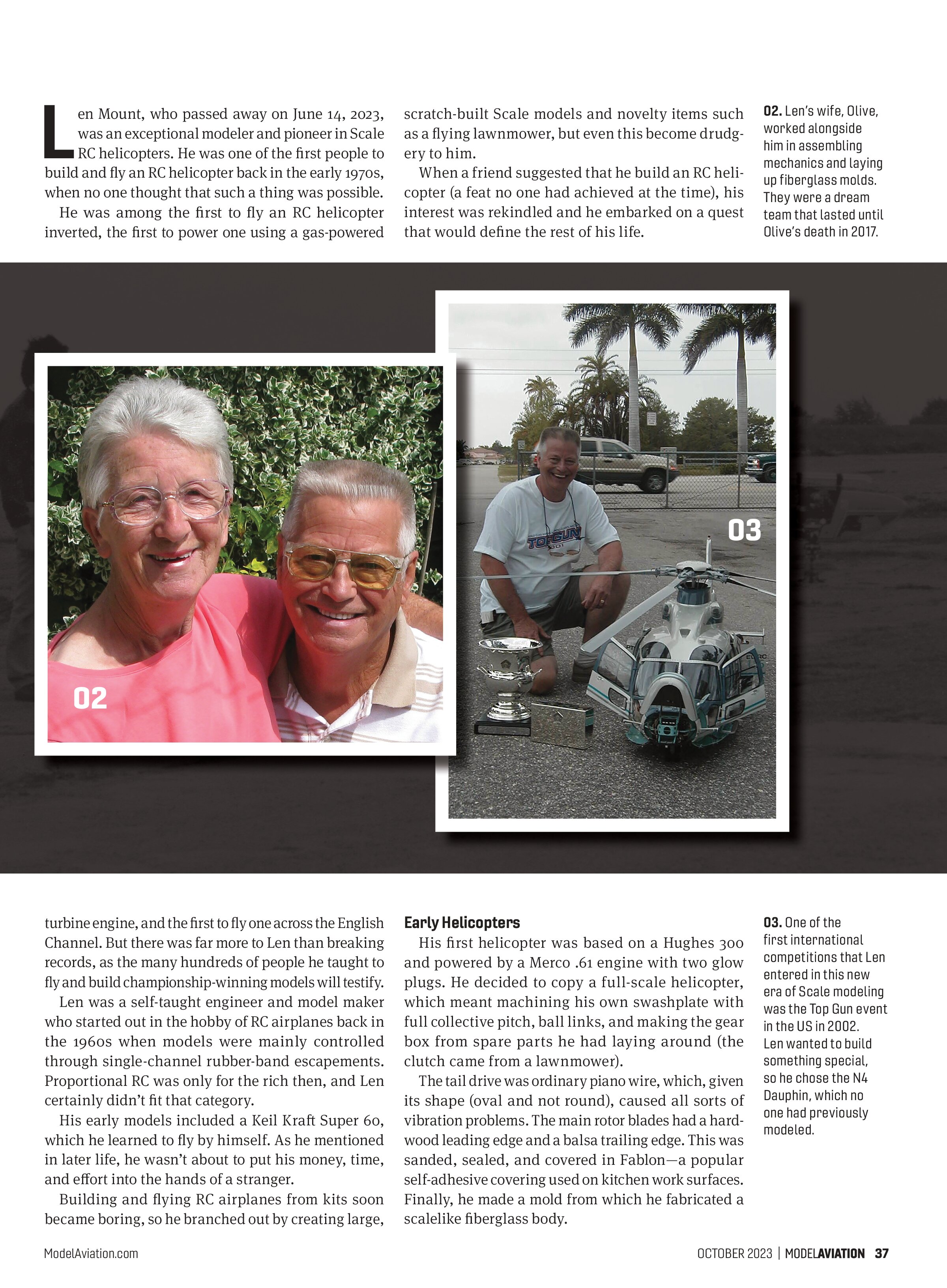
By 2006, he had made slightly more than 150 fuselages. A special mention must also be given to Olive. For many years, she worked alongside Len in assembling mechanics and laying up fiberglass molds. They were a dream team that lasted right up until Olive’s death in 2017.
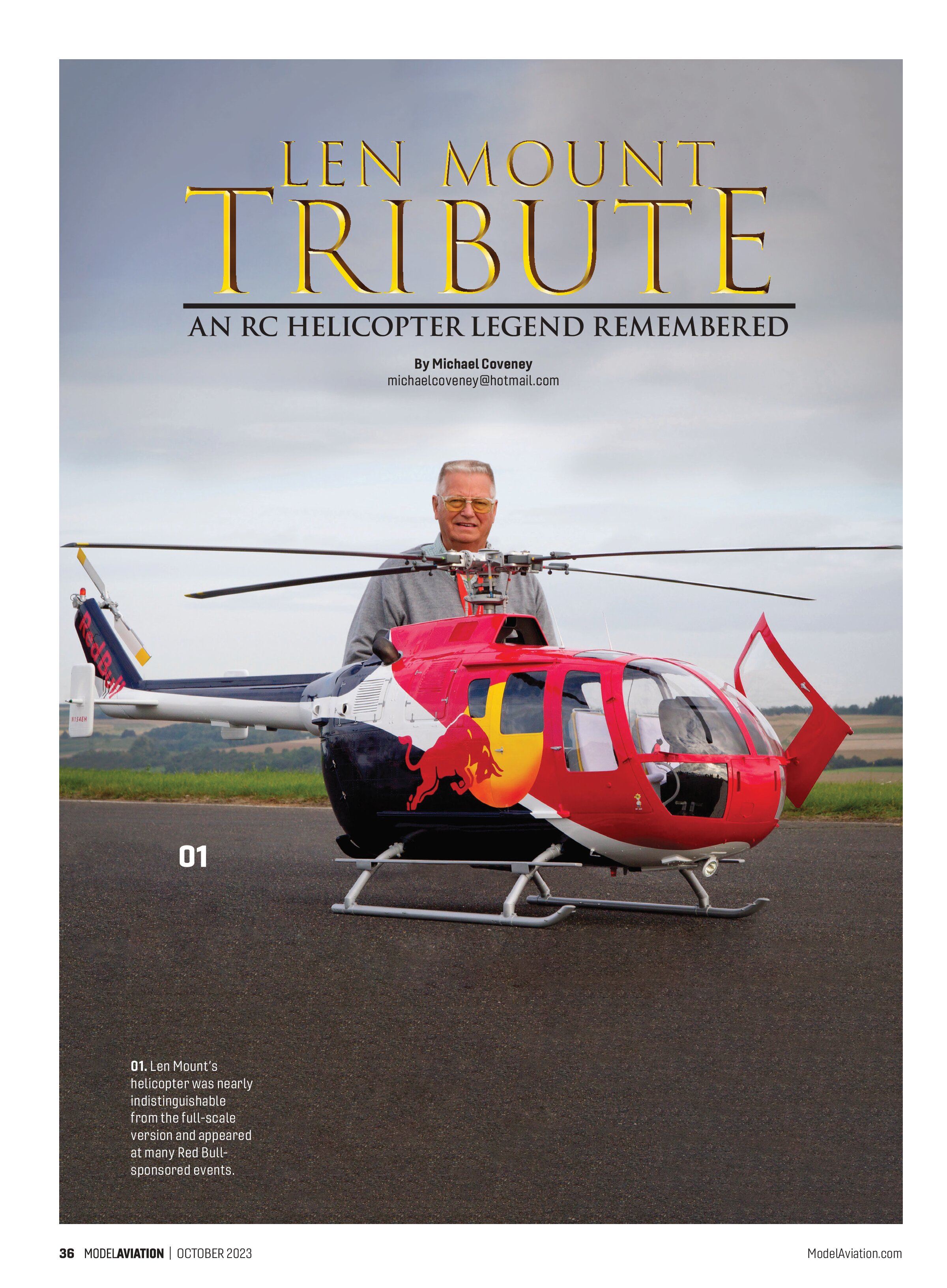
Toward the end of his building life, Len was also fortunate enough to be sponsored by Red Bull. The company gave him full access to its amazing aerobatic MBB Bo 105 to model. Len’s version is indistinguishable from the full-scale aircraft, and appeared at many Red Bull-sponsored events. It is displayed in the company’s aircraft hangar in Austria.
What made the model special was the scale tow truck that would take the model through the crowd to the flightline from where it would be started, take off, and, following a 10-minute flight, would land back on the trolley. The truck would then tow the helicopter back through the crowd with the model pilot waving to the crowd.
Len was a one-off. His achievements were outstanding and, as one of the early RC helicopter pioneers, he was a true legend. His website is still active and has many photos and videos of his models in flight. Do take a look and take off your hat to a remarkable man.
SOURCES:
Len Mount’s Scale Helicopters website
www.lenmountscalehelicopters.co.uk