FOCAL POINT
Interested in sharing your handiwork? Visit www.ModelAviation.com for submission guidelines.
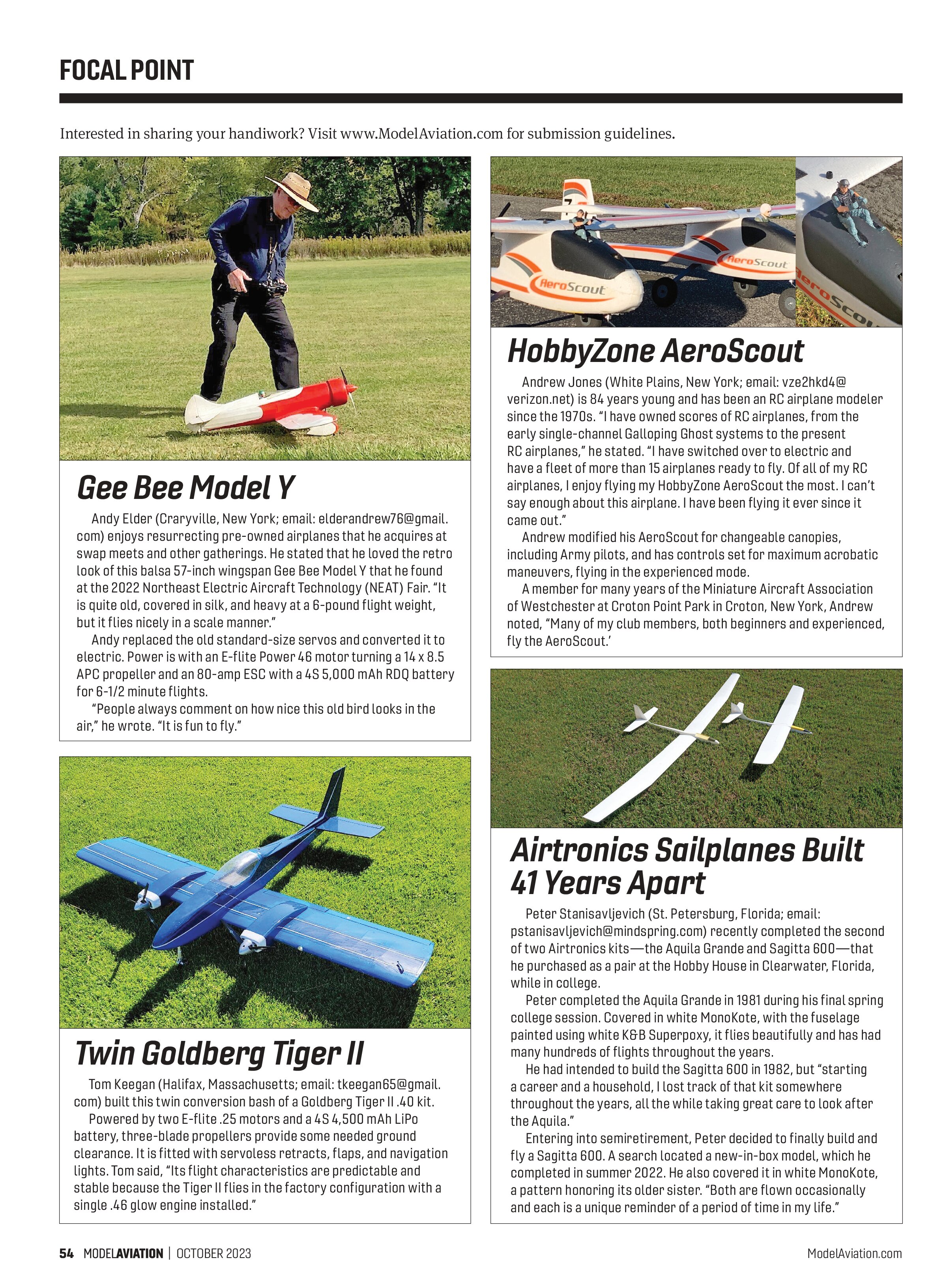
Gee Bee Model Y
Andy Elder (Craryville, New York; email: elderandrew76@gmail.com) enjoys resurrecting pre-owned airplanes that he acquires at swap meets and other gatherings. He stated that he loved the retro look of this balsa 57-inch wingspan Gee Bee Model Y that he found at the 2022 Northeast Electric Aircraft Technology (NEAT) Fair. “It is quite old, covered in silk, and heavy at a 6-pound flight weight, but it flies nicely in a scale manner.”
Andy replaced the old standard-size servos and converted it to electric. Power is with an E-flite Power 46 motor turning a 14 x 8.5 APC propeller and an 80-amp ESC with a 4S 5,000 mAh RDQ battery for 6-1/2 minute flights.
“People always comment on how nice this old bird looks in the air,” he wrote. “It is fun to fly.”

Twin Goldberg Tiger II
Tom Keegan (Halifax, Massachusetts; email: tkeegan65@gmail.com) built this twin conversion bash of a Goldberg Tiger II .40 kit. Powered by two E-flite .25 motors and a 4S 4,500 mAh LiPo battery, three-blade propellers provide some needed ground clearance. It is fitted with servoless retracts, flaps, and navigation lights. Tom said, “Its flight characteristics are predictable and stable because the Tiger II flies in the factory configuration with a single .46 glow engine installed.”

HobbyZone AeroScout
Andrew Jones (White Plains, New York; email: vze2hkd4@verizon.net) is 84 years young and has been an RC airplane modeler since the 1970s. “I have owned scores of RC airplanes, from the early single-channel Galloping Ghost systems to the present RC airplanes,” he stated. “I have switched over to electric and have a fleet of more than 15 airplanes ready to fly. Of all of my RC airplanes, I enjoy flying my HobbyZone AeroScout the most. I can’t say enough about this airplane. I have been flying it ever since it came out.”
Andrew modified his AeroScout for changeable canopies, including Army pilots, and has controls set for maximum acrobatic maneuvers, flying in the experienced mode.
A member for many years of the Miniature Aircraft Association of Westchester at Croton Point Park in Croton, New York, Andrew noted, “Many of my club members, both beginners and experienced, fly the AeroScout.”

Airtronics Sailplanes Built 41 Years Apart
Peter Stanislavljevich (St. Petersburg, Florida; email: pstanislavljevich@mindspring.com) recently completed the second of two Airtronics kits—the Aquila Grande and Sagitta 600—that he purchased as a pair at the Hobby House in Clearwater, Florida, while in college.
Peter completed the Aquila Grande in 1981 during his final spring college session. Covered in white MonoKote, with the fuselage painted using white K&B Superpoxy, it flies beautifully and has had many hundreds of flights throughout the years.
He had intended to build the Sagitta 600 in 1982, but “starting a career and a household, I lost track of that kit somewhere throughout the years, all the while taking great care to look after the Aquila.”
Entering into semiretirement, Peter decided to finally build and fly a Sagitta 600. A search located a new-in-box model, which he completed in summer 2022. He also covered it in white MonoKote, a pattern honoring its older sister. “Both are flown occasionally and each is a unique reminder of a period of time in my life.”

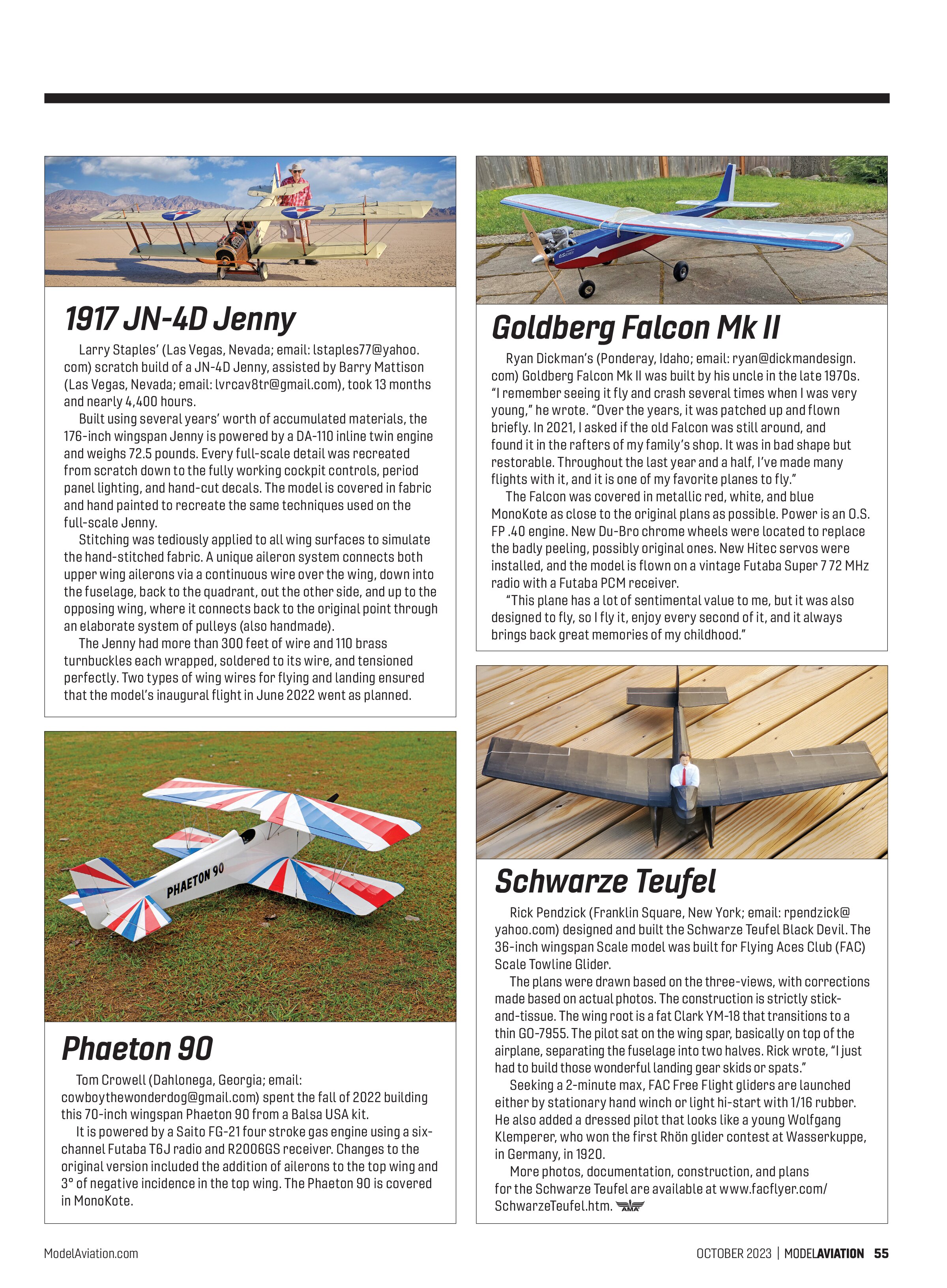
1917 JN-4D Jenny
Larry Staples’ (Las Vegas, Nevada; email: lstaples77@yahoo.com) scratch build of a JN-4D Jenny, assisted by Barry Mattison (Las Vegas, Nevada; email: lvrcav8tr@gmail.com), took 13 months and nearly 4,400 hours.
Built using several years’ worth of accumulated materials, the 176-inch wingspan Jenny is powered by a DA-110 inline twin engine and weighs 72.5 pounds. Every full-scale detail was recreated from scratch down to the fully working cockpit controls, period panel lighting, and hand-cut decals. The model is covered in fabric and hand painted to recreate the same techniques used on the full-scale Jenny.
Stitching was tediously applied to all wing surfaces to simulate the hand-stitched fabric. A unique aileron system connects both upper wing ailerons via a continuous wire over the wing, down into the fuselage, back to the quadrant, out the other side, and up to the opposing wing, where it connects back to the original point through an elaborate system of pulleys (also handmade).
The Jenny had more than 300 feet of wire and 110 brass turnbuckles each wrapped, soldered to its wire, and tensioned perfectly. Two types of wing wires for flying and landing ensured that the model’s inaugural flight in June 2022 went as planned.

Phaeton 90
Tom Crowell (Dahlonega, Georgia; email: cowboythewonderdog@gmail.com) spent the fall of 2022 building this 70-inch wingspan Phaeton 90 from a Balsa USA kit.
It is powered by a Saito FG-21 four stroke gas engine using a six-channel Futaba T6J radio and R2006GS receiver. Changes to the original version included the addition of ailerons to the top wing and 3° of negative incidence in the top wing. The Phaeton 90 is covered in MonoKote.

Goldberg Falcon Mk II
Ryan Dickman’s (Ponderay, Idaho; email: ryan@dickmandesign.com) Goldberg Falcon Mk II was built by his uncle in the late 1970s. “I remember seeing it fly and crash several times when I was very young,” he wrote. “Over the years, it was patched up and flown briefly. In 2021, I asked if the old Falcon was still around, and found it in the rafters of my family’s shop. It was in bad shape but restorable. Throughout the last year and a half, I’ve made many flights with it, and it is one of my favorite planes to fly.”
The Falcon was covered in metallic red, white, and blue MonoKote as close to the original plans as possible. Power is an O.S. FP .40 engine. New Du-Bro chrome wheels were located to replace the badly peeling, possibly original ones. New Hitec servos were installed, and the model is flown on a vintage Futaba Super 7 72 MHz radio with a Futaba PCM receiver.
“This plane has a lot of sentimental value to me, but it was also designed to fly, so I fly it, enjoy every second of it, and it always brings back great memories of my childhood.”

Schwarze Teufel
Rick Pendzick (Franklin Square, New York; email: rpendzick@yahoo.com) designed and built the Schwarze Teufel Black Devil. The 36-inch wingspan Scale model was built for Flying Aces Club (FAC) Scale Towline Glider.
The plans were drawn based on the three-views, with corrections made based on actual photos. The construction is strictly stick-and-tissue. The wing root is a fat Clark YM-18 that transitions to a thin GO-7955. The pilot sat on the wing spar, basically on top of the airplane, separating the fuselage into two halves. Rick wrote, “I just had to build those wonderful landing gear skis or spats.”
Seeking a 2-minute max, FAC Free flight gliders are launched either by stationary hand winch or light hi-start with 1/16 rubber. He also added a dressed pilot that looks like a young Wolfgang Klemperer, who won the first Rhön glider contest at Wasserkuppe, in Germany, in 1920.
More photos, documentation, construction, and plans for the Schwarze Teufel are available at www.facflyer.com/SchwarzeTeufel.htm.