PREDICTING POWER SYSTEM PERFORMANCE
By Terry Dunn | terrydunn74@gmail.com

I HAVE WRITTEN in previous columns about the importance of using a wattmeter to directly measure the current and power of your model’s propulsion system, but what about those times when you do not have a complete power system on hand?
Maybe you’re deciding what motor to buy for a new project. Or perhaps you need to know which ESC to use on a swap-meet purchase. In those cases—and more—it is very helpful to be able to predict, rather than measure, how a power system will perform.
Worry not. A performance calculator will help you find the information that you need.
Why Use a Calculator?
I have used a few different performance calculators throughout the years. The calculator I now use is a website called eCalc. All performance calculators work essentially the same way. You tell the calculator what components are in your power system—the motor, battery, ESC, and propeller. It then pulls the known attributes of those components from its database and calculates an estimate of how they will perform as a complete system.
Notice that I used the word “estimate.” Although accurate, these types of calculators are purely theoretical. There are numerous “real world” variables that prevent the results from being exact, so these should be considered approximation tools. They are perfect for making sure that a power system is in the right ballpark. Precise results will only come from direct measurements using a wattmeter.
Using eCalc
eCalc is actually the name of a suite of online tools that can be used for things such as figuring out the correct center of gravity for a model or sorting out the power system for a multirotor. The specific tool that I use for electric-powered, fixed-wing models is called propCalc. eCalc is a subscription service that costs just a few dollars per year. There is a free version, but the database of batteries, ESCs, and motors is drastically smaller.
I am convinced that my eCalc subscription saves me money every year just by helping me identify the propellers that I should buy for new setups.
There are a lot of fields on the eCalc interface. It can be a little overwhelming at first, but don’t let that intimidate you. Most of the fields will autofill as you input the components from your power system.
The first set of data to enter is general information about your model and environment. It will ask for the wingspan, wing area, and weight. Be advised that the cell for field elevation defaults to a

variety of those propellers on the model with a wattmeter. We settled on a propeller that gave strong power readings without pulling more current than any of the components could handle.
To summarize, we used the estimated values from eCalc to narrow the selection of viable propellers. We then used a wattmeter to validate those performance predictions with static tests on the actual model. You would normally make a final selection after evaluating the flight performance of the model with different propellers. In this case, Ehren was very happy with the first propeller he tried. Success!

value of 1,640 feet above sea level. Make sure that you enter the correct elevation for your flying site. This can have a significant impact on the resulting calculations.
Use the drop-down menus to select the battery and ESC from your power system. You might not find an exact match, so choose the closest option you can find. You will have to manually enter the number of cells in your battery.
The motor drop-down menu contains a huge selection of brushless motors. I would be surprised if you did not find an exact match for your particular motor. The same is true for propellers. Select the brand and type of propeller you intend to use, then manually enter the diameter and pitch.
After pressing the calculate button, the bottom of the screen will populate with the tool’s performance predictions. Again, the sheer amount of data can be overwhelming. It’s all useful stuff, but I usually only care about two values.
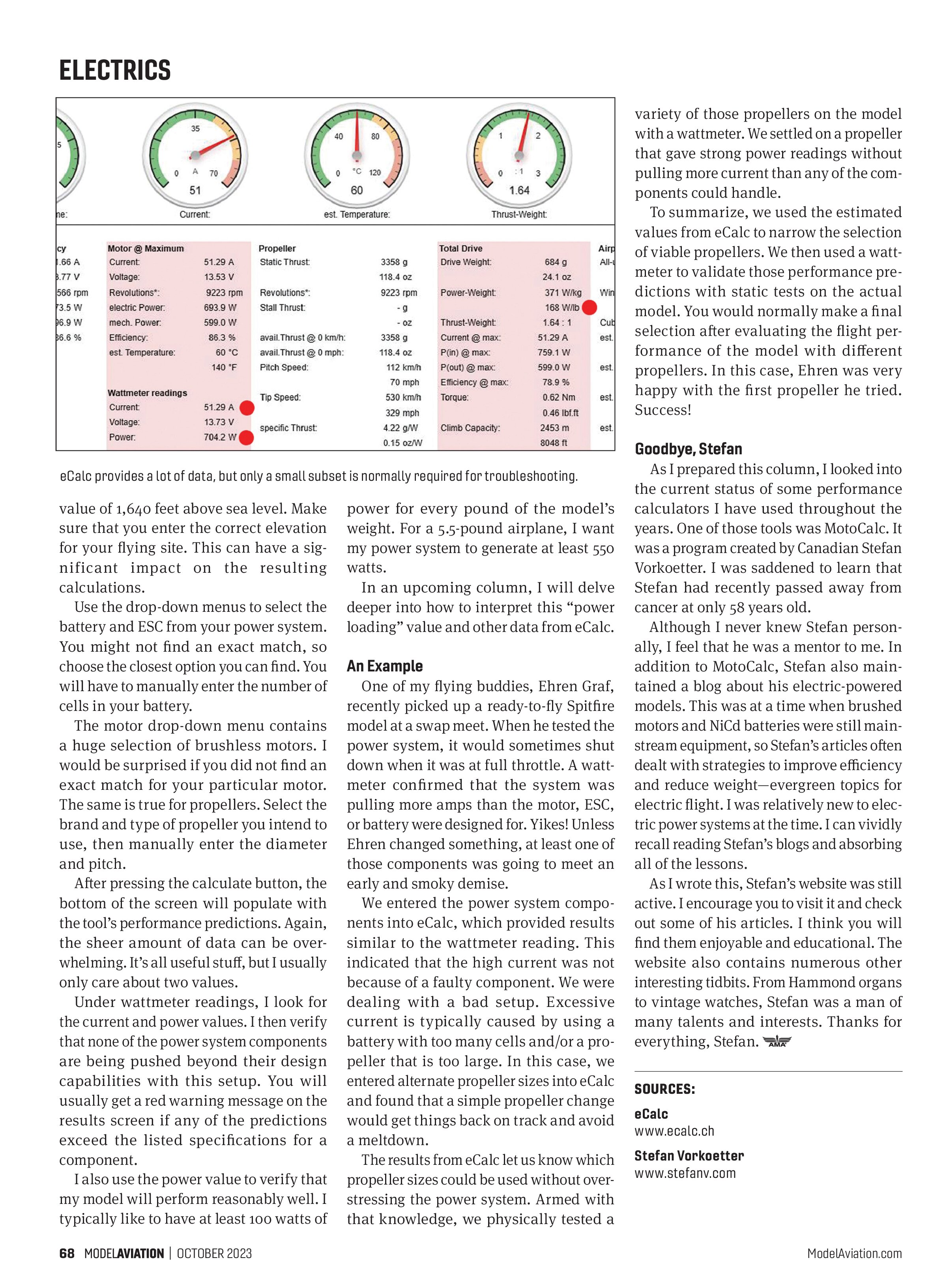
Under wattmeter readings, I look for the current and power values. I then verify that none of the power system components are being pushed beyond their design capabilities with this setup. You will usually get a red warning message on the results screen if any of the predictions exceed the listed specifications for a component.
I also use the power value to verify that my model will perform reasonably well. I typically like to have at least 100 watts of power for every pound of the model’s weight. For a 5.5-pound airplane, I want my power system to generate at least 550 watts.
In an upcoming column, I will delve deeper into how to interpret this “power loading” value and other data from eCalc.
An Example
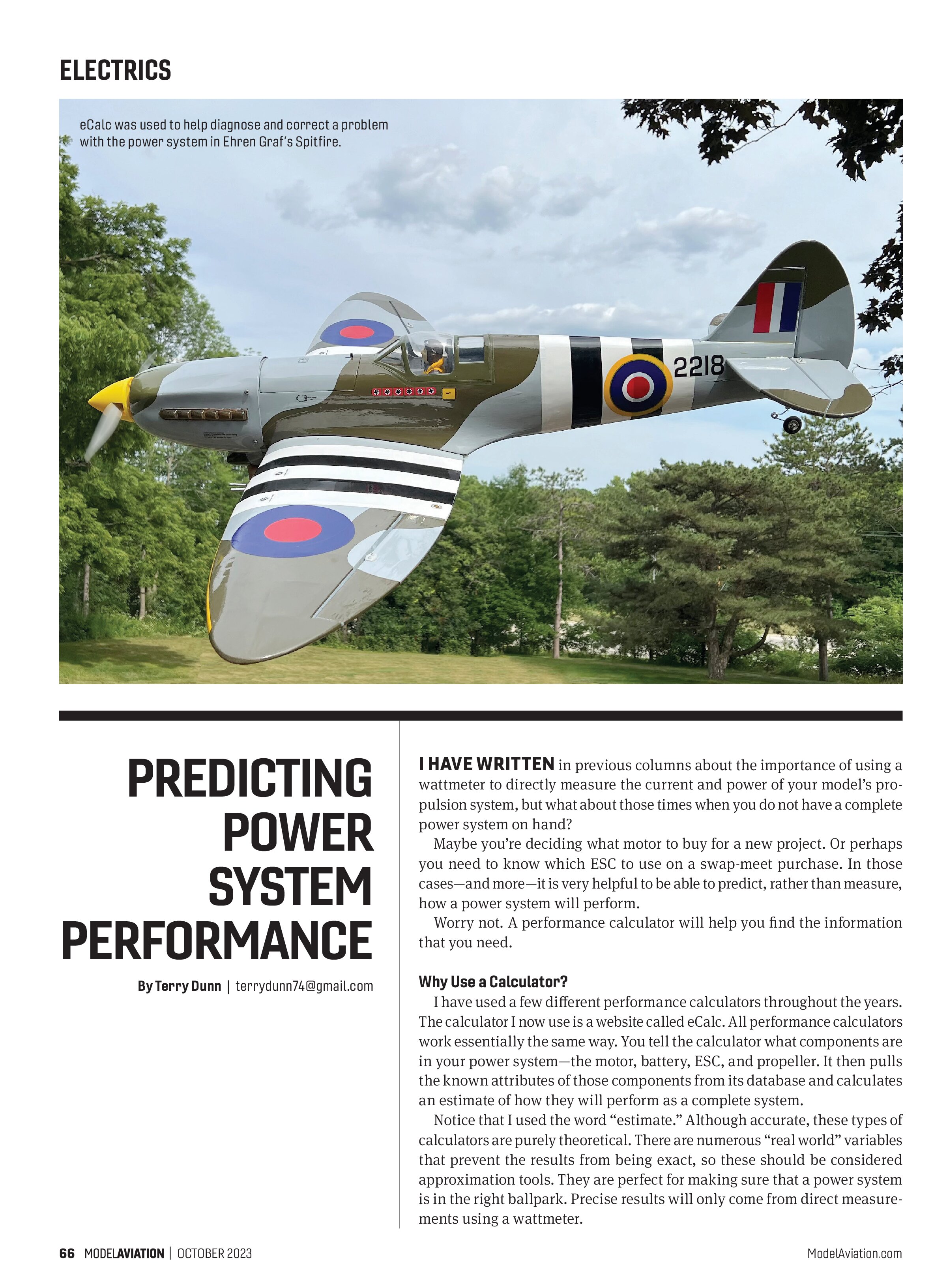
One of my flying buddies, Ehren Graf, recently picked up a ready-to-fly Spitfire model at a swap meet. When he tested the power system, it would sometimes shut down when it was at full throttle. A wattmeter confirmed that the system was pulling more amps than the motor, ESC, or battery were designed for. Yikes! Unless Ehren changed something, at least one of those components was going to meet an early and smoky demise.
We entered the power system components into eCalc, which provided results similar to the wattmeter reading. This indicated that the high current was not because of a faulty component. We were dealing with a bad setup. Excessive current is typically caused by using a battery with too many cells and/or a propeller that is too large. In this case, we entered alternate propeller sizes into eCalc and found that a simple propeller change would get things back on track and avoid a meltdown.
The results from eCalc let us know which propeller sizes could be used without overstressing the power system. Armed with that knowledge, we physically tested a variety of those propellers on the model with a wattmeter. We settled on a propeller that gave strong power readings without pulling more current than any of the components could handle.
To summarize, we used the estimated values from eCalc to narrow the selection of viable propellers. We then used a wattmeter to validate those performance predictions with static tests on the actual model. You would normally make a final selection after evaluating the flight performance of the model with different propellers. In this case, Ehren was very happy with the first propeller he tried. Success!
Goodbye, Stefan
As I prepared this column, I looked into the current status of some performance calculators I have used throughout the years. One of those tools was MotoCalc. It was a program created by Canadian Stefan Vorkoetter. I was saddened to learn that Stefan had recently passed away from cancer at only 58 years old.
Although I never knew Stefan personally, I feel that he was a mentor to me. In addition to MotoCalc, Stefan also maintained a blog about his electric-powered models. This was at a time when brushed motors and NiCd batteries were still mainstream equipment, so Stefan’s articles often dealt with strategies to improve efficiency and reduce weight—evergreen topics for electric flight. I was relatively new to electric power systems at the time. I can vividly recall reading Stefan’s blogs and absorbing all of the lessons.
As I wrote this, Stefan’s website was still active. I encourage you to visit it and check out some of his articles. I think you will find them enjoyable and educational. The website also contains numerous other interesting tidbits. From Hammond organs to vintage watches, Stefan was a man of many talents and interests. Thanks for everything, Stefan.
SOURCES:
eCalc
www.ecalc.ch
Stefan Vorkoetter
www.stefanv.com