THE DEAL WITH DRONES

THE CHASE IS ON: WORKING WITH DRONE PILOTS
By Susan Smith | susankaysmith@gmail.com
I PLUG IN MY DRONE, turn on the high-definition camera on top of it, and wait for the airplane to take off ahead of me. It’s my first time chasing an RC airplane, and the adrenaline is running high. I want to get good footage, but not damaging the airplane I’m chasing is of paramount importance.
I see the airplane’s propellers spinning ahead of me and I take a deep breath, moving the throttle and pitch sticks on my radio. Our spotters stand next to us as I take off after the aircraft. I circle above and below it, capturing the red airplane’s rolls and power loops. It’s an adrenaline rush like I’ve never experienced in drone racing or freestyle flying.
FPV provides new opportunities to see the world up close. From fireworks to drift cars, drones give us a front-row seat to the action. In fact, chase footage is what puts drones on the map for many RC enthusiasts. As my partner, Tom, said, “The first time I saw a drone was chase footage on a YouTube video with millions of views. The drone was following two other drones through the forest like something out of Star Wars. I had to learn to fly a drone too.”
RC airplanes and wings are no different. Enthusiasts are working with drone pilots to capture chase footage that allows us to see their acrobatic feats up close and personal.
“Formation or chase flying are some of the most fun I’ve ever had in the RC hobby,” said Dawson “Reck” Reckinger, who has experience as both the lead pilot and chaser of a variety of aircraft. “Flying FPV normally is almost surreal and hard for me to really connect what I’m seeing with what’s actually happening,” he said. “Somehow following an airplane gives this sense of where I actually am in the sky and how I’m moving, giving me a feeling of flight.”
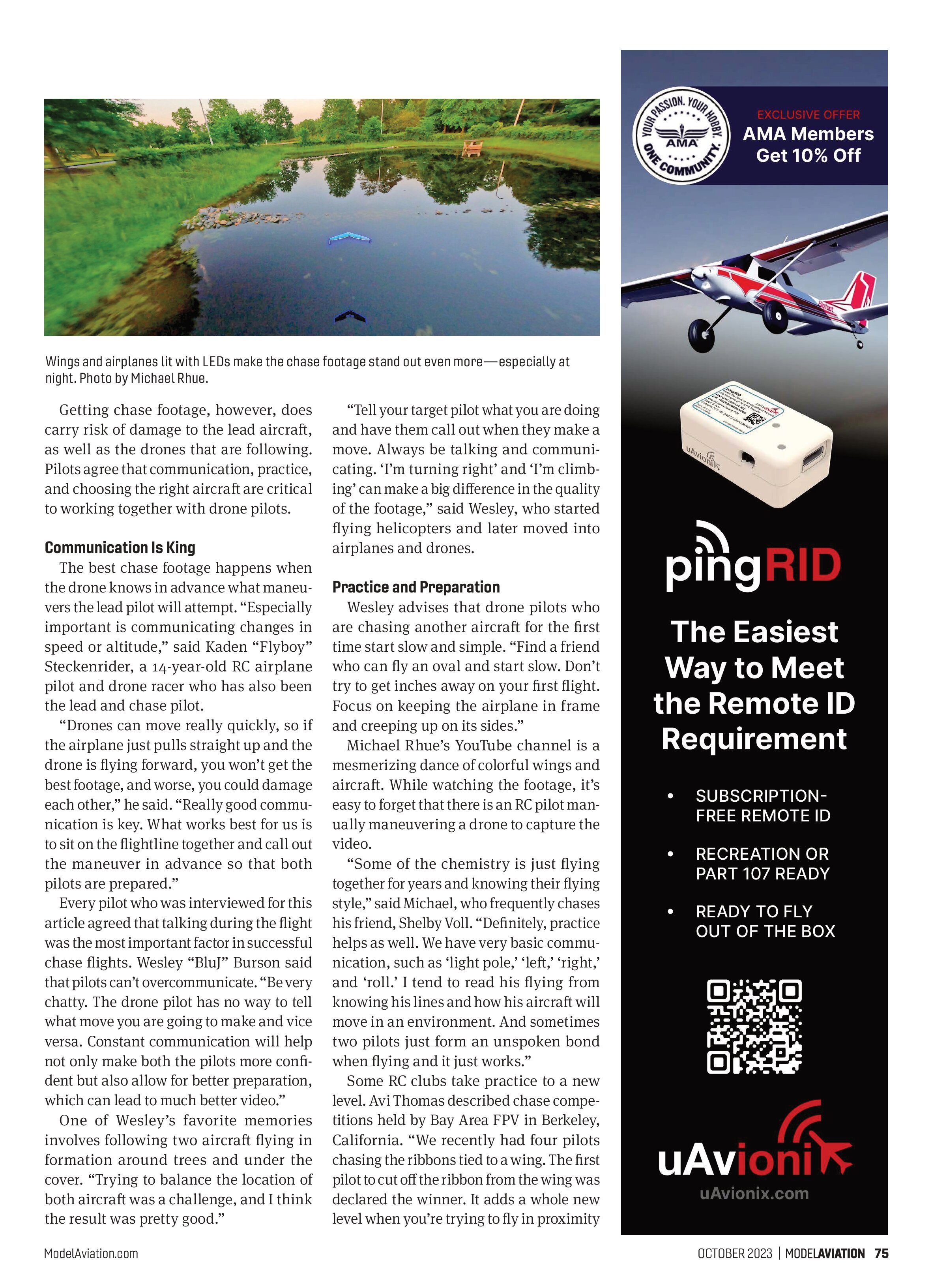
Wings and airplanes lit with LEDs make the chase footage stand out even more—especially at night.
Getting chase footage, however, does carry risk of damage to the lead aircraft, as well as the drones that are following. Pilots agree that communication, practice, and choosing the right aircraft are critical to working together with drone pilots.
Communication Is King
The best chase footage happens when the drone knows in advance what maneuvers the lead pilot will attempt. “Especially important is communicating changes in speed or altitude,” said Kaden “Flyboy” Steckenrider, a 14-year-old RC airplane pilot and drone racer who has also been the lead and chase pilot.
“Drones can move really quickly, so if the airplane just pulls straight up and the drone is flying forward, you won’t get the best footage, and worse, you could damage each other,” he said. “Really good communication is key. What works best for us is to sit on the flightline together and call out the maneuver in advance so that both pilots are prepared.”
Every pilot who was interviewed for this article agreed that talking during the flight was the most important factor in successful chase flights. Wesley “BluJ” Burson said that pilots can’t overcommunicate. “Be very chatty. The drone pilot has no way to tell what move you are going to make and vice versa. Constant communication will help not only make both the pilots more confident but also allow for better preparation, which can lead to much better video.”
One of Wesley’s favorite memories involves following two aircraft flying in formation around trees and under the cover. “Trying to balance the location of both aircraft was a challenge, and I think the result was pretty good.”
“Tell your target pilot what you are doing and have them call out when they make a move. Always be talking and communicating. ‘I’m turning right’ and ‘I’m climbing’ can make a big difference in the quality of the footage,” said Wesley, who started flying helicopters and later moved into airplanes and drones.
Practice and Preparation
Wesley advises that drone pilots who are chasing another aircraft for the first time start slow and simple. “Find a friend who can fly an oval and start slow. Don’t try to get inches away on your first flight. Focus on keeping the airplane in frame and creeping up on its sides.”
Michael Rhue’s YouTube channel is a mesmerizing dance of colorful wings and aircraft. While watching the footage, it’s easy to forget that there is an RC pilot manually maneuvering a drone to capture the video.
“Some of the chemistry is just flying together for years and knowing their flying style,” said Michael, who frequently chases his friend, Shelby Voll. “Definitely, practice helps as well. We have very basic communication, such as ‘light pole,’ ‘left,’ ‘right,’ and ‘roll.’ I tend to read his flying from knowing his lines and how his aircraft will move in an environment. And sometimes two pilots just form an unspoken bond when flying and it just works.”
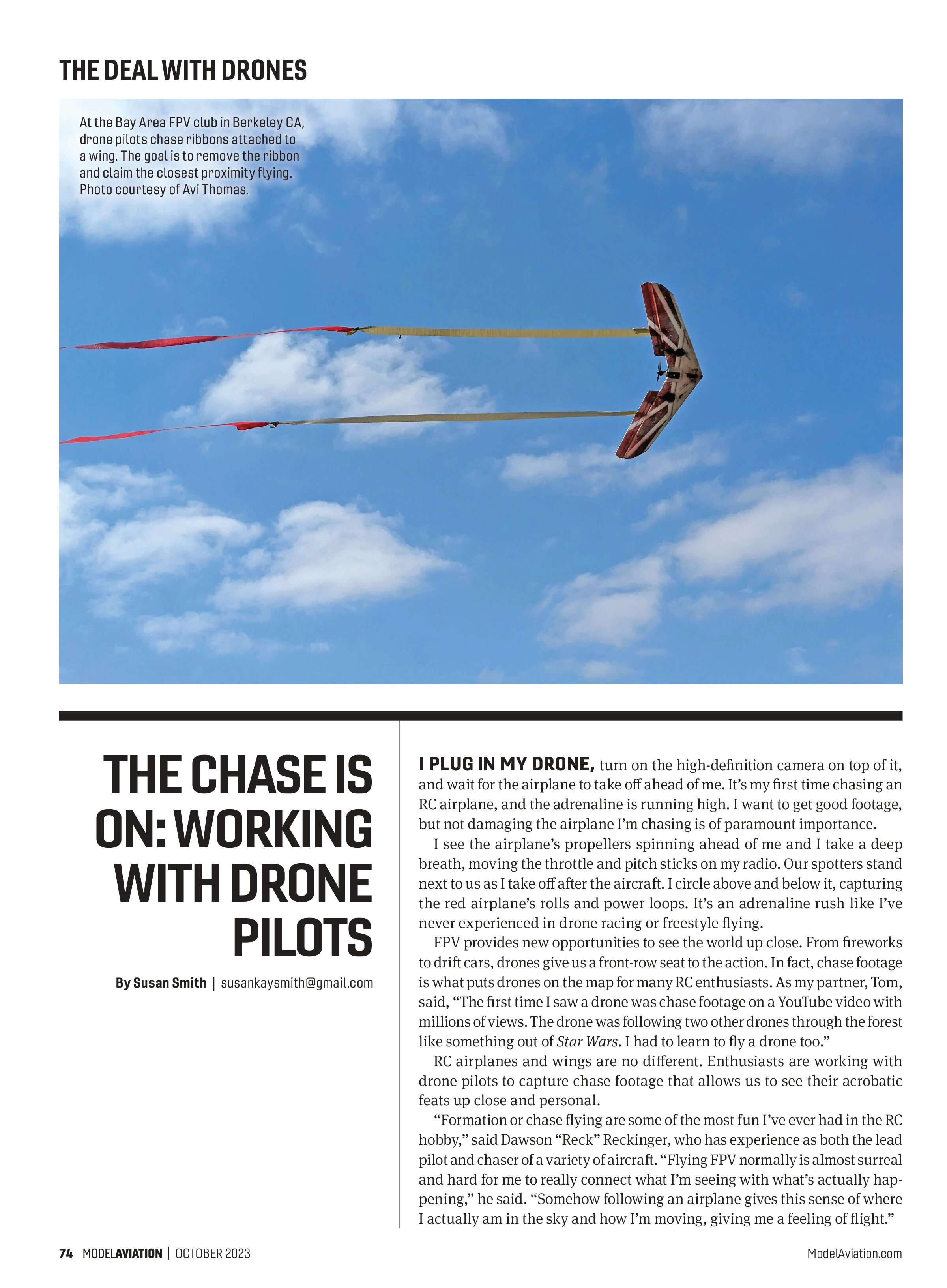
Some RC clubs take practice to a new level. Avi Thomas described chase competitions held by Bay Area FPV in Berkeley, California. “We recently had four pilots chasing the ribbons tied to a wing. The first pilot to cut off the ribbon from the wing was declared the winner. It adds a whole new level when you’re trying to fly in proximity


and the tail was clipped by a quad when I made an unexpected move. I managed to land the airplane safely. I still have the remains of the vertical stabilizer.”
Making it easier to see the lead aircraft is also important. “With bigger airplanes, you need more light so that you have a better visual,” Kaden said.
Pilots can take it to the next level by outfitting the lead aircraft with LEDs. “Many airplanes now have LED kits that help light it up and allow you to fly it in the dark,” he said.
Wesley echoed, “The LEDs add something extra when you’re doing a chase flight at dusk. Not only is the aircraft easier for the drone pilot to spot, but the colors on the resulting footage make it that much better.”
while also needing to be mindful of where the other drone pilots are,” he said.
essential to have spotters, and it’s also helpful if other pilots can wait to launch until your flight has finished.
Right Aircraft, Right Lighting
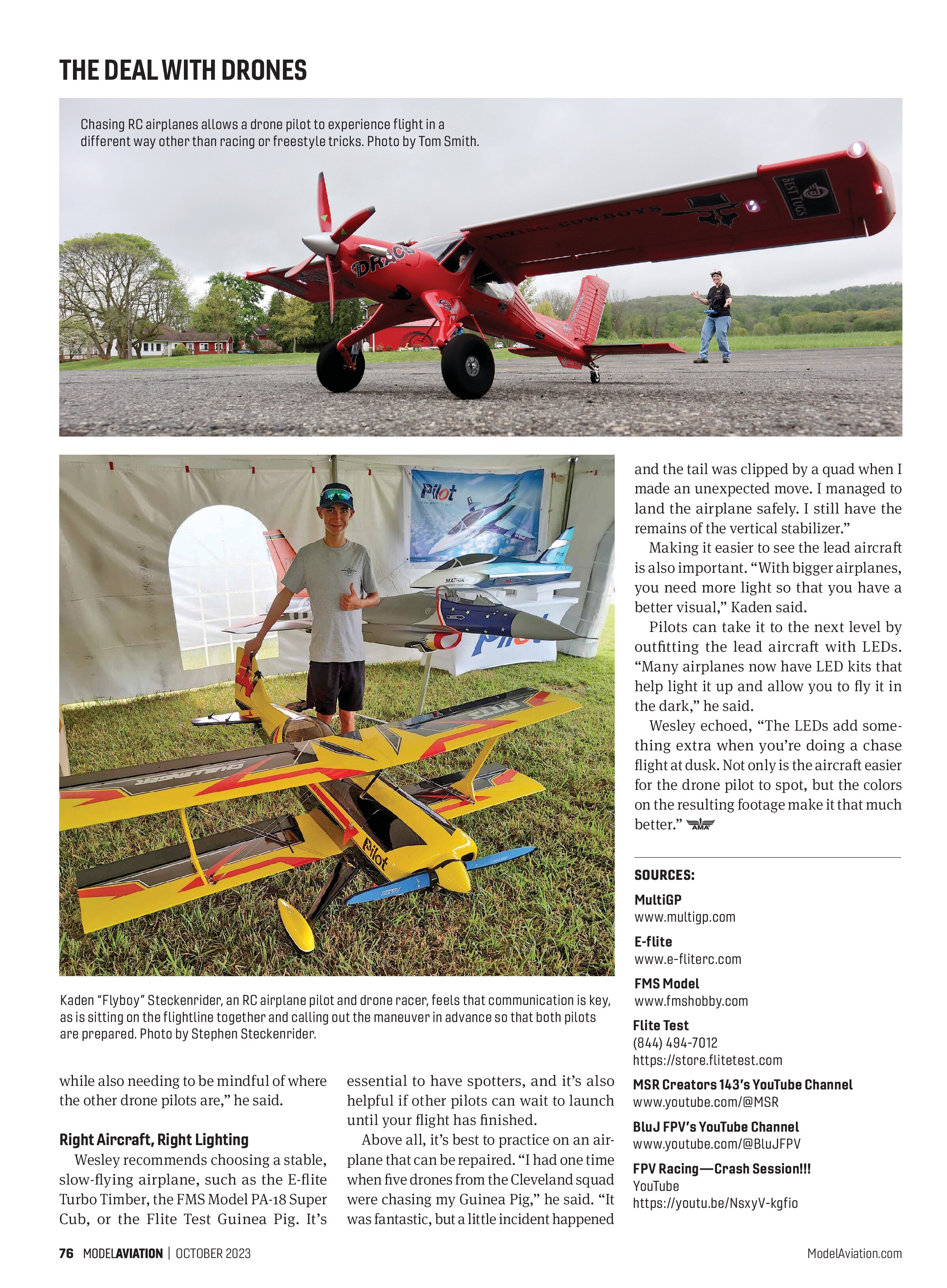
Wesley recommends choosing a stable, slow-flying airplane, such as the E-flite Turbo Timber, the FMS Model PA-18 Super Cub, or the Flite Test Guinea Pig. It’s
Above all, it’s best to practice on an airplane that can be repaired. “I had one time when five drones from the Cleveland squad were chasing my Guinea Pig,” he said. “It was fantastic, but a little incident happened
SOURCES:
MultiGP
www.multigp.com
E-flite
www.e-fliterc.com
FMS Model
www.fmshobby.com
Flite Test
(844) 494-7012
https://store.flitetest.com
MSR Creators 143’s YouTube Channel
www.youtube.com/@MSR
BluJ FPV’s YouTube Channel
www.youtube.com/@BluJFPV
FPV Racing—Crash Session!!!
YouTube
https://youtu.be/NsxyV-kgfio