Safety Comes First

LOUSY PHOTO, GREAT PPE
By Dave Gee | safetycolumn@cs.com
THE PHOTOGRAPHS you see in Model Aviation magazine are superb, except for those in this column. Rookie mistakes, such as having people’s faces shaded by their hats, are not allowed. Perhaps a devious trick will slip one of my low-quality photos past the editor. Here goes ...
Matt Keenon is a great guy, and he is also a famous aerospace engineer who helped design the Ingenuity helicopter that flies on Mars. I ran into him in Pasadena, California, at the NASA Jet Propulsion Laboratory (JPL) open house. Matt was demonstrating the RC version of Ingenuity, tuned for flight on Earth.
He kindly waved me over to pose for a picture with the helicopter. Matt came prepared for solar radiation with a broad-brimmed hat and long sleeves. My own bald head was covered by a hat as well. Of course, the photo came out with both of our faces heavily shaded, but that was actually good, right?
Most modelers fly their aircraft outdoors, and sunny weather is flying weather. Skin cancer is no joke. Sharp pilots prepare for exposure to the sun by using sunscreen and proper clothing. It’s much better to avoid medical trouble than to treat it! These days, we have plenty of long-term data to let us know how to minimize our melanoma risk. Using the right personal protective equipment (PPE) can make a big difference. Sunscreen and long sleeves are very effective.
I tried a bunch of different hats until the right one came along. It’s a subjective thing, and everyone has their own headgear preference. Blocking heavy sunlight with a good hat is a winning strategy for preventing skin cancer, but it can result in poorly composed photographs.

Eye See the Light
Too much sunshine is also a risk to our eyes. Ultraviolet (UV) light can contribute to corneal damage, cataracts, and macular degeneration. The local dollar store might carry sunglasses, but this is not the place to cut corners. Spend a bit more and get high-quality UV-blocking shades. Staring up into the sky at our models (except me because I’m usually just looking down at the wreckage) justifies having the best PPE we can find.
I wear excellent impact-resistant, wrap-around sunglasses from Zurich International. There are many other fine products, but I have brand loyalty for those particular ones, which are well-suited for model aircraft use.
Tooling Around
Some of us remember the good old days when Jim Walker sold wonderful folding-wing gliders. These American Junior
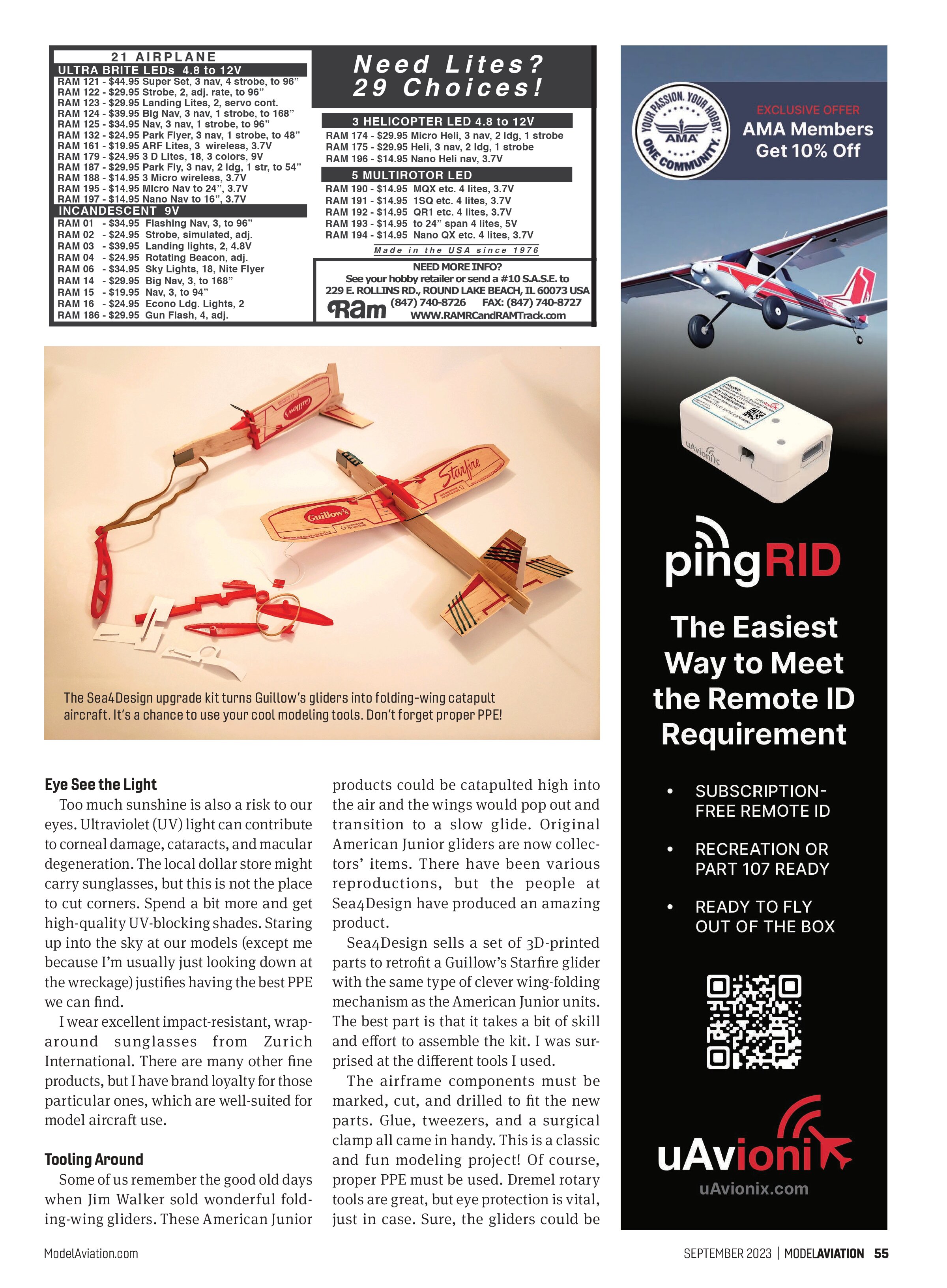
products could be catapulted high into the air and the wings would pop out and transition to a slow glide. Original American Junior gliders are now collectors’ items. There have been various reproductions, but the people at Sea4Design have produced an amazing product.
Sea4Design sells a set of 3D-printed parts to retrofit a Guillows’ Starfire glider with the same type of clever wing-folding mechanism as the American Junior units. The best part is that it takes a bit of skill and effort to assemble the kit. I was surprised at the different tools I used.
The airframe components must be marked, cut, and drilled to fit the new parts. Glue, tweezers, and a surgical clamp all came in handy. This is a classic and fun modeling project! Of course, proper PPE must be used. Dremel rotary tools are great, but eye protection is vital, just in case. Sure, the gliders could be


assembled with more basic equipment, but it’s fun to have and use exactly the right tools for a job.
My club bought a batch of the Sea4Design upgrade kits and had an informal contest. The mechanisms worked just as they should and, although the airplanes aren’t quite as robust as the 1940s versions, they all ended up flying well. Don’t get just one. You’ll want a spare for when the first airplane gets treed.
Calling All Close Calls!
Anecdotal tales of modeling incidents can be excellent learning tools. Hearing stories of how other people made it through a dangerous situation means that we will be more likely to make the right choice in similar circumstances. It’s sometimes called “hangar flying.”
If you’ve had a close call, please consider dropping me an email to share the information with fellow pilots. I’ll even provide anonymity if you prefer. Sharing that kind of story might keep someone else from getting hurt, and that’s a good deed for sure!
A Shiny Mystery Airplane
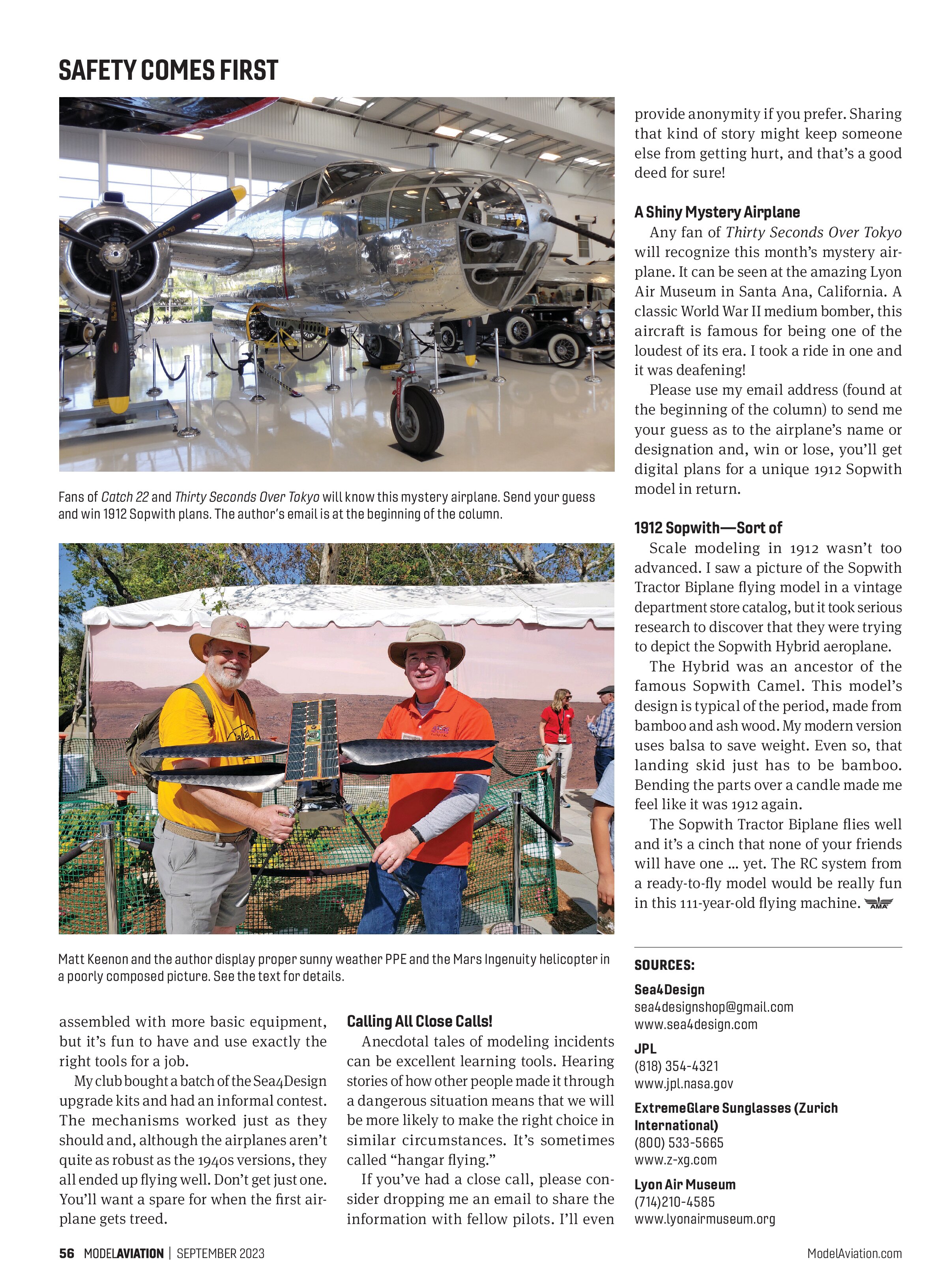
Any fan of Thirty Seconds Over Tokyo will recognize this month’s mystery airplane. It can be seen at the amazing Lyon Air Museum in Santa Ana, California. A classic World War II medium bomber, this aircraft is famous for being one of the loudest of its era. I took a ride in one and it was deafening!
Please use my email address (found at the beginning of the column) to send me your guess as to the airplane’s name or designation and, win or lose, you’ll get digital plans for a unique 1912 Sopwith model in return.
1912 Sopwith—Sort of
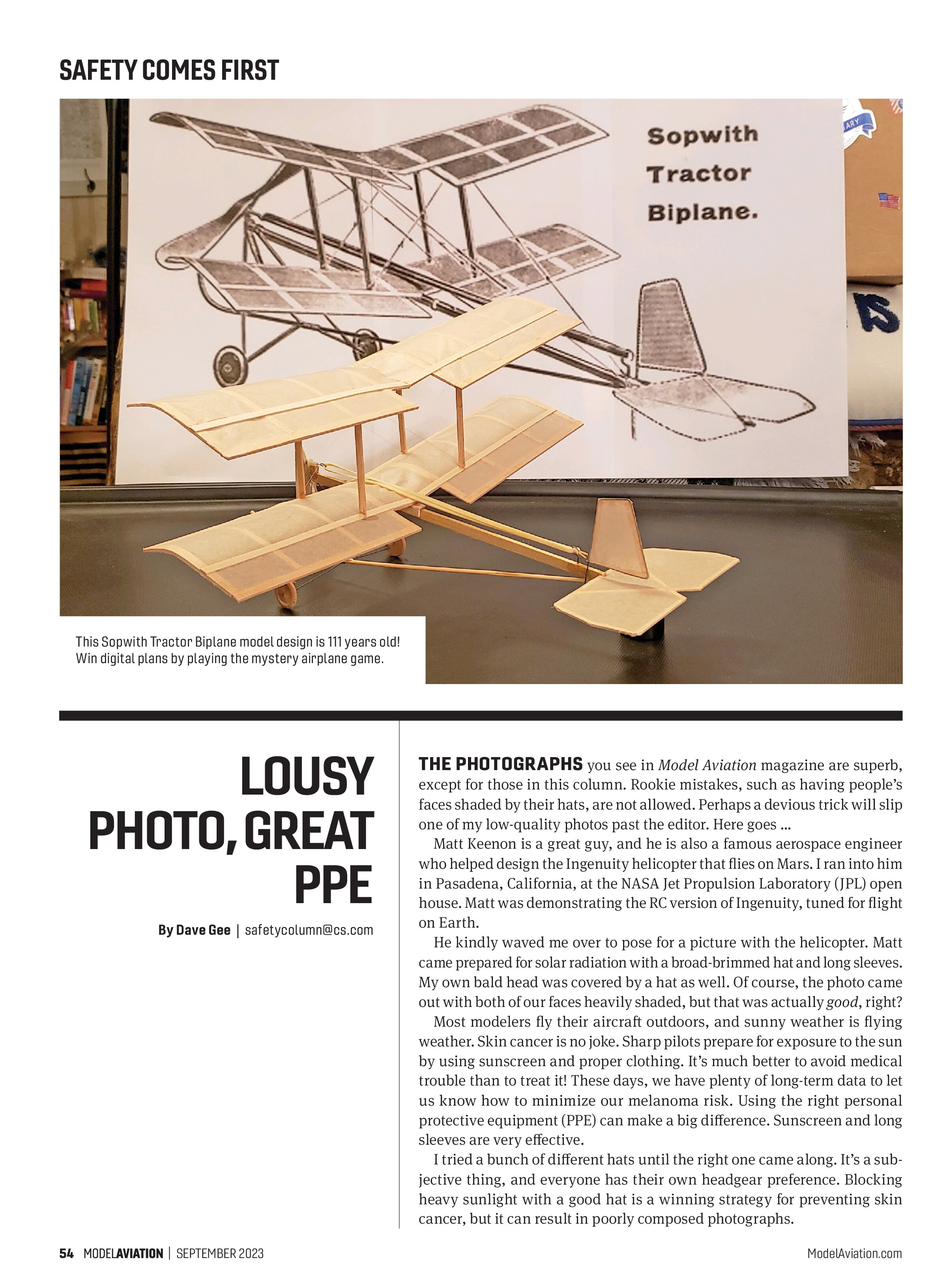
Scale modeling in 1912 wasn’t too advanced. I saw a picture of the Sopwith Tractor Biplane flying model in a vintage department store catalog, but it took serious research to discover that they were trying to depict the Sopwith Hybrid aeroplane.
The Hybrid was an ancestor of the famous Sopwith Camel. This model’s design is typical of the period, made from bamboo and ash wood. My modern version uses balsa to save weight. Even so, that landing skid just has to be bamboo. Bending the parts over a candle made me feel like it was 1912 again.
The Sopwith Tractor Biplane flies well and it’s a cinch that none of your friends will have one ... yet. The RC system from a ready-to-fly model would be really fun in this 111-year-old flying machine.
SOURCES:
Sea4Design
sea4designshop@gmail.com
www.sea4design.com
JPL
(818) 354-4321
www.jpl.nasa.gov
ExtremeGlare Sunglasses (Zurich International)
(800) 533-5665
www.z-xg.com
Lyon Air Museum
(714) 210-4585
www.lyonairmuseum.org