TWIN TURBINE-POWERED MODELS
By Jim Hiller | jetmodeler@earthlink.net

TWIN TURBINE-ENGINE models are becoming popular, with many manufacturers now offering Scale twin turbine-engine-powered airframes. How much do you really know about flying a twin-powered airplane? The subject of setting up and flying twin-engine models is seldom discussed among experienced modelers, especially if an engine goes out in flight. It’s a good subject for this month.
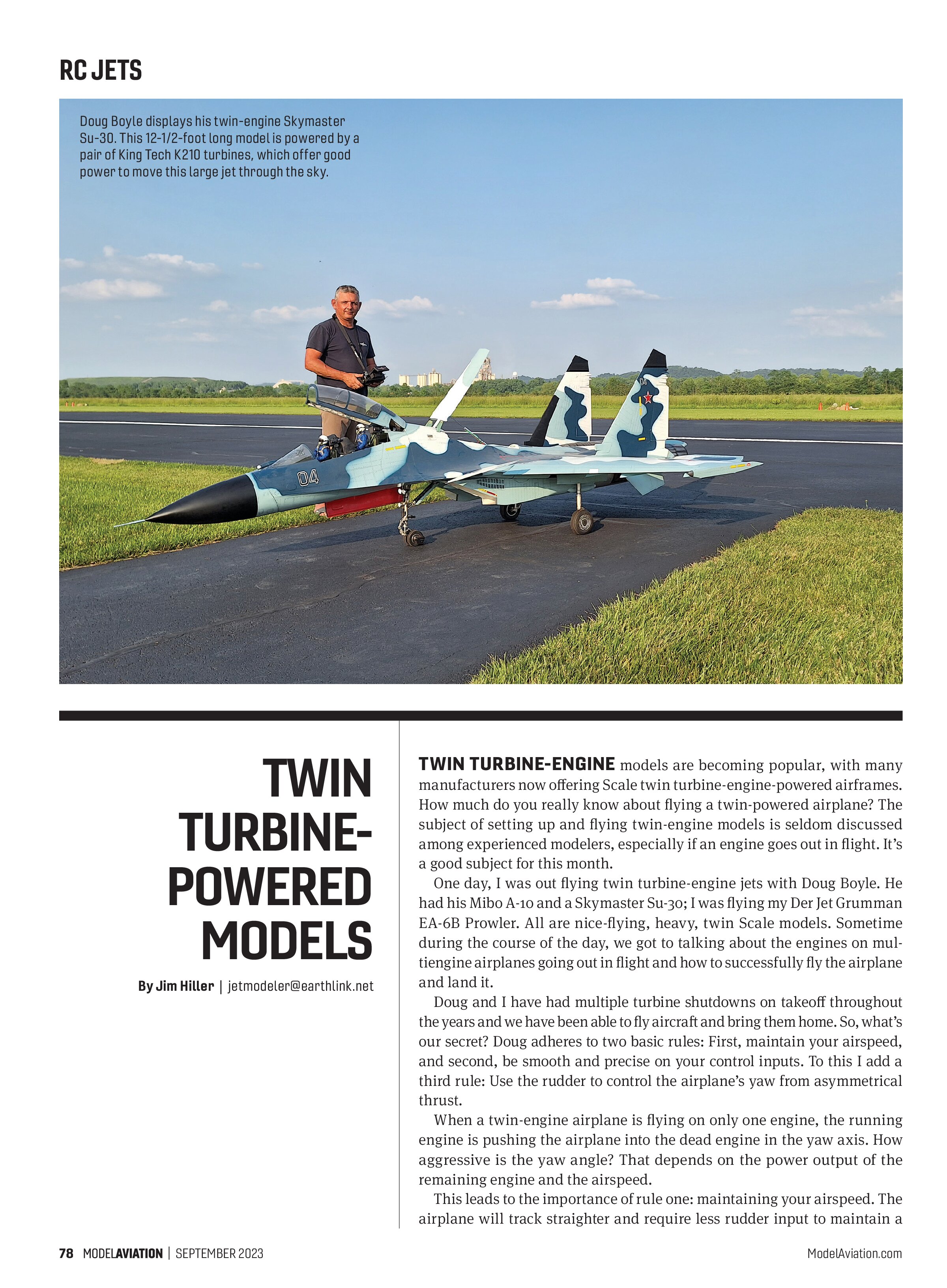
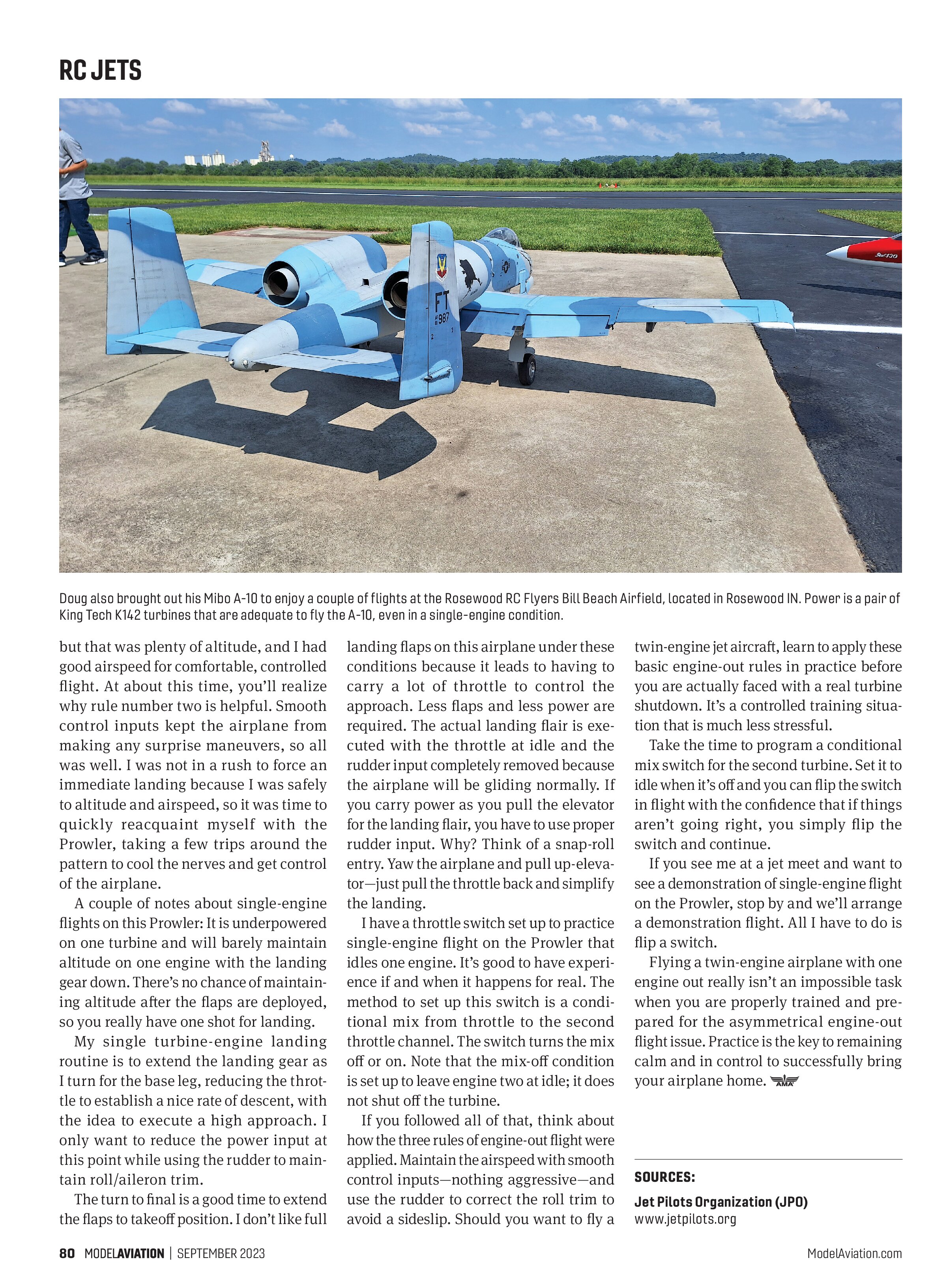
One day, I was out flying twin turbine-engine jets with Doug Boyle. He had his Mibo A-10 and a Skymaster Su-30; I was flying my Der Jet Grumman EA-6B Prowler. All are nice-flying, heavy, twin Scale models. Sometime during the course of the day, we got to talking about the engines on multiengine airplanes going out in flight and how to successfully fly the airplane and land it.
Doug and I have had multiple turbine shutdowns on takeoff throughout the years and we have been able to fly aircraft and bring them home. So, what’s our secret? Doug adheres to two basic rules: First, maintain your airspeed, and second, be smooth and precise on your control inputs. To this I add a third rule: Use the rudder to control the airplane’s yaw from asymmetrical thrust.
When a twin-engine airplane is flying on only one engine, the running engine is pushing the airplane into the dead engine in the yaw axis. How aggressive is the yaw angle? That depends on the power output of the remaining engine and the airspeed.
This leads to the importance of rule one: maintaining your airspeed. The airplane will track straighter and require less rudder input to maintain a non-skidding flight if you maintain your airspeed. The ability of the fin to control the skid angle, along with rudder input, is reduced as the airspeed slows without the corresponding reduction in power. This is the magic of an engine or turbine being out in flight. Using the available controls and power to adequately control the airplane, and understanding the relationship of airspeed and asymmetrical power and how it affects the airplane’s flight, are vital to successful recoveries.
In full-scale aviation, the pilot has a slip ball indicator—a simple ball level—to see the amount of skid an airplane has, and with that, the amount of rudder input to keep the fuselage aligned with the flight direction. As pilots who are not in the cockpit, we don’t have an instrument to aid us, so we must find other ways to determine the skid and visual observation of the fuselage, and whether it is aligned with the flight direction. The modeler having the experience to observe a skid is one effective way.
I have another more accurate and simple method that works well when a turbine shuts down. The airplane tends to lose aileron trim and rolls into the dead engine, which is caused by the yaw imposed by the running turbine. Rule number three is to use the rudder to correct the asymmetrical power yaw with rudder inputs to correct the roll trim.
Resist the urge to use the ailerons to attempt to control the roll. The rudder can be used to align the fuselage with the flight direction, eliminating the loss of roll trim imposed by roll coupling, with the added benefit of reducing the airplane’s drag compared with using only the ailerons.
Think of a J-3 Cub in a sideslip, which is a maneuver used to increase drag for a steeper landing approach. The rudder is pushed to induce slip then the ailerons are used to lower the wing to maintain a straight flight, with a big increase in drag to lose airspeed and altitude. This happens when a pilot facing an engine-out situation does not correct the slip with rudder and only uses the ailerons. The drag increases and the airspeed and altitude lose the sideslip—so use the rudder.
Those are the basics. Now let’s discuss the application of these basic rules to an actual situation. On my Der Jet Prowler’s first flight of the year, I had a turbine shut down on the takeoff roll. I suspect the cause was a classic air bubble from the ultimate air trap because I failed to shake it out after the first turbine start of the year.
There I was, just lifting off the ground with low airspeed and low altitude. I knew the Prowler would not climb on one turbine with the landing gear down, so my immediate response was to level the nose at approximately 4 feet of altitude and work on gaining the airspeed, retracting the landing gear, and getting the rudder pushed to maintain level roll trim. That’s a lot of things happening almost at once, but engine-out practice develops these responses as habits.
I maintained level flight at 4 feet, gaining speed and confidence in my ability to control the airplane. At close to the end of the runway, I had enough speed to start a gentle climb. If you want to climb first, get your airspeed. The wing will then lift the airplane up into a climb.
The Prowler was approximately 100 feet in altitude as I entered the downwind leg,

but that was plenty of altitude, and I had good airspeed for comfortable, controlled flight. At about this time, you’ll realize why rule number two is helpful. Smooth control inputs kept the airplane from making any surprise maneuvers, so all was well. I was not in a rush to force an immediate landing because I was safely to altitude and airspeed, so it was time to quickly reacquaint myself with the Prowler, taking a few trips around the pattern to cool the nerves and get control of the airplane.
A couple of notes about single-engine flights on this Prowler: It is underpowered on one turbine and will barely maintain altitude on one engine with the landing gear down. There’s no chance of maintaining altitude after the flaps are deployed, so you really have one shot for landing.
My single turbine-engine landing routine is to extend the landing gear as I turn for the base leg, reducing the throttle to establish a nice rate of descent, with the idea to execute a high approach. I only want to reduce the power input at this point while using the rudder to maintain roll/aileron trim.
The turn to final is a good time to extend the flaps to takeoff position. I don’t like full landing flaps on this airplane under these conditions because it leads to having to carry a lot of throttle to control the approach. Less flaps and less power are required. The actual landing flair is executed with the throttle at idle and the rudder input completely removed because the airplane will be gliding normally. If you carry power as you pull the elevator for the landing flair, you have to use proper rudder input. Why? Think of a snap-roll entry. Yaw the airplane and pull up elevator—just pull the throttle back and simplify the landing.
I have a throttle switch set up to practice single-engine flight on the Prowler that idles one engine. It’s good to have experience if and when it happens for real. The method to set up this switch is a conditional mix from throttle to the second throttle channel. The switch turns the mix off or on. Note that the mix-off condition is set up to leave engine two at idle; it does not shut off the turbine.
If you followed all of that, think about how the three rules of engine-out flight were applied. Maintain the airspeed with smooth control inputs—nothing aggressive—and use the rudder to correct the roll trim to avoid a sideslip. Should you want to fly a twin-engine jet aircraft, learn to apply these basic engine-out rules in practice before you are actually faced with a real turbine shutdown. It’s a controlled training situation that is much less stressful.
Take the time to program a conditional mix switch for the second turbine. Set it to idle when it’s off and you can flip the switch in flight with the confidence that if things aren’t going right, you simply flip the switch and continue.
If you see me at a jet meet and want to see a demonstration of single-engine flight on the Prowler, stop by and we’ll arrange a demonstration flight. All I have to do is flip a switch.
Flying a twin-engine airplane with one engine out really isn’t an impossible task when you are properly trained and prepared for the asymmetrical engine-out flight issue. Practice is the key to remaining calm and in control to successfully bring your airplane home.
SOURCES:
Jet Pilots Organization (JPO)
www.jetpilots.org