PERFECTING YOUR ROLLS
By Justin Wells | justinwells@mac.com
I’VE TOUCHED ON a lot of maneuvers throughout the last few columns. We’ve built our skills by learning to keep the airplane on a straight track and learned some good, solid turnaround maneuvers, as well as loops.
I want to take some time and discuss some good methods for making your rolls—full, half, or anything in between—smoother and to score even better. I’ll try to break things down as much as possible and might pick up more tips in my next column as well.
Rolling the airplane is one of the easiest maneuvers we do. It’s simple—just push the aileron stick over hard and let go when the airplane is upright. It sounds easy, right? It is easy, but I want to discuss some methods that will make your rolls present better and put you in complete control of the maneuver. A simple flick of the stick to the far side of the transmitter is probably hoping for the best approach to execute rolls. Let’s dive in and make our rolls better.
Down-Elevator
If you learned to fly on a high-wing aircraft, you were probably taught that you needed to add some down-elevator so that the airplane didn’t dive while on its back when executing a roll while the airplane was inverted. I would say this is still true of most high-wing trainers, and depending on your type of aircraft, you might need a little down-elevator so not to lose your line. Remember, you are trying to fly more precisely and remain in control of your airplane.
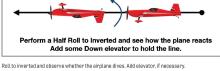
During your next flying session, try to observe your airplane’s behavior in a roll and see whether adding a little down-elevator while inverted helps

some down-elevator into your rolls. Do this a few times, and then try a full roll to see whether you notice the improvement. I bet you will. Take some time and just work on this first step before moving on.
Rudder
Another element to smoothing out your roll is adding some rudder input when the airplane is on its side, or what is referred to as knife-edge position. For example, with your first point of the roll, the airplane is on its side. The nose will drop slightly
your case or not. It really depends on the airplane that you are flying and how you have it set up (center of gravity, speed, etc.).
Take your time and just perform a half roll to inverted and see what the airplane does. If it starts diving, you’ll need to add