CONTROL LINE COMBAT
By Mark Rudner | mark.s.rudner@gmail.com

BY THE TIME this article comes out, a whole summer’s worth of Control Line (CL) Combat will have taken place, including the Kansas City F2D contest, Team Trials, the Nats, and the Bladder Grabber, among other prominent local, regional, and national contests. Unfortunately, lacking the power to see the future, at the time of this writing (in early June), I can’t report on the results of any of these great events.
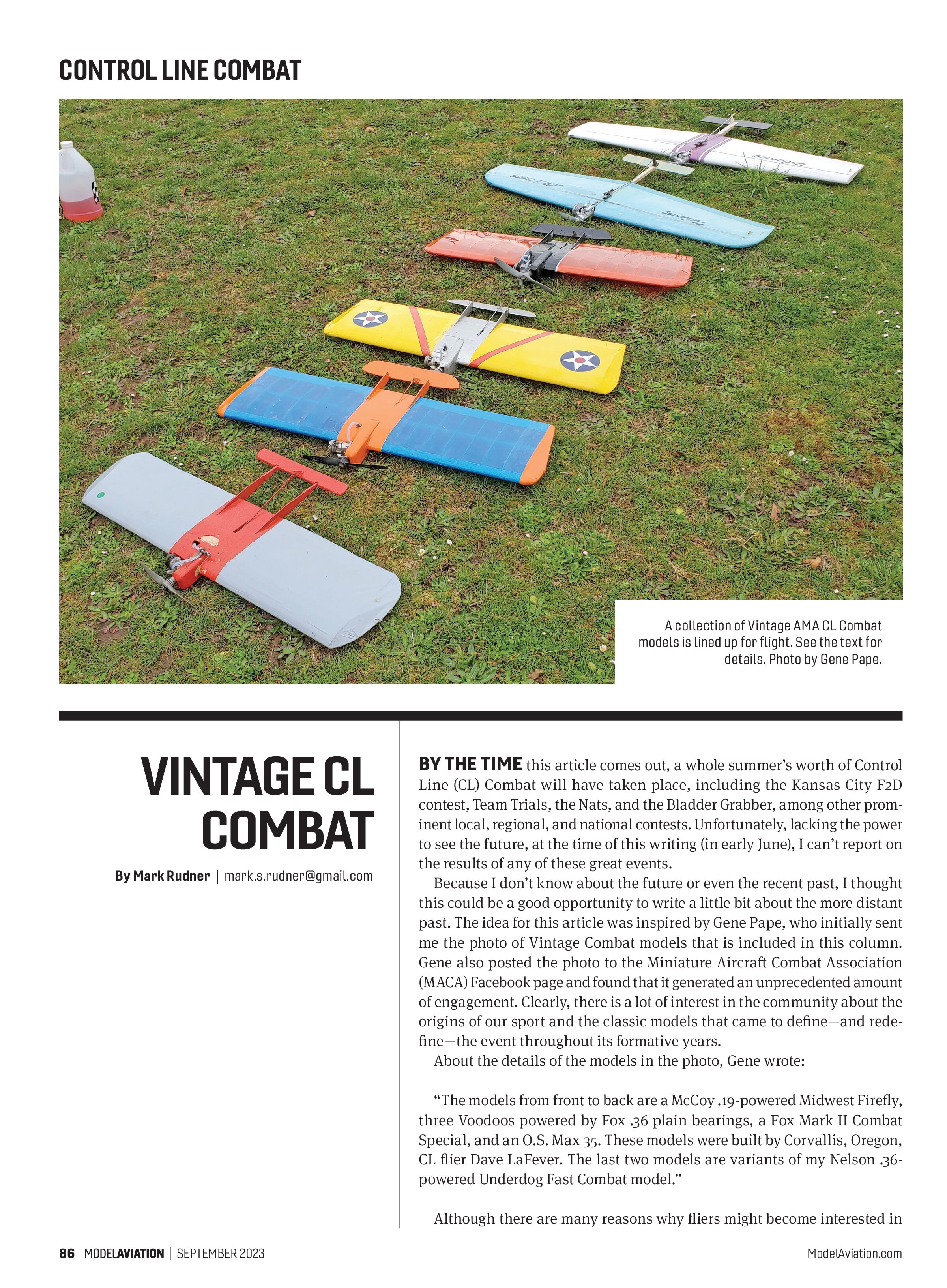
Because I don’t know about the future or even the recent past, I thought this could be a good opportunity to write a little bit about the more distant past. The idea for this article was inspired by Gene Pape, who initially sent me the photo of Vintage Combat models that is included in this column. Gene also posted the photo to the Miniature Aircraft Combat Association (MACA) Facebook page and found that it generated an unprecedented amount of engagement. Clearly, there is a lot of interest in the community about the origins of our sport and the classic models that came to define—and redefine—the event throughout its formative years.
About the details of the models in the photo, Gene wrote:
“The models from front to back are a McCoy .19-powered Midwest Firefly, three Voodoos powered by Fox .36 plain bearings, a Fox Mark II Combat Special, and an O.S. Max 35. These models were built by Corvallis, Oregon, CL flier Dave LaFever. The last two models are variants of my Nelson .36-powered Underdog Fast Combat model.”
Although there are many reasons why fliers might become interested in Vintage Combat, Gene wrote that his own interest arose out of his curiosity to try out some of the models that were popular in the years before he started flying in 1961, such as the T-Square and Half Fast III.
Interest extends beyond the virtual world, as is reflected in the rise in popularity of Vintage and Nostalgia Combat events. The U.K. has had a robust series of Vintage Combat events, mostly limited to diesel-powered models, for many years.
In the US, the rise in popularity of Vintage and Nostalgia Combat events is a more recent phenomenon. Rules vary wildly from contest to contest in terms of which types of models and engines are allowed, what type of scoring and match procedures are used, and whether or not any speed limits are imposed.
In the early days of CL Combat, safety was, at best, an afterthought. I remember how shocked I was as a kid when my dad explained to me some of the common practices from the early 1960s when he first started flying. For example, in those early days, the match was live as soon as one pilot would get in the air (there was no obligation to fly level and wait for a signal to begin combat); therefore, it was normal for the first pilot in the air to perform maneuvers right over the opposing team’s mechanics in order to be in striking position as soon as their opponent would get airborne. What could possibly go wrong?
Fortunately, as the sport further developed, a number of important rules were put into place in the interest of safety. To comply with current AMA safety rules, various modifications of legacy rules are imposed in Nostalgia events. If you wish to take part in a Vintage/Nostalgia Combat event, be sure to inquire about the particulars of the rules to be used well ahead of time.
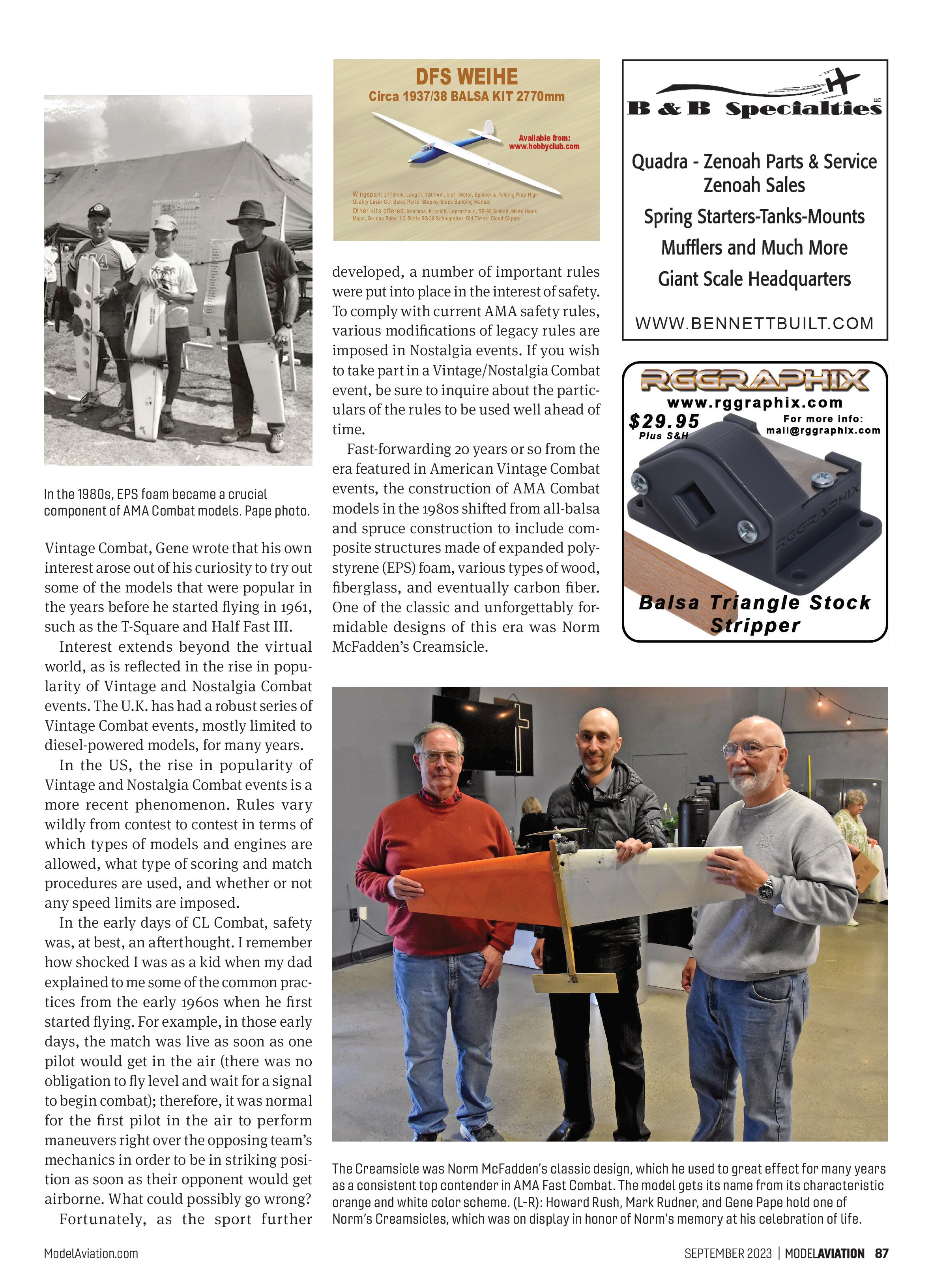
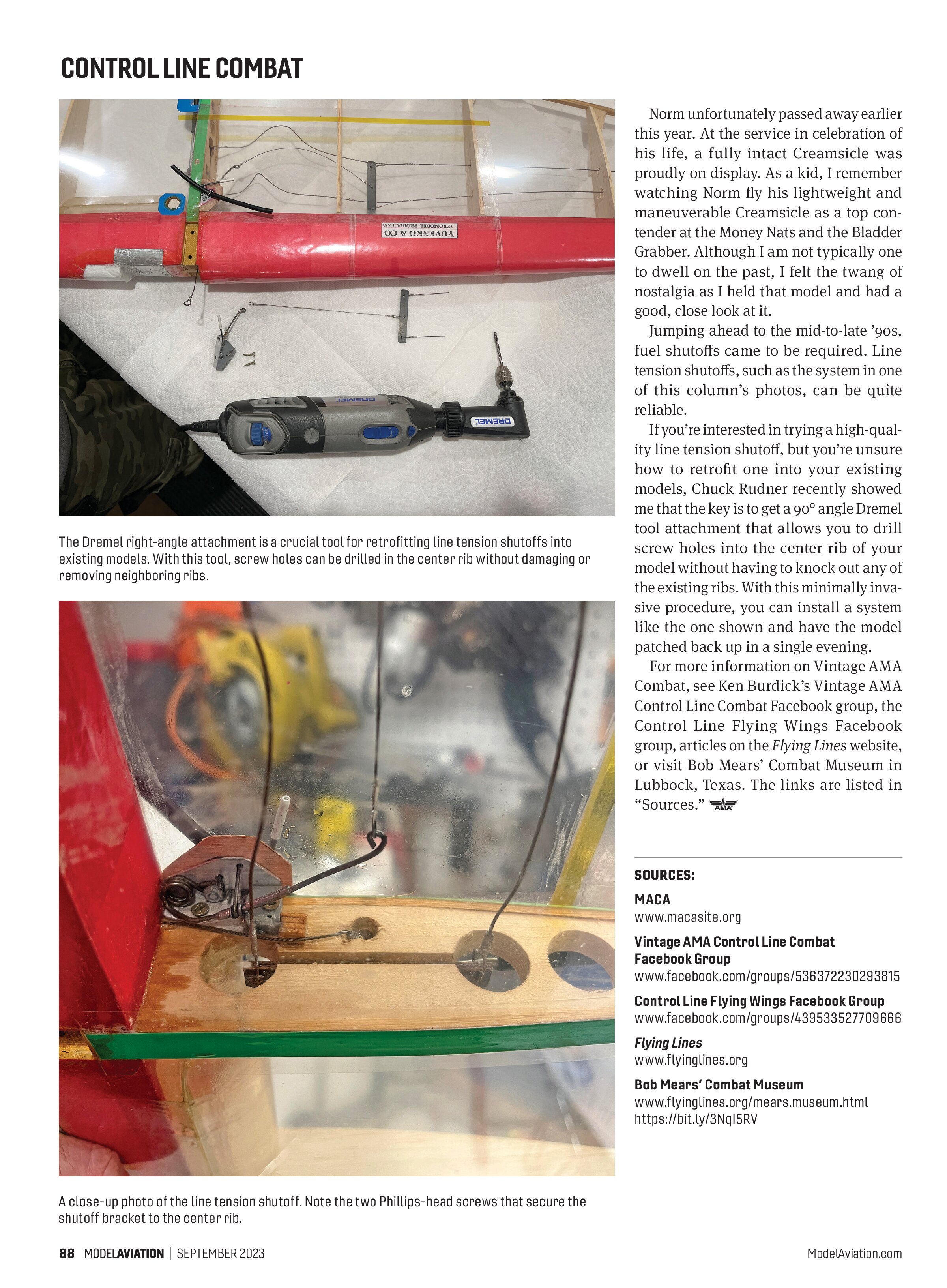
Fast-forwarding 20 years or so from the era featured in American Vintage Combat events, the construction of AMA Combat models in the 1980s shifted from all-balsa and spruce construction to include composite structures made of expanded polystyrene (EPS) foam, various types of wood, fiberglass, and eventually carbon fiber. One of the classic and unforgettably formidable designs of this era was Norm McFadden’s Creamsicle.

Vintage Combat, Gene wrote that his own interest arose out of his curiosity to try out some of the models that were popular in the years before he started flying in 1961, such as the T-Square and Half Fast III.

Norm unfortunately passed away earlier this year. At the service in celebration of his life, a fully intact Creamsicle was proudly on display. As a kid, I remember watching Norm fly his lightweight and maneuverable Creamsicle as a top contender at the Money Nats and the Bladder Grabber. Although I am not typically one to dwell on the past, I felt the twang of nostalgia as I held that model and had a good, close look at it.
Jumping ahead to the mid-to-late ’90s, fuel shutoffs came to be required. Line tension shutoffs, such as the system in one of this column’s photos, can be quite reliable.
If you’re interested in trying a high-quality line tension shutoff, but you’re unsure how to retrofit one into your existing models, Chuck Rudner recently showed me that the key is to get a 90° angle Dremel tool attachment that allows you to drill screw holes into the center rib of your model without having to knock out any of the existing ribs. With this minimally invasive procedure, you can install a system like the one shown and have the model patched back up in a single evening.

For more information on Vintage AMA Combat, see Ken Burdick’s Vintage AMA Control Line Combat Facebook group, the Control Line Flying Wings Facebook group, articles on the Flying Lines website, or visit Bob Mears’ Combat Museum in Lubbock, Texas. The links are listed in “Sources.”

SOURCES:
MACA
www.macasite.org
Vintage AMA Control Line Combat Facebook Group
www.facebook.com/groups/536372230293815
Control Line Flying Wings Facebook Group
www.facebook.com/groups/439533527709666
Flying Lines
www.flyinglines.org
Bob Mears’ Combat Museum
www.flyinglines.org/mears.museum.html
https://bit.ly/3NqI5RV