Around the Patch

Reader Correspondence
By Thayer Syme | thayer@flying-models.com
OCCASIONALLY, I’ve mentioned acknowledging those who have inspired us along our hobby paths. Most recently, I mentioned Don Srull in my March 2023 column. I thought you might find interest in some examples pulled from reader correspondence this month, followed by a look at a rarely used—but imminently practical—power technology.
The Spitfire
After seeing my March column, Walt Smelton, of Colorado, placed an order for my Spitfire plans, inspired by Don’s Spirit of Biggen Hill, from the October 1981 Model Aviation. For reasons that escape me now, Walt and I ended up on the phone and he mentioned being inspired by the column and Don’s legacy, as well as that of his late brother.
His older brother, Chuck, had built a stick-and-tissue Sterling Spitfire approximately 50 years ago that was equipped with a Cox .010 engine for power. In the end, it was deemed much too nice to risk in flight and was set aside for “someday.”
As is often the case, it was never flown, and Chuck offered it to Walt while preparing for a move a while back. He instantly accepted. It remains to this day as it was when it was finished, along with the patina acquired throughout its five decades.
Of course, the model’s unrealized promise has nagged Walt a bit across the years, and seeing my similar design in the March issue sparked his recent order. Building a new version will allow for the closing of the circle, without risking the emotional investment infused within his brother’s creation.
I’m all for seeing another Spitfire in the air, and I wish Walt the best with his build. With any luck, we might see it within these pages in the near future.
Ken Lawrence’s Albatros
Four years ago, I included a 1/2A-size Albatros biplane that was developed through a collaboration with Dave Johnson. Appearing in the July 2019 issue, the model was based upon his first original design, dating back 50 years to when he was just 9 years old.
Dave still had the model when I first saw it during the 2011 Weak Signals Toledo Show: R/C Model Expo, and I was immediately captivated by its charm. To this day, the Albatros remains one of my favorite models, and I think of Dave every time it catches my eye hanging from my shop ceiling, or whenever someone orders the Flying Models plans set.
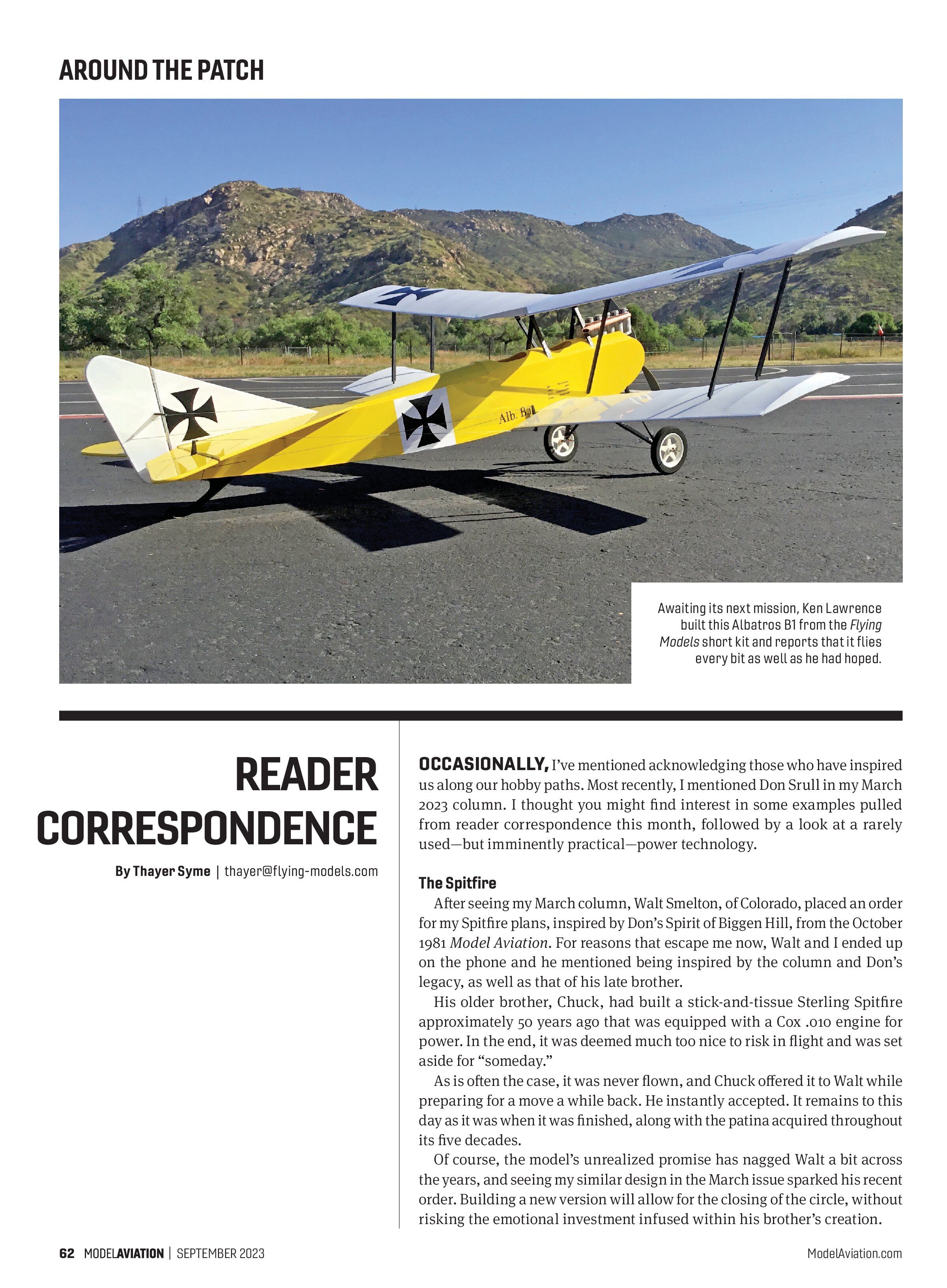
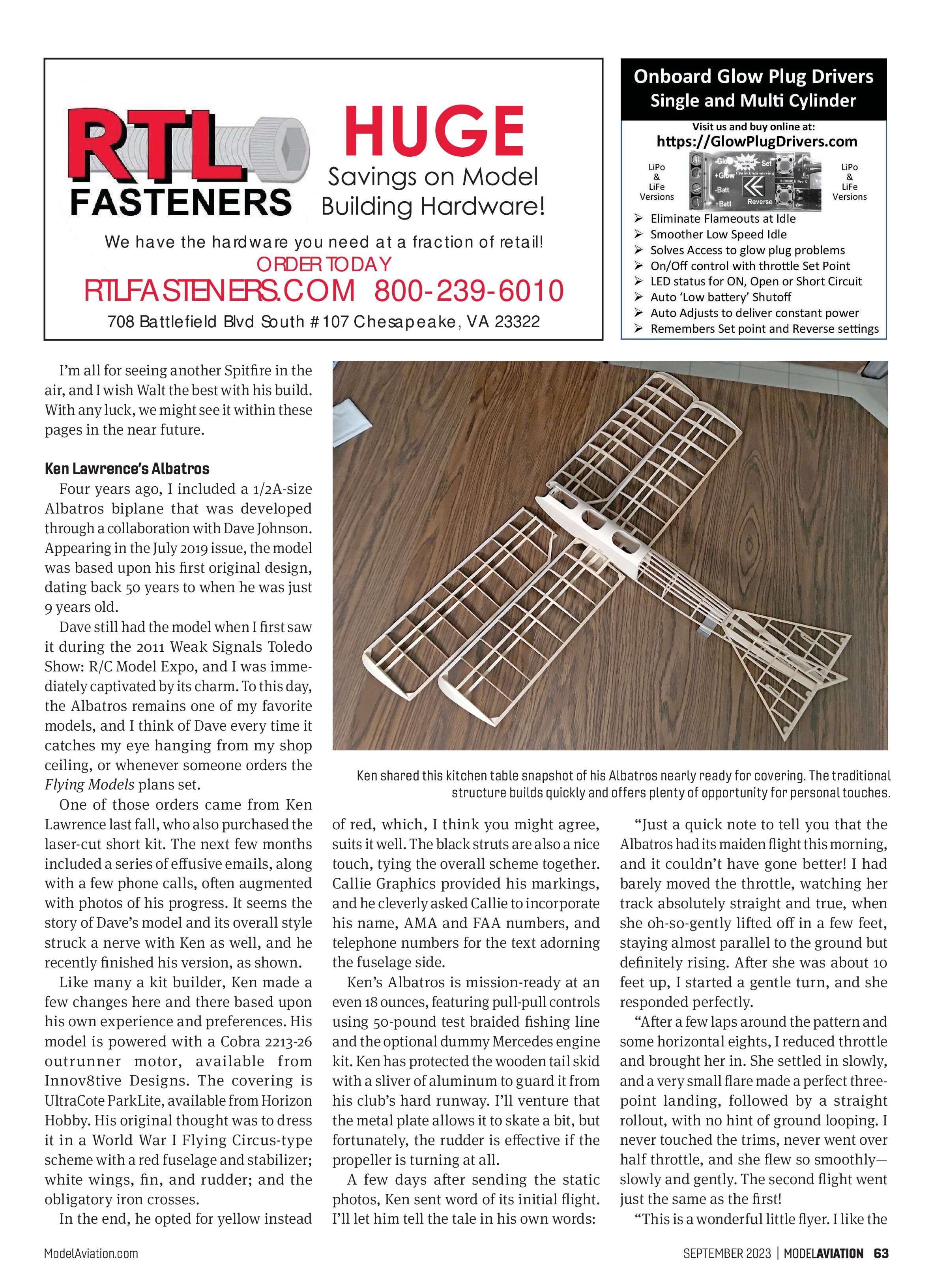
One of those orders came from Ken Lawrence last fall, who also purchased the laser-cut short kit. The next few months included a series of effusive emails, along with a few phone calls, often augmented with photos of his progress. It seems the story of Dave’s model and its overall style struck a nerve with Ken as well, and he recently finished his version, as shown.
Like many a kit builder, Ken made a few changes here and there based upon his own experience and preferences. His model is powered with a Cobra 2213-26 outrunner motor, available from Innov8tive Designs. The covering is UltraCote ParkLite, available from Horizon Hobby. His original thought was to dress it in a World War I Flying Circus-type scheme with a red fuselage and stabilizer; white wings, fin, and rudder; and the obligatory iron crosses.
In the end, he opted for yellow instead of red, which, I think you might agree, suits it well. The black struts are also a nice touch, tying the overall scheme together. Callie Graphics provided his markings, and he cleverly asked Callie to incorporate his name, AMA and FAA numbers, and telephone numbers for the text adorning the fuselage side.
Ken’s Albatros is mission-ready at an even 18 ounces, featuring pull-pull controls using 50-pound test braided fishing line and the optional dummy Mercedes engine kit. Ken has protected the wooden tail skid with a sliver of aluminum to guard it from his club’s hard runway. I’ll venture that the metal plate allows it to skate a bit, but fortunately, the rudder is effective if the propeller is turning at all.
A few days after sending the static photos, Ken sent word of its initial flight. I’ll let him tell the tale in his own words:

“Just a quick note to tell you that the Albatros had its maiden flight this morning, and it couldn’t have gone better! I had barely moved the throttle, watching her track absolutely straight and true, when she oh-so-gently lifted off in a few feet, staying almost parallel to the ground but definitely rising. After she was about 10 feet up, I started a gentle turn, and she responded perfectly.
“After a few laps around the pattern and some horizontal eights, I reduced throttle and brought her in. She settled in slowly, and a very small flare made a perfect three-point landing, followed by a straight rollout, with no hint of ground looping. I never touched the trims, never went over half throttle, and she flew so smoothly—slowly and gently. The second flight went just the same as the first!
“This is a wonderful little flyer. I like the

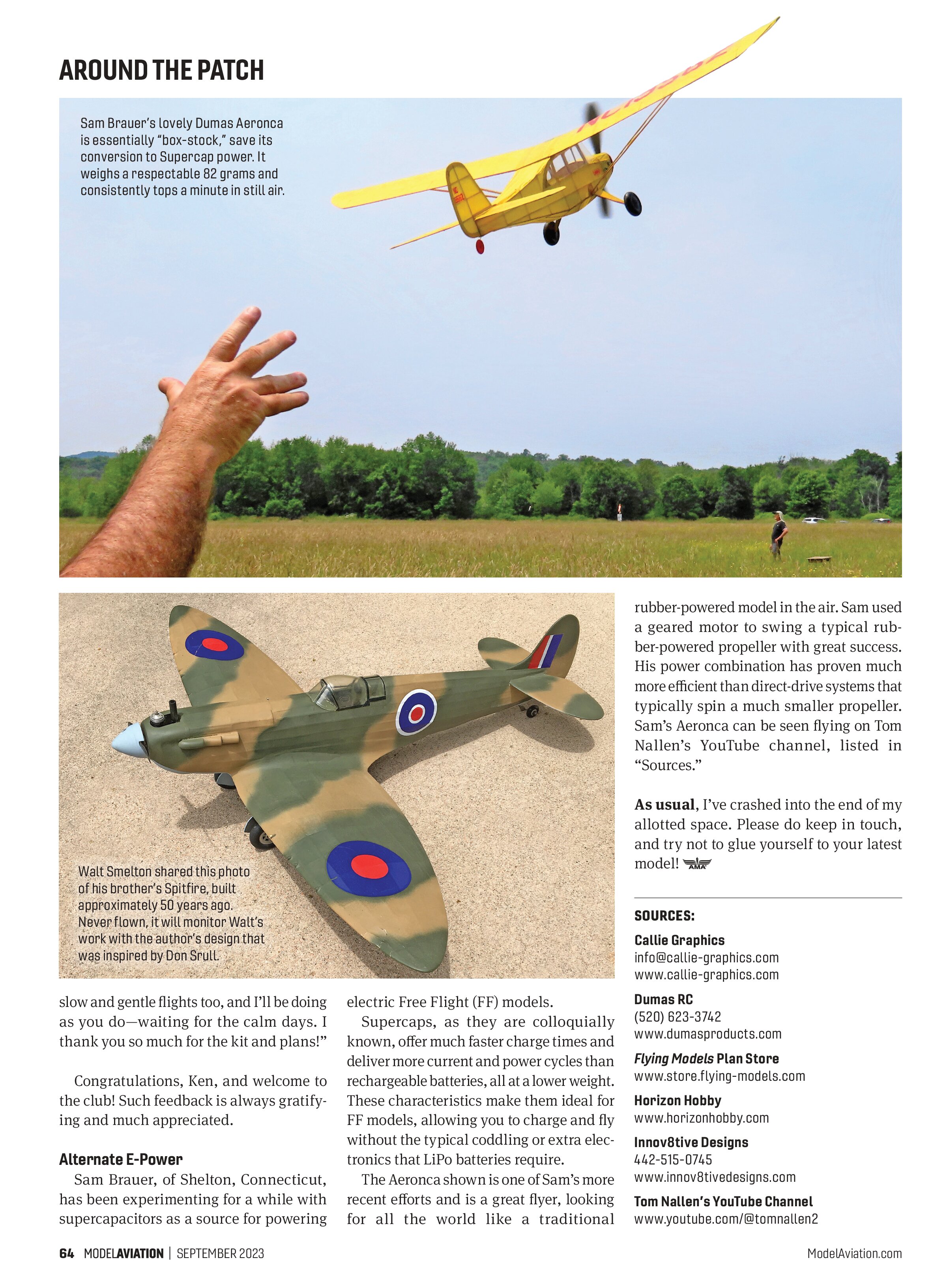
rubber-powered model in the air. Sam used a geared motor to swing a typical rubber-powered propeller with great success. His power combination has proven much more efficient than direct-drive systems that typically spin a much smaller propeller. Sam’s Aeronca can be seen flying on Tom Nallen’s YouTube channel, listed in “Sources.”
As usual, I’ve crashed into the end of my allotted space. Please do keep in touch, and try not to glue yourself to your latest model!

slow and gentle flights too, and I’ll be doing as you do—waiting for the calm days. I thank you so much for the kit and plans!”
Congratulations, Ken, and welcome to the club! Such feedback is always gratifying and much appreciated.
Alternate E-Power
Sam Brauer, of Shelton, Connecticut, has been experimenting for a while with supercapacitors as a source for powering electric Free Flight (FF) models. Supercaps, as they are colloquially known, offer much faster charge times and deliver more current and power cycles than rechargeable batteries, all at a lower weight. These characteristics make them ideal for FF models, allowing you to charge and fly without the typical coddling or extra electronics that LiPo batteries require.
The Aeronca shown is one of Sam’s more recent efforts and is a great flyer, looking for all the world like a traditional
SOURCES:
Callie Graphics
info@callie-graphics.com
www.callie-graphics.com
Dumas RC
(520) 623-3742
www.dumasproducts.com
Flying Models Plan Store
www.store.flying-models.com
Horizon Hobby
www.horizonhobby.com
Innov8tive Designs
442-515-0745
www.innov8tivedesigns.com
Tom Nallen’s YouTube Channel
www.youtube.com/@tomnallen2