SLOPE “FUN-FLY”


Photos provided by Bryan Lorentzen | bryan11or@gmail.com
BRYAN LORENTZEN (Franklin, Wisconsin) sent the following:
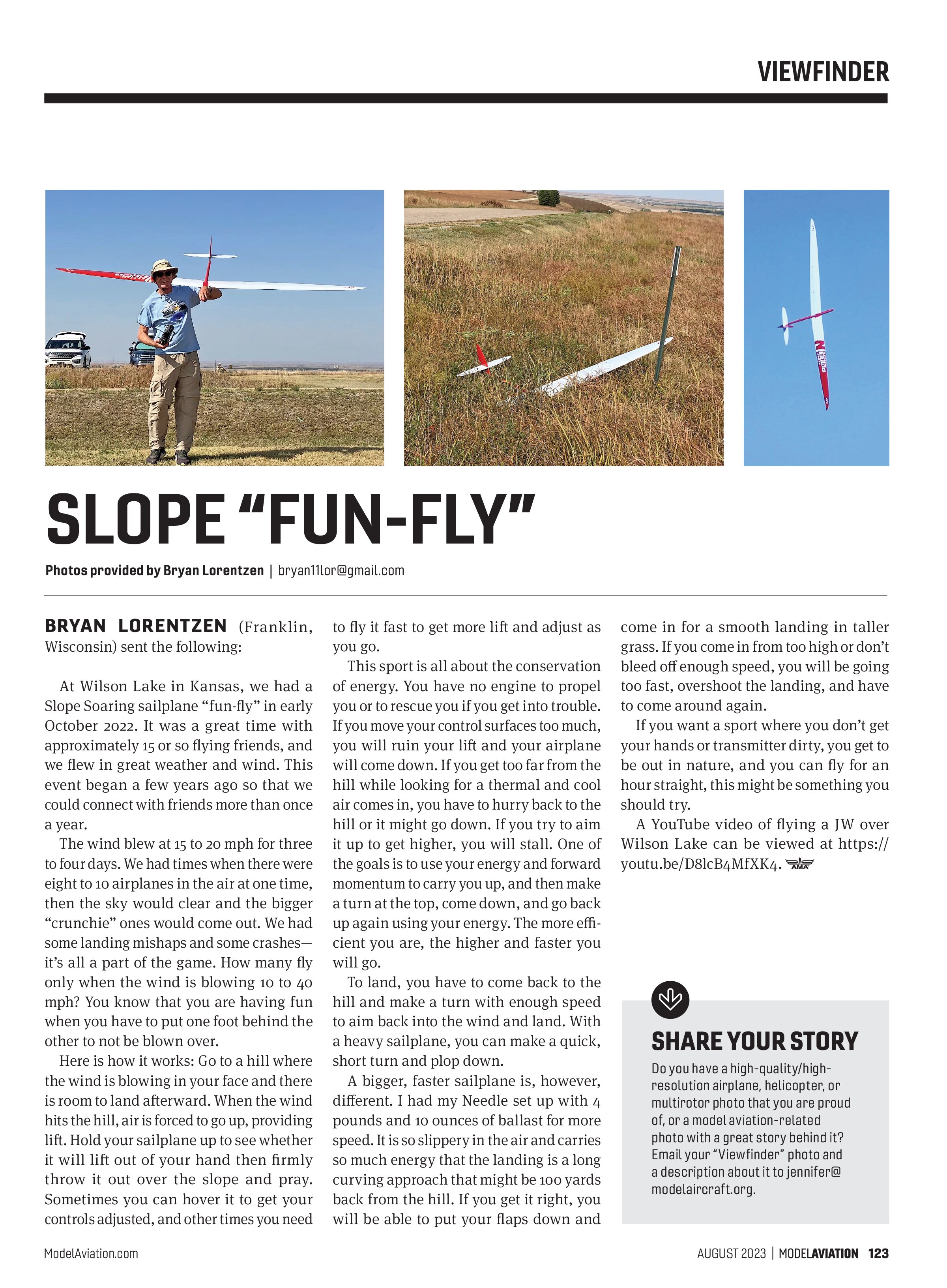
At Wilson Lake in Kansas, we had a Slope Soaring sailplane “fun-fly” in early October 2022. It was a great time with approximately 15 or so flying friends, and we flew in great weather and wind. This event began a few years ago so that we could connect with friends more than once a year.
The wind blew at 15 to 20 mph for three to four days. We had times when there were eight to 10 airplanes in the air at one time, then the sky would clear and the bigger “crunchie” ones would come out. We had some landing mishaps and some crashes—it’s all a part of the game. How many fly only when the wind is blowing 10 to 40 mph? You know that you are having fun when you have to put one foot behind the other to not be blown over.
Here is how it works: Go to a hill where the wind is blowing in your face and there is room to land afterward. When the wind hits the hill, air is forced to go up, providing lift. Hold your sailplane up to see whether it will lift out of your hand then firmly throw it out over the slope and pray. Sometimes you can hover it to get your controls adjusted, and other times you need to fly it fast to get more lift and adjust as you go.
This sport is all about the conservation of energy. You have no engine to propel you or to rescue you if you get into trouble. If you move your control surfaces too much, you will ruin your lift and your airplane will come down. If you get too far from the hill while looking for a thermal and cool air comes in, you have to hurry back to the hill or it might go down. If you try to aim it up to get higher, you will stall. One of the goals is to use your energy and forward momentum to carry you up, and then make a turn at the top, come down, and go back up again using your energy. The more efficient you are, the higher and faster you will go.
To land, you have to come back to the hill and make a turn with enough speed to aim back into the wind and land. With a heavy sailplane, you can make a quick, short turn and plop down.
A bigger, faster sailplane is, however, different. I had my Needle set up with 4 pounds and 10 ounces of ballast for more speed. It is so slippery in the air and carries so much energy that the landing is a long curving approach that might be 100 yards back from the hill. If you get it right, you will be able to put your flaps down and come in for a smooth landing in taller grass. If you come in from too high or don’t bleed off enough speed, you will be going too fast, overshoot the landing, and have to come around again.
If you want a sport where you don’t get your hands or transmitter dirty, you get to be out in nature, and you can fly for an hour straight, this might be something you should try.
A YouTube video of flying a JW over Wilson Lake can be viewed at https://youtu.be/D8lcB4MfXK4.