RC COMBAT

BUILDING
WITH FOAM
BOARD
By Heath Bartel | heath.bartel@gmail.com
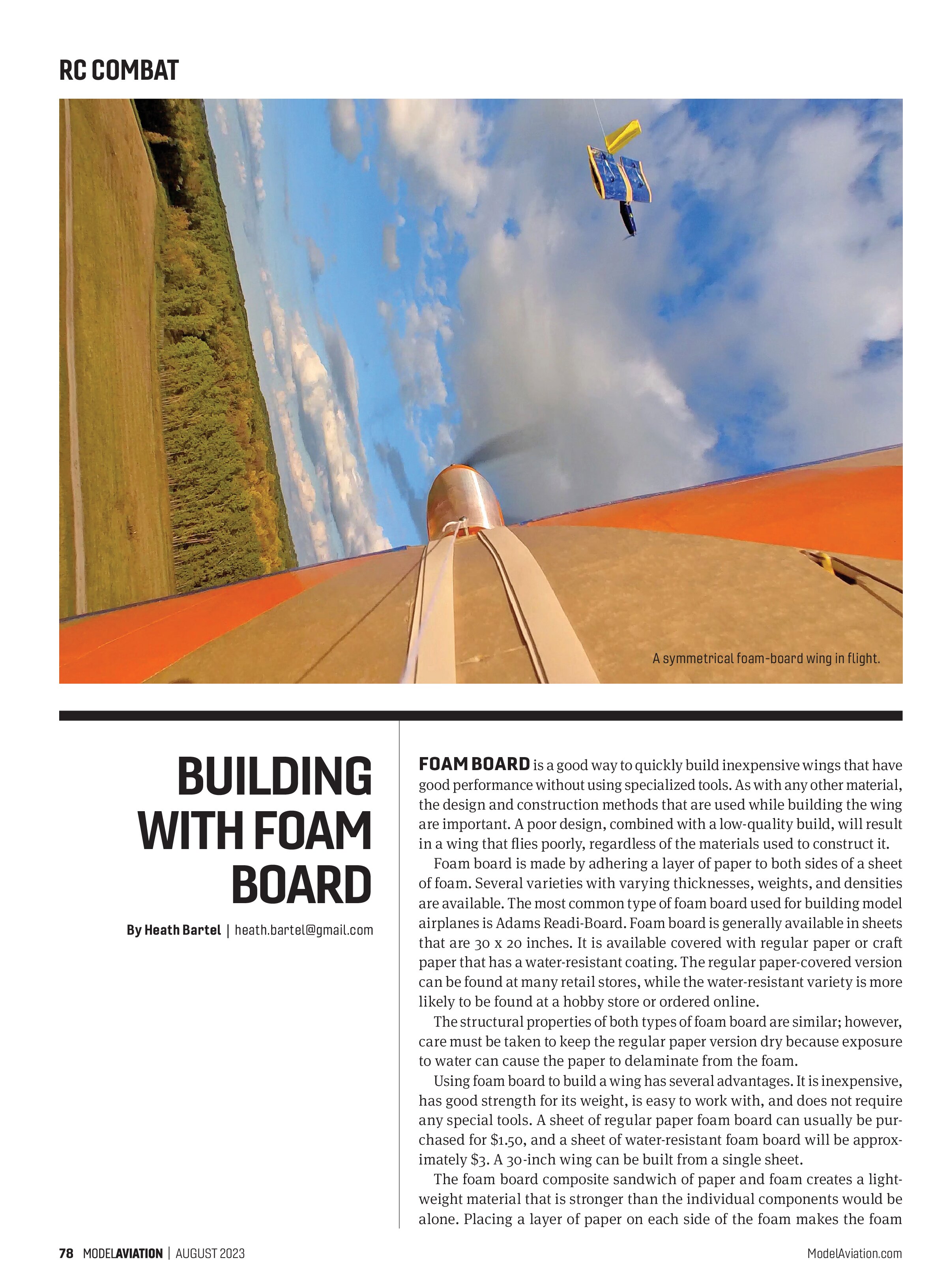
FOAM BOARD is a good way to quickly build inexpensive wings that have good performance without using specialized tools. As with any other material, the design and construction methods that are used while building the wing are important. A poor design, combined with a low-quality build, will result in a wing that flies poorly, regardless of the materials used to construct it.
Foam board is made by adhering a layer of paper to both sides of a sheet of foam. Several varieties with varying thicknesses, weights, and densities are available. The most common type of foam board used for building model airplanes is Adams Readi-Board. Foam board is generally available in sheets that are 30 x 20 inches. It is available covered with regular paper or craft paper that has a water-resistant coating. The regular paper-covered version can be found at many retail stores, while the water-resistant variety is more likely to be found at a hobby store or ordered online.
The structural properties of both types of foam board are similar; however, care must be taken to keep the regular paper version dry because exposure to water can cause the paper to delaminate from the foam.
Using foam board to build a wing has several advantages. It is inexpensive, has good strength for its weight, is easy to work with, and does not require any special tools. A sheet of regular paper foam board can usually be purchased for $1.50, and a sheet of water-resistant foam board will be approximately $3. A 30-inch wing can be built from a single sheet.
The foam board composite sandwich of paper and foam creates a lightweight material that is stronger than the individual components would be alone. Placing a layer of paper on each side of the foam makes the foam board much stiffer than a foam sheet of a similar thickness.
Tools needed to build a foam-board wing are the common tools that most hobbyists already have or can purchase at a minimal cost, such as a hobby knife, a straightedge, packing tape, and glue. If hot glue is used, a hot glue gun is also required. Weights to hold the wing while the glue cures or cools are also helpful.
The fastest and simplest foam-board wing to build is a flat-plate-style wing. This type of wing does not use the foam board to its full potential and often needs added spars to withstand the bending and twisting loads that it will experience while in flight. Flat wings have poor aerodynamic properties and high drag. They also lack internal space for servos or wires, resulting in even more drag after these components are installed. Although this type of wing can be forced to fly, with a small amount of additional effort, a foam-board wing with far better performance can be built.
The key to building a better foam-board wing is to build one that has an airfoil shape. The goal is not exactly to replicate a specific airfoil; instead, it is to build a wing shape that is generally flat-bottomed or symmetrical, depending on the desired performance profile. The performance gain between a flat-plate wing and a “just about” airfoil wing is considerable, while the extra time required is minimal.
By using the foam board as a wing skin, the strength of the foam board is optimized, eliminating the need for additional wood or carbon-fiber spars in most wings. This method also provides hollow internal space for servos, wires, and other components.
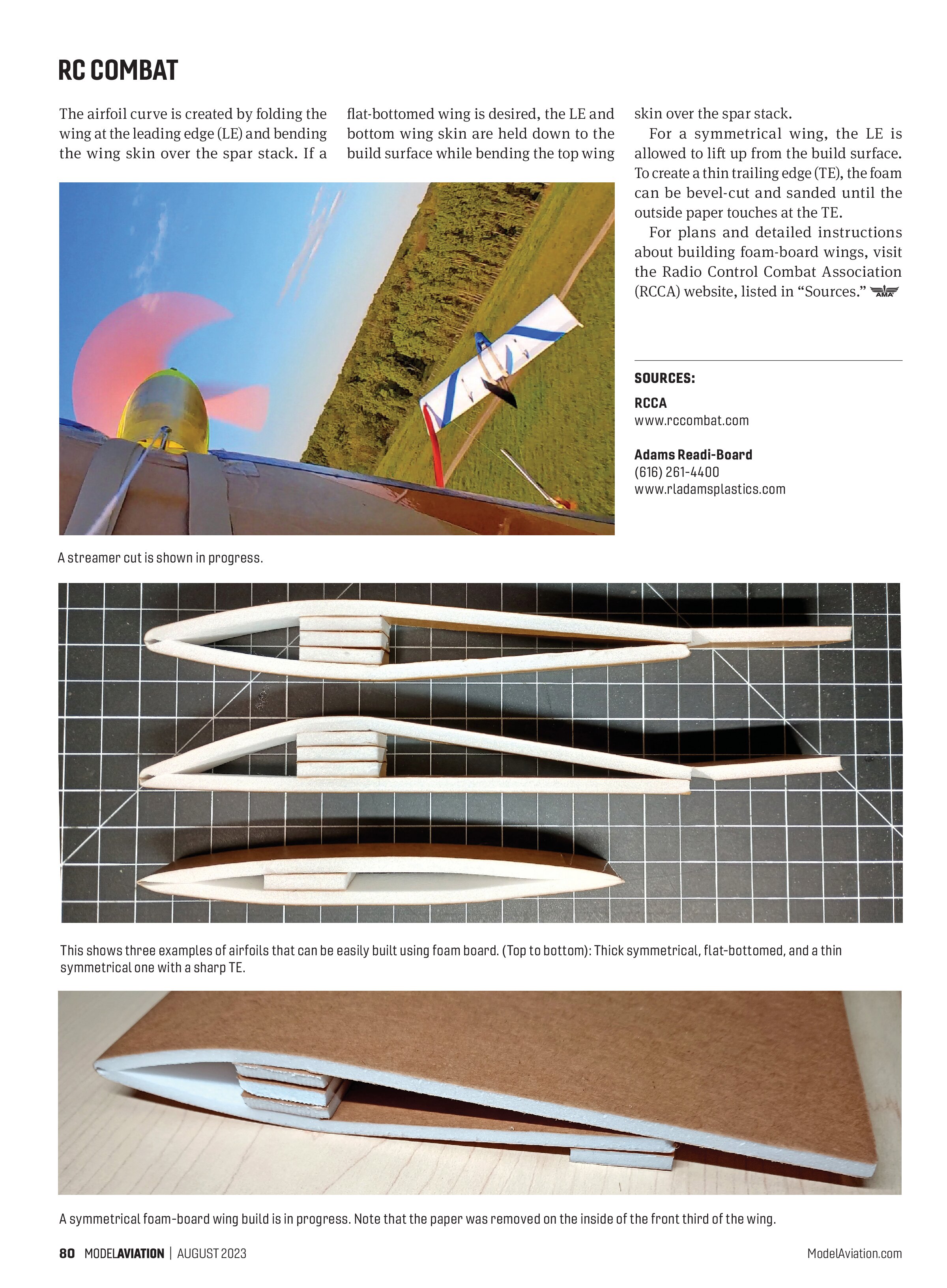
My preferred method to create airfoil shapes in foam board is to remove the paper from the inside of the curved parts of the wing skin. Removing the paper from one side of the foam board allows it to be bent into a curved shape to form the airfoil. I build a spar by laminating a stack of foam strips together. The thickness of the airfoil can be adjusted by adding or removing foam strips from the spar stack.
For most of my wings, I use two or three layers of foam for the spar, while a single layer works well for narrower and smaller surfaces such as tail fins or horizontal stabilizers. The height of the spar stock needed to form the airfoil shape will change depending on the wing’s chord.

The airfoil curve is created by folding the wing at the leading edge (LE) and bending the wing skin over the spar stack. If a flat-bottomed wing is desired, the LE and bottom wing skin are held down to the build surface while bending the top wing skin over the spar stack.
For a symmetrical wing, the LE is allowed to lift up from the build surface. To create a thin trailing edge (TE), the foam can be bevel-cut and sanded until the outside paper touches at the TE.
For plans and detailed instructions about building foam-board wings, visit the Radio Control Combat Association (RCCA) website, listed in “Sources.”
SOURCES:
RCCA
www.rccombat.com
Adams Readi-Board
(616) 261-4400
www.rl adamsplastics.com