FILLING THE PIPELINE: PILOT SHORTFALL COULD REACH 30,000
By Rich Hanson, AMA President | richh@modelaircraft.org

AVIATION CONSULTING FIRMS estimate that the industry is currently facing a deficit of roughly 8,000 pilots, or 11% of the total workforce, and further projects that the shortfall could reach 30,000 by 2025. What has changed? How have we gone from a significant surplus of qualified pilots in the 1950s, ’60s, and ’70s, to the severe shortage choking the industry today? What’s depleting the pipeline?
In the 1950s and ’60s, there were thousands of military-trained pilots entering the civil workforce from World War II and the Korean conflict, and commercial operators were able to choose the best of the best. In the ’70s, the Vietnam War brought another surge of experienced military pilots seeking employment in the civil marketplace.
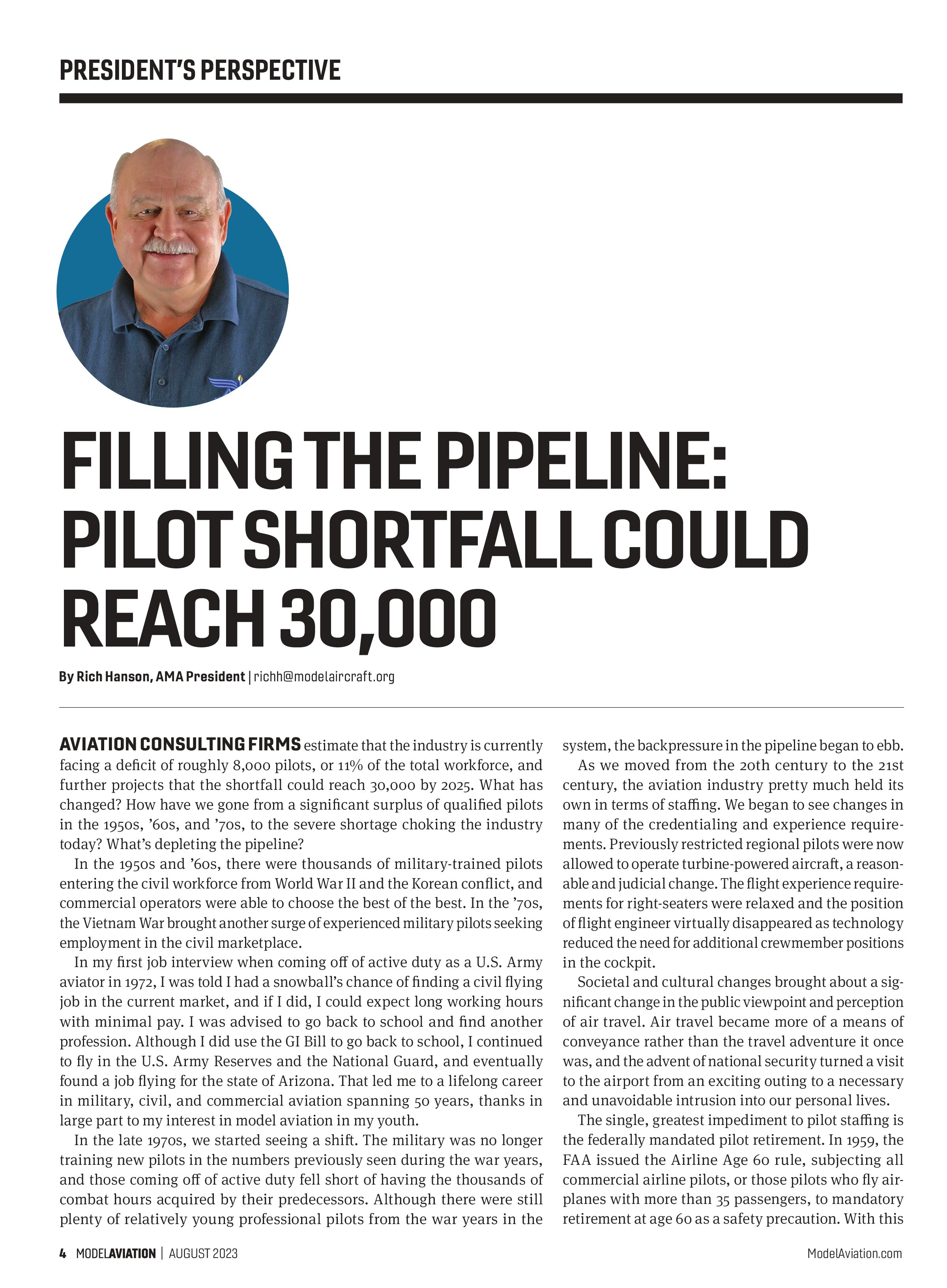
In my first job interview when coming off of active duty as a U.S. Army aviator in 1972, I was told I had a snowball’s chance of finding a civil flying job in the current market, and if I did, I could expect long working hours with minimal pay. I was advised to go back to school and find another profession. Although I did use the GI Bill to go back to school, I continued to fly in the U.S. Army Reserves and the National Guard, and eventually found a job flying for the state of Arizona. That led me to a lifelong career in military, civil, and commercial aviation spanning 50 years, thanks in large part to my interest in model aviation in my youth.
In the late 1970s, we started seeing a shift. The military was no longer training new pilots in the numbers previously seen during the war years, and those coming off of active duty fell short of having the thousands of combat hours acquired by their predecessors. Although there were still plenty of relatively young professional pilots from the war years in the system, the backpressure in the pipeline began to ebb.
As we moved from the 20th century to the 21st century, the aviation industry pretty much held its own in terms of staffing. We began to see changes in many of the credentialing and experience requirements. Previously restricted regional pilots were now allowed to operate turbine-powered aircraft, a reasonable and judicious change. The flight experience requirements for right-seaters were relaxed and the position of flight engineer virtually disappeared as technology reduced the need for additional crewmember positions in the cockpit.
Societal and cultural changes brought about a significant change in the public viewpoint and perception of air travel. Air travel became more of a means of conveyance rather than the travel adventure it once was, and the advent of national security turned a visit to the airport from an exciting outing to a necessary and unavoidable intrusion into our personal lives.
The single, greatest impediment to pilot staffing is the federally mandated pilot retirement. In 1959, the FAA issued the Airline Age 60 rule, subjecting all commercial airline pilots, or those pilots who fly airplanes with more than 35 passengers, to mandatory retirement at age 60 as a safety precaution. With this mandate, we started seeing WW II-era pilots retiring out of the system in the ’90s, and Korean War pilots soon followed as we entered the 21st century.
In 2007, legislation known as the Fair Treatment for Experienced Pilots Act raised the upper age limit from 60 to 65; however, this only placed a band-aid on the situation by adding five more years before the inevitable took place. In the next decade, nearly all of the Vietnam-era pilots reached mandatory retirement age, including me.
Senator Lindsey Graham recently introduced the Let Experienced Pilots Fly Act to address airline flight cancellations caused by the shortage of pilots. The new legislation would raise the mandatory commercial pilot retirement age from 65 to 67 and would require pilots over the age of 65 to maintain a first-class medical certificate. This legislation also only places a band-aid on the situation and, unfortunately, faces opposition from the industry and from the pilots’ unions, asserting that it would compromise safety and stifle the advancement of younger pilots.
The final straw, and what might have been the coup de grâce in terms of pilot staffing, was COVID-19. When the pandemic hit in March 2020, countries quickly closed their borders and travel came to a screeching halt. In an effort to cut costs, carriers scaled back operations, tens of thousands of pilots were furloughed, and thousands of senior pilots were offered early retirement packages. When the COVID-19 vaccine relaxed international restrictions in the summer of 2021, the damage was done, and the pipeline was down to a trickle.
Emerging from COVID-19, the airlines have been working hard to address the staffing shortages. In 2022, many airlines cut back service to less popular and rural destinations because of the scarcity of pilots. The airlines have also attempted to expand the pilot workforce by raising salaries and providing faster paths to career advancement, especially in the case of regional carriers. Public awareness of the looming shortage has also helped to attract new candidates to a restructured industry that promises long-term job security, something previously lacking in the aviation world.
The staffing problems surrounding pilot shortages are compounded by a growing shortage of aircraft mechanics. Industry analysts foresee a shortfall in the number of aviation maintenance workers in the coming year, which will likely worsen as the decade progresses. The shortfall could reach 40,000, depending in part on how quickly the industry moves to attract more mechanics and the success of those efforts.
Pilots and mechanics are also overwhelmingly male and white, meaning a large pool of potential female and minority candidates have been overlooked for decades. Only 2.6% of mechanics and 4.6% of airline pilots in the US identify as female. With this awareness, the industry has pivoted and is aggressively reaching out to attract more underrepresented minorities to the workforce.
For decades, aeromodeling has served as a seed ground and stepping stone to careers in aviation. We’ve all heard the stories about how the careers of many of the notable pioneers in aviation, such as Neil Armstrong, Burt Rutan, and Robert “Hoot” Gibson, were influenced by their participation in model aviation. Since 1962, the National Aviation Hall of Fame has inducted more than 250 of the nation’s forerunners in aeronautics and aerospace sciences into its ranks, many of whom credit their success to their youthful experience with model aircraft. The real story, however, lies with the thousands of individuals whose interest in aviation was sparked in their youth by building and flying model airplanes and have gone on to fulfill highly successful careers in the aviation and aerospace industries.
The aeromodeling community continues to serve a role in welcoming and introducing newcomers to the hobby, and AMA is redoubling its efforts in reaching out to our youth and a variety of community groups to build renewed interest in aviation and to help fill the pipeline. AMA has formed alliances with several sister organizations, such as the Experimental Aircraft Association (EAA), the Aircraft Owners and Pilots Association (AOPA), the Civil Air Patrol (CAP), and a number of ROTC programs across the country. These alliances are focused on introducing our youth to the world of aviation and using model aircraft in developing educational curricula in STEM programs.
In the June issue of Sport Aviation, EAA President Jack Pelton discussed the need to grow our aviation community and shared the following:
“The drive to bring in young aviation enthusiasts is something that all of us should consider part of our mission, and it should be one of the legacies that each of us leaves personally. We were all young once, just as the young people we bring into aviation will grow up and eventually inspire the next generation. We have an amazing opportunity through our chapters to use programs like Young Eagles to engage and bring people out to the airport.
“Chapters (and AMA clubs) have so many other tools at their disposal, like Flying Start programming and Eagle Flights for young people’s parents and other interested adults, not to mention fly-ins and the good old pancake breakfast. The Young Eagles Build and Fly program that partners an EAA chapter with a local AMA club to bring kids into the world of RC flying is another excellent opportunity. The key to expanding our community is right there at the front door of our EAA chapters.”
Please continue to do your part in welcoming newcomers to the hobby. Share your enthusiasm for model aviation with family, friends, and acquaintances, and work with your local clubs in reaching out to your community. Spread the word that model aviation is alive, a heck of a lot of fun, and serves as a portal to the world of aviation.
Keep ’em safe, keep ’em flying, and continue to enjoy this great hobby!