DO MODELERS
LIVE LONGER?
By Bob Angel
samrcflier@verizon.net

I SUSPECT THAT, on average, modelers do live longer, even with no statistical evidence to back that up. We probably spend less time sitting and more time standing and moving than the general population, and we probably spend more time than average in outdoor activities. That thought occurred to me after the recent passing of a prominent model builder at a little past the age of 100.
Henry A. (Hank) Cole Jr. passed away earlier this year. Hank was one of my heroes when I was a teenager struggling to learn Control Line (CL) flying. I considered him a good friend, although we only met face-to-face on two occasions, which I discussed in my February 2010 column. His AMA Hall of Fame biography documents his modeling activities quite well, but, as did many modelers, he also made important contributions to the aviation world—particularly in the space race.
In 2019, Society of Antique Modelers (SAM) Chapter 21 had Hank as a guest speaker while celebrating the 50th anniversary of Apollo 11 and the moon landing. Along the way, Hank had met and worked closely with many contributors to that program, including Neil Armstrong, who was the first man to set foot on the moon, a model builder, and an AMA Model Aviation Hall of Fame member.
Hank wrote and self-published a book titled The Fascination of Flight, with the subtitle, “Hank’s seventy years designing, building & flying model airplanes.” I briefly reviewed his book in my August 2017 column. At the end of his AMA History Project biography, he mentions his book titled My Sixty Years of Model Flying, which is housed in the AMA History Project files in the National Model Aviation Museum. Perhaps that 10-year difference in the title isn’t a discrepancy at all, but merely represents an additional 10 years of model flying between the write-ups.
Hank had sent me a prepublication version of his book for review and comment. I made a couple of minor editorial suggestions and was later gifted with an autographed version of the final product, which is my most treasured model publication.
Uniflow Revisited
I ran out of column space last time before explaining why a Uniflow fuel tank causes an engine to go slightly rich just before the tank completely empties. Maybe I subconsciously wanted the pause to generate more interest in a subject that’s hardly foremost on most people’s minds!
Unless stopped by a shutoff or flood-off, most tanks cut the engine off quickly or allow it to lean out a bit during the final few seconds as the fuel supply is exhausted. The only other tanks I can think of that might go a little rich at the end are bladder-type tanks. Most of us have played with toy balloons and might have noticed that little pressure increase near the end after you suddenly release all the air. That result seems counterintuitive, but the final little squeeze demonstrates why a bladder-type tank can cause an engine to go rich at the end.
In an otherwise sealed Uniflow tank, the replacement air enters through its breather tube, which is submerged near the effective bottom of the fuel supply. The air enters as a constant stream of little bubbles. Bubbles have surface tension that slightly restricts their entry into the fuel supply. We compensate for that by a click or two of the needle toward the rich side. When the fuel level drops sufficiently to uncover the breather tube, the bubbles disappear, along with the slight restriction that they provide. The engine goes slightly rich until the fuel is finally depleted.
When developing the tanks, I was doing mostly CL fun or sport flying, often in warm weather in Southern California. I welcomed that slight richening effect near the end, because it provided a warning not to get caught flying inverted or at the top of some maneuver when the engine stops. It also allowed the engine to relax and cool slightly before landing.
In certain types of competition, such as Racing events, where tank size is limited and refueling is required, we usually want the engine running at full speed until the fuel is exhausted. The richening can be minimized by positioning the breather tube’s inside opening as deeply as possible into the fuel supply. Although I’ve never tested it, I suspect you could probably reduce the extent of richening by increasing the usual 1/8-inch outside diameter of the breather tube to produce larger bubbles. It so happens that the surface tension of bubbles decreases as the diameter increases, in a manner analogous to the balloon example.
Sal Taibi
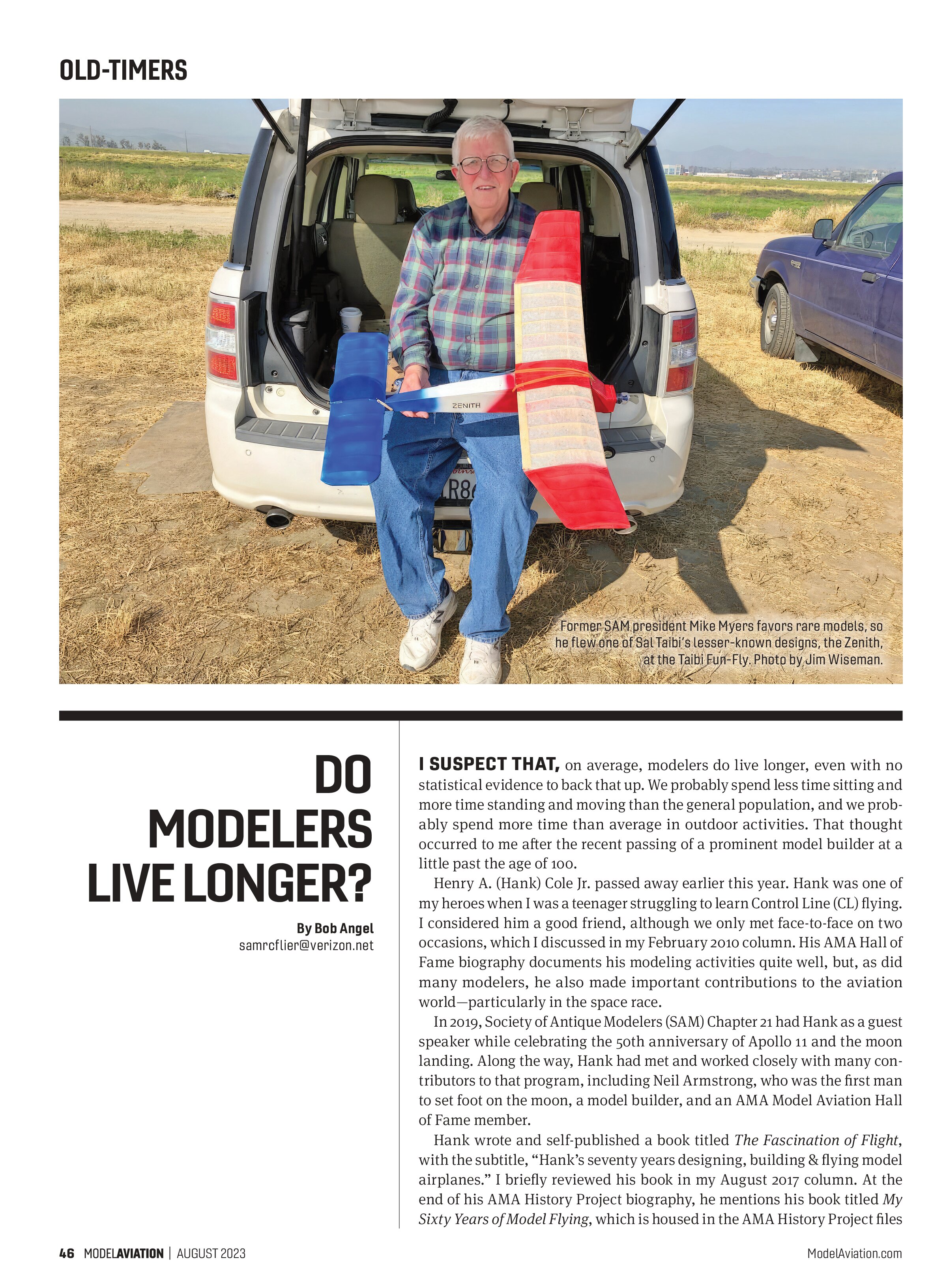
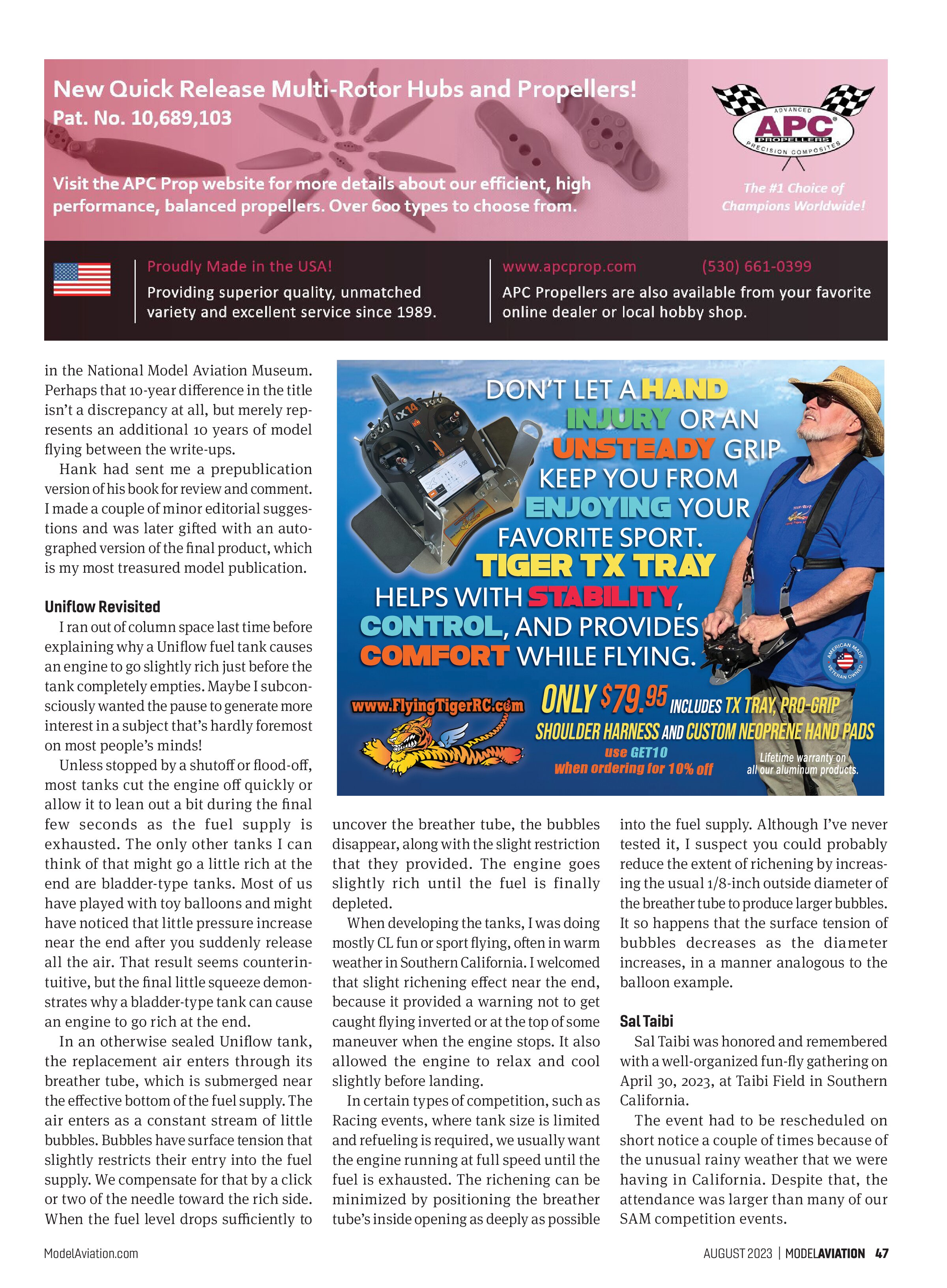
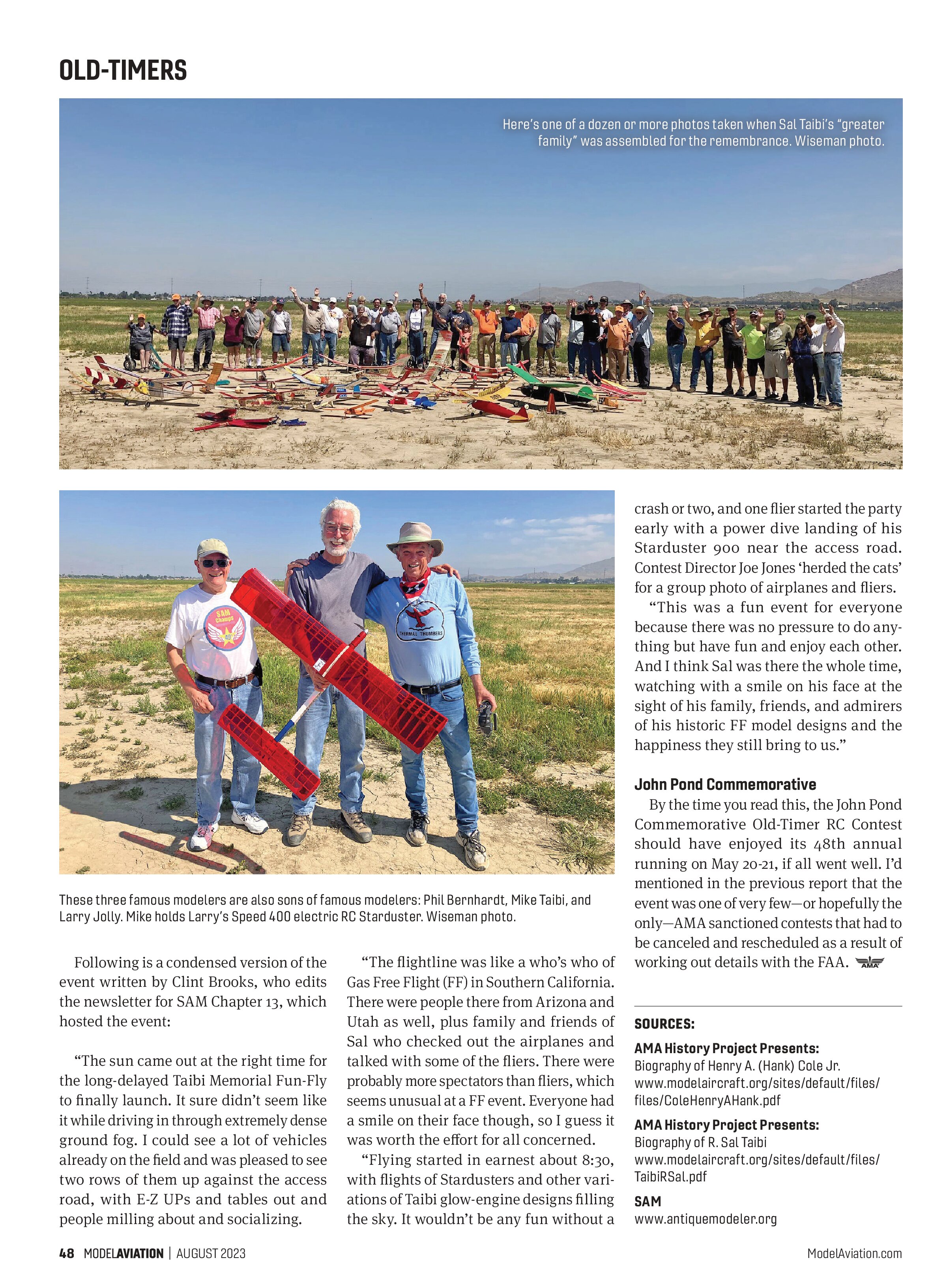
Sal Taibi was honored and remembered with a well-organized fun-fly gathering on April 30, 2023, at Taibi Field in Southern California.
The event had to be rescheduled on short notice a couple of times because of the unusual rainy weather that we were having in California. Despite that, the attendance was larger than many of our SAM competition events.


Following is a condensed version of the event written by Clint Brooks, who edits the newsletter for SAM Chapter 13, which hosted the event:
“The sun came out at the right time for the long-delayed Taibi Memorial Fun-Fly to finally launch. It sure didn’t seem like it while driving in through extremely dense ground fog. I could see a lot of vehicles already on the field and was pleased to see two rows of them up against the access road, with E-Z UPs and tables out and people milling about and socializing.
“The flightline was like a who’s who of Gas Free Flight (FF) in Southern California. There were people there from Arizona and Utah as well, plus family and friends of Sal who checked out the airplanes and talked with some of the fliers. There were probably more spectators than fliers, which seems unusual at a FF event. Everyone had a smile on their face though, so I guess it was worth the effort for all concerned.
“Flying started in earnest about 8:30, with flights of Stardusters and other variations of Taibi glow-engine designs filling the sky. It wouldn’t be any fun without a crash or two, and one flier started the party early with a power dive landing of his Starduster 900 near the access road. Contest Director Joe Jones ‘herded the cats’ for a group photo of airplanes and fliers.
“This was a fun event for everyone because there was no pressure to do anything but have fun and enjoy each other. And I think Sal was there the whole time, watching with a smile on his face at the sight of his family, friends, and admirers of his historic FF model designs and the happiness they still bring to us.”
John Pond Commemorative
By the time you read this, the John Pond Commemorative Old-Timer RC Contest should have enjoyed its 48th annual running on May 20-21, if all went well. I’d mentioned in the previous report that the event was one of very few—or hopefully the only—AMA sanctioned contests that had to be canceled and rescheduled as a result of working out details with the FAA.
SOURCES:
AMA History Project Presents:
Biography of Henry A. (Hank) Cole Jr.
www.modelaircraft.org/sites/default/files/files/ColeHenryAHank.pdf
AMA History Project Presents:
Biography of R. Sal Taibi
www.modelaircraft.org/sites/default/files/TaibiRSal.pdf