FOCAL POINT
Interested in sharing your handiwork? Visit www.ModelAviation.com for submission guidelines.
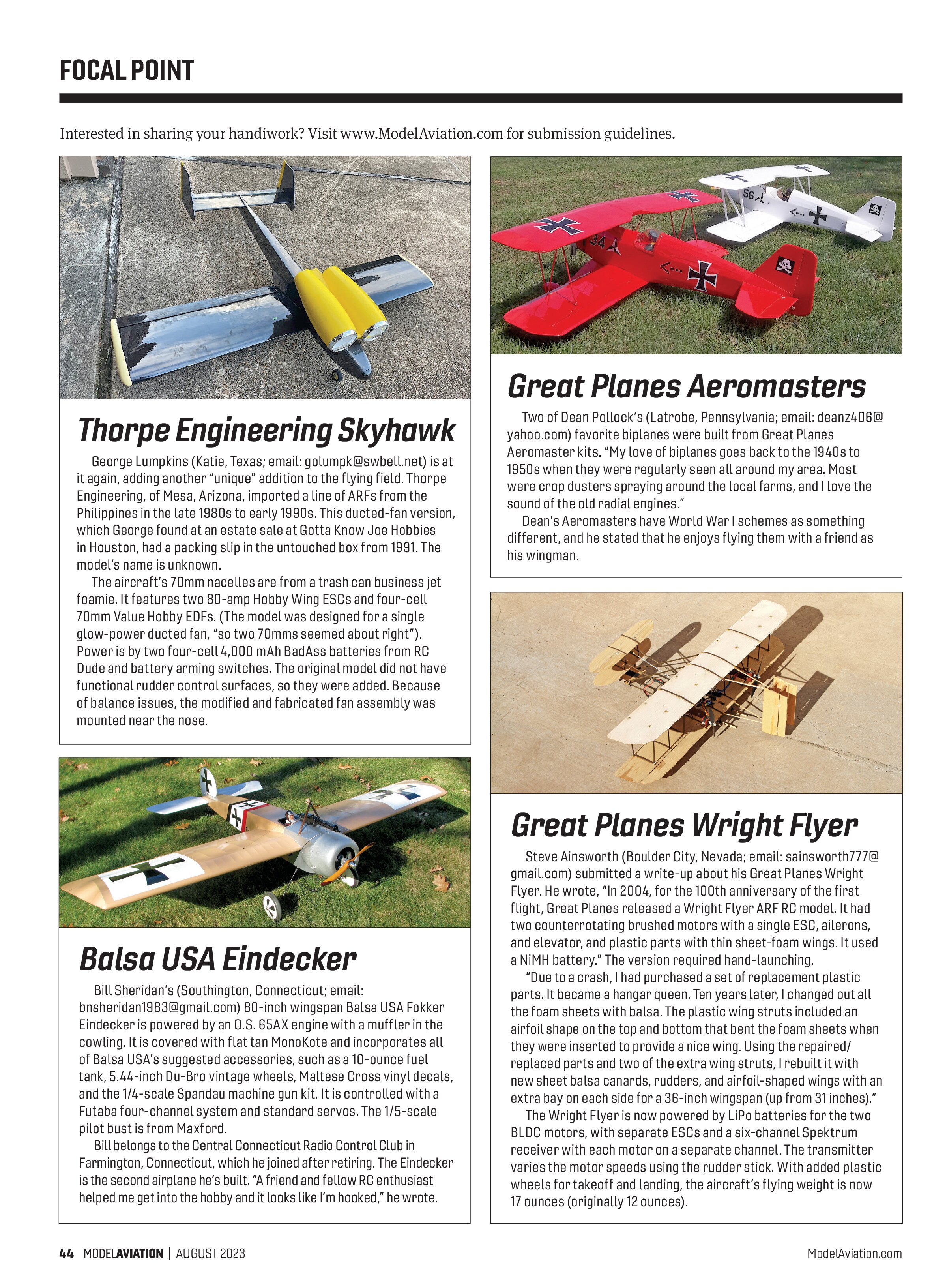
Thorpe Engineering Skyhawk

George Lumpkins (Katy, Texas; email: golumpk@swbell.net) is at it again, adding another “unique” addition to the flying field. Thorpe Engineering, of Mesa, Arizona, imported a line of ARFs from the Philippines in the late 1980s to early 1990s. This ducted-fan version, which George found at an estate sale at Gotta Know Joe Hobbies in Houston, had a packing slip in the untouched box from 1991. The model’s name is unknown.
The aircraft’s 70mm nacelles are from a trash can business jet foamie. It features two 80-amp Hobby Wing ESCs and four-cell 70mm Value Hobby EDFs. (The model was designed for a single glow-power ducted fan, “so two 70mms seemed about right”). Power is by two four-cell 4,000 mAh BadAss batteries from RC Dude and battery arming switches. The original model did not have functional rudder control surfaces, so they were added. Because of balance issues, the modified and fabricated fan assembly was mounted near the nose.
Balsa USA Findecker

Bill Sheridan’s (Southington, Connecticut; email: bnsheridan1983@gmail.com) 80-inch wingspan Balsa USA Fokker Eindecker is powered by an O.S. 65AX engine with a muffler in the cowling. It is covered with flat MonoKote and incorporates all of Balsa USA’s suggested accessories, such as a 10-ounce fuel tank, 5.44-inch Du-Bro vintage wheels, Maltese Cross vinyl decals, and the 1/4-scale Spandau machine gun kit. It is controlled with a Futaba four-channel system and standard servos. The 1/5-scale pilot bust is from Maxford.
Bill belongs to the Central Connecticut Radio Control Club in Farmington, Connecticut, which he joined after retiring. The Eindecker is the second airplane he’s built. “A friend and fellow RC enthusiast helped me get into the hobby and it looks like I’m hooked,” he wrote.
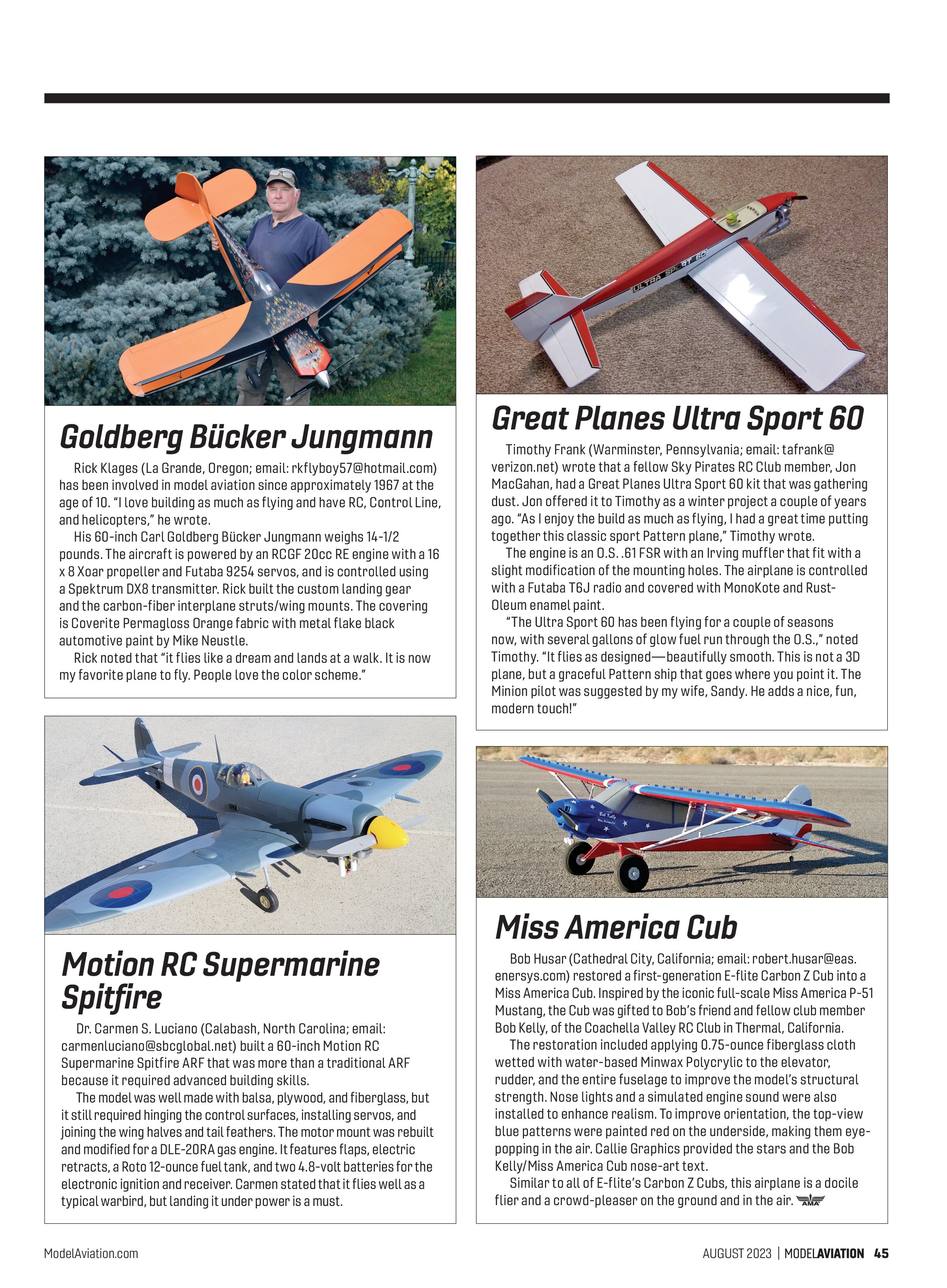
Goldberg Bücker Jungmann

Rick Klages (La Grande, Oregon; email: rkflyboy57@hotmail.com) has been involved in model aviation since approximately 1967 at the age of 10. “I love building as much as flying and have RC, Control Line, and helicopters,” he wrote.
His 60-inch Carl Goldberg Bücker Jungmann weighs 14-1/2 pounds. The aircraft is powered by an RCGF 20cc RE engine with a 16 x 8 Xoar propeller and Futaba 9254 servos, and is controlled using a Spektrum DX8 transmitter. Rick built the custom landing gear and the carbon-fiber interplane struts/wing mounts. The covering is Coverite Permagloss Orange fabric with metal flake black automotive paint by Mike Neustle.
Rick noted that “it flies like a dream and lands at a walk. It is now my favorite plane to fly. People love the color scheme.”
Motion RC Supermarine Spitfire

Dr. Carmen S. Luciano (Calabash, North Carolina; email: carmenluciano@sbcglobal.net) built a 60-inch Motion RC Supermarine Spitfire ARF that was more than a traditional ARF because it required advanced building skills.
The model was well made with balsa, plywood, and fiberglass, but it still required hinging the control surfaces, installing servos, and joining the wing halves and tail feathers. The motor mount was rebuilt and modified for a DLE-20RA gas engine. It features flaps, electric retracts, a Roto 12-ounce fuel tank, and two 4.8-volt batteries for the electronic ignition and receiver. Carmen stated that it flies well as a typical warbird, but landing it under power is a must.
Great Planes Aeromasters

Two of Dean Pollock’s (Latrobe, Pennsylvania; email: deanz406@yahoo.com) favorite biplanes were built from Great Planes Aeromaster kits. “My love of biplanes goes back to the 1940s to 1950s when they were regularly seen all around my area. Most were crop dusters spraying around the local farms, and I love the sound of the old radial engines.”
Dean’s Aeromasters have World War I schemes as something different, and he stated that he enjoys flying them with a friend as his wingman.
Great Planes Wright Flyer

Steve Ainsworth (Boulder City, Nevada; email: sainsworth777@gmail.com) submitted a write-up about his Great Planes Wright Flyer. He wrote, “In 2004, for the 100th anniversary of the first flight, Great Planes released a Wright Flyer ARF RC model. It had two counterrotating brushed motors with a single ESC, ailerons, and elevator, and plastic parts with thin sheet-foam wings. It used a NiMH battery.” The version required hand-launching.
“Due to a crash, I had purchased a set of replacement plastic parts. It became a hangar queen. Ten years later, I changed out all the foam sheets with balsa. The plastic wing struts included an airfoil shape on the top and bottom that bent the foam sheets when they were inserted to provide a nice wing. Using the repaired/replaced parts and two of the extra wing struts, I rebuilt it with new sheet balsa canards, rudders, and airfoil-shaped wings with an extra bay on each side for a 36-inch wingspan (up from 31 inches).”
The Wright Flyer is now powered by LiPo batteries for the two BLDC motors, with separate ESCs and a six-channel Spektrum receiver with each motor on a separate channel. The transmitter varies the motor speeds using the rudder stick. With added plastic wheels for takeoff and landing, the aircraft’s flying weight is now 17 ounces (originally 12 ounces).
Great Planes Ultra Sport 60

Timothy Frank (Warminster, Pennsylvania; email: tafrank@verizon.net) wrote that a fellow Sky Pirates RC Club member, Jon MacGahan, had a Great Planes Ultra Sport 60 kit that was gathering dust. Jon offered it to Timothy as a winter project a couple of years ago. “As I enjoy the build as much as flying, I had a great time putting together this classic sport Pattern plane,” Timothy wrote.
The engine is an O.S. .61 FSR with an Irving muffler that fit with a slight modification of the mounting holes. The airplane is controlled with a Futaba T6J radio and covered with MonoKote and Rust-Oleum enamel paint.
“The Ultra Sport 60 has been flying for a couple of seasons now, with several gallons of glow fuel run through the O.S.,” noted Timothy. “It flies as designed—beautifully smooth. This is not a 3D plane, but a graceful Pattern ship that goes where you point it. The Minion pilot was suggested by my wife, Sandy. He adds a nice, fun, modern touch!”
Miss America Cub

Bob Husar (Cathedral City, California; email: robert.husar@eas.ensys.com) restored a first-generation E-flite Carbon Z Cub into a Miss America Cub. Inspired by the iconic full-scale Miss America P-51 Mustang, the Cub was gifted to Bob’s friend and fellow club member Bob Kelly, of the Coachella Valley RC Club in Thermal, California.
The restoration included applying 0.75-ounce fiberglass cloth wetted with water-based Minwax Polycrylic to the elevator, rudder, and the entire fuselage to improve the model’s structural strength. Nose lights and a simulated engine sound were also installed to enhance realism. To improve orientation, the top-view blue patterns were painted red on the underside, making them eye-popping in the air. Callie Graphics provided the stars and the Bob Kelly/Miss America Cub nose-art text.
Similar to all of E-flite’s Carbon Z Cubs, this airplane is a docile flier and a crowd-pleaser on the ground and in the air.