
ELECTRIC SMORGASBORD
By Terry Dunn | terrydunn74@gmail.com
I HAVE A FEW TOPICS that I want to cover in this column, so I’ll jump right into it. The first bit of news is bittersweet.
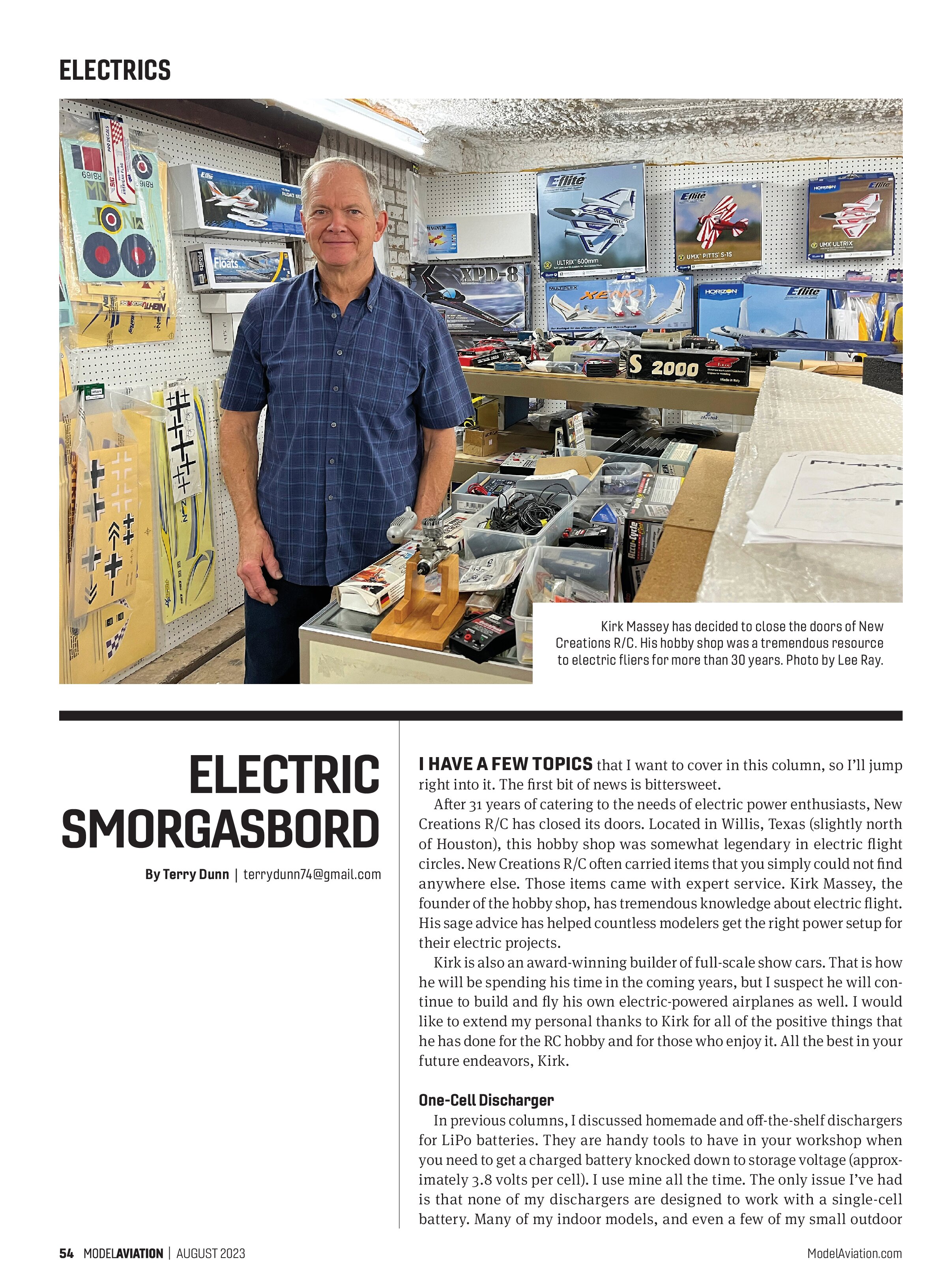
After 31 years of catering to the needs of electric power enthusiasts, New Creations R/C has closed its doors. Located in Willis, Texas (slightly north of Houston), this hobby shop was somewhat legendary in electric flight circles. New Creations R/C often carried items that you simply could not find anywhere else. Those items came with expert service. Kirk Massey, the founder of the hobby shop, has tremendous knowledge about electric flight. His sage advice has helped countless modelers get the right power setup for their electric projects.
Kirk is also an award-winning builder of full-scale show cars. That is how he will be spending his time in the coming years, but I suspect he will continue to build and fly his own electric-powered airplanes as well. I would like to extend my personal thanks to Kirk for all of the positive things that he has done for the RC hobby and for those who enjoy it. All the best in your future endeavors, Kirk.
One-Cell Discharger
In previous columns, I discussed homemade and off-the-shelf dischargers for LiPo batteries. They are handy tools to have in your workshop when you need to get a charged battery knocked down to storage voltage (approximately 3.8 volts per cell). I use mine all the time. The only issue I’ve had is that none of my dischargers are designed to work with a single-cell battery. Many of my indoor models, and even a few of my small outdoor airplanes, use single-cell LiPos, so I needed to fill that gap.


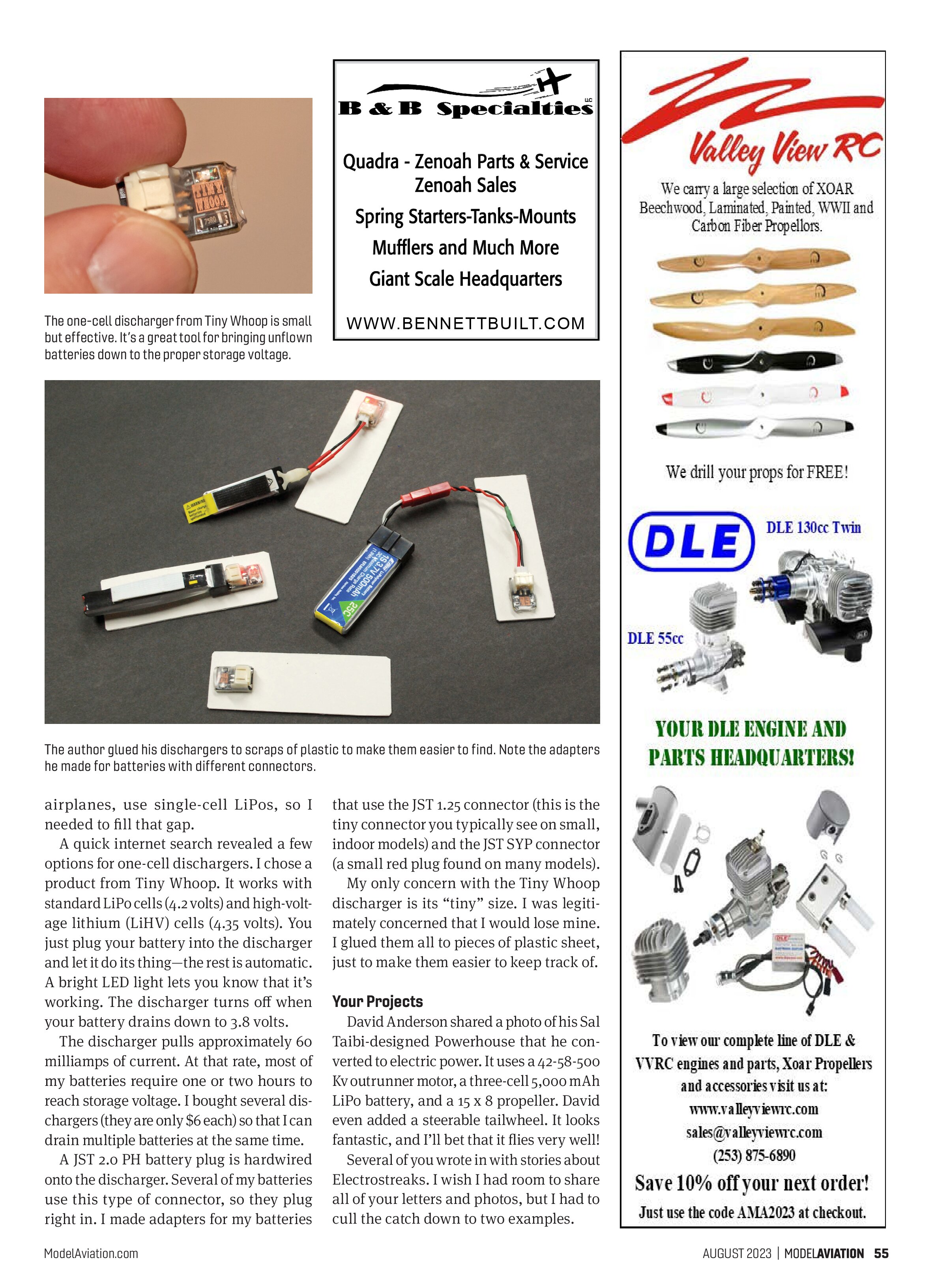
A quick internet search revealed a few options for one-cell dischargers. I chose a product from Tiny Whoop. It works with standard LiPo cells (4.2 volts) and high-voltage lithium (LiHV) cells (4.35 volts). You just plug your battery into the discharger and let it do its thing—the rest is automatic. A bright LED light lets you know that it’s working. The discharger turns off when your battery drains down to 3.8 volts.
The discharger pulls approximately 60 milliamps of current. At that rate, most of my batteries require one or two hours to reach storage voltage. I bought several dischargers (they are only $6 each) so that I can drain multiple batteries at the same time.
A JST 2.0 PH battery plug is hardwired onto the discharger. Several of my batteries use this type of connector, so they plug right in. I made adapters for my batteries that use the JST 1.25 connector (this is the tiny connector you typically see on small, indoor models) and the JST SYP connector (a small red plug found on many models).
My only concern with the Tiny Whoop discharger is its “tiny” size. I was legitimately concerned that I would lose mine. I glued them all to pieces of plastic sheet, just to make them easier to keep track of.
Your Projects
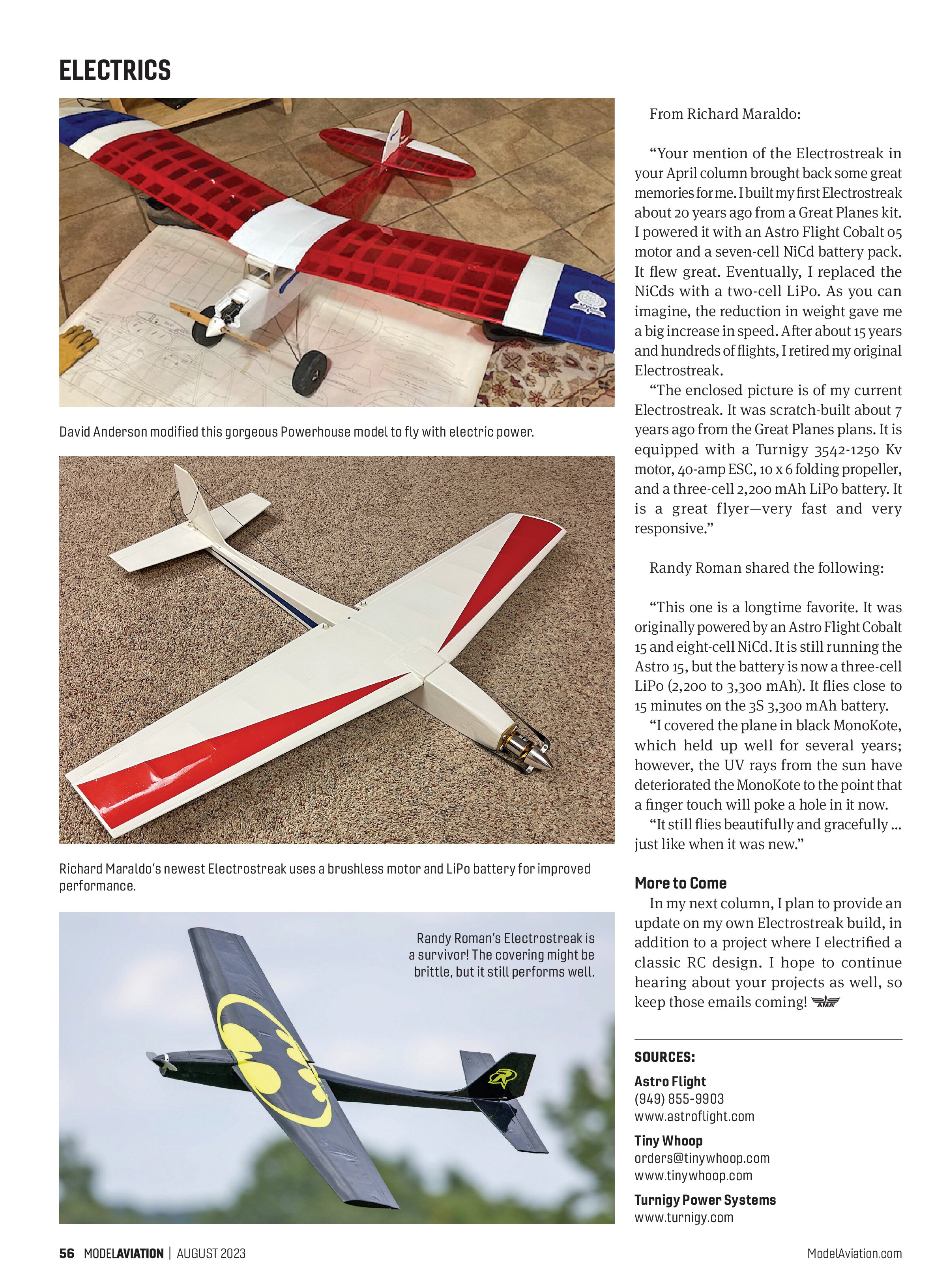
David Anderson shared a photo of his Sal Taibi-designed Powerhouse that he converted to electric power. It uses a 42-58-500 Kv outrunner motor, a three-cell 5,000 mAh LiPo battery, and a 15 x 8 propeller. David even added a steerable tailwheel. It looks fantastic, and I’ll bet that it flies very well!
Several of you wrote in with stories about Electrostreaks. I wish I had room to share all of your letters and photos, but I had to cull the catch down to two examples.


From Richard Maraldo:
“Your mention of the Electrostreak in your April column brought back some great memories for me. I built my first Electrostreak about 20 years ago from a Great Planes kit. I powered it with an Astro Flight Cobalt 05 motor and a seven-cell NiCd battery pack. It flew great. Eventually, I replaced the NiCds with a two-cell LiPo. As you can imagine, the reduction in weight gave me a big increase in speed. After about 15 years and hundreds of flights, I retired my original Electrostreak.
“The enclosed picture is of my current Electrostreak. It was scratch-built about 7 years ago from the Great Planes plans. It is equipped with a Turnigy 3542-1250 Kv motor, 40-amp ESC, 10 x 6 folding propeller, and a three-cell 2,200 mAh LiPo battery. It is a great flyer—very fast and very responsive.”
Randy Roman shared the following:
“This one is a longtime favorite. It was originally powered by an Astro Flight Cobalt 15 and eight-cell NiCd. It is still running the Astro 15, but the battery is now a three-cell LiPo (2,200 to 3,300 mAh). It flies close to 15 minutes on the 3S 3,300 mAh battery.
“I covered the plane in black MonoKote, which held up well for several years; however, the UV rays from the sun have deteriorated the MonoKote to the point that a finger touch will poke a hole in it now.
“It still flies beautifully and gracefully ... just like when it was new.”
More to Come
In my next column, I plan to provide an update on my own Electrostreak build, in addition to a project where I electrified a classic RC design. I hope to continue hearing about your projects as well, so keep those emails coming!
SOURCES:
Astro Flight
(949) 855-9903
www.astroflight.com
Tiny Whoop
orders@tinywhoop.com
www.tinywhoop.com
Turnigy Power Systems
www.turnigy.com