VINTAGE VIEWPOINT
PUBLISHED ARTICLES FROM 50 YEARS AGO
By Bob Noll | bobrc@aol.com

THIS MONTH, I will take a look back 50 years to see what was being published in our model magazines.
Flying Models (FM) had a headline for part two of “Dave Gierke on Dynamotor Engine Testing.” Part two explored the unknowns of powerplants, dynamometer procedures, atmospheric factors, test results, and the flow of energy through your engine. It was an intriguing read!
Jack Sheeks reviewed the Hand Crafted Models R/C Sport Scale Me 109 kit. He wrote that the kit included precision-cut parts. Powered by a .60 engine for thrust, Jack installed a Royal Super Sport I radio. He reported that he had the Me 109 construction completed in just 19-1/2 hours.
“Tailgater,” by Phil D’Ostilio, was an article about Phil’s latest RC Aerobatics (Pattern) airplane. It featured Rom Air retracts, a Webra .61 powerplant, and a ProLine system for control. The Tailgater featured a midwing fuselage design configuration that was coupled with a retractable landing gear system. The design had an inline wing chord, stabilizer, and thrustline arrangement.
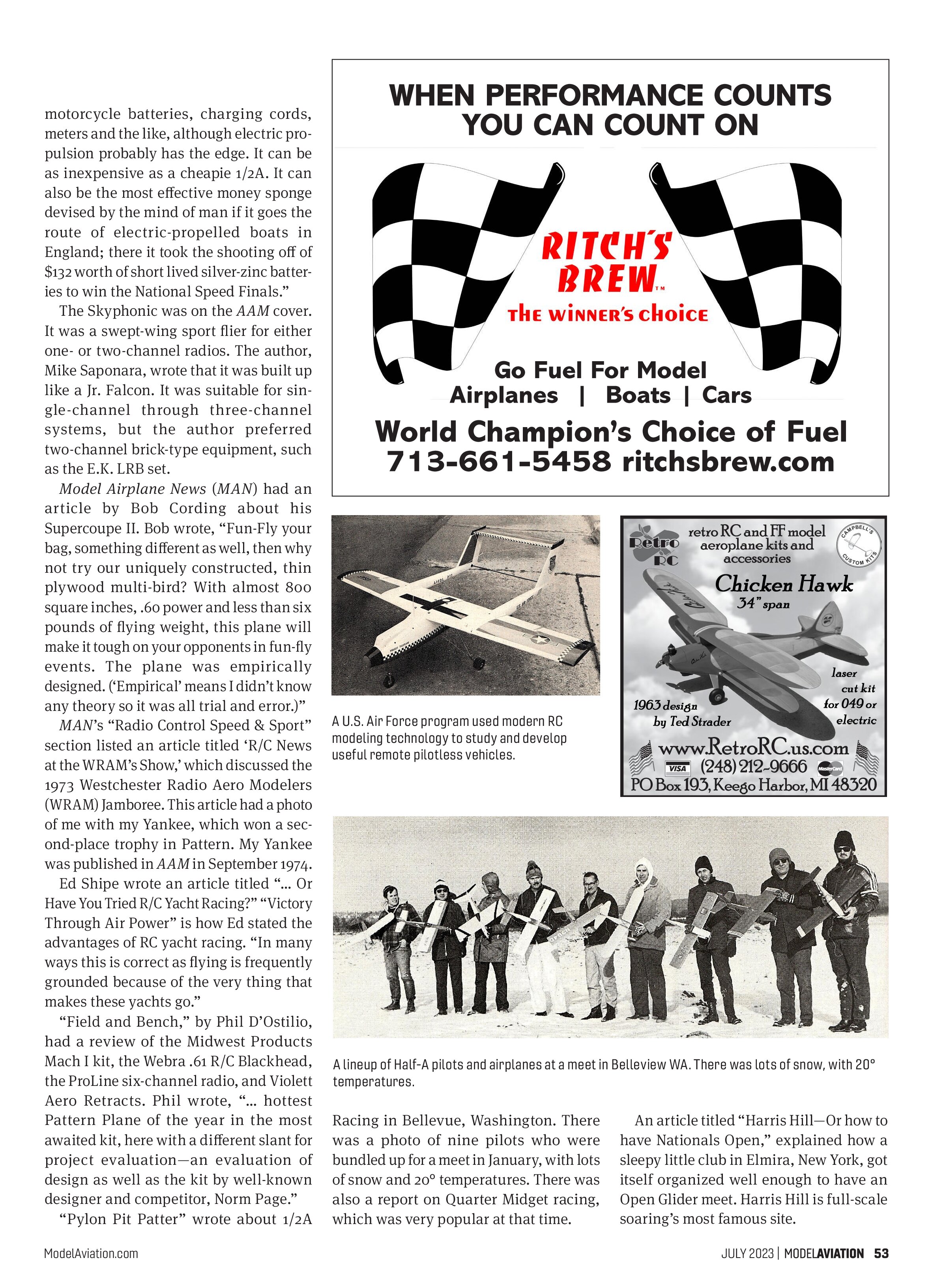
American Aircraft Modeler (AAM) had an article by Don Lowe titled “Project Teleplane.” This was a U.S. Air Force program that used modern RC modeling technology to study and develop useful remote pilotless vehicles. Project Teleplane was conceived by the Air Force Flight Dynamics Lab as an in-house capability for designing, fabricating, and flight-testing experimental military aircraft concepts in subscale form through the use of remote control systems.
Bob Meuser published an interesting review of what was available in electric power systems at the time. Bob wrote, “The inconvenience of greasy kid stuff and balky engines must be weighed against an assemblage of motorcycle batteries, charging cords, meters and the like, although electric propulsion probably has the edge. It can be as inexpensive as a cheapie 1/2A. It can also be the most effective money sponge devised by the mind of man if it goes the route of electric-propelled boats in England; there it took the shooting off of $132 worth of short lived silver-zinc batteries to win the National Speed Finals.”
The Skyphonic was on the AAM cover. It was a swept-wing sport flier for either one- or two-channel radios. The author, Mike Saponara, wrote that it was built up like a Jr. Falcon. It was suitable for single-channel through three-channel systems, but the author preferred two-channel brick-type equipment, such as the E.K. LRB set.
Model Airplane News (MAN) had an article by Bob Cording about his Supercoupe II. Bob wrote, “Fun-Fly your bag, something different as well, then why not try our uniquely constructed, thin plywood multi-bird? With almost 800 square inches, .60 power and less than six pounds of flying weight, this plane will make it tough on your opponents in fun-fly events. The plane was empirically designed. (‘Empirical’ means I didn’t know any theory so it was all trial and error.)”
MAN’s “Radio Control Speed & Sport” section listed an article titled ‘R/C News at the WRAM’s Show,’ which discussed the 1973 Westchester Radio Aero Modelers (WRAM) Jamboree. This article had a photo of me with my Yankee, which won a second-place trophy in Pattern. My Yankee was published in AAM in September 1974.
Ed Shipe wrote an article titled “... Or Have You Tried R/C Yacht Racing?” “Victory Through Air Power” is how Ed stated the advantages of RC yacht racing. “In many ways this is correct as flying is frequently grounded because of the very thing that makes these yachts go.”
“Field and Bench,” by Phil D’Ostilio, had a review of the Midwest Products Mach I kit, the Webra .61 R/C Blackhead, the ProLine six-channel radio, and Violett Aero Retracts. Phil wrote, “... hottest Pattern Plane of the year in the most awaited kit, here with a different slant for project evaluation—an evaluation of design as well as the kit by well-known designer and competitor, Norm Page.”
“Pylon Pit Patter” wrote about 1/2A motorcycle batteries, charging cords, meters and the like, although electric propulsion probably has the edge. It can be as inexpensive as a cheapie 1/2A. It can also be the most effective money sponge devised by the mind of man if it goes the route of electric-propelled boats in England; there it took the shooting off of $132 worth of short lived silver-zinc batteries to win the National Speed Finals.
The Skyphonic was on the AAM cover. It was a swept-wing sport flier for either one- or two-channel radios. The author, Mike Saponara, wrote that it was built up like a Jr. Falcon. It was suitable for single-channel through three-channel systems, but the author preferred two-channel brick-type equipment, such as the E.K. LRB set.
Model Airplane News (MAN) had an article by Bob Cording about his Supercoupe II. Bob wrote, “Fun-Fly your bag, something different as well, then why not try our uniquely constructed, thin plywood multi-bird? With almost 800 square inches, .60 power and less than six pounds of flying weight, this plane will make it tough on your opponents in fun-fly events. The plane was empirically designed. (‘Empirical’ means I didn’t know any theory so it was all trial and error.)”
MAN’s “Radio Control Speed & Sport” section listed an article titled ‘R/C News at the WRAM’s Show,’ which discussed the 1973 Westchester Radio Aero Modelers (WRAM) Jamboree. This article had a photo of me with my Yankee, which won a second-place trophy in Pattern. My Yankee was published in AAM in September 1974.
Ed Shipe wrote an article titled “... Or Have You Tried R/C Yacht Racing?” “Victory Through Air Power” is how Ed stated the advantages of RC yacht racing. “In many ways this is correct as flying is frequently grounded because of the very thing that makes these yachts go.”
“Field and Bench,” by Phil D’Ostilio, had a review of the Midwest Products Mach I kit, the Webra .61 R/C Blackhead, the ProLine six-channel radio, and Violett Aero Retracts. Phil wrote, “... hottest Pattern Plane of the year in the most awaited kit, here with a different slant for project evaluation—an evaluation of design as well as the kit by well-known designer and competitor, Norm Page.”
Racing in Bellevue, Washington. There was a photo of nine pilots who were bundled up for a meet in January, with lots of snow and 20° temperatures. There was also a report on Quarter Midget racing, which was very popular at that time.

An article titled “Harris Hill—Or how to have Nationals Open,” explained how a sleepy little club in Elmira, New York, got itself organized well enough to have an Open Glider meet. Harris Hill is full-scale soaring’s most famous site.


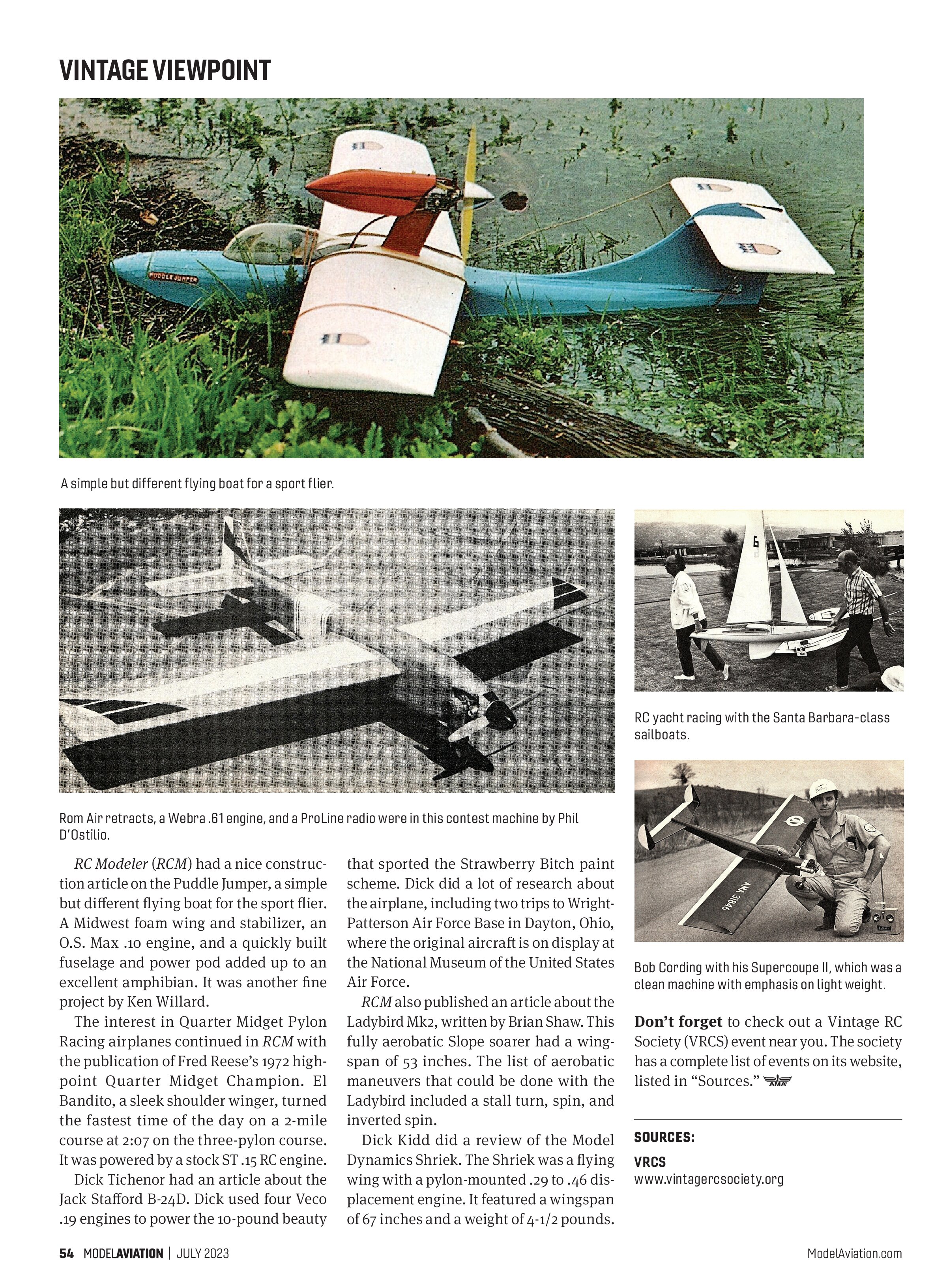
RC Modeler (RCM) had a nice construction article on the Puddle Jumper, a simple but different flying boat for the sport flier. A Midwest foam wing and stabilizer, an O.S. Max .10 engine, and a quickly built fuselage and power pod added up to an excellent amphibian. It was another fine project by Ken Willard.
The interest in Quarter Midget Pylon Racing airplanes continued in RCM with the publication of Fred Reese’s 1972 high-point Quarter Midget Champion. El Bandito, a sleek shoulder winger, turned the fastest time of the day on a 2-mile course at 2:07 on the three-pylon course. It was powered by a stock ST .15 RC engine.
Dick Tichenor had an article about the Jack Stafford B-24D. Dick used four Veco .19 engines to power the 10-pound beauty that sported the Strawberry Bitch paint scheme. Dick did a lot of research about the airplane, including two trips to Wright-Patterson Air Force Base in Dayton, Ohio, where the original aircraft is on display at the National Museum of the United States Air Force.
RCM also published an article about the Ladybird Mk2, written by Brian Shaw. This fully aerobatic Slope soarer had a wingspan of 53 inches. The list of aerobatic maneuvers that could be done with the Ladybird included a stall turn, spin, and inverted spin.
Dick Kidd did a review of the Model Dynamics Shriek. The Shriek was a flying wing with a pylon-mounted .29 to .46 displacement engine. It featured a wingspan of 67 inches and a weight of 4-1/2 pounds.
Don’t forget to check out a Vintage RC Society (VRCS) event near you. The society has a complete list of events on its website, listed in “Sources.”