WHO WERE THE HORTEN
BROTHERS?
Photos provided by Gonzalo Bures | gonzalobures@gmail.com
IN 2018, Gonzalo Bures (Toa Baja, Puerto Rico) couldn’t answer the question of who the Horten brothers were and hadn’t heard of their great achievements as designers of the flying wing. The Horten brothers’ beginnings as flying wing glider pilots developed into the design of the most advanced flying machine of their time, and it took decades for aviation to advance to the point of matching their 1944 turbine-powered flying wing into a military operational weapon.
Late in 2018, during a conversation with friends at the Borinquen RC Club site in Sabana Seca, Toa Baja, Puerto Rico, the topic of the B2 flying wing was introduced. Two of Gonzalo’s knowledgeable friends, Rafa Sacarelo and Gustavo Diaz, shared the roots of the B2, the Horten Ho 229 flying wing, which was flown in late 1944. After years of design and variant tryouts, the Horten brothers’ operational, turbine-powered flying wing was the first of its class.
“I have an attraction for strange, exotic and challenging subjects to model,” stated Gonzalo. “I immediately fell in love with this attractive and unique flying machine. I started gathering all the information I could on this airplane, including RC models. I bought many books on the history of the Horten project. The thrill of experiencing what these men did in very challenging and dangerous times made the subject even more interesting. I was sure that I had to build and fly a scale RC Ho 229.”

Gonzalo began searching for available kits, plans, and articles to build an RC model. “Needless to say, in 2018, there were not many builds of this model in the RC world. On YouTube, I was able to find videos of flying models of the Ho 229—some successful, others not.
“Searching through the videos, I met RC model designer Gary Hethcoat. Gary kindly answered my questions and provided valuable information on the requirements of his design. I shared what I planned to build and ordered one of his 82-inch wingspan Horten Ho 229 short kits.” (Gary’s RC models can be viewed and purchased on his Wings on the Web website: http://gary- hethcoat.com).
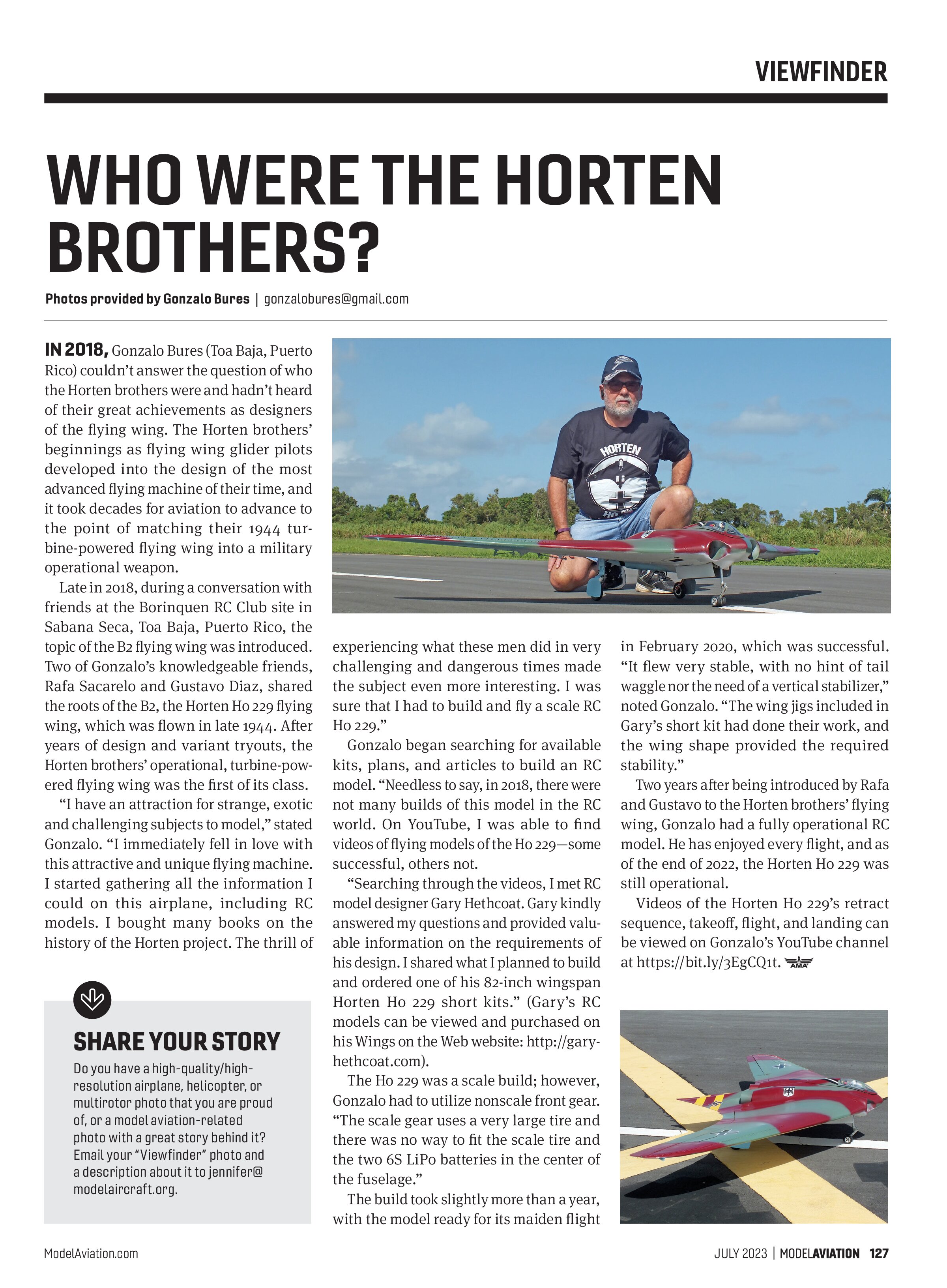
The Ho 229 was a scale build; however, Gonzalo had to utilize nonscale front gear. “The scale gear uses a very large tire and there was no way to fit the scale tire and the two 6S LiPo batteries in the center of the fuselage.”
The build took slightly more than a year, with the model ready for its maiden flight in February 2020, which was successful. “It flew very stable, with no hint of tail waggle nor the need of a vertical stabilizer,” noted Gonzalo. “The wing jigs included in Gary’s short kit had done their work, and the wing shape provided the required stability.”
Two years after being introduced by Rafa and Gustavo to the Horten brothers’ flying wing, Gonzalo had a fully operational RC model. He has enjoyed every flight, and as of the end of 2022, the Horten Ho 229 was still operational.
Videos of the Horten Ho 229’s retract sequence, takeoff, flight, and landing can be viewed on Gonzalo’s YouTube channel at https://bit.ly/3EgCQ1t.
SHARE YOUR STORY
Do you have a high-quality/high-resolution airplane, helicopter, or multirotor photo that you are proud of, or a model aviation-related photo with a great story behind it? Email your “Viewfinder” photo and a description about it to jennifer@modelaircraft.org.