SAFETY COMES FIRST

LEAVE A TIP
By Dave Gee | safetycolumn@cs.com
WHAT’S THE single most important safety tip you would give to a newcomer in our aeromodeling sport? I bet it would vary depending on your specific niche of modeling. There are so many different types of model aircraft, and everyone has their favorite.
Many electric pilots will double check that the power is disconnected before making adjustments near the propeller. Glider guiders might say that your focus should be on the powerful launching winch and cable, or maybe on avoiding a fall from the cliff where the slope lift develops.
Rotary-wing fliers are always interested in staying clear of where fast-moving blade tips are or will be. Control Line types have to be mindful of propeller and powerplant issues, but they must also inspect bellcrank mounts that Free Flight (FF) models don’t even carry.
Choose your very best newcomer tip, send it via my email, and I’ll print the results.
Learning Via Videos
While watching model airplane videos online, I came across one about “what’s killing the sport,” but it didn’t make much sense to me. First of all, the other videos that popped up seemed to show robust action in all aspects of aeromodeling. Far from a death knell, it looked as though many people were posting and watching fun clips on how to safely build and fly models. I’m not too worried about our sport dying. It seems that overcrowding will be a more likely problem.
Online videos are the current way to learn how to do things in this hobby.

Pilots can look up a how-to video to study a new airframe construction skill, or watch an unboxing clip before purchasing the latest hobby gadget. Of course, the quality of this information can vary!
Watch more than one and read the comments to make sure the guidance you’re getting is correct. For instance, the sketchy information in my own online videos should be taken with a grain of salt!
Demonstration Decisions
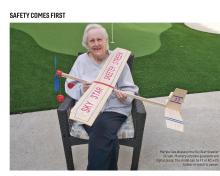
I recently met a group of enthusiastic newcomers who soaked up all of the information I could give them. A troop of young Girl Scouts wanted to earn aviation badges, and a flight demonstration session of models was a good start.
Expert modeler Gary Teti came along and we brought a selection of indoor models to the meeting. There were fixed-wing, rise-off-ground (ROG) aircraft, canard and pusher types, a FF helicopter, and even an ornithopter. As the airplanes flew around the room, we talked about basic aerodynamics, aviation history (emphasizing women in aviation, which is a badge requirement), and how much fun we have with our models.
The girls then built and test-flew their own airplanes. This involved more screaming and running around than my club’s indoor meets, but their enthusiasm was delightful.
If you do a demonstration or teaching session, you’ll want to plan ahead to ensure the safety of your audience. Demonstration outings are quite different from open-house events at an RC field. You will not be in your familiar fenced-off place. Kids (and adults) might swarm around the tables and touch things. You need to decide what airplanes to bring and what stuff to leave home. Even a static display should be thought through to prevent any possible problems with the inert airframes.
I enjoy smaller indoor models, so those are an easy choice for demonstration outings. Even a small classroom can work, but larger is better. These rubber-powered models are so lightweight that I can let them land in the audience. Kids love that!


If I’m bringing powered RC models, I need to separate them from the humans, even if they’re super lightweight aircraft such as the E-flite Vapor or indoor-type helicopters. These models get standard flightline/spectator separation.
Incidentally, I’ve learned not to bring static display models to a flying demonstration session. I only bring airplanes that can safely fly at that site; otherwise, people are disappointed to find that the larger models won’t be flown. Static-only displays are a different matter because everyone understands that none of the airplanes will take to the air that day.
For static displays of larger powered models, use common sense. No batteries for the electric-powered aircraft are on hand at all so that accidental motor start-ups are prevented. If gas-powered models are shown, there should be no fuel or starting equipment present. I’ve learned that certain young enthusiasts can’t resist grabbing these shiny, wondrous objects, so I put some “touchable” models out front. These are sturdy or expendable aircraft and choppers that will protect the other models by sacrificing themselves.
Sure, kid, put a finger through the wing ...
Headache Prevention
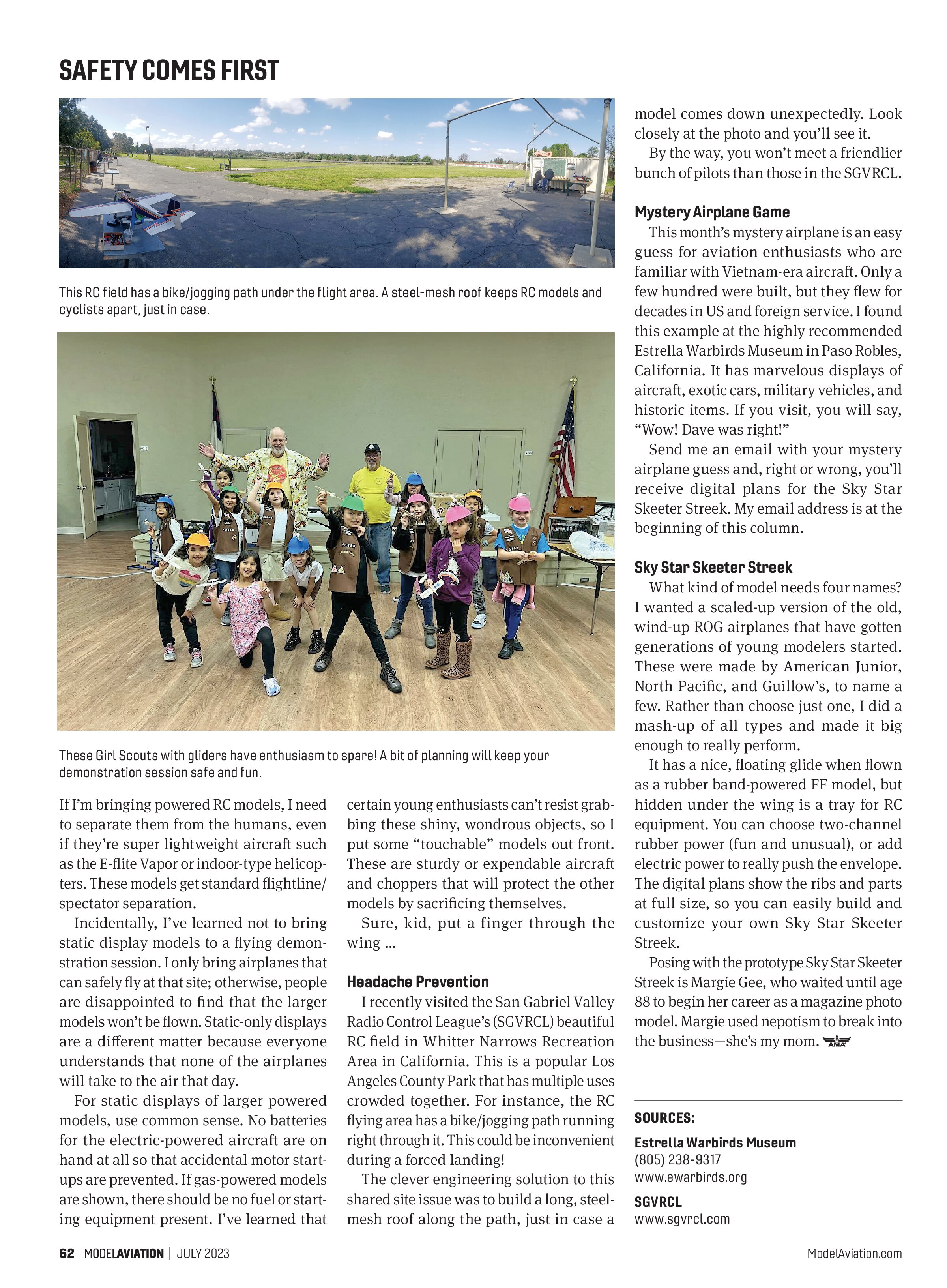
I recently visited the San Gabriel Valley Radio Control League’s (SGVRCL) beautiful RC field in Whittier Narrows Recreation Area in California. This is a popular Los Angeles County Park that has multiple uses crowded together. For instance, the RC flying area has a bike/jogging path running right through it. This could be inconvenient during a forced landing!
The clever engineering solution to this shared site issue was to build a long, steel-mesh roof along the path, just in case a model comes down unexpectedly. Look closely at the photo and you’ll see it.
By the way, you won’t meet a friendlier bunch of pilots than those in the SGVRCL.
Mystery Airplane Game
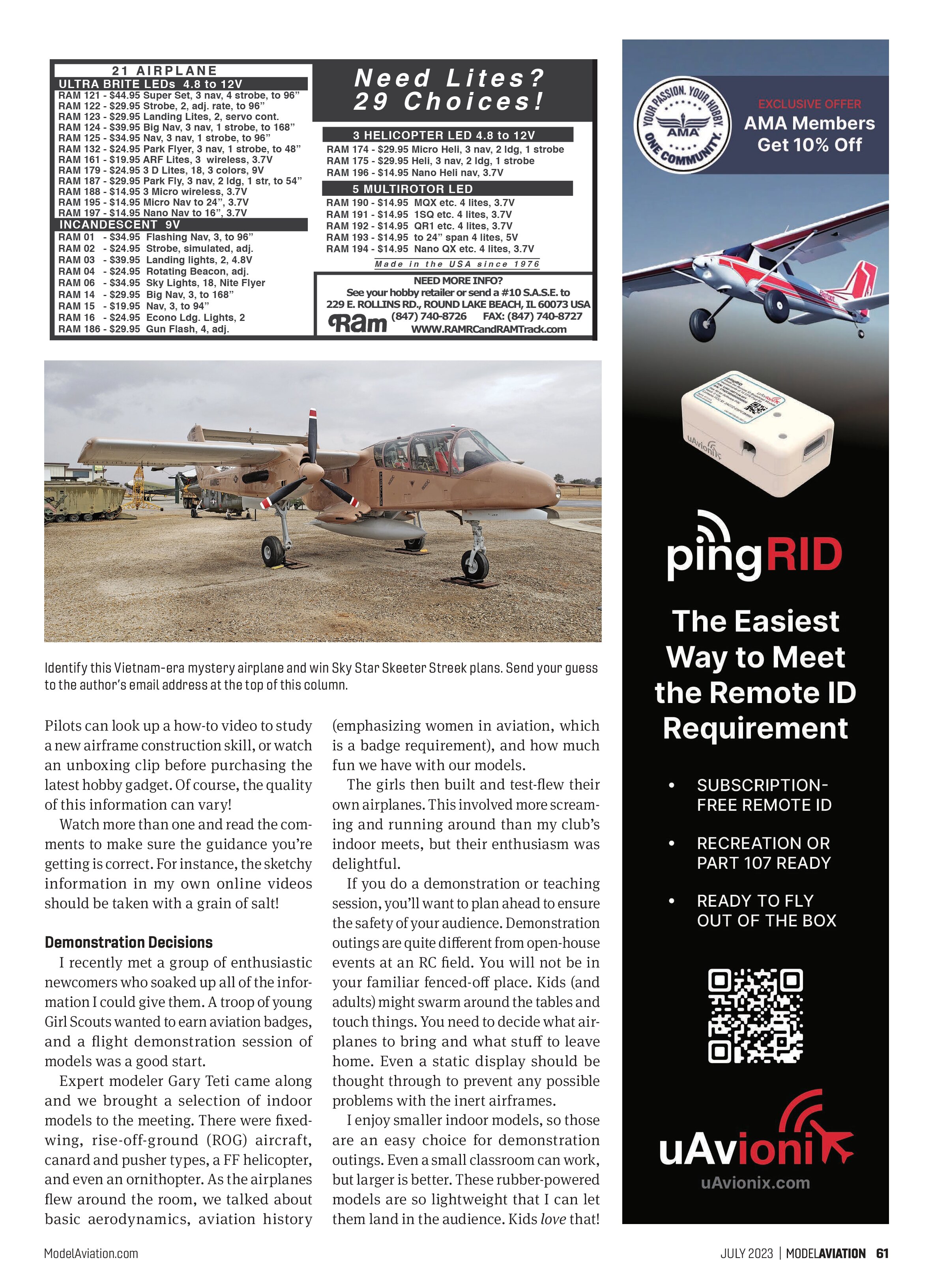
This month’s mystery airplane is an easy guess for aviation enthusiasts who are familiar with Vietnam-era aircraft. Only a few hundred were built, but they flew for decades in US and foreign service. I found this example at the highly recommended Estrella Warbirds Museum in Paso Robles, California. It has marvelous displays of aircraft, exotic cars, military vehicles, and historic items. If you visit, you will say, “Wow! Dave was right!”
Send me an email with your mystery airplane guess and, right or wrong, you’ll receive digital plans for the Sky Star Skeeter Streek. My email address is at the beginning of this column.
Sky Star Skeeter Streek
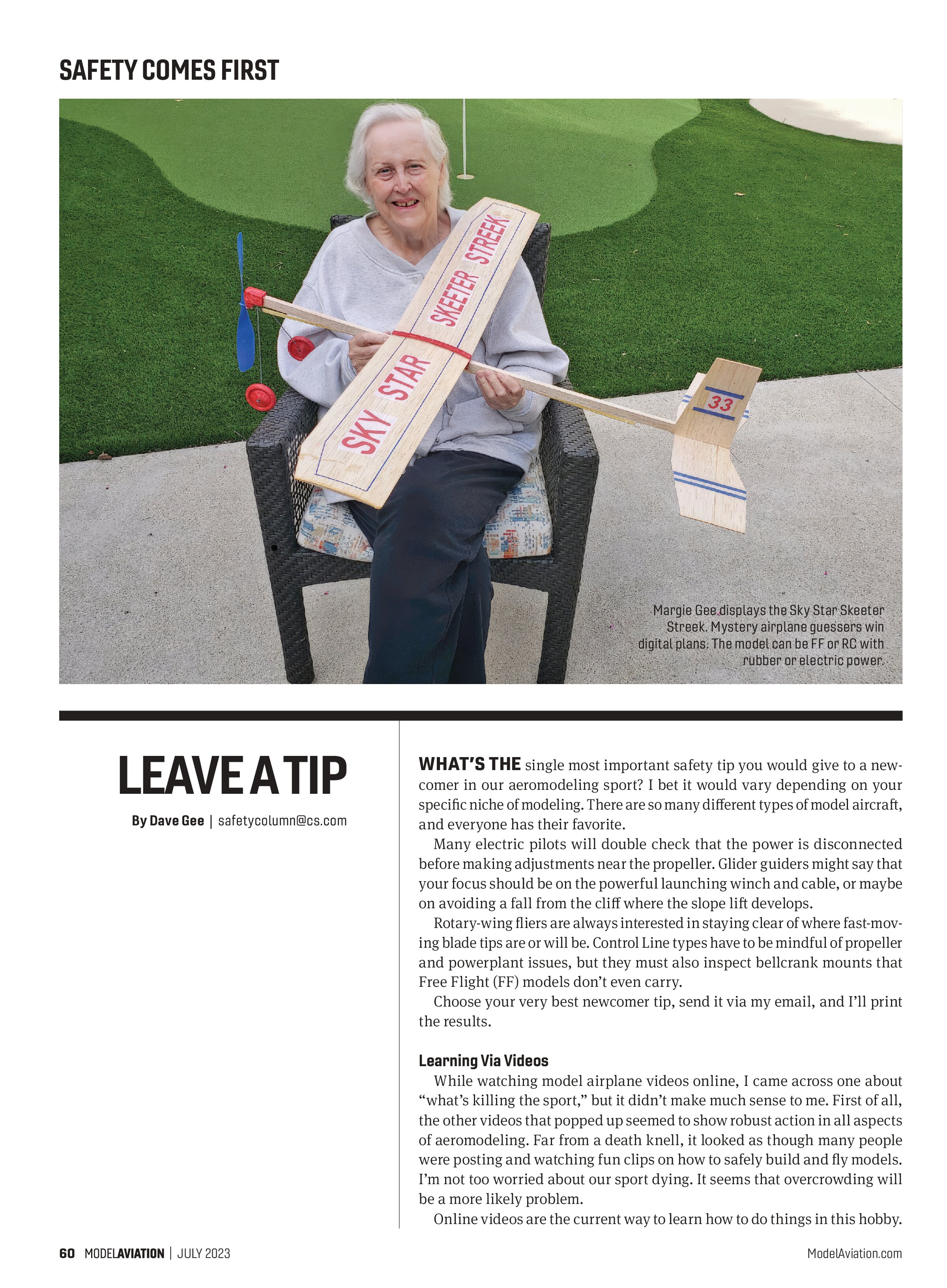
What kind of model needs four names? I wanted a scaled-up version of the old, wind-up ROG airplanes that have gotten generations of young modelers started. These were made by American Junior, North Pacific, and Guillow’s, to name a few. Rather than choose just one, I did a mash-up of all types and made it big enough to really perform.
It has a nice, floating glide when flown as a rubber band-powered FF model, but hidden under the wing is a tray for RC equipment. You can choose two-channel rubber power (fun and unusual), or add electric power to really push the envelope. The digital plans show the ribs and parts at full size, so you can easily build and customize your own Sky Star Skeeter Streek.
Posing with the prototype Sky Star Skeeter Streek is Margie Gee, who waited until age 88 to begin her career as a magazine photo model. Margie used nepotism to break into the business—she’s my mom.
SOURCES:
Estrella Warbirds Museum
(805) 238-9317
www.ewarbirds.org
SGVRCL
www.sgvrcl.com