Glow Plugs
By Tim Lampe | tim.lampe@hotmail.com

Similar to the column I wrote in the May 2021 issue about aluminum pistons, I wanted to attempt another technical article for this month. The subject of glow plugs came to mind, but I didn’t know who to consult, so I did my own research.
There is much information available about glow plugs and how they work. One source was a column by Brian Gardiner in a newsletter from the Propstoppers RC Club in Delaware County, Pennsylvania. I read this and sifted through lots of other information to understand the topic as best as I could to put together a worthwhile presentation. Let’s give it a try.
When a glow engine is running after the battery used to initially light the plug has been disconnected, it remains lit, or ignited ... not only from the heat of compression/combustion, but because of a reaction between the coiled element in the plug and the fuel. The platinum in the glow plug element and the methyl alcohol (methanol) in the fuel are critical elements, because platinum will glow in the presence of methanol vapor. This is the catalytic reaction that keeps the cycle going.
A certain ratio of platinum-to-methanol is required to generate a sufficient reaction to perpetuate the combustion process. If the amount of methanol exposed to the element is reduced—as in the case of an engine that is idling or fuel with a higher nitromethane content (displacing the methanol required for the catalytic reaction)—more platinum is required to make the catalytic reaction stronger to keep it going between strokes. Conversely, if the amount of methanol in the fuel is greater (lower nitromethane content), less platinum is required for the catalytic reaction.

According to Brian’s article, a hotter glow plug (less platinum) should be used with fuel that has 80% or above methanol content. A medium-temperature plug should be used with fuel that has 70% to 75% methanol, while a colder plug (more platinum) should be used with fuel that has 60% to 75% methanol, although there are other factors at play that could affect this rule of thumb.
When the terms “hot” or “cold” are attributed to glow plugs, they refer to the power of the catalytic reaction from the methanol content in the fuel. A hotter, more powerful catalytic reaction would come from fuel with a higher methanol content, so a plug that has less platinum would be used.
A less intense catalytic reaction would come from fuel with less methanol, and a cold plug that has more platinum would be used. A hot plug is intended for fuel with more methanol, and a cold plug is intended for fuel with less methanol.
Let’s discuss nitromethane. The higher the nitro content, the more the ignition point is advanced. Nitromethane is an oxidizer that causes the combustion reaction to occur sooner. Ideally, the ignition point is when the piston is at top dead center (TDC) to push it back down then up again for the next stroke. When you run higher nitro (less methanol) and don’t switch to a colder plug, you advance the ignition point, causing detonation where the fuel ignites before the piston reaches TDC.
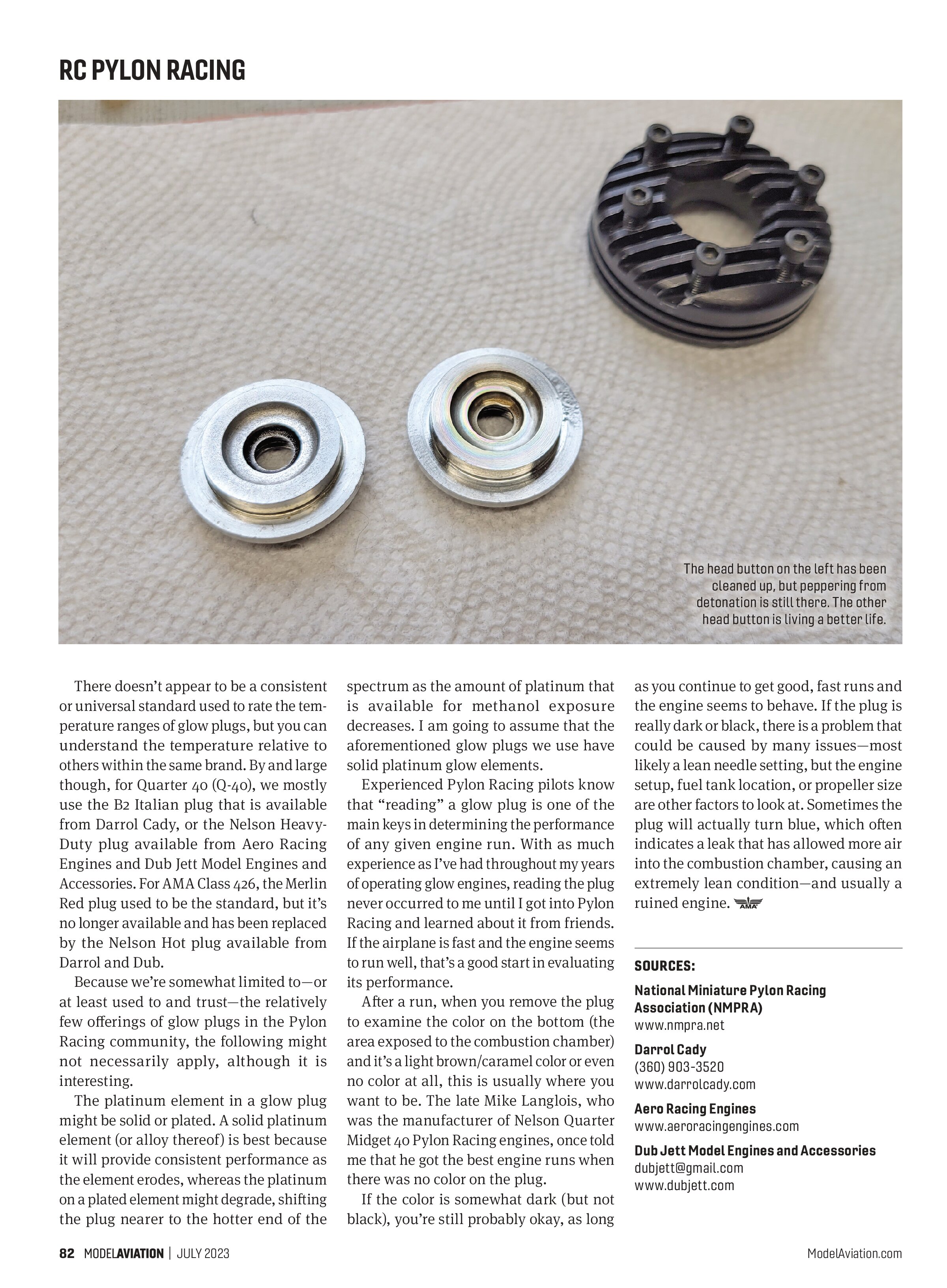
“Peppering” in the head or on the tops of pistons is a sign of detonation. In general, the higher the nitro percentage, the less methanol there will be, so a plug with more platinum—a cold plug—would work better. Although nitromethane content doesn’t really apply to Pylon racers because the fuel we use is specified at 10% nitro, it is still interesting to know that the lower the nitro and the more methanol, the hotter the plug should be, and vice versa. I’m aware that I’m being somewhat repetitive, but it helps with my own comprehension.
Top fuel dragsters use fuel with 90% nitromethane and the rest is methanol and other additives. The ideal stoichiometric air/fuel ratio for gasoline is 14.7:1. The stoichiometric ratio for methanol is 6.45:1. For 100% nitromethane, however, it’s 1.7:1. This means 8.7 times more nitromethane than gasoline can be burned during one combustion cycle in a top fuel dragster. Racing nitro engines, however, run even richer than that.
It’s possible to dump nitro at ratios approaching 5:1. At 80% nitro and above, the optimum air fuel/ratio no longer exists and the power output becomes linked to the actual amount of fuel by weight—as long as it can be ignited! At 5:1, the energy potential of nitro could be six times greater than gas. The cylinders in top fuel drag racing engines are flooded with so much fuel that the fuel itself also serves as the engine coolant. Two spark plugs per cylinder at an extremely high voltage are required to ignite that much fuel. After a run, the spark plugs’ electrodes are vaporized. (Oops, I got off topic a bit.)

There doesn’t appear to be a consistent or universal standard used to rate the temperature ranges of glow plugs, but you can understand the temperature relative to others within the same brand. By and large though, for Quarter 40 (Q-40), we mostly use the B2 Italian plug that is available from Darrol Cady, or the Nelson Heavy-Duty plug available from Aero Racing Engines and Dub Jett Model Engines and Accessories. For AMA Class 426, the Merlin Red plug used to be the standard, but it’s no longer available and has been replaced by the Nelson Hot plug available from Darrol and Dub.
Because we’re somewhat limited to—or at least used to and trust—the relatively few offerings of glow plugs in the Pylon Racing community, the following might not necessarily apply, although it is interesting.
The platinum element in a glow plug might be solid or plated. A solid platinum element (or alloy thereof) is best because it will provide consistent performance as the element erodes, whereas the platinum on a plated element might degrade, shifting the plug nearer to the hotter end of the spectrum as the amount of platinum that is available for methanol exposure decreases. I am going to assume that the aforementioned glow plugs we use have solid platinum glow elements.
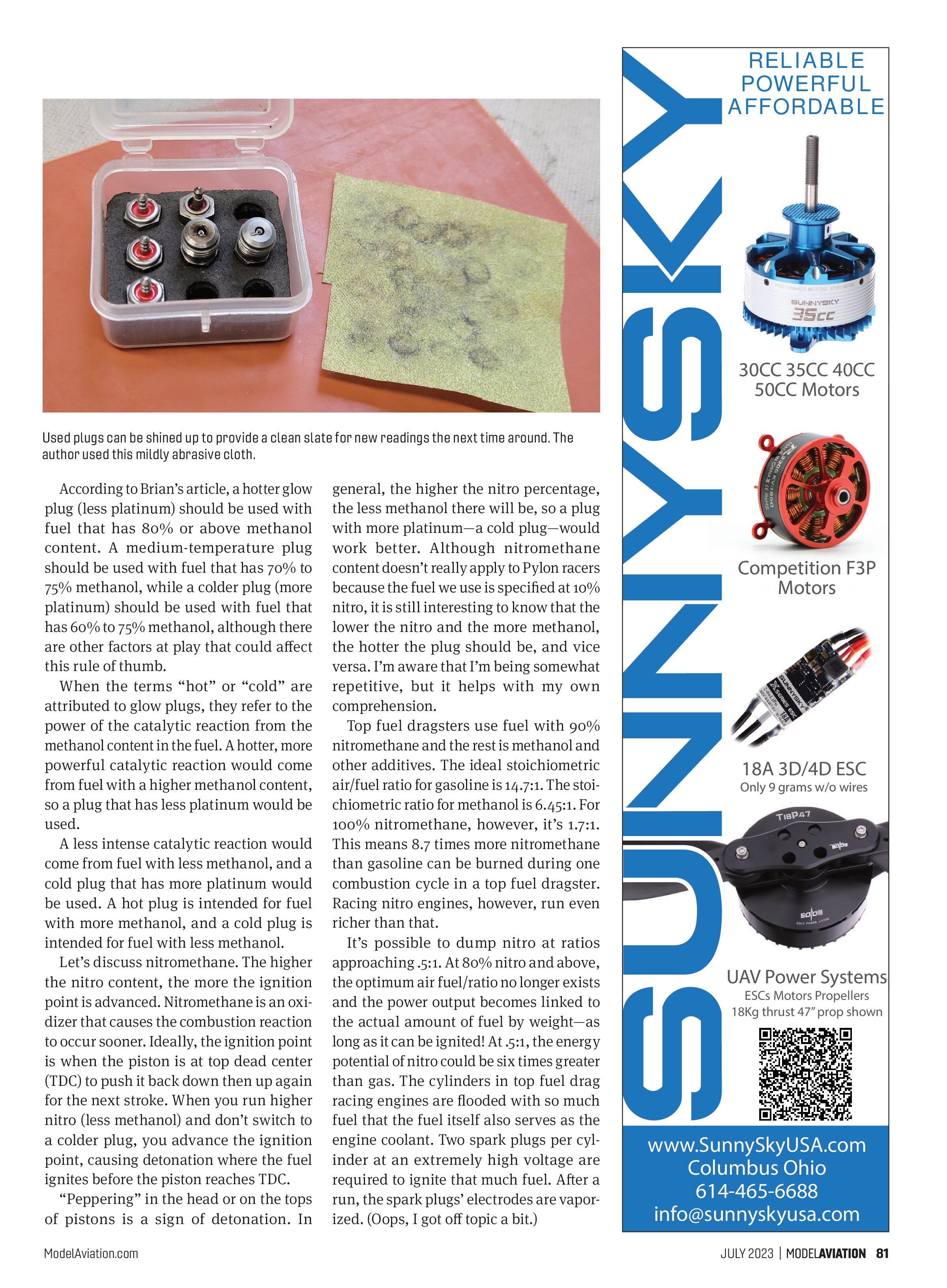
Experienced Pylon Racing pilots know that “reading” a glow plug is one of the main keys in determining the performance of any given engine run. With as much experience as I’ve had throughout my years of operating glow engines, reading the plug never occurred to me until I got into Pylon Racing and learned about it from friends. If the airplane is fast and the engine seems to run well, that’s a good start in evaluating its performance.
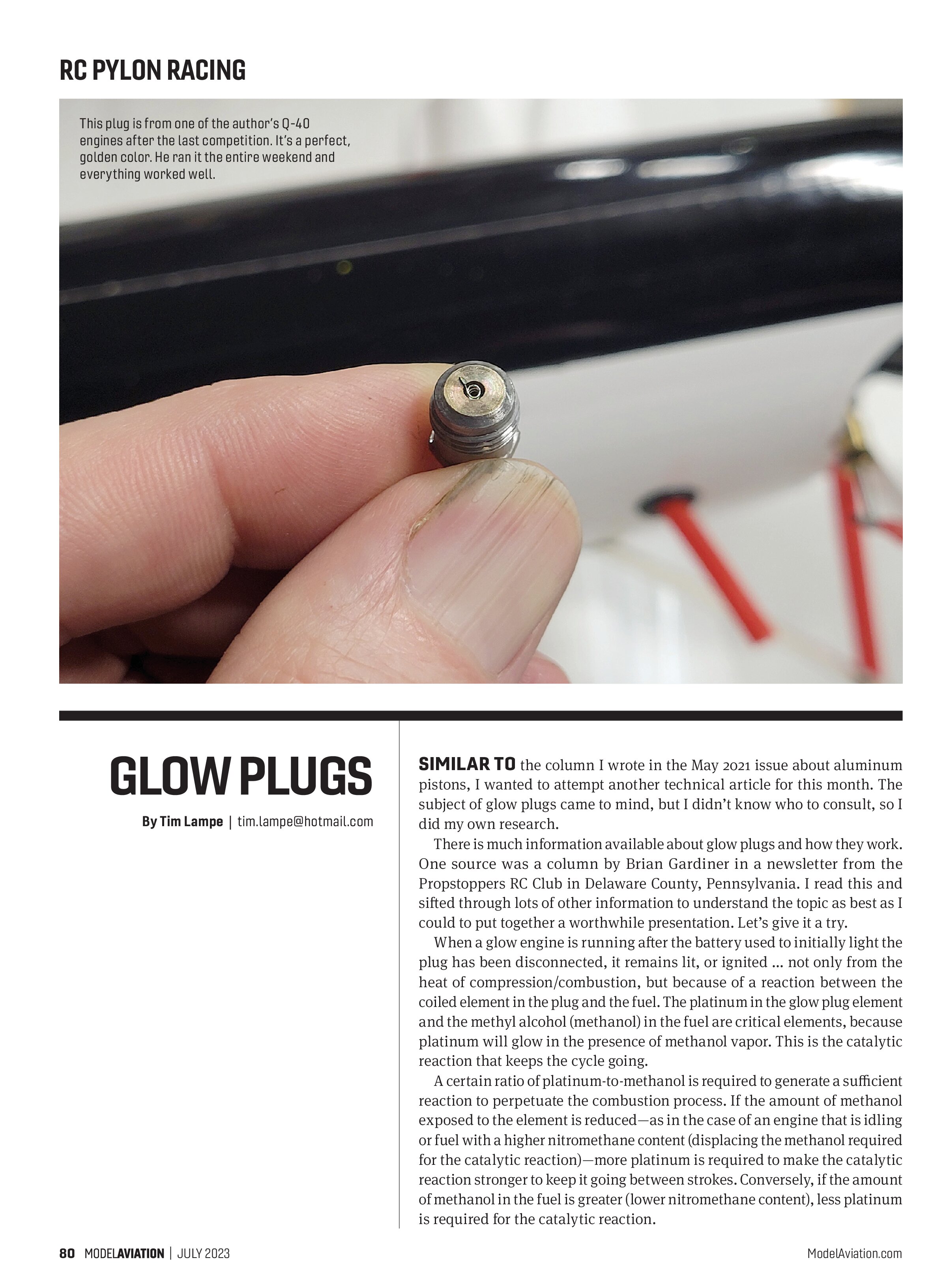
After a run, when you remove the plug to examine the color on the bottom (the area exposed to the combustion chamber) and it’s a light brown/caramel color or even no color at all, this is usually where you want to be. The late Mike Langlois, who was the manufacturer of Nelson Quarter Midget 40 Pylon Racing engines, once told me that he got the best engine runs when there was no color on the plug.
If the color is somewhat dark (but not black), you’re still probably okay, as long as you continue to get good, fast runs and the engine seems to behave. If the plug is really dark or black, there is a problem that could be caused by many issues—most likely a lean needle setting, but the engine setup, fuel tank location, or propeller size are other factors to look at. Sometimes the plug will actually turn blue, which often indicates a leak that has allowed more air into the combustion chamber, causing an extremely lean condition—and usually a ruined engine.
SOURCES:
National Miniature Pylon Racing Association (NMPRA)
www.nmpra.net
Darrol Cady
(360) 903-3520
www.darrolcady.com
Aero Racing Engines
www.aeroracingengines.com
Dub Jett Model Engines and Accessories
dubjett@gmail.com
www.dubjett.com