
WHY DO TURBINES QUIT RUNNING?
By Jim Hiller | jetmodeler@earthlink.net
TURBINES that quit running can be a problem. Even with their reliability, it does happen. Those dead-stick landings that follow are no fun at all. Diagnosing a problem is slightly different with a turbine engine when compared with a piston engine. A turbine is unique because it has a continuous combustion burn and no glow plug or spark plug to keep igniting the combustion process.
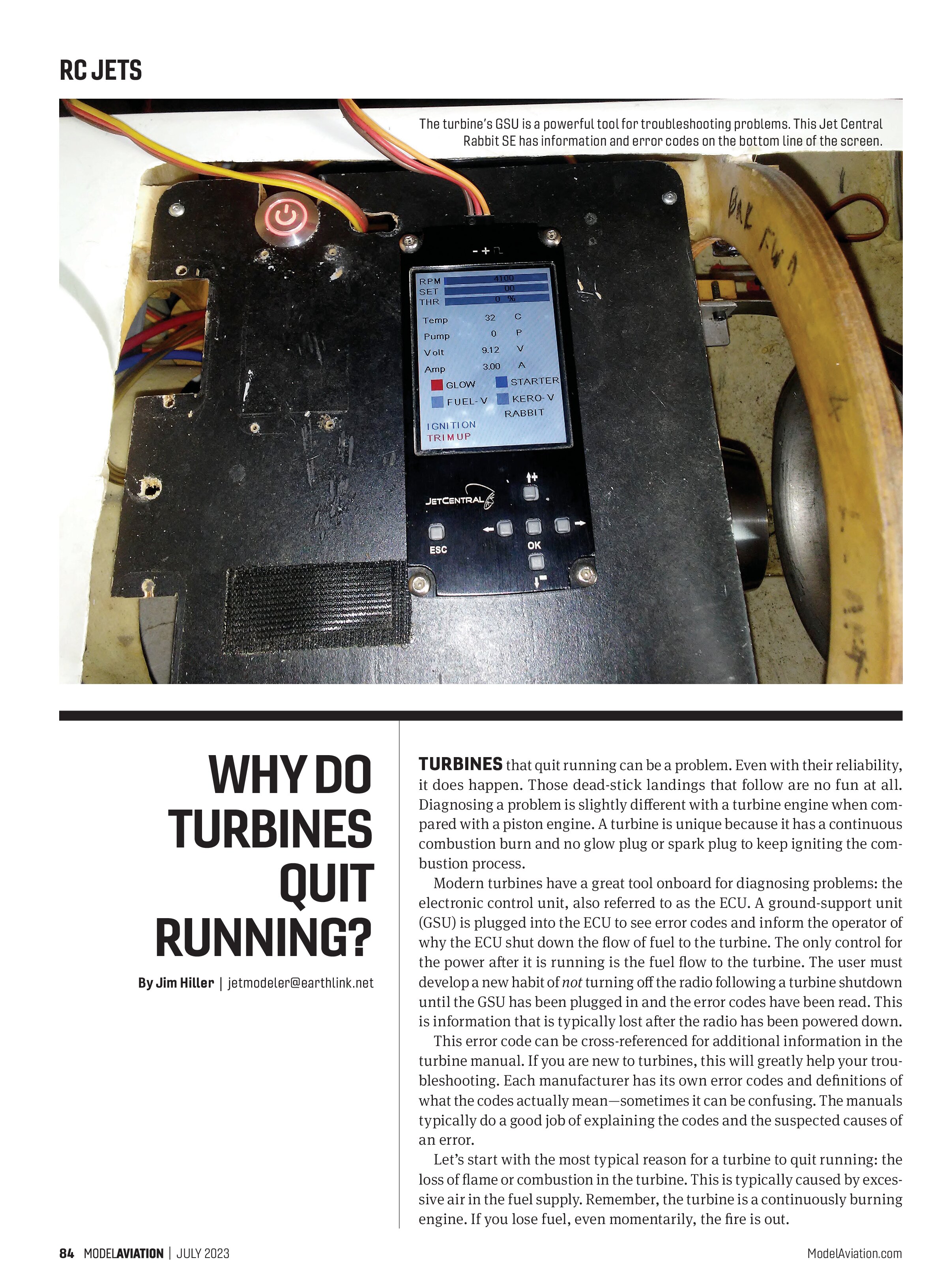
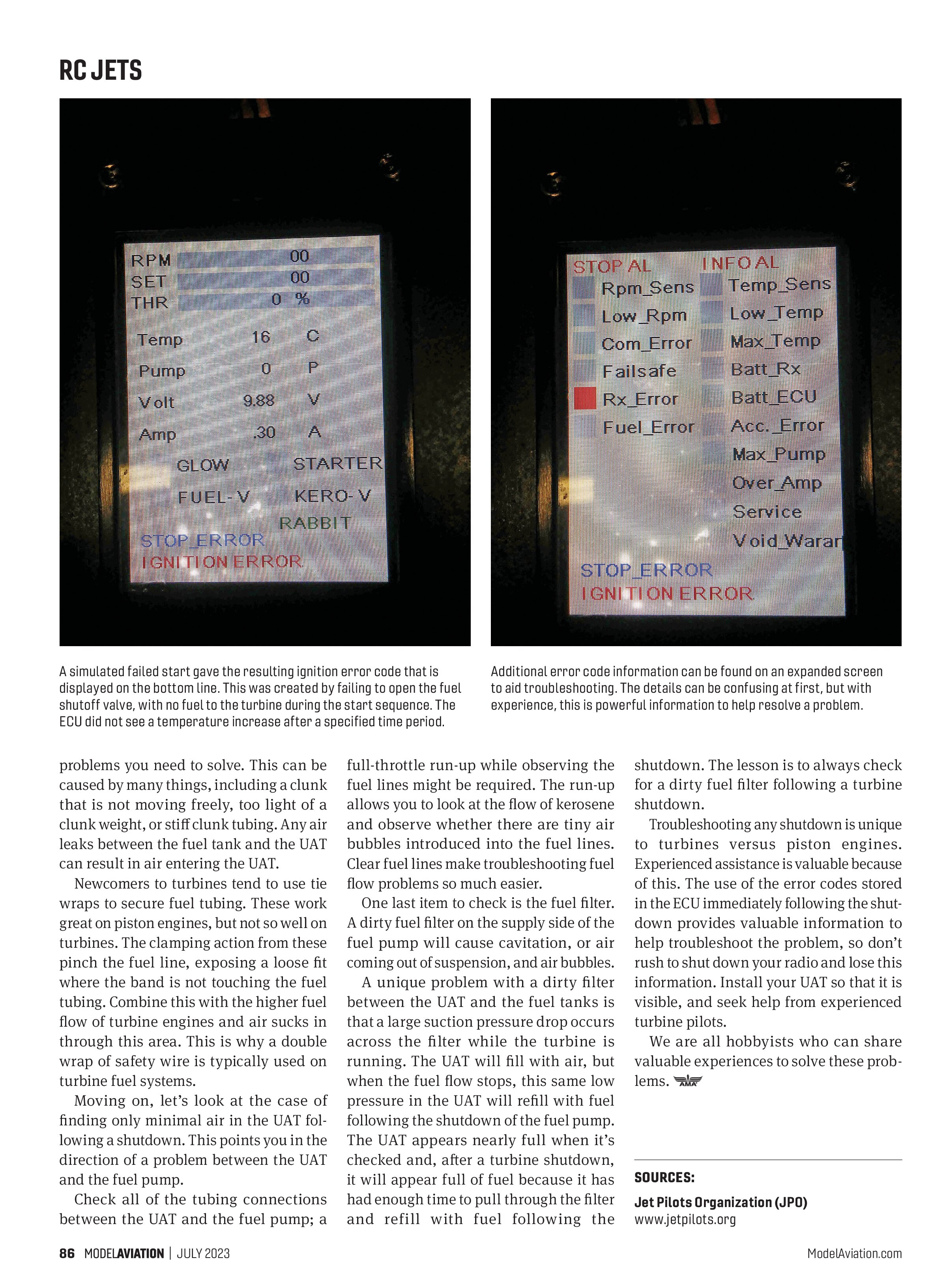
Modern turbines have a great tool onboard for diagnosing problems: the electronic control unit, also referred to as the ECU. A ground-support unit (GSU) is plugged into the ECU to see error codes and inform the operator of why the ECU shut down the flow of fuel to the turbine. The only control for the power after it is running is the fuel flow to the turbine. The user must develop a new habit of not turning off the radio following a turbine shutdown until the GSU has been plugged in and the error codes have been read. This is information that is typically lost after the radio has been powered down.
This error code can be cross-referenced for additional information in the turbine manual. If you are new to turbines, this will greatly help your troubleshooting. Each manufacturer has its own error codes and definitions of what the codes actually mean—sometimes it can be confusing. The manuals typically do a good job of explaining the codes and the suspected causes of an error.
Let’s start with the most typical reason for a turbine to quit running: the loss of flame or combustion in the turbine. This is typically caused by excessive air in the fuel supply. Remember, the turbine is a continuously burning engine. If you lose fuel, even momentarily, the fire is out.
On small turbines, it only takes a tiny air bubble in the fuel supply line to lose the flame. The resulting error codes tend to be for low rpm, low temperature, or an acceleration error, depending on your turbine’s ECU response and controller type. It’s not unusual to see a combination of these faults.
In flight, a big clue to an air-bubble shutdown tends to be a loss of power, but often, another clue is a smoke trail for a short time (typically less than 1 second). When this momentary smoke trail happens, it is a good visual indicator to the pilot of a loss of power. The smoke trail is the result of the flow of kerosene hitting the hot internal metal and not burning as a result of the earlier loss of flame. The ECU will typically shut down the kerosene pump after it detects a loss of either temperature and/or rpm. This smoke occurs during that brief time period.
That covers the actual failure occurrence, but let us move to the causes of air in the fuel supply. One common problem is trapped air from the ultimate air trap (UAT) tank filter, which typically follows the initial fill of kerosene of a completely empty UAT. It is released when shaken, such as during a taxi or takeoff roll. This problem is common of all filter types, whether they are membrane, ceramic, or cloth.
A word of warning: Avoid using cloth filter-type clunks on small turbines, or you can expect lots of exercise walking out to get your airplane when it shuts down during the taxi out for takeoff.
Kerosene can hold air that can come out of suspension as a result of cavitation and create havoc on our systems. The high flow requirements of our fuel systems result in significant pressure reductions on the pump inlet and the fuel lines feeding it, which is good for using ground fuel tanks that plug into the model. It pulls fuel up into the onboard fuel tanks so that we can taxi out with full tanks, regardless of how long we wait for takeoff clearance.
One aggravation to this problem is when there is an air leak on the fuel system prior to the pump. Often, part of the troubleshooting methods will require a full throttle run while watching the fuel line between the tanks and the UAT supplying the fuel pump.
I had a problem one day with, of all things, a fuel can leak on the supply side of the filler pump, which was combined with an old fuel filter on the filler can. Air-rich kerosene pumped into the airplane, resulting in a typical fuel bubble-type shutdown approximately 2 or 3 minutes into the flight. I relay this only to show just how elusive this problem of air bubbles can be.
Following a turbine shutdown for low rpm or low temperature, always check your UAT for excessive air. If enough air is in your UAT to expose any part of the pickup, or if it’s equipped with a filter or any part of the filter is exposed, those are the


problems you need to solve. This can be caused by many things, including a clunk that is not moving freely, too light of a clunk weight, or stiff clunk tubing. Any air leaks between the fuel tank and the UAT can result in air entering the UAT.
Newcomers to turbines tend to use tie wraps to secure fuel tubing. These work great on piston engines, but not so well on turbines. The clamping action from these pinch the fuel line, exposing a loose fit where the band is not touching the fuel tubing. Combine this with the higher fuel flow of turbine engines and air sucks in through this area. This is why a double wrap of safety wire is typically used on turbine fuel systems.
Moving on, let’s look at the case of finding only minimal air in the UAT following a shutdown. This points you in the direction of a problem between the UAT and the fuel pump.
Check all of the tubing connections between the UAT and the fuel pump; a full-throttle run-up while observing the fuel lines might be required. The run-up allows you to look at the flow of kerosene and observe whether there are tiny air bubbles introduced into the fuel lines. Clear fuel lines make troubleshooting fuel flow problems so much easier.
One last item to check is the fuel filter. A dirty fuel filter on the supply side of the fuel pump will cause cavitation, or air coming out of suspension, and air bubbles.
A unique problem with a dirty filter between the UAT and the fuel tanks is that a large suction pressure drop occurs across the filter while the turbine is running. The UAT will fill with air, but when the fuel flow stops, this same low pressure in the UAT will refill with fuel following the shutdown of the fuel pump. The UAT appears nearly full when it’s checked and, after a turbine shutdown, it will appear full of fuel because it has had enough time to pull through the filter and refill with fuel following the shutdown. The lesson is to always check for a dirty fuel filter following a turbine shutdown.
Troubleshooting any shutdown is unique to turbines versus piston engines. Experienced assistance is valuable because of this. The use of the error codes stored in the ECU immediately following the shutdown provides valuable information to help troubleshoot the problem, so don’t rush to shut down your radio and lose this information. Install your UAT so that it is visible, and seek help from experienced turbine pilots.
We are all hobbyists who can share valuable experiences to solve these problems.
SOURCES:
Jet Pilots Organization (JPO)
www.jetpilots.org