RC AEROBATICS
HALF CUBAN 8 TURNAROUNDS
By Justin Wells | justintwells@mac.com

WE’VE PROGRESSED a lot throughout the last few sessions. Let’s look at some turnaround maneuvers that you will find quite useful: the Half Cuban 8 and the Half-Reverse Cuban 8. We will use a lot of what we have learned in the past few articles to make this easy and score well.
The full Cuban 8 is a maneuver that is commonly performed on center. We use the half portions as an end-of-box turnaround. Be careful, and know the differences between a Half Cuban 8 and a Half-Reverse Cuban 8. The differences will mean a good score or a bad one as you progress through the classes. The elements might change to increase difficulty.
Half-Reverse Cuban 8
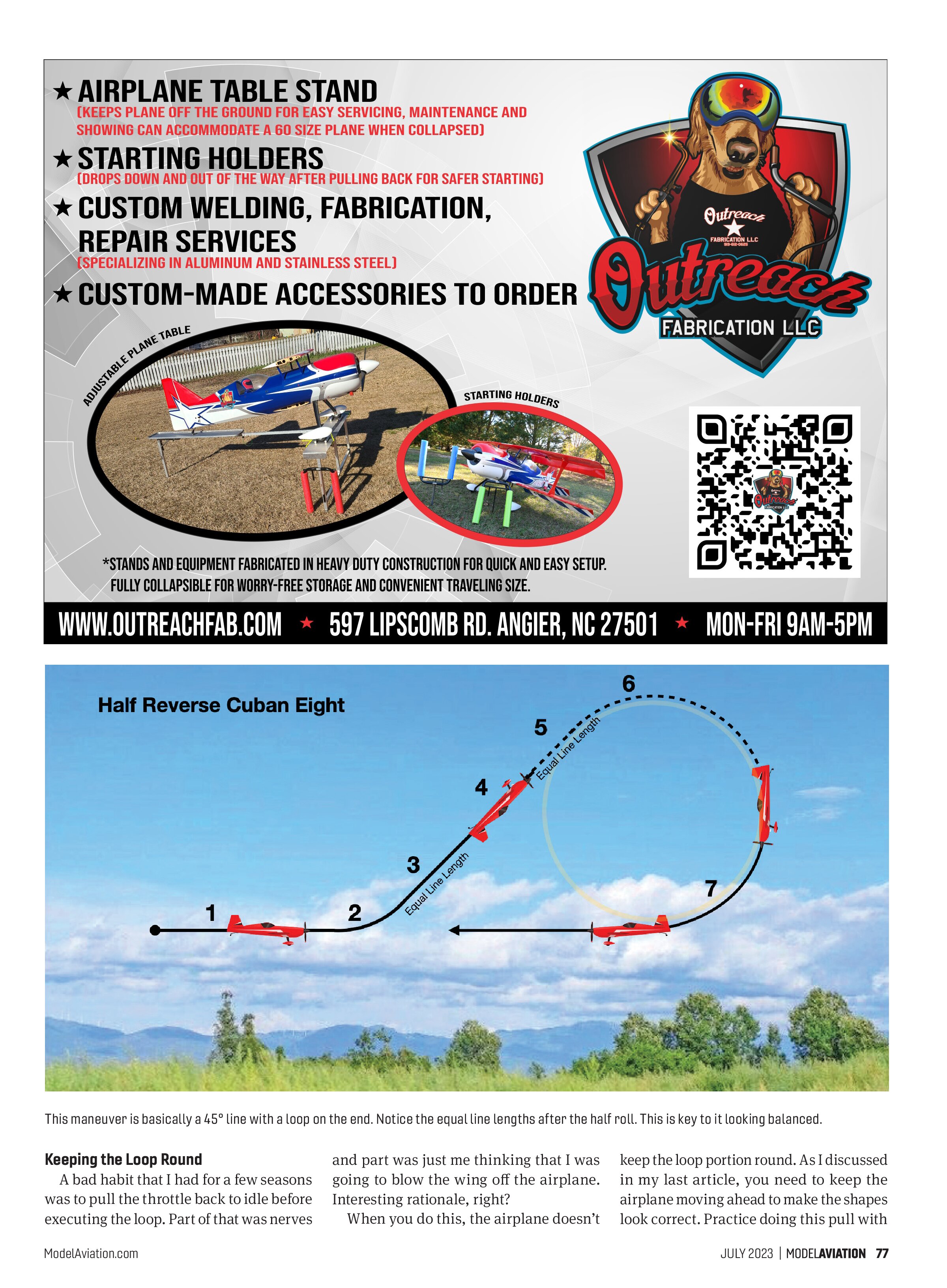
This maneuver starts with a 45° upline, a half roll, and a half loop. It sounds simple, right? Your first challenge is determining when to start your 45° upline. If you start too late, your loop will put you outside of the box and you’ll find yourself a few points less. Let’s walk through the steps:
- Throttle up (not full).
- A gentle pull to a 45° line.
- Hesitate to define your line.
- Half roll to inverted.
- Hesitate and add a little down-elevator to keep your 45° line.
- Reduce your throttle (not to idle). Start a gentle pull and create a nice, round loop.
- Increase throttle to round out the loop.

Keeping the Loop Round
A bad habit that I had for a few seasons was to pull the throttle back to idle before executing the loop. Part of that was nerves
and part was just me thinking that I was going to blow the wing off the airplane. Interesting rationale, right?
When you do this, the airplane doesn’t keep the loop portion round. As I discussed in my last article, you need to keep the airplane moving ahead to make the shapes look correct. Practice doing this pull with

throttle; it doesn’t have to be full, but you don’t want to cut to idle. You’ll find yourself adding some throttle toward the end to round things out.
Review the downgrades for the Half-Reverse Cuban 8, as defined by the National Society of Radio Controlled Aerobatics (NSRCA), and see how you did:
- Loop segments not round, with the same size and radius.
- Model not at 45° before and after the half roll. Apply the “one point per 15°” rule.
- Changes in the track in loop segments or after a half roll.
- Half roll not centered in a 45° line.
- No hesitations before or after the half roll.
- Over- or under-rotation of the roll. Apply the “one point per 15°” rule.
The Half Cuban 8
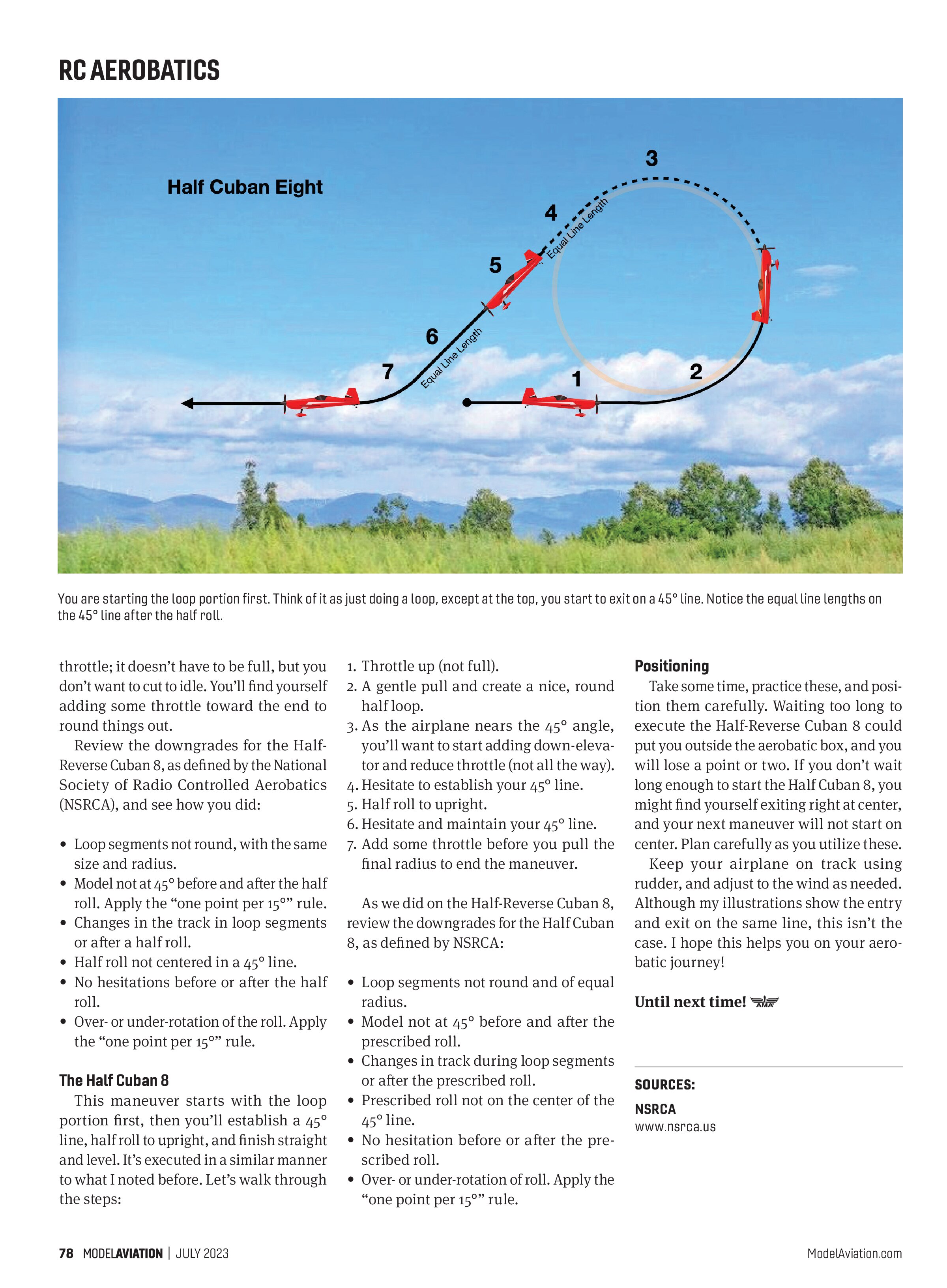
This maneuver starts with the loop portion first, then you’ll establish a 45° line, half roll to upright, and finish straight and level. It’s executed in a similar manner to what I noted before. Let’s walk through the steps:
- Throttle up (not full).
- A gentle pull and create a nice, round half loop.
- As the airplane nears the 45° angle, you’ll want to start adding down-elevator and reduce throttle (not all the way).
- Hesitate to establish your 45° line.
- Half roll to upright.
- Hesitate and maintain your 45° line.
- Add some throttle before you pull the final radius to end the maneuver.
As we did on the Half-Reverse Cuban 8, review the downgrades for the Half Cuban 8, as defined by NSRCA:
- Loop segments not round and of equal radius.
- Model not at 45° before and after the prescribed roll.
- Changes in track during loop segments or after the prescribed roll.
- Prescribed roll not on the center of the 45° line.
- No hesitation before or after the prescribed roll.
- Over- or under-rotation of roll. Apply the “one point per 15°” rule.
Positioning
Take some time, practice these, and position them carefully. Waiting too long to execute the Half-Reverse Cuban 8 could put you outside the aerobatic box, and you will lose a point or two. If you don’t wait long enough to start the Half Cuban 8, you might find yourself exiting right at center, and your next maneuver will not start on center. Plan carefully as you utilize these.
Keep your airplane on track using rudder, and adjust to the wind as needed. Although my illustrations show the entry and exit on the same line, this isn’t the case. I hope this helps you on your aerobatic journey!
Until next time!
SOURCES:
NSRCA
www.nsrca.us